

Ripple Maps XRP Ledger’s Future: ‘No Privacy, No Adoption’

Ripple’s latest think piece on the XRP Ledger (XRPL) makes a blunt case that institutional finance will not move on-chain at scale without first-class privacy—and that the missing capability can be delivered without abandoning public-chain transparency or compliance.
Ripple Pushes Programmable Privacy For The XRP Ledger
In an article published on October 2, Senior Director of Engineering J. Ayo Akinyele argues that “finance cannot function without confidentiality, yet blockchains are built on transparency,” framing the next phase of XRPL development around programmable privacy, verifiable compliance, and trust-minimized scalability.
Akinyele, a cryptographer with a decade of applied-privacy work, sets out a two-track roadmap: embed privacy primitives directly into infrastructure, and pair them with mechanisms that let market participants—and regulators—verify rules were followed without exposing sensitive data.
He points to zero-knowledge proofs (ZKPs) for selective disclosure and confidential computing for protected off-chain logic, alongside “fair ordering” via trusted execution environments to mitigate frontrunning and MEV. The throughline is that confidentiality and accountability are not opposites; in his words, programmable privacy can enable institutions to “prove adherence to compliance requirements… without revealing sensitive transaction data.”
The timing is not theoretical. On October 1, the XRP Ledger activated its Multi-Purpose Token (MPT) standard on mainnet—a protocol-level framework for issuing fungible tokens without custom smart contracts that is explicitly aimed at institutional tokenization. Ripple engineers emphasized the institutional design goal in public posts announcing the activation.
Akinyele’s privacy focus dovetails with a parallel standards push to extend MPTs with confidentiality. In mid-September, Ripple engineers Murat Cenk and Aanchal Malhotra opened an XRPL Standards discussion for “Confidential Multi-Purpose Tokens,” proposing to encrypt balances and transfer amounts using EC-ElGamal and ZKPs while preserving the accounting semantics of XRPL’s existing MPT framework. The draft describes confidential transfers and balances with proofs that let verifiers check correctness without reading underlying values. The discussion was posted on September 12, and coverage spread in the days that followed.
In practical terms, the confidential-MPT blueprint targets precisely the friction that keeps heavily regulated issuers on private ledgers or permissioned systems. Under the approach, an issuer could demonstrate that a customer passed KYC/AML checks or that reserves are fully collateralized, while keeping the customer’s identity and transaction amounts hidden from the public. Akinyele cites these as canonical examples of how “regulated DeFi” can operate on public infrastructure: private, compliant markets for tokenized collateral, stablecoins, and real-world assets, with auditability preserved through cryptographic proofs rather than intermediaries.
The argument is also a critique of how some chains pursued throughput by eroding trust assumptions. Akinyele contends that scale must be achieved without sacrificing verifiability or decentralization, and he situates ZK light clients, fair ordering, and enclave-based confidential computation as complementary parts of that design space.
The XRPL angle here is that features historically built into the protocol—such as the native DEX, escrow, and payment channels—can be extended with privacy and compliance controls at the same layer, rather than scattered across bespoke contracts. Ripple’s documentation positions MPTs as a “version 2” fungible token standard that distills lessons from trust-line tokens and is being integrated more deeply into issuance, trading, and settlement flows on XRPL’s native rails.
Akinyele’s near-term horizon is explicit. He writes that the next 12 months will prioritize ZKPs on XRPL to enable private, compliant transactions while improving scalability, and that 2026 is targeted for “confidential MPTs” bringing privacy-preserving tokenized collateral to market. That roadmap triangulates with the standards draft now under discussion and with the October 1 activation of baseline MPTs, which collectively sketch a path from private issuance to private trading and settlement—without asking institutions to abandon the assurance that public chains provide.
The message to institutions is unambiguous and, in Akinyele’s framing, non-negotiable. Privacy is not a bolt-on for bad actors; it is the precondition for legitimate finance to operate in the open. “With programmable privacy, we can have both,” he writes—confidentiality for users and counterparties, and verifiable compliance for auditors and regulators. For XRPL specifically, the combination of a live protocol-level token standard and an active proposal to make those tokens confidential signals a bet that public-chain neutrality, with privacy and compliance embedded, is the architecture that can unlock the next wave of tokenized assets.
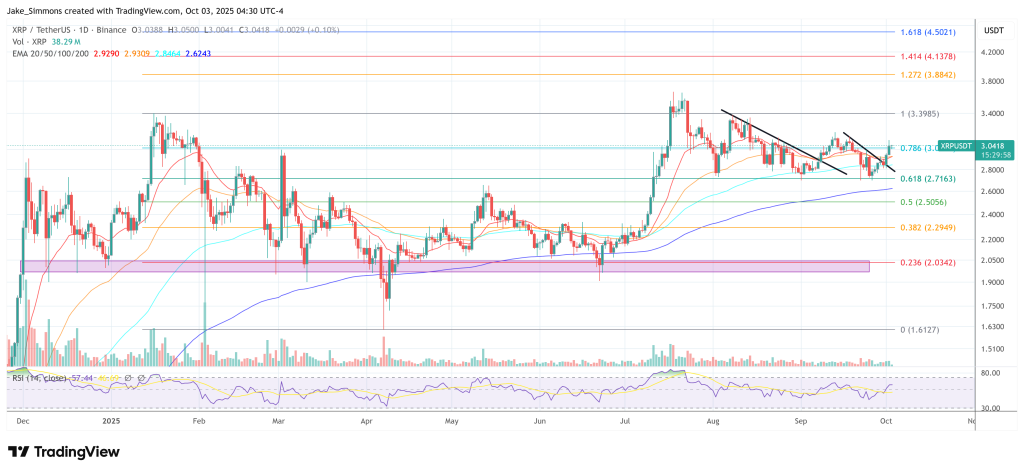
At press time, XRP traded at $3.04.
You May Also Like

XRP Price News: Elon Musk Confirms X Money Crypto Plans as Pepeto’s Three Products Approach Launch and the 537x Window Stays Open

What should investors expect from the Federal Reserve after latest jobs data?
