Ripple has added another institutional rail to its stablecoin strategy: through an integration with Securitize, holders of BlackRock’s USD Institutional Digital Liquidity Fund (BUIDL) and VanEck’s VBILL tokenized US Treasuries can now redeem fund shares for Ripple USD (RLUSD) around the clock—initially on Ethereum, with support for the XRP Ledger (XRPL) in the pipeline. BlackRock […]Ripple has added another institutional rail to its stablecoin strategy: through an integration with Securitize, holders of BlackRock’s USD Institutional Digital Liquidity Fund (BUIDL) and VanEck’s VBILL tokenized US Treasuries can now redeem fund shares for Ripple USD (RLUSD) around the clock—initially on Ethereum, with support for the XRP Ledger (XRPL) in the pipeline. BlackRock […]

Ripple Powers New Offramp For BlackRock, VanEck Tokenized Fund

Ripple has added another institutional rail to its stablecoin strategy: through an integration with Securitize, holders of BlackRock’s USD Institutional Digital Liquidity Fund (BUIDL) and VanEck’s VBILL tokenized US Treasuries can now redeem fund shares for Ripple USD (RLUSD) around the clock—initially on Ethereum, with support for the XRP Ledger (XRPL) in the pipeline.

BlackRock And VanEck Turn To Ripple’s RLUSD

In a press release dated September 23, Ripple and Securitize said a new smart-contract flow “would allow holders of BlackRock’s BUIDL and VanEck’s VBILL to exchange their shares … for Ripple USD (RLUSD),” describing the mechanism as “an additional stablecoin off ramp for BUIDL and VBILL tokenized short term treasury funds.” The companies emphasized continuous availability—“24/7”—and framed the upgrade as programmable liquidity for compliant, on-chain investment products. Securitize also confirmed it is integrating with the XRP Ledger “to expand access and bring new utility to the XRPL ecosystem.”

Jack McDonald, Ripple’s SVP of Stablecoins, positioned the move as a bridge between tokenized funds and transactional money: “RLUSD is for institutional use, offering regulatory clarity, stability, and real utility. As adoption grows, partnerships with trusted platforms like Securitize are key to unlocking new liquidity and enterprise-grade use cases.” On X, McDonald distilled the news for market participants: “RLUSD is now a key stablecoin offramp for BlackRock’s BUIDL and VanEck’s VBILL tokenized fund holders. The integration is starting with ETH, though Securitize is planning to integrate with the XRP Ledger.”

Ripple President Monica Long linked the Securitize integration to a broader RLUSD tokenization push announced the prior week with DBS and Franklin Templeton, where RLUSD serves as a “liquid, stable and compliant exchange mechanism for tokenized assets in lending and trading use cases.” “This week, Securitize added RLUSD as a new offramp for BlackRock and VanEck’s tokenized funds,” she noted.

Ripple CEO Brad Garlinghouse underscored the 24/7 redemption promise and the XRPL roadmap: “Very excited to share that BlackRock’s BUIDL and @VanEck_US’s VBILL tokenized fund holders can redeem shares for RLUSD/ETH 24/7 365 through Securitize, and soon to come RLUSD/XRPL. Enterprise-grade instant onchain liquidity at your fingertips. That’s real utility.”

The companies framed the design as explicitly regulatory-first. Ripple said RLUSD is issued under a New York Department of Financial Services (NYDFS) trust charter, with “1:1 USD backing by high-quality liquid assets, strict reserve management and asset segregation, third-party attestations and clear redemption rights.” Ripple added that since launch in late 2024, RLUSD has integrated into DeFi and cross-border payment flows and surpassed $700 million in market capitalization.

For tokenized funds, the off-ramp matters because it stitches together yield-bearing on-chain treasuries with settlement-grade stablecoin liquidity. BlackRock’s BUIDL and VanEck’s VBILL are tokenized short-term US Treasury strategies issued through Securitize on public blockchains; the new workflow lets qualified holders convert fund shares into RLUSD without banking hours friction, potentially improving collateral mobility for trading, lending, repo and treasury operations.

Ripple Puts New Focus On Tokenization

The development also follows Ripple’s tie-up with DBS and Franklin Templeton, which is listing Franklin’s sgBENJI token on the DBS Digital Exchange alongside RLUSD to enable swapping between the tokenized fund and the stablecoin, and to explore using tokenized fund units as repo collateral—an example of how banks envisage tokenization rails meeting institutional liquidity needs.

While the initial redemption path is live on Ethereum via Securitize, both firms signaled that XRPL integration is next, aligning with Ripple’s push to make RLUSD natively useful across multiple venues. If executed, XRPL support would extend the same institutional redemption mechanics to a different settlement environment—one that Ripple and parts of the treasury-tokenization market already touch via custody, payments, and prior Franklin Templeton XRPL issuance plans.

Notably, BlackRock will be represented at Ripple Swell 2025 in New York on November 4–5 at Convene Hudson Yards. Maxwell Stein, BlackRock’s Director of Digital Assets, is slated to speak in a session titled “The Impact of Tokenized Financial Assets on Capital Markets,” alongside Rory Callagy of Moody’s.

At press time, XRP traded at $2.88.
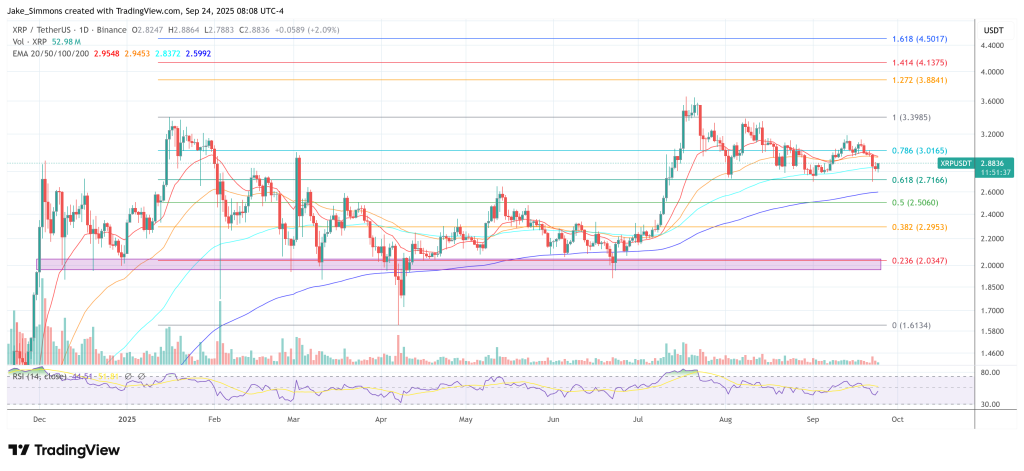
XRP price
Market Opportunity
XRP Logo
XRP Price(XRP)
$1.8717
$1.8717$1.8717
+0.48%
USD
XRP (XRP) Live Price Chart
Disclaimer: The articles reposted on this site are sourced from public platforms and are provided for informational purposes only. They do not necessarily reflect the views of MEXC. All rights remain with the original authors. If you believe any content infringes on third-party rights, please contact service@support.mexc.com for removal. MEXC makes no guarantees regarding the accuracy, completeness, or timeliness of the content and is not responsible for any actions taken based on the information provided. The content does not constitute financial, legal, or other professional advice, nor should it be considered a recommendation or endorsement by MEXC.

You May Also Like

Academic Publishing and Fairness: A Game-Theoretic Model of Peer-Review Bias

Academic Publishing and Fairness: A Game-Theoretic Model of Peer-Review Bias

Exploring how biases in the peer-review system impact researchers' choices, showing how principles of fairness relate to the production of scientific knowledge based on topic importance and hardness.
Share
Hackernoon2025/09/17 23:15
Foreigner’s Lou Gramm Revisits The Band’s Classic ‘4’ Album, Now Reissued

Foreigner’s Lou Gramm Revisits The Band’s Classic ‘4’ Album, Now Reissued

The post Foreigner’s Lou Gramm Revisits The Band’s Classic ‘4’ Album, Now Reissued appeared on BitcoinEthereumNews.com. American-based rock band Foreigner performs onstage at the Rosemont Horizon, Rosemont, Illinois, November 8, 1981. Pictured are, from left, Mick Jones, on guitar, and vocalist Lou Gramm. (Photo by Paul Natkin/Getty Images) Getty Images Singer Lou Gramm has a vivid memory of recording the ballad “Waiting for a Girl Like You” at New York City’s Electric Lady Studio for his band Foreigner more than 40 years ago. Gramm was adding his vocals for the track in the control room on the other side of the glass when he noticed a beautiful woman walking through the door. “She sits on the sofa in front of the board,” he says. “She looked at me while I was singing. And every now and then, she had a little smile on her face. I’m not sure what that was, but it was driving me crazy. “And at the end of the song, when I’m singing the ad-libs and stuff like that, she gets up,” he continues. “She gives me a little smile and walks out of the room. And when the song ended, I would look up every now and then to see where Mick [Jones] and Mutt [Lange] were, and they were pushing buttons and turning knobs. They were not aware that she was even in the room. So when the song ended, I said, ‘Guys, who was that woman who walked in? She was beautiful.’ And they looked at each other, and they went, ‘What are you talking about? We didn’t see anything.’ But you know what? I think they put her up to it. Doesn’t that sound more like them?” “Waiting for a Girl Like You” became a massive hit in 1981 for Foreigner off their album 4, which peaked at number one on the Billboard chart for 10 weeks and…
Share
BitcoinEthereumNews2025/09/18 01:26
Vitalik Buterin Reveals Ethereum’s Bold Plan to Stay Quantum-Secure and Simple!

Vitalik Buterin Reveals Ethereum’s Bold Plan to Stay Quantum-Secure and Simple!

Buterin unveils Ethereum’s strategy to tackle quantum security challenges ahead. Ethereum focuses on simplifying architecture while boosting security for users. Ethereum’s market stability grows as Buterin’s roadmap gains investor confidence. Ethereum founder Vitalik Buterin has unveiled his long-term vision for the blockchain, focusing on making Ethereum quantum-secure while maintaining its simplicity for users. Buterin presented his roadmap at the Japanese Developer Conference, and splits the future of Ethereum into three phases: short-term, mid-term, and long-term. Buterin’s most ambitious goal for Ethereum is to safeguard the blockchain against the threats posed by quantum computing.  The danger of such future developments is that the future may call into question the cryptographic security of most blockchain systems, and Ethereum will be able to remain ahead thanks to more sophisticated mathematical techniques to ensure the safety and integrity of its protocols. Buterin is committed to ensuring that Ethereum evolves in a way that not only meets today’s security challenges but also prepares for the unknowns of tomorrow. Also Read: Ethereum Giant The Ether Machine Takes Major Step Toward Going Public! However, in spite of such high ambitions, Buterin insisted that Ethereum also needed to simplify its architecture. An important aspect of this vision is to remove unnecessary complexity and make Ethereum more accessible and maintainable without losing its strong security capabilities. Security and simplicity form the core of Buterin’s strategy, as they guarantee that the users of Ethereum experience both security and smooth processes. Focus on Speed and Efficiency in the Short-Term In the short term, Buterin aims to enhance Ethereum’s transaction efficiency, a crucial step toward improving scalability and reducing transaction costs. These advantages are attributed to the fact that, within the mid-term, Ethereum is planning to enhance the speed of transactions in layer-2 networks. According to Butterin, this is part of Ethereum’s expansion, particularly because there is still more need to use blockchain technology to date. The other important aspect of Ethereum’s development is the layer-2 solutions. Buterin supports an approach in which the layer-2 networks are dependent on layer-1 to perform some essential tasks like data security, proof, and censorship resistance. This will enable the layer-2 systems of Ethereum to be concerned with verifying and sequencing transactions, which will improve the overall speed and efficiency of the network. Ethereum’s Market Stability Reflects Confidence in Long-Term Strategy Ethereum’s market performance has remained solid, with the cryptocurrency holding steady above $4,000. Currently priced at $4,492.15, Ethereum has experienced a slight 0.93% increase over the last 24 hours, while its trading volume surged by 8.72%, reaching $34.14 billion. These figures point to growing investor confidence in Ethereum’s long-term vision. The crypto community remains optimistic about Ethereum’s future, with many predicting the price could rise to $5,500 by mid-October. Buterin’s clear, forward-thinking strategy continues to build trust in Ethereum as one of the most secure and scalable blockchain platforms in the market. Also Read: Whales Dump 200 Million XRP in Just 2 Weeks – Is XRP’s Price on the Verge of Collapse? The post Vitalik Buterin Reveals Ethereum’s Bold Plan to Stay Quantum-Secure and Simple! appeared first on 36Crypto.
Share
Coinstats2025/09/18 01:22