1. Abstract KYC (Know Your Customer) is a globally recognized compliance procedure in the financial industry, designed to verify customer identities, understand their financial behavior, and prevent1. Abstract KYC (Know Your Customer) is a globally recognized compliance procedure in the financial industry, designed to verify customer identities, understand their financial behavior, and prevent
Learn/Cryptocurrency Knowledge/Basic Concepts/KYC Uncover...and Finance

KYC Uncovered: The Key to Crypto Trading and Finance

Jan 19, 2026MEXC
0m
4
4$0.008518+3.08%
7
7$----%
LONG
LONG$----%


1. Abstract


KYC (Know Your Customer) is a globally recognized compliance procedure in the financial industry, designed to verify customer identities, understand their financial behavior, and prevent illegal activities such as money laundering, fraud, and terrorist financing. Whether in traditional financial institutions or cryptocurrency exchanges, KYC Verification is a crucial measure for safeguarding platform security and protecting user assets.

For new users engaging in crypto trading, investing, or using financial services, understanding the purpose and operation of the KYC process is the first step toward compliant trading and ensuring the safety of funds.

2. What is KYC?


KYC refers to the process in which a financial institution or trading platform collects and verifies a customer's identity information before account opening or executing transactions. Its core objectives include:

  • Combating money laundering (AML)
  • Preventing terrorist financing
  • Curbing fraud and illegal capital flows
  • Enhancing financial system transparency

In practice, users are typically required to submit valid identification documents such as an ID card, passport, or driver's license. Some platforms may also request a selfie or proof of address to complete the KYC process.

For example, after signing up for an account on mainstream exchanges like MEXC, users will be prompted to complete either "Primary" or "Advanced" identity verification. Accounts without completed KYC are usually restricted from fiat deposits, withdrawals, or large transactions.


3. Why Conduct KYC? What Are the Benefits?


KYC is not only a compliance requirement but also a key mechanism for safeguarding the financial system and building user trust. In both traditional finance and the crypto asset space, KYC offers multiple benefits:

3.1 Combating Financial Fraud and Identity Theft


KYC effectively prevents users from creating accounts with fake identities and stops fraudsters from using stolen identities for illegal transactions, reducing risks such as financial scams and account breaches at the source.

3.2 Reducing the Risk of Money Laundering and Illegal Capital Flows


By collecting and verifying customer identity information, financial institutions can identify high-risk clients and detect suspicious transactions, effectively blocking activities such as money laundering, terrorist financing, and illicit cross-border transfers.

3.3 Improving Transparency and Stability in the Financial System


In services like lending, KYC helps institutions more accurately assess a user's creditworthiness and financial background, enabling more responsible lending practices, lowering default rates, and optimizing risk management.

3.4 Enhancing Platform Credibility and Regulatory Compliance


Strict KYC procedures increase transparency and accountability for financial service providers, boosting public trust, meeting regulatory requirements, and attracting more compliant investors.

3.5 Promoting Industry Standardization and Long-Term Growth


In the crypto industry, KYC helps reduce the misuse of anonymous accounts, sets compliance benchmarks, strengthens overall market confidence, and accelerates the integration of crypto assets into the mainstream financial system.

4. KYC Application Requirements


Generally, applying for KYC Verification requires meeting the following conditions:

  • Customer Identification Program (CIP): Users must provide basic personal information such as their full name, date of birth, address, and identification number to verify their identity.
  • Customer Due Diligence (CDD): In addition to identity details, an assessment of risk level is required, including understanding users' financial situation, investment experience, source of funds, and intended account use.
  • Enhanced Due Diligence (EDD): If users are identified as high-risk (e.g., a politically exposed person, linked to terrorism, or with unclear sources of funds), a deeper investigation is needed, such as verifying the origin of funds, conducting background checks, and ongoing monitoring.

In short, applying for KYC typically requires providing detailed identity information and cooperating with risk assessments, while high-risk users may be subject to additional reviews and continuous monitoring.


KYC has become an essential compliance benchmark in global finance and the crypto asset market. While legal bases and enforcement standards vary across jurisdictions, the core principles are increasingly aligned, especially in combating money laundering (AML) and counter-terrorism financing (CFT):

As a global leader in financial regulation, the U.S. bases its KYC framework on the Bank Secrecy Act and the USA PATRIOT Act. These laws require financial institutions to implement CIP systems, review transactions regularly, and report suspicious activity to the Financial Crimes Enforcement Network (FinCEN).

The EU has rolled out multiple AML directives (with AMLD6 being the latest), mandating CDD and continuous identity verification. PSD2 further enhances transparency in online payments, with KYC obligations extending to cryptocurrency platforms.


Financial hubs such as Singapore, Hong Kong, and Australia have localized the Financial Action Task Force (FATF) KYC guidelines. For example, the Monetary Authority of Singapore (MAS) and the Hong Kong Securities and Futures Commission (SFC) impose strict KYC obligations on virtual asset service providers.

  • Global Level: Financial Action Task Force (FATF)

FATF is the world's leading AML and CFT body, setting widely applicable KYC standards for both traditional finance and crypto assets. Its recommendations form the basis of international regulatory cooperation and drive global alignment in KYC policies.

6. Why Should Cryptocurrency Users Complete KYC?


Although cryptocurrency transactions offer a degree of anonymity and decentralization, these same features also make them a high-risk channel for money laundering, fraud, or illegal fund transfers. To improve industry transparency and compliance, regulators worldwide are pushing crypto platforms to enforce mandatory KYC.

Key reasons include:

  • Blockchain transactions are irreversible: Once a transfer is complete, it cannot be reversed; KYC helps track the source of funds.
  • Wallets don't require real names: Users can create wallets anonymously, which facilitates illicit activities.
  • Unclear tax and regulatory frameworks: Regulators rely on KYC to help platforms assist governments with audits and enforcement.
  • Enhancing platform security and user protection: Verified users are more likely to receive support in cases of asset disputes or technical issues, such as account freezes or restoring access, thereby improving the overall safety of user funds.

Example: An investigation by Indian law enforcement revealed that WazirX partnered with several so-called loan apps to coordinate cross-border crypto money laundering. Due to weak KYC measures and an inability to fully trace fund origins, regulators froze assets worth around $8.1 million. This case illustrates that inadequate KYC can severely impede fund tracking and audits.

A complete and compliant KYC process is essential for crypto platforms to build trust and meet regulatory requirements. Without effective KYC, law enforcement struggles to investigate crimes and recover stolen assets. For individual users, KYC helps restore access and protect asset rights in the event of account anomalies.

7. Is KYC Contrary to the "Decentralized" Spirit of Cryptocurrency?


In principle, the KYC mechanism does conflict with the crypto ethos of decentralization, anonymity, and self-sovereignty. Many tech enthusiasts and libertarians are drawn to cryptocurrency because it allows them to create wallets, hold assets, and conduct peer-to-peer transactions without intermediaries or identity checks. However, real-world application and compliance requirements are gradually reconciling this cognitive dissonance.

7.1 Why Does It Seem Contradictory?


  • Decentralized wallets require no identity verification: Users can generate wallet addresses anonymously without providing personal information like name or address.
  • KYC demands real-name authentication: Exchanges and wallet service providers under regulation must collect real user identities and take responsibility for monitoring transactions to comply with AML and CFT laws.
  • Freedom vs. compliance: Decentralization emphasizes "financial freedom," while KYC focuses on "risk control and accountability."

Despite the ideological gap, decentralized technology and KYC are not strictly opposed, they can complement each other:

  • Centralized platforms vs. decentralized protocols: Most KYC rules apply only to centralized exchanges. True DeFi protocols such as Uniswap and MetaMask currently do not require KYC.
  • A compliance gateway for fiat on/off ramps: KYC serves as a "compliance gate" for moving fiat money in and out of the crypto market, helping prevent criminal funds from entering mainstream platforms.
  • Encouraging wider adoption: KYC increases institutional confidence and reduces regulatory friction, which can actually help blockchain technology gain mainstream acceptance.

8. What Are the Controversies Surrounding KYC? The Privacy, Security, and Decentralization Debate


Although KYC is widely accepted in financial regulation and regarded as a core tool to prevent money laundering, fraud, and illicit fund flows, it remains controversial within the crypto community. The main concerns are:

8.1 Privacy Invasion and Conflict with Decentralization Ideals


KYC requires submission of sensitive personal information such as ID documents and proof of address. This runs counter to crypto's original principles of decentralization, anonymity, and self-ownership of data. Many crypto users fear that a data breach on a centralized platform could compromise both their identity and funds.

Case in point: In 2020, hardware wallet provider Ledger suffered a massive data breach that exposed customer addresses, phone numbers, and other details, triggering widespread protests and concern.

8.2 Data Security and Risk of Misuse


Providing KYC data means platforms must store and protect it. Some irresponsible platforms invest too little in data security—or worse, may sell or leak it—reducing user trust in KYC.

8.3 Raising Barriers and Financial Exclusion


KYC can be an obstacle for:

  • People without proof of residence
  • Those lacking identity documents or unable to be verified due to special status (e.g., refugees)
  • Users from countries with underdeveloped banking systems

These groups may be excluded from participation, worsening financial inequality.

8.4 Higher Costs and Complexity for Users


KYC verification can be time-consuming, requiring extensive documentation and repeated submissions if documents fail to meet platform standards. This raises the barrier for account opening and trading.


9. Conclusion: Finding the Balance Between KYC and Crypto's Future


KYC has become a foundational compliance requirement in the global financial system and is a key defense against money laundering, terrorist financing, and fraud on crypto platforms. While it may increase onboarding friction and raise privacy concerns, KYC remains essential for transaction security and the stability of the financial system.

In today's fast-growing crypto industry, finding the right balance between regulatory compliance and user privacy is a critical challenge. Emerging privacy-preserving technologies—such as zero-knowledge proofs (ZK Proof), decentralized identity (DID), and Soulbound Tokens—are offering feasible paths toward "anonymous yet trustworthy" verification.

In the future, as global regulations become clearer and technology evolves, KYC may take on a smarter, less intrusive form, supporting the healthy growth of the crypto sector and enabling secure compliance to exist alongside decentralized freedom.

Recommended Reading:


Disclaimer: This information does not provide advice on investment, taxation, legal, financial, accounting, consultation, or any other related services, nor does it constitute advice to purchase, sell, or hold any assets. MEXC Learn provides information for reference purposes only and does not constitute investment advice. Please ensure you fully understand the risks involved and exercise caution when investing. MEXC is not responsible for users' investment decisions.

Market Opportunity
4 Logo
4 Price(4)
$0.008518
$0.008518$0.008518
+4.38%
USD
4 (4) Live Price Chart

Popular Articles

View More
Scott Bessent on U.S. Gold Reserves: Why America’s $1 Trillion Gold Question Matters

Scott Bessent on U.S. Gold Reserves: Why America’s $1 Trillion Gold Question Matters

Scott Bessent’s comments on U.S. gold reserves touched a market question that never really goes away: how much does America’s gold still matter in a dollar system that is no longer backed by gold?

MEXC Account Frozen? Withdrawal Limits & How to Fix Restricted Account Issues

MEXC Account Frozen? Withdrawal Limits & How to Fix Restricted Account Issues

Account freezing refers to the temporary blocking or restriction of a user's cryptocurrency trading account, preventing them from making transactions or withdrawing funds. The duration of a

Is XRP Going to Go Up? The Honest Answer No One Gives You

Is XRP Going to Go Up? The Honest Answer No One Gives You

Sooner or later, almost every XRP holder types the same question into a search bar: is XRP going to go up? Here's the honest problem with that question — anyone who answers it with a confident yes

Will XRP Replace SWIFT? Inside Ripple's 14% Bet Against the Banking Giant

Will XRP Replace SWIFT? Inside Ripple's 14% Bet Against the Banking Giant

Every time XRP makes headlines, the same debate resurfaces — can a cryptocurrency actually challenge the backbone of global banking? SWIFT has moved trillions of dollars across borders for decades,

Hot Crypto Updates

View More
Tesla vs SpaceX Which Company Has the Bigger AI Opportunity in 2026

Tesla vs SpaceX Which Company Has the Bigger AI Opportunity in 2026

Overview The market is comparing Tesla and SpaceX this summer for a concrete reason. On July 22, Tesla reported record quarterly revenue of $28.24 billion while its operating margin compressed to

Qualcomm Q2 2026 Earnings Preview What to Watch When QCOM Reports on July 29

Qualcomm Q2 2026 Earnings Preview What to Watch When QCOM Reports on July 29

Overview Qualcomm shares spiked after the 24 June investor day and then surrendered most of that gain within a month, drifting back toward 170 dollars by mid-July and leaving the stock roughly flat

BMNR Stock Explained What You Actually Own When You Buy BitMine Shares

BMNR Stock Explained What You Actually Own When You Buy BitMine Shares

Overview The 14 July filing put the company's dual identity in plain view: a quarterly revenue line up roughly 22 times year on year from staking, alongside about 9.1 billion dollars of nine-month

San Diego Padres vs Atlanta Braves Prediction: MLB Preview, Pitchers and Score

San Diego Padres vs Atlanta Braves Prediction: MLB Preview, Pitchers and Score

The San Diego Padres face the Atlanta Braves in the final game of their four-game series at Truist Park. The game begins on July 24, 2026, at 00:15 Singapore Time, corresponding to July 23 at 12:15

Trending News

View More
$1.4B Bitcoin Options Expire Today: 23,400 Contracts in Focus

$1.4B Bitcoin Options Expire Today: 23,400 Contracts in Focus

About 23,400 Bitcoin options contracts worth roughly $1. 4 billion are set to expire today, creating a focal point for traders monitoring short-term price volatility

Gold Holds Steady Above $4,100 as Weaker Dollar Offsets Fed Hawkishness and Iran Tensions

Gold Holds Steady Above $4,100 as Weaker Dollar Offsets Fed Hawkishness and Iran Tensions

BitcoinWorld Gold Holds Steady Above $4,100 as Weaker Dollar Offsets Fed Hawkishness and Iran Tensions Gold prices remained largely unchanged above the $4,100
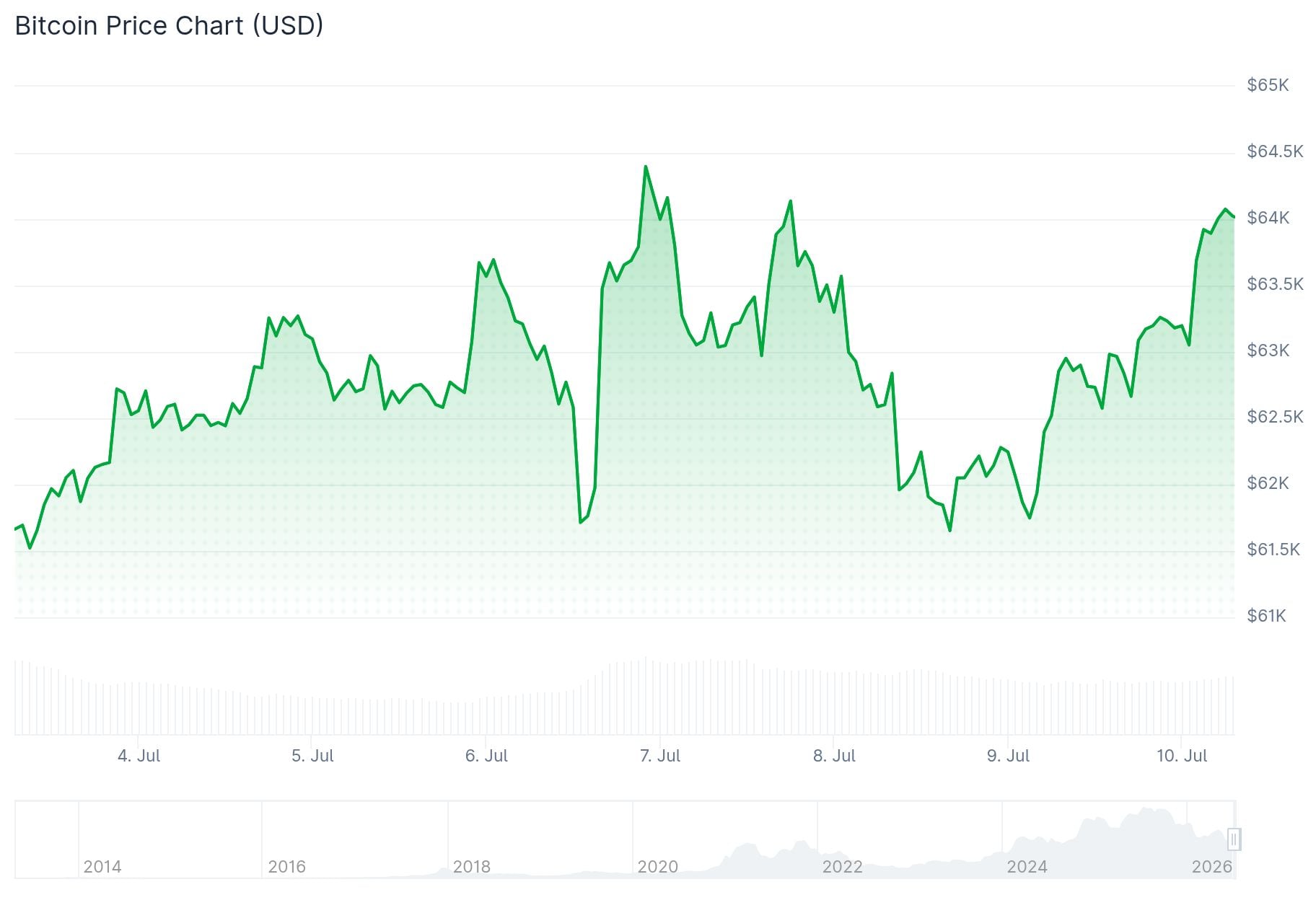

Daily Market Update: Nasdaq Gains 1.3% and Bitcoin Recovers as AI Chip Demand Grows

Daily Market Update: Nasdaq Gains 1.3% and Bitcoin Recovers as AI Chip Demand Grows

TLDR Bitcoin rose 3.5% to nearly $64,000, finishing the week up 4.2% Ether, XRP, Dogecoin, and Solana all posted gains on Friday The Nasdaq led U.S. stocks higher

NordFX Morning Update — July 10, 2026

NordFX Morning Update — July 10, 2026

🌏 Asia: Chip stocks are roaring back — Nikkei 225 up ~2%, Kospi surging over 4% as SK Hynix’s Nasdaq debut looms today. Yen firmer on hopes GPIF shifts more into

Related Articles

View More
Crypto Fear and Greed Index Drops to Extreme Fear, What It Means and How Investors Should Respond

Crypto Fear and Greed Index Drops to Extreme Fear, What It Means and How Investors Should Respond

As of May 28, 2026, the crypto fear and greed index has dropped sharply to 22 — placing the market deep inside Extreme Fear territory once again.Social media is flooded with panic alerts, and traders
What is Stablecoin?

What is Stablecoin?

A stablecoin is a stable cryptocurrency backed by fiat currency, cryptocurrencies, or other assets like gold. Its purpose is to anchor the value to fiat currencies such as the US dollar or Euro. It co
What is ERC-20?

What is ERC-20?

After years of development, Ethereum (ETH) has formed a complete ecosystem that allows developers to innovate and create complex DAPP (Decentralized Application) applications based on Ethereum. ERC-20
What is Blockchain?

What is Blockchain?

Blockchain is not only confusing to newcomers in the cryptocurrency world, but many seasoned traders in the cryptocurrency community may also find it challenging to fully understand. However, after re

Sign Up on MEXC
Sign Up & Receive Up to 10,000 USDT Bonus
Is Your Stablecoin Truly Safe?
Is Your Stablecoin Truly Safe?Is Your Stablecoin Truly Safe?
Know the risks of USDT, USDC, OpenUSD & USD1