Author: Nom Compiled by: TechFlow TL;DR -SOL’s Digital Asset Treasury (DAT) will be more efficient at accumulating current trading supply than ETH or BTC’s DAT. - The recently announced $2.5 billion SOL DAT, equivalent to $30 billion in funding for ETH or $91 billion in funding for BTC. -SOL in FTX Legacy is about to exit the market, but its narrative impact still needs to be further digested. -SOL’s inflation problem remains an obstacle to price increases, with its size being approximately three times the unlocked amount, and needs to be resolved as soon as possible. Do you really want to read the full content? Let’s take a look at a few key points: I won't get into the question of whether inflation is good or bad because I've spent enough time on that and I look forward to the changes that are coming. I am a holder of spot SOL, staked SOL, and locked SOL (thanks to SPV on Estate SOL), so my perspective may be biased. I hope the tokens I hold appreciate in value, and price stagnation is a negative for me. Headwinds: FTX Legacy and Market Pressure Like many familiar blockchains, Solana sold tokens to investors through multiple funding rounds. A significant portion of these tokens went to FTX. According to @CoinDesk's @realDannyNelson, FTX held 41 million Sol at the time of its bankruptcy, most of which were sold through several funding rounds. The main buyers included Galaxy and Pantera, with exercise prices of approximately $64 and $102 (plus fees). At the current Sol price of approximately $190, these investments have already yielded significant profits. Through analysis of pledged accounts, there are currently approximately 5 million units of "FTX Legacy SOL" to be unlocked, with a total value of approximately US$1 billion. Why mention this? Galaxy and Pantera recently announced $1.25 billion and $1 billion SOL DAT programs, respectively. Together with Sol Markets' $400 million, this totals approximately $2.5 billion (net of fees). The problem is that this likely won't have a material impact on Solana's price, as the SOL currently locked in the market can be purchased or distributed by these entities. According to @4shpool (gelato.sh), approximately 21 million units of SOL remain to be unlocked until 2028, with a total value of approximately $4 billion. A rough calculation (more detailed modeling can be provided by professional financial analysts) suggests that "FTX Legacy SOL" accounts for approximately a quarter of the remaining unlocked supply. On the other hand, Solana's inflation is also a concern. While the current inflation rate is generally considered to be 7-8%, the actual inflation rate is approximately 4.5% of the circulating supply. This means that, based on the supply of approximately 608 million SOL in epoch 839, the supply will have increased by approximately 27.5 million (inflation) and 10 million (unlocking) a year later, bringing the total circulating supply to approximately 645.5 million, with an inflation rate of approximately 6.2%. Again, this is just theoretical calculation; I'll let a more experienced analyst review it and provide you with a more accurate chart. As can be seen from the sharp increase in circulating supply, a "static" inflation rate is not accurate, with large increases at some points and smaller increases at others. We have completed the remaining large unlock points. We need to keep an eye on one key number: the amount of SOL entering the market daily. If someone receives tokens for free (e.g., through staking inflation or unlocking) or at a discount (e.g., FTX Legacy SOL), we can expect some of them to be sold. I'm assuming that all of the 37.5 million SOL inflation over the next year will be sold. This is bad news for me if I'm hoping for price appreciation—see point 2. Therefore, we need an inflow of funds, which can be achieved through DATs or ETFs like $SSK (thanks to the @REXShares team for creating and submitting the BONK ETF, which I unabashedly recommend). Ideally, every dollar spent on SOL purchases should enter the market, driving the price up. However, this approach is less efficient when SOL can be purchased at a locked or discounted price. Therefore, we assume that greedy DAT participants will buy these tokens before they unlock. Is that bad? The short answer: Not bad. To offset the annual supply of 37.5 million SOL (assuming an ideal price of $200 per SOL), the market would need an inflow of approximately $7.5 billion, or about $20.5 million per day (this is a simplification, excluding Monday-Friday trading days and bank holidays). If DATs could purchase tokens at a discount from FTX Legacy SOL or other locked SOL zones, this would increase the efficiency of this inflow. For example, raising $400 million to buy SOL at a 5% discount equates to a $420 million inflow, which is clearly better than injecting $400 million directly into the market. The only question is how to assess the time value between buying SOL from the market today and reducing sales in the future. The SOL inflation rate for the next three years will be higher than the unlocked supply (until the lockup ends in 2028), and FTX Legacy SOL only accounts for a quarter of the remaining unlocked supply. Therefore, DATs prioritizing the purchase of Legacy SOL over existing SOL will not significantly impact the overall market. Either Galaxy or Pantera could clear the remaining supply (assuming all Legacy SOL is available for sale), and this does not include existing DATs like @defidevcorp, @solstrategies_, or @UpexiTreasury (as well as existing ETPs). Good News: Trading Supply vs. Circulating Supply Funds spent on SOL are more efficient than funds spent on ETH or BTC for two main reasons. Trading Supply First, circulating supply does not equal tradable supply, especially for staked assets. Staked SOL cannot be purchased directly, but it can be used to purchase staked token derivatives (LSTs). According to the @solscanofficial team, Solana currently has 608 million SOL, of which 384 million SOL are staked, representing 63.1%. LSTs account for 33.5 million SOL, so the actual tradable supply in the market is approximately 57.5% (approximately 350 million SOL cannot be traded, with at least a two-day delay). In comparison, ETH's stake ratio is 29.6%, and LSTs account for 11.9%. A higher supply in the market makes price fluctuations more difficult to achieve, while SOL's lower tradable supply contributes to price increases. Relative capital efficiency Solana's market capitalization is significantly lower than both ETH and BTC, with a circulating market capitalization of approximately $104 billion, compared to ETH's $540 billion and BTC's $2.19 trillion. Therefore, every dollar invested in Solana DAT is 5x more efficient than investing in ETH DAT and 22x more efficient than investing in BTC DAT. When considering the staked supply, these efficiencies increase to 11x and 36x, respectively. The benefit of these DATs is that they remove supply from the market, earn tokens through staking returns (already factored into inflation above), and enable subsequent instruments like ETFs to drive the market more efficiently. SSK has seen approximately $2 million in daily inflows since launch, but an inflationary plan would require 10x that inflow—possibly achievable with the approval of more ETFs. Why read this? I've never signed up for Elon bucks, so this is a mystery to all of us. Summarize - Compared to ETH or BTC DAT, SOL DAT will be more efficient in accumulating current trading supply (rather than circulating supply). Currently, less than 1% of the supply is managed by SOL DAT, and it is expected that with the launch of the new plan, this proportion will increase to 3%, and may reach 5% in the future. - The recently announced $2.5 billion SOL DAT raise is equivalent to ETH’s $30 billion or BTC’s $91 billion. SOL DAT needs a leading figure like Michael Saylor or Tom Lee to drive the narrative. -SOL in FTX Legacy is about to exit the market, but its narrative impact still needs to be further digested. -SOL's inflation problem still needs to be solved, and its scale is about three times the unlocked amount. -Currently, ETF inflows are insufficient, but as larger-scale financial instruments are approved, SOL is expected to become a focus of institutional attention starting in Q4. -Buy $BONK (not investment advice, please do your own research). -If you just want to get investment advice from posts like this, I suggest you find a more professional quantitative analyst to manage your assetsAuthor: Nom Compiled by: TechFlow TL;DR -SOL’s Digital Asset Treasury (DAT) will be more efficient at accumulating current trading supply than ETH or BTC’s DAT. - The recently announced $2.5 billion SOL DAT, equivalent to $30 billion in funding for ETH or $91 billion in funding for BTC. -SOL in FTX Legacy is about to exit the market, but its narrative impact still needs to be further digested. -SOL’s inflation problem remains an obstacle to price increases, with its size being approximately three times the unlocked amount, and needs to be resolved as soon as possible. Do you really want to read the full content? Let’s take a look at a few key points: I won't get into the question of whether inflation is good or bad because I've spent enough time on that and I look forward to the changes that are coming. I am a holder of spot SOL, staked SOL, and locked SOL (thanks to SPV on Estate SOL), so my perspective may be biased. I hope the tokens I hold appreciate in value, and price stagnation is a negative for me. Headwinds: FTX Legacy and Market Pressure Like many familiar blockchains, Solana sold tokens to investors through multiple funding rounds. A significant portion of these tokens went to FTX. According to @CoinDesk's @realDannyNelson, FTX held 41 million Sol at the time of its bankruptcy, most of which were sold through several funding rounds. The main buyers included Galaxy and Pantera, with exercise prices of approximately $64 and $102 (plus fees). At the current Sol price of approximately $190, these investments have already yielded significant profits. Through analysis of pledged accounts, there are currently approximately 5 million units of "FTX Legacy SOL" to be unlocked, with a total value of approximately US$1 billion. Why mention this? Galaxy and Pantera recently announced $1.25 billion and $1 billion SOL DAT programs, respectively. Together with Sol Markets' $400 million, this totals approximately $2.5 billion (net of fees). The problem is that this likely won't have a material impact on Solana's price, as the SOL currently locked in the market can be purchased or distributed by these entities. According to @4shpool (gelato.sh), approximately 21 million units of SOL remain to be unlocked until 2028, with a total value of approximately $4 billion. A rough calculation (more detailed modeling can be provided by professional financial analysts) suggests that "FTX Legacy SOL" accounts for approximately a quarter of the remaining unlocked supply. On the other hand, Solana's inflation is also a concern. While the current inflation rate is generally considered to be 7-8%, the actual inflation rate is approximately 4.5% of the circulating supply. This means that, based on the supply of approximately 608 million SOL in epoch 839, the supply will have increased by approximately 27.5 million (inflation) and 10 million (unlocking) a year later, bringing the total circulating supply to approximately 645.5 million, with an inflation rate of approximately 6.2%. Again, this is just theoretical calculation; I'll let a more experienced analyst review it and provide you with a more accurate chart. As can be seen from the sharp increase in circulating supply, a "static" inflation rate is not accurate, with large increases at some points and smaller increases at others. We have completed the remaining large unlock points. We need to keep an eye on one key number: the amount of SOL entering the market daily. If someone receives tokens for free (e.g., through staking inflation or unlocking) or at a discount (e.g., FTX Legacy SOL), we can expect some of them to be sold. I'm assuming that all of the 37.5 million SOL inflation over the next year will be sold. This is bad news for me if I'm hoping for price appreciation—see point 2. Therefore, we need an inflow of funds, which can be achieved through DATs or ETFs like $SSK (thanks to the @REXShares team for creating and submitting the BONK ETF, which I unabashedly recommend). Ideally, every dollar spent on SOL purchases should enter the market, driving the price up. However, this approach is less efficient when SOL can be purchased at a locked or discounted price. Therefore, we assume that greedy DAT participants will buy these tokens before they unlock. Is that bad? The short answer: Not bad. To offset the annual supply of 37.5 million SOL (assuming an ideal price of $200 per SOL), the market would need an inflow of approximately $7.5 billion, or about $20.5 million per day (this is a simplification, excluding Monday-Friday trading days and bank holidays). If DATs could purchase tokens at a discount from FTX Legacy SOL or other locked SOL zones, this would increase the efficiency of this inflow. For example, raising $400 million to buy SOL at a 5% discount equates to a $420 million inflow, which is clearly better than injecting $400 million directly into the market. The only question is how to assess the time value between buying SOL from the market today and reducing sales in the future. The SOL inflation rate for the next three years will be higher than the unlocked supply (until the lockup ends in 2028), and FTX Legacy SOL only accounts for a quarter of the remaining unlocked supply. Therefore, DATs prioritizing the purchase of Legacy SOL over existing SOL will not significantly impact the overall market. Either Galaxy or Pantera could clear the remaining supply (assuming all Legacy SOL is available for sale), and this does not include existing DATs like @defidevcorp, @solstrategies_, or @UpexiTreasury (as well as existing ETPs). Good News: Trading Supply vs. Circulating Supply Funds spent on SOL are more efficient than funds spent on ETH or BTC for two main reasons. Trading Supply First, circulating supply does not equal tradable supply, especially for staked assets. Staked SOL cannot be purchased directly, but it can be used to purchase staked token derivatives (LSTs). According to the @solscanofficial team, Solana currently has 608 million SOL, of which 384 million SOL are staked, representing 63.1%. LSTs account for 33.5 million SOL, so the actual tradable supply in the market is approximately 57.5% (approximately 350 million SOL cannot be traded, with at least a two-day delay). In comparison, ETH's stake ratio is 29.6%, and LSTs account for 11.9%. A higher supply in the market makes price fluctuations more difficult to achieve, while SOL's lower tradable supply contributes to price increases. Relative capital efficiency Solana's market capitalization is significantly lower than both ETH and BTC, with a circulating market capitalization of approximately $104 billion, compared to ETH's $540 billion and BTC's $2.19 trillion. Therefore, every dollar invested in Solana DAT is 5x more efficient than investing in ETH DAT and 22x more efficient than investing in BTC DAT. When considering the staked supply, these efficiencies increase to 11x and 36x, respectively. The benefit of these DATs is that they remove supply from the market, earn tokens through staking returns (already factored into inflation above), and enable subsequent instruments like ETFs to drive the market more efficiently. SSK has seen approximately $2 million in daily inflows since launch, but an inflationary plan would require 10x that inflow—possibly achievable with the approval of more ETFs. Why read this? I've never signed up for Elon bucks, so this is a mystery to all of us. Summarize - Compared to ETH or BTC DAT, SOL DAT will be more efficient in accumulating current trading supply (rather than circulating supply). Currently, less than 1% of the supply is managed by SOL DAT, and it is expected that with the launch of the new plan, this proportion will increase to 3%, and may reach 5% in the future. - The recently announced $2.5 billion SOL DAT raise is equivalent to ETH’s $30 billion or BTC’s $91 billion. SOL DAT needs a leading figure like Michael Saylor or Tom Lee to drive the narrative. -SOL in FTX Legacy is about to exit the market, but its narrative impact still needs to be further digested. -SOL's inflation problem still needs to be solved, and its scale is about three times the unlocked amount. -Currently, ETF inflows are insufficient, but as larger-scale financial instruments are approved, SOL is expected to become a focus of institutional attention starting in Q4. -Buy $BONK (not investment advice, please do your own research). -If you just want to get investment advice from posts like this, I suggest you find a more professional quantitative analyst to manage your assets

5 times that of ETH and 22 times that of BTC, capital efficiency is the biggest advantage of the SOL digital asset treasury

2025/08/28 21:00
8 min di lettura
Per feedback o dubbi su questo contenuto, contattateci all'indirizzo crypto.news@mexc.com.

Author: Nom

Compiled by: TechFlow

TL;DR

-SOL’s Digital Asset Treasury (DAT) will be more efficient at accumulating current trading supply than ETH or BTC’s DAT.

- The recently announced $2.5 billion SOL DAT, equivalent to $30 billion in funding for ETH or $91 billion in funding for BTC.

-SOL in FTX Legacy is about to exit the market, but its narrative impact still needs to be further digested.

-SOL’s inflation problem remains an obstacle to price increases, with its size being approximately three times the unlocked amount, and needs to be resolved as soon as possible.

Do you really want to read the full content? Let’s take a look at a few key points:

I won't get into the question of whether inflation is good or bad because I've spent enough time on that and I look forward to the changes that are coming.

I am a holder of spot SOL, staked SOL, and locked SOL (thanks to SPV on Estate SOL), so my perspective may be biased. I hope the tokens I hold appreciate in value, and price stagnation is a negative for me.

Headwinds: FTX Legacy and Market Pressure

Like many familiar blockchains, Solana sold tokens to investors through multiple funding rounds. A significant portion of these tokens went to FTX. According to @CoinDesk's @realDannyNelson, FTX held 41 million Sol at the time of its bankruptcy, most of which were sold through several funding rounds. The main buyers included Galaxy and Pantera, with exercise prices of approximately $64 and $102 (plus fees). At the current Sol price of approximately $190, these investments have already yielded significant profits.

Through analysis of pledged accounts, there are currently approximately 5 million units of "FTX Legacy SOL" to be unlocked, with a total value of approximately US$1 billion.

Why mention this?

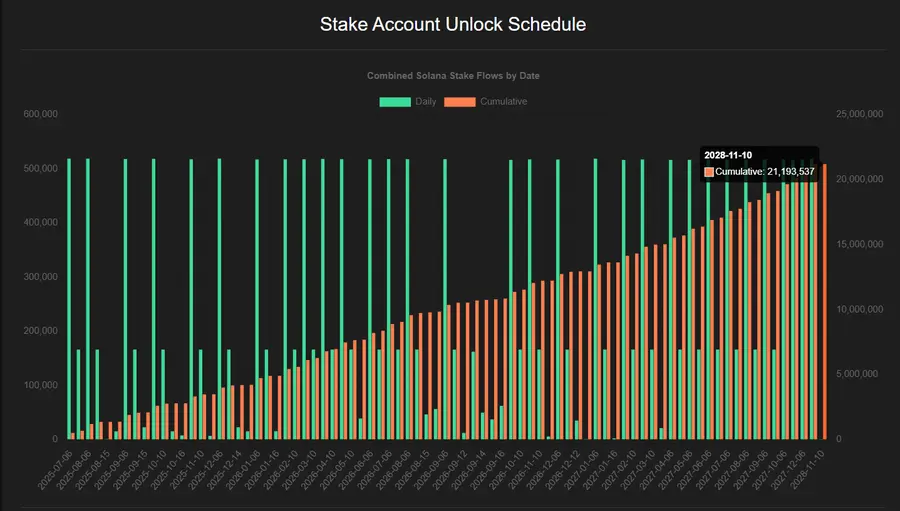
Galaxy and Pantera recently announced $1.25 billion and $1 billion SOL DAT programs, respectively. Together with Sol Markets' $400 million, this totals approximately $2.5 billion (net of fees). The problem is that this likely won't have a material impact on Solana's price, as the SOL currently locked in the market can be purchased or distributed by these entities. According to @4shpool (gelato.sh), approximately 21 million units of SOL remain to be unlocked until 2028, with a total value of approximately $4 billion. A rough calculation (more detailed modeling can be provided by professional financial analysts) suggests that "FTX Legacy SOL" accounts for approximately a quarter of the remaining unlocked supply.
On the other hand, Solana's inflation is also a concern. While the current inflation rate is generally considered to be 7-8%, the actual inflation rate is approximately 4.5% of the circulating supply. This means that, based on the supply of approximately 608 million SOL in epoch 839, the supply will have increased by approximately 27.5 million (inflation) and 10 million (unlocking) a year later, bringing the total circulating supply to approximately 645.5 million, with an inflation rate of approximately 6.2%. Again, this is just theoretical calculation; I'll let a more experienced analyst review it and provide you with a more accurate chart.
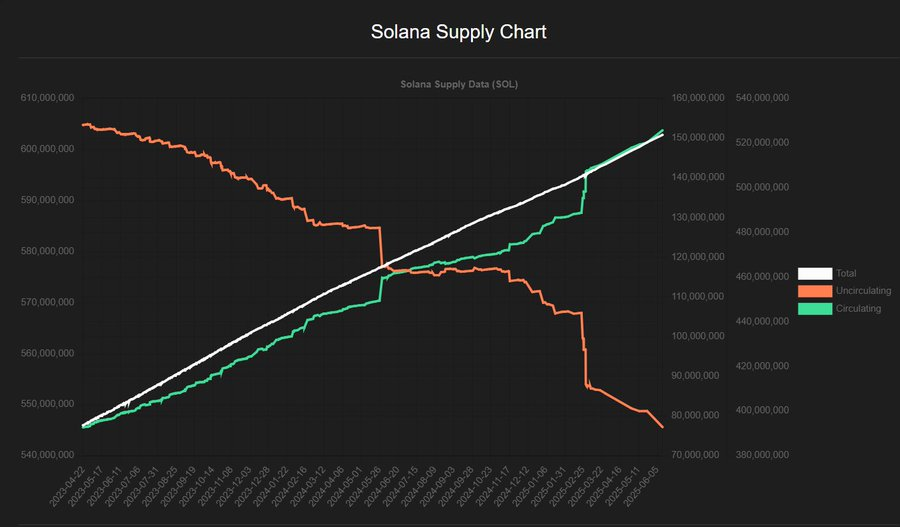
As can be seen from the sharp increase in circulating supply, a "static" inflation rate is not accurate, with large increases at some points and smaller increases at others. We have completed the remaining large unlock points.

We need to keep an eye on one key number: the amount of SOL entering the market daily. If someone receives tokens for free (e.g., through staking inflation or unlocking) or at a discount (e.g., FTX Legacy SOL), we can expect some of them to be sold. I'm assuming that all of the 37.5 million SOL inflation over the next year will be sold. This is bad news for me if I'm hoping for price appreciation—see point 2. Therefore, we need an inflow of funds, which can be achieved through DATs or ETFs like $SSK (thanks to the @REXShares team for creating and submitting the BONK ETF, which I unabashedly recommend). Ideally, every dollar spent on SOL purchases should enter the market, driving the price up. However, this approach is less efficient when SOL can be purchased at a locked or discounted price. Therefore, we assume that greedy DAT participants will buy these tokens before they unlock.

Is that bad?

The short answer: Not bad. To offset the annual supply of 37.5 million SOL (assuming an ideal price of $200 per SOL), the market would need an inflow of approximately $7.5 billion, or about $20.5 million per day (this is a simplification, excluding Monday-Friday trading days and bank holidays). If DATs could purchase tokens at a discount from FTX Legacy SOL or other locked SOL zones, this would increase the efficiency of this inflow.

For example, raising $400 million to buy SOL at a 5% discount equates to a $420 million inflow, which is clearly better than injecting $400 million directly into the market. The only question is how to assess the time value between buying SOL from the market today and reducing sales in the future.

The SOL inflation rate for the next three years will be higher than the unlocked supply (until the lockup ends in 2028), and FTX Legacy SOL only accounts for a quarter of the remaining unlocked supply. Therefore, DATs prioritizing the purchase of Legacy SOL over existing SOL will not significantly impact the overall market. Either Galaxy or Pantera could clear the remaining supply (assuming all Legacy SOL is available for sale), and this does not include existing DATs like @defidevcorp, @solstrategies_, or @UpexiTreasury (as well as existing ETPs).

Good News: Trading Supply vs. Circulating Supply

Funds spent on SOL are more efficient than funds spent on ETH or BTC for two main reasons.

Trading Supply

First, circulating supply does not equal tradable supply, especially for staked assets. Staked SOL cannot be purchased directly, but it can be used to purchase staked token derivatives (LSTs). According to the @solscanofficial team, Solana currently has 608 million SOL, of which 384 million SOL are staked, representing 63.1%. LSTs account for 33.5 million SOL, so the actual tradable supply in the market is approximately 57.5% (approximately 350 million SOL cannot be traded, with at least a two-day delay). In comparison, ETH's stake ratio is 29.6%, and LSTs account for 11.9%. A higher supply in the market makes price fluctuations more difficult to achieve, while SOL's lower tradable supply contributes to price increases.

Relative capital efficiency

Solana's market capitalization is significantly lower than both ETH and BTC, with a circulating market capitalization of approximately $104 billion, compared to ETH's $540 billion and BTC's $2.19 trillion. Therefore, every dollar invested in Solana DAT is 5x more efficient than investing in ETH DAT and 22x more efficient than investing in BTC DAT. When considering the staked supply, these efficiencies increase to 11x and 36x, respectively.

The benefit of these DATs is that they remove supply from the market, earn tokens through staking returns (already factored into inflation above), and enable subsequent instruments like ETFs to drive the market more efficiently. SSK has seen approximately $2 million in daily inflows since launch, but an inflationary plan would require 10x that inflow—possibly achievable with the approval of more ETFs.

Why read this?

I've never signed up for Elon bucks, so this is a mystery to all of us.

Summarize

- Compared to ETH or BTC DAT, SOL DAT will be more efficient in accumulating current trading supply (rather than circulating supply). Currently, less than 1% of the supply is managed by SOL DAT, and it is expected that with the launch of the new plan, this proportion will increase to 3%, and may reach 5% in the future.

- The recently announced $2.5 billion SOL DAT raise is equivalent to ETH’s $30 billion or BTC’s $91 billion. SOL DAT needs a leading figure like Michael Saylor or Tom Lee to drive the narrative.

-SOL in FTX Legacy is about to exit the market, but its narrative impact still needs to be further digested.

-SOL's inflation problem still needs to be solved, and its scale is about three times the unlocked amount.

-Currently, ETF inflows are insufficient, but as larger-scale financial instruments are approved, SOL is expected to become a focus of institutional attention starting in Q4.

-Buy $BONK (not investment advice, please do your own research).

-If you just want to get investment advice from posts like this, I suggest you find a more professional quantitative analyst to manage your assets


Opportunità di mercato
Logo Gravity
Valore Gravity (G)
$0.003832
$0.003832$0.003832
+3.09%
USD
Grafico dei prezzi in tempo reale di Gravity (G)
Disclaimer: gli articoli ripubblicati su questo sito provengono da piattaforme pubbliche e sono forniti esclusivamente a scopo informativo. Non riflettono necessariamente le opinioni di MEXC. Tutti i diritti rimangono agli autori originali. Se ritieni che un contenuto violi i diritti di terze parti, contatta crypto.news@mexc.com per la rimozione. MEXC non fornisce alcuna garanzia in merito all'accuratezza, completezza o tempestività del contenuto e non è responsabile per eventuali azioni intraprese sulla base delle informazioni fornite. Il contenuto non costituisce consulenza finanziaria, legale o professionale di altro tipo, né deve essere considerato una raccomandazione o un'approvazione da parte di MEXC.

Potrebbe anche piacerti

Lovable AI’s Astonishing Rise: Anton Osika Reveals Startup Secrets at Bitcoin World Disrupt 2025

Lovable AI’s Astonishing Rise: Anton Osika Reveals Startup Secrets at Bitcoin World Disrupt 2025

BitcoinWorld Lovable AI’s Astonishing Rise: Anton Osika Reveals Startup Secrets at Bitcoin World Disrupt 2025 Are you ready to witness a phenomenon? The world of technology is abuzz with the incredible rise of Lovable AI, a startup that’s not just breaking records but rewriting the rulebook for rapid growth. Imagine creating powerful apps and websites just by speaking to an AI – that’s the magic Lovable brings to the masses. This groundbreaking approach has propelled the company into the spotlight, making it one of the fastest-growing software firms in history. And now, the visionary behind this sensation, co-founder and CEO Anton Osika, is set to share his invaluable insights on the Disrupt Stage at the highly anticipated Bitcoin World Disrupt 2025. If you’re a founder, investor, or tech enthusiast eager to understand the future of innovation, this is an event you cannot afford to miss. Lovable AI’s Meteoric Ascent: Redefining Software Creation In an era where digital transformation is paramount, Lovable AI has emerged as a true game-changer. Its core premise is deceptively simple yet profoundly impactful: democratize software creation. By enabling anyone to build applications and websites through intuitive AI conversations, Lovable is empowering the vast majority of individuals who lack coding skills to transform their ideas into tangible digital products. This mission has resonated globally, leading to unprecedented momentum. The numbers speak for themselves: Achieved an astonishing $100 million Annual Recurring Revenue (ARR) in less than a year. Successfully raised a $200 million Series A funding round, valuing the company at $1.8 billion, led by industry giant Accel. Is currently fielding unsolicited investor offers, pushing its valuation towards an incredible $4 billion. As industry reports suggest, investors are unequivocally “loving Lovable,” and it’s clear why. This isn’t just about impressive financial metrics; it’s about a company that has tapped into a fundamental need, offering a solution that is both innovative and accessible. The rapid scaling of Lovable AI provides a compelling case study for any entrepreneur aiming for similar exponential growth. The Visionary Behind the Hype: Anton Osika’s Journey to Innovation Every groundbreaking company has a driving force, and for Lovable, that force is co-founder and CEO Anton Osika. His journey is as fascinating as his company’s success. A physicist by training, Osika previously contributed to the cutting-edge research at CERN, the European Organization for Nuclear Research. This deep technical background, combined with his entrepreneurial spirit, has been instrumental in Lovable’s rapid ascent. Before Lovable, he honed his skills as a co-founder of Depict.ai and a Founding Engineer at Sana. Based in Stockholm, Osika has masterfully steered Lovable from a nascent idea to a global phenomenon in record time. His leadership embodies a unique blend of profound technical understanding and a keen, consumer-first vision. At Bitcoin World Disrupt 2025, attendees will have the rare opportunity to hear directly from Osika about what it truly takes to build a brand that not only scales at an incredible pace in a fiercely competitive market but also adeptly manages the intense cultural conversations that inevitably accompany such swift and significant success. His insights will be crucial for anyone looking to understand the dynamics of high-growth tech leadership. Unpacking Consumer Tech Innovation at Bitcoin World Disrupt 2025 The 20th anniversary of Bitcoin World is set to be marked by a truly special event: Bitcoin World Disrupt 2025. From October 27–29, Moscone West in San Francisco will transform into the epicenter of innovation, gathering over 10,000 founders, investors, and tech leaders. It’s the ideal platform to explore the future of consumer tech innovation, and Anton Osika’s presence on the Disrupt Stage is a highlight. His session will delve into how Lovable is not just participating in but actively shaping the next wave of consumer-facing technologies. Why is this session particularly relevant for those interested in the future of consumer experiences? Osika’s discussion will go beyond the superficial, offering a deep dive into the strategies that have allowed Lovable to carve out a unique category in a market long thought to be saturated. Attendees will gain a front-row seat to understanding how to identify unmet consumer needs, leverage advanced AI to meet those needs, and build a product that captivates users globally. The event itself promises a rich tapestry of ideas and networking opportunities: For Founders: Sharpen your pitch and connect with potential investors. For Investors: Discover the next breakout startup poised for massive growth. For Innovators: Claim your spot at the forefront of technological advancements. The insights shared regarding consumer tech innovation at this event will be invaluable for anyone looking to navigate the complexities and capitalize on the opportunities within this dynamic sector. Mastering Startup Growth Strategies: A Blueprint for the Future Lovable’s journey isn’t just another startup success story; it’s a meticulously crafted blueprint for effective startup growth strategies in the modern era. Anton Osika’s experience offers a rare glimpse into the practicalities of scaling a business at breakneck speed while maintaining product integrity and managing external pressures. For entrepreneurs and aspiring tech leaders, his talk will serve as a masterclass in several critical areas: Strategy Focus Key Takeaways from Lovable’s Journey Rapid Scaling How to build infrastructure and teams that support exponential user and revenue growth without compromising quality. Product-Market Fit Identifying a significant, underserved market (the 99% who can’t code) and developing a truly innovative solution (AI-powered app creation). Investor Relations Balancing intense investor interest and pressure with a steadfast focus on product development and long-term vision. Category Creation Carving out an entirely new niche by democratizing complex technologies, rather than competing in existing crowded markets. Understanding these startup growth strategies is essential for anyone aiming to build a resilient and impactful consumer experience. Osika’s session will provide actionable insights into how to replicate elements of Lovable’s success, offering guidance on navigating challenges from product development to market penetration and investor management. Conclusion: Seize the Future of Tech The story of Lovable, under the astute leadership of Anton Osika, is a testament to the power of innovative ideas meeting flawless execution. Their remarkable journey from concept to a multi-billion-dollar valuation in record time is a compelling narrative for anyone interested in the future of technology. By democratizing software creation through Lovable AI, they are not just building a company; they are fostering a new generation of creators. His appearance at Bitcoin World Disrupt 2025 is an unmissable opportunity to gain direct insights from a leader who is truly shaping the landscape of consumer tech innovation. Don’t miss this chance to learn about cutting-edge startup growth strategies and secure your front-row seat to the future. Register now and save up to $668 before Regular Bird rates end on September 26. To learn more about the latest AI market trends, explore our article on key developments shaping AI features. This post Lovable AI’s Astonishing Rise: Anton Osika Reveals Startup Secrets at Bitcoin World Disrupt 2025 first appeared on BitcoinWorld.
Condividi
Coinstats2025/09/17 23:40
The Nationwide Tug-of-War over Prediction Markets
The Nationwide Tug-of-War over Prediction Markets

The post The Nationwide Tug-of-War over Prediction Markets appeared on BitcoinEthereumNews.com. A contentious legal battle in the United States over the classification

Condividi
BitcoinEthereumNews2026/04/09 17:42
BlackRock Moves 2,000 BTC to Coinbase, Making YIMiner a New Daily Returns Option

BlackRock Moves 2,000 BTC to Coinbase, Making YIMiner a New Daily Returns Option

Recently, BlackRock, the world’s largest asset management company, transferred 2,000 bitcoins to Coinbase, a move that has sparked widespread discussion in the
Condividi
Techbullion2026/04/02 21:50

$30,000 in PRL + 15,000 USDT

$30,000 in PRL + 15,000 USDT$30,000 in PRL + 15,000 USDT

Deposit & trade PRL to boost your rewards!


