

The Ethereum Foundation has begun to change. Can ETH return to its peak?
Written by: Pzai, Foresight News
On July 10, the Ethereum Foundation released “The Future of Ecosystem Development”, launching a series of profound architectural reforms for the Ethereum Foundation aimed at addressing long-standing challenges in project support, ecosystem operations, and fund management.
In the new vision statement, the Ethereum Foundation outlined two primary overall goals: first, to maximize the number of people who directly or indirectly use Ethereum and benefit from its underlying values; second, to maximize the resilience of Ethereum's technical and social infrastructure. The core of this structural reform is to redefine the role of the Foundation in the Ethereum ecosystem by introducing four strategic pillars (acceleration, amplification, support, and long-term dredging), establishing a new governance framework, and reforming its fund management strategy to enhance the scalability, resilience, and decentralization of the ecosystem.
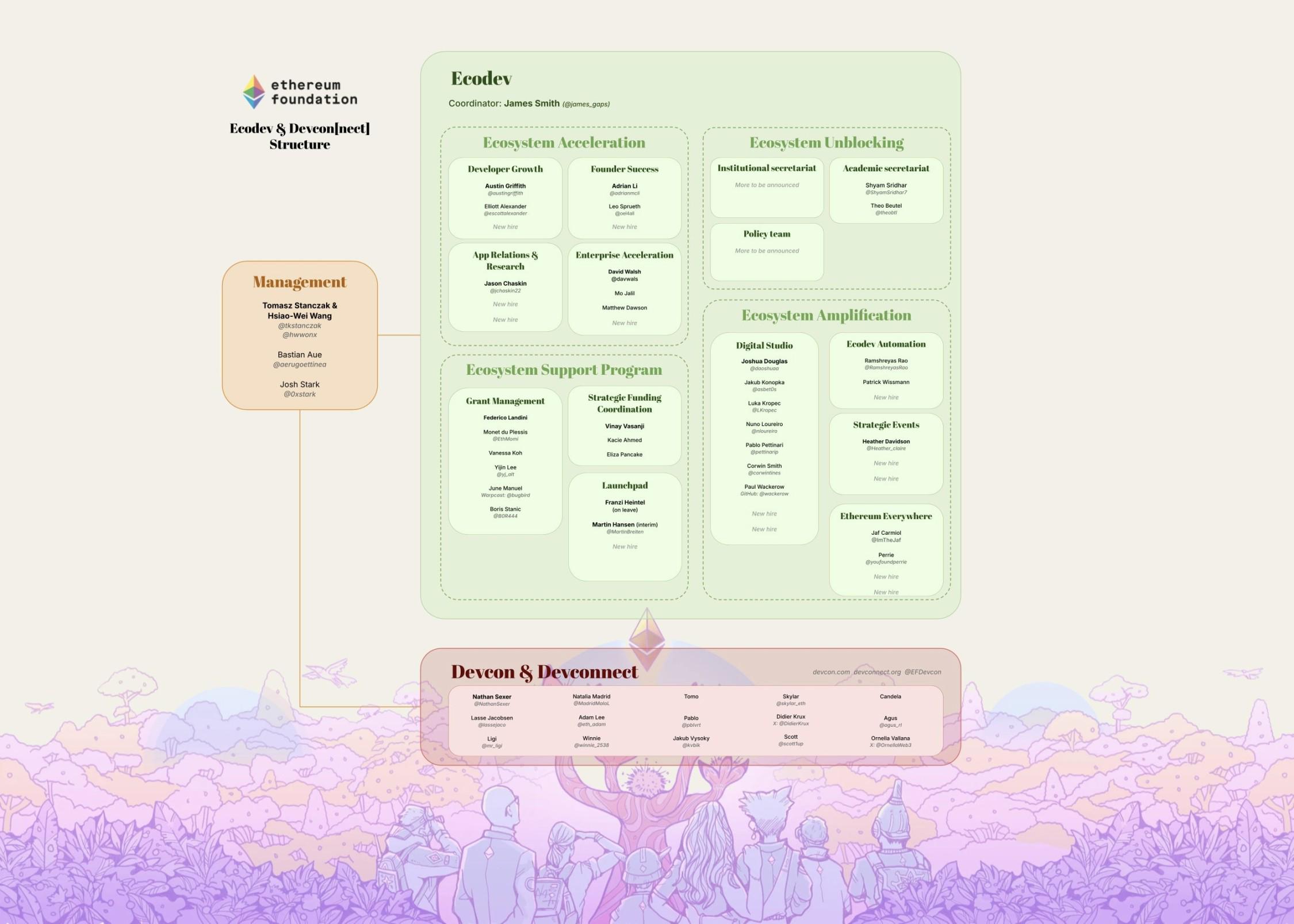
New Ecodev Organization Chart
Ecosystem Acceleration
Previously, some users and developers accused the Ethereum Foundation of "hands-off governance" for a long time, which led to a series of ecological divisions and loss of narrative identity. As more and more companies are competing to establish crypto reserves, the strategic conquest of reserves has become a key factor in the development of the ecosystem. In terms of ecological acceleration, the Ethereum Foundation has newly established support modules for subdivided directions, including:
- Corporate Relations : Providing support to enterprises that wish to adopt Ethereum, the team will focus on serving vertical fields such as finance and supply chain, and promote the on-chain tokenization (RWA) of physical assets (such as real estate and bonds).
- Developer Growth : Attract and support the next generation of Ethereum ecosystem developers. This module is led by Gitcoin Research Director Austin Griffith.
- Application support : Accelerate the construction of meaningful user-facing applications.
- Founder Support : Non-financial project-related support, this module is led by Adrian Li, former Consensys front-end technology director.
The amplification of previous ecosystem acceleration covers work in advocacy and ecosystem development, including:
- Digital Studio (ethereum.org team) : Ethereum narrative engine, producing narrative-rich content, videos, publications, and unique visualizations to showcase the potential of Ethereum.
- Strategic Campaigns : Design and execute targeted campaigns.
- Ethereum Everywhere : A team focused on expanding local communities and hubs that support application developers.
- EcoDev Automation : Enhance internal operations through automation and AI-driven tools, enabling teams to achieve their goals more effectively.
Ecosystem Support
The Ethereum Foundation has long been criticized for its lack of transparency. For example, in terms of the Ecosystem Support Program (ESP), the Foundation previously only disclosed the names of funded projects, but did not announce specific funding amounts or subsequent updates on project progress. Earlier, when early Ethereum developer @econoar left, he criticized the Foundation for its "cumbersome processes", "time-consuming and labor-intensive", and "disconnection between leadership and the broader community". After that, the Foundation also reduced its future operating expenses from 15% to 5% in 2025, gradually approaching the standards of donation-based institutions, and deployed on-chain assets to ensure long-term financial buffers (the goal is to maintain 2.5 years of operating cash reserves).
In the new structural reform, the foundation's new ESP/funding support program emphasizes more targeted applications and non-financial support, and jointly funds important public product organizations through strategic funding programs to benefit the broader Ethereum ecosystem. In addition, in the new support structure, Launchpad will assist organizations in dealing with operational design, sustainable funding, governance and other challenges. Support for Launchpad can come from derivatives of the foundation, grantees, or other ecosystem organizations (similar to Protocol Guild).
In the future, the Ethereum Foundation will also participate in global encryption policy coordination, monitor global issues related to the Ethereum ecosystem, and work with policy organizations around the world to establish ongoing relationships with governments and non-governmental organizations. In addition, as one of the practice fields of blockchain academics, the Academic Secretariat will actively promote Ethereum's cooperation with universities, professors and students to advance blockchain technology.
Conclusion
On July 11, Ethereum officially broke through $3,000. As the price of the currency climbed, the ecological development was also gradually advancing. From the perspective of this architectural change, the core goal of the Ethereum Foundation's transformation is to expand the user base and enhance the resilience of the infrastructure. It means that the Foundation will more actively coordinate resources, guide narratives, bridge community differences, and promote its large-scale implementation in key application areas while maintaining the core value of Ethereum. As the advantages of the public chain are gradually being caught up, the Foundation attempts to explore and shape the next growth engine for the Ethereum ecosystem through systematic support and strategic guidance.
Potrebbe anche piacerti

White House Publishes Trump’s New Strategy Against Cybercrimes

Trump's new DHS pick can't stop embarrassing himself — and he hasn't even started
