TLDR XRP fell 3.14% to $2.0412 on December 10 after the Federal Reserve cut interest rates but signaled fewer rate cuts in 2026 than previously expected. XRP-spot ETF inflows dropped sharply to $8.73 million on December 9, down from $38.04 million the previous day, with Franklin’s XRPZ ETF reporting zero inflows for the first time. [...] The post Why is XRP Down Today? appeared first on CoinCentral.TLDR XRP fell 3.14% to $2.0412 on December 10 after the Federal Reserve cut interest rates but signaled fewer rate cuts in 2026 than previously expected. XRP-spot ETF inflows dropped sharply to $8.73 million on December 9, down from $38.04 million the previous day, with Franklin’s XRPZ ETF reporting zero inflows for the first time. [...] The post Why is XRP Down Today? appeared first on CoinCentral.

Why is XRP Down Today?

2025/12/11 15:22
4 min di lettura
Per feedback o dubbi su questo contenuto, contattateci all'indirizzo crypto.news@mexc.com.

TLDR

  • XRP fell 3.14% to $2.0412 on December 10 after the Federal Reserve cut interest rates but signaled fewer rate cuts in 2026 than previously expected.
  • XRP-spot ETF inflows dropped sharply to $8.73 million on December 9, down from $38.04 million the previous day, with Franklin’s XRPZ ETF reporting zero inflows for the first time.
  • The crypto market structure bill faces delays as Democrats and Republicans continue negotiations over key provisions including token classification and stablecoin regulations.
  • XRP traded below both its 50-day and 200-day moving averages, with key support at $2.00 and resistance at $2.05 to $2.10.
  • Ripple’s pending application for a US-chartered banking license and potential bipartisan support for crypto legislation could drive prices toward $2.35 to $2.50 in coming weeks.

XRP dropped over 3% on December 10 following a Federal Reserve rate decision that delivered mixed signals to crypto traders. The token closed at $2.0412 after briefly rallying to $2.1097 immediately following the Fed’s announcement.

xrp priceXRP Price

The Federal Reserve cut interest rates by 25 basis points to a 3.50%-3.75% target range. Traders initially reacted positively to the widely expected cut. However, the Fed’s economic projections showed inflation staying above the 2% target until 2028.

The dot plot projections revealed a more hawkish stance than markets anticipated. Committee members now expect just one rate cut in 2026 and another in 2027. This represents a shift from September projections that showed two rate cuts in 2026.

XRP fell to a session low of $1.9936 after the projections were released. The token now trades below its 100-hour simple moving average and faces resistance near $2.05.

ETF Inflows Decline Sharply

XRP-spot ETF inflows slowed dramatically on December 9, dropping to $8.73 million from $38.04 million the previous day. Franklin’s XRPZ ETF reported zero net flows for the first time since launch after seeing $31.7 million in inflows on December 8.
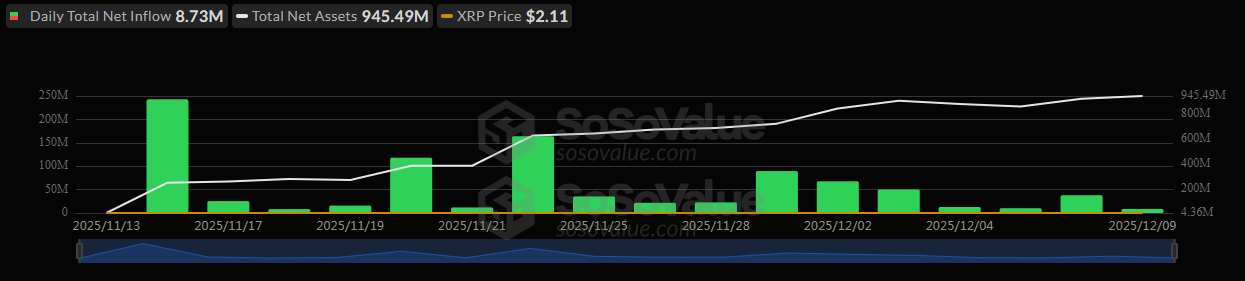
XRP-spot ETFs extend inflow streak.Source: SoSoValue

The slowdown came ahead of the Fed decision as institutional investors appeared to take a cautious approach. Bitcoin spot ETFs outperformed XRP ETFs on December 9 with $151.9 million in net inflows.

For December, XRP-spot ETFs have attracted $277.5 million in total inflows compared to just $3.8 million for Bitcoin spot ETFs. The strong overall performance reflects growing institutional interest in XRP despite the recent single-day slowdown.

Vanguard recently opened its brokerage accounts to crypto-spot ETF investments. This move could expand the potential investor base for XRP products in the coming weeks.

Legislative Progress Stalls

Negotiations over crypto market structure legislation continue on Capitol Hill with Democrats and Republicans working to resolve key differences. Democrats released a three-page counteroffer outlining their priorities on token classification, illicit finance rules, ethics standards, and stablecoin yield restrictions.

Crypto journalist Eleanor Terrett reported that Democrats have accepted portions of the Senate Banking Committee’s text. However, significant gaps remain between the two parties on core principles.

XRP rallied 14.69% in July when the House of Representatives passed the market structure bill. The token reached an all-time high of $3.66 but has since fallen 44% from that peak. The government shutdown and resulting legislative delays contributed to the reversal.

Banking License Application Pending

Ripple’s application for a US-chartered banking license with the Office of the Comptroller of the Currency remains under review. Approval would mark a turning point for Ripple’s regulatory standing in the United States.

The Fed will resume buying Treasuries on December 12 after ending quantitative tightening on December 1. The return to quantitative easing typically adds liquidity to financial markets and can boost demand for risk assets including cryptocurrencies.

XRP now tests key support at the $2.00 level. Technical resistance sits at $2.05 with additional barriers at $2.10 and $2.22. A break below $2.00 could push the token toward $1.9850 support.

The post Why is XRP Down Today? appeared first on CoinCentral.

Opportunità di mercato
Logo XRP
Valore XRP (XRP)
$1.3462
$1.3462$1.3462
-0.51%
USD
Grafico dei prezzi in tempo reale di XRP (XRP)
Disclaimer: gli articoli ripubblicati su questo sito provengono da piattaforme pubbliche e sono forniti esclusivamente a scopo informativo. Non riflettono necessariamente le opinioni di MEXC. Tutti i diritti rimangono agli autori originali. Se ritieni che un contenuto violi i diritti di terze parti, contatta crypto.news@mexc.com per la rimozione. MEXC non fornisce alcuna garanzia in merito all'accuratezza, completezza o tempestività del contenuto e non è responsabile per eventuali azioni intraprese sulla base delle informazioni fornite. Il contenuto non costituisce consulenza finanziaria, legale o professionale di altro tipo, né deve essere considerato una raccomandazione o un'approvazione da parte di MEXC.

Potrebbe anche piacerti

USDH Power Struggle Ignites Stablecoin “Bidding Wars” Across DeFi: Bloomberg

USDH Power Struggle Ignites Stablecoin “Bidding Wars” Across DeFi: Bloomberg

A heated contest for control over a new dollar-pegged token has set the stage for what analysts say could define the next phase of the stablecoin industry. According to Bloomberg, a bidding war unfolded on Hyperliquid, one of crypto’s fastest-growing trading platforms, with the prize being the right to issue USDH, its native stablecoin. The competition drew some of the sector’s most prominent names, including Paxos, Sky, and Ethena, who later withdrew their bid, alongside the lesser-known Native Markets, a startup backed by Stripe stablecoin subsidiary Bridge. Hyperliquid Stablecoin Race Shows Branding and Partnerships Matter as Much as Tech Over the weekend, Hyperliquid’s validators, the contributors who secure the network and vote on key decisions, awarded the USDH contract to Native Markets over the weekend. Despite its relatively new status, the firm’s connection with Stripe helped it outpace more established rivals. Stablecoins underpin decentralized finance by providing a dollar-backed medium for collateral, settlement, and payments across applications. What began as a grassroots, community-led sector has evolved into a battleground for institutions and payment companies seeking revenue from interest on reserves. Circle, for example, shares proceeds from its USDC with Coinbase under a partnership designed to stabilize earnings during market swings. The Hyperliquid contest offered a rare glimpse into just how intense competition has become. Paxos pledged to take no revenue until USDH surpassed $1 billion in circulation. Agora offered to share 100% of net revenue with Hyperliquid, while Ethena put forward 95%. All were outbid by Native Markets, whose ties to Stripe’s $1.1 billion acquisition of Bridge and subsequent rollout of the Tempo blockchain positioned it as a strong contender. “Every stablecoin issuer is extremely desperate for supply,” said Zaheer Ebtikar, co-founder of Split Capital. “They are willing to publicly announce how much they are willing to offer. It just shows it’s a very tough business for stablecoin issuers.” While USDC remains dominant on Hyperliquid with more than $5.6 billion in deposits, the arrival of USDH could shift flows and revenue dynamics. Paxos co-founder Bhau Kotecha said the firm sees the exchange’s growth as an important opportunity, while Agora’s co-founder Nick van Eck warned that awarding the contract to a vertically integrated issuer risked undermining decentralization. Regulatory positioning also factored into the debate. Paxos operates under a New York trust charter and is seeking a federal license, while Bridge holds money transmitter approvals in 30 states. Native Markets, in a blog post, cited regulatory flexibility and deployment speed as reasons for its selection. Hyperliquid said the strong engagement from its community validated the process. Circle CEO Jeremy Allaire dismissed concerns over USDC’s status, noting on X that competition benefits the ecosystem. Analysts suggested that fears of centralization may be exaggerated, noting that Hyperliquid is likely to remain neutral and support multiple stablecoins. Still, the contest over USDH highlighted a new reality for stablecoins: branding, partnerships, and business strategy are becoming as decisive as technology. Native Markets Secures USDH Stablecoin Mandate on Hyperliquid Hyperliquid has concluded its governance vote for the USDH stablecoin, awarding the mandate to Native Markets after a closely watched process that drew weeks of community debate and rival proposals. USDH, described by Hyperliquid as a “Hyperliquid-first, compliant, and natively minted” dollar-backed token, is intended to reduce the platform’s dependence on USDC and strengthen its spot markets. Validators on the decentralized exchange voted in favor of Native Markets, a relatively new player backed by Stripe’s Bridge subsidiary, over established contenders including Paxos and Ethena. The outcome followed a string of proposals offering aggressive revenue-sharing terms to win validator support, underscoring the scale of incentives attached to controlling USDH. Hyperliquid’s exchange has become a critical hub for stablecoin liquidity, with $5.7 billion in USDC, around 8% of its total supply, currently held on the network. At prevailing treasury yields, that translates to an estimated $200 million to $220 million in annual revenue for Circle, underlining why a native alternative could be transformative. Hyperliquid’s validators, who secure the network and vote on key decisions, selected Native Markets following an on-chain governance process that concluded September 15. Native Markets has laid out a phased rollout for USDH, beginning with capped minting and redemption trials before expanding into spot markets. Its reserves will be managed in cash and treasuries by BlackRock, with on-chain tokenization through Superstate and Bridge. Yield from those reserves will be split between Hyperliquid’s Assistance Fund and ecosystem development. The launch of USDH comes as Hyperliquid records record profits from perpetual futures trading, with $106 million in revenue in August alone, and prepares to slash spot trading fees by 80% to bolster liquidity. Analysts say the move positions Hyperliquid to capture more of the stablecoin economics internally, marking a significant step in its bid to rival the largest players in decentralized finance
Condividi
CryptoNews2025/09/18 00:48
XRP Price Prediction: Could XRP Hit $10 or Will a 150x Presale Get There First

XRP Price Prediction: Could XRP Hit $10 or Will a 150x Presale Get There First

A sudden BTC bounce from $66,800 just jolted the entire market, dragging altcoins up and forcing late sellers to cover in a move that instantly changed short term
Condividi
Techbullion2026/03/29 03:34
How a Dutch IPTV Provider Is Rethinking the Trial-First Model for European Cord-Cutters

How a Dutch IPTV Provider Is Rethinking the Trial-First Model for European Cord-Cutters

The European IPTV market has grown aggressively over the past three years. According to IMARC Group, the global IPTV market reached $94.1 billion in 2024 and is
Condividi
Techbullion2026/03/29 03:25