Canadian Solana Treasury firm, SOL Strategies, has submitted an application to the U.S. SEC in hopes of gaining permission to trade on the Nasdaq exchange under the ticker STKE. According to the recently filed official document, SOL (SOL) Strategies intends…Canadian Solana Treasury firm, SOL Strategies, has submitted an application to the U.S. SEC in hopes of gaining permission to trade on the Nasdaq exchange under the ticker STKE. According to the recently filed official document, SOL (SOL) Strategies intends…

Solana’s Canada-based ‘Strategy’ firm files with U.S. SEC to trade on Nasdaq

2025/06/19 14:33
3 min di lettura
Per feedback o dubbi su questo contenuto, contattateci all'indirizzo crypto.news@mexc.com.

Canadian Solana Treasury firm, SOL Strategies, has submitted an application to the U.S. SEC in hopes of gaining permission to trade on the Nasdaq exchange under the ticker STKE.

According to the recently filed official document, SOL (SOL) Strategies intends to trade Common Shares without par value under the the trading symbol “STKE” on the Nasdaq Capital Market. Initially, the company’s common stock was trading under the “HODL” symbol on the Canadian Securities Exchange and under “CYFRF” on the OTCQB.

On June 19, the Ontario-based filed a Form 40-F application with the U.S. financial watchdog. A Form 40-F filing with the U.S. SEC is a necessary requirement for companies seeking to register securities for trading in the U.S. market.

The form is still awaiting approval from the SEC. This is the first time the Solana Treasury firm plans to enter the U.S. market, which could potentially grant them more exposure into America’s increasingly pro-crypto movement.

After news of the filing broke, SOL Strategies’ stock saw an increase in value by 4.3% as of June 19. According to data from Google Finance, HODL stock rose 10 points to 2.38 from 2.28.
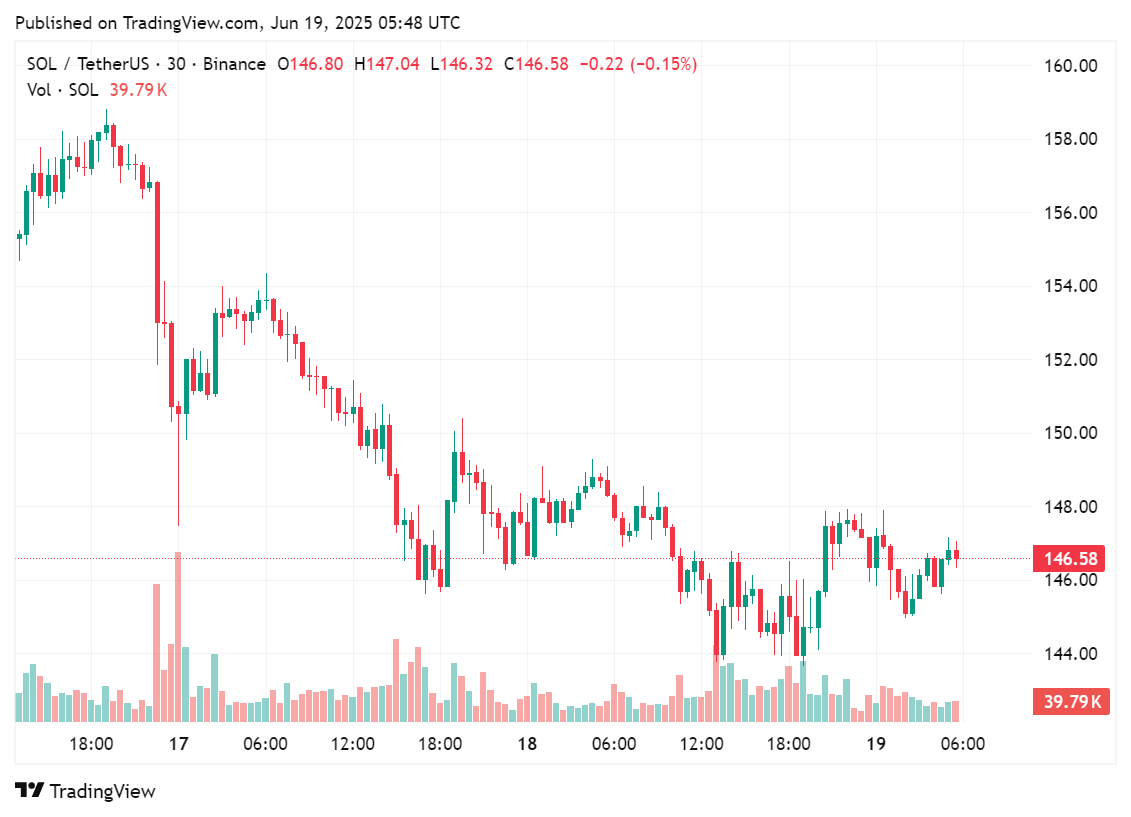
Price chart for Solana in the past few days of trading, June 19, 2025 | Source: crypto.news

In contrast, the news of SOL Strategies’ SEC filing barely affected the price of Solana. Shortly after the news went viral, SOL jumped slightly by 0.3% in the past hour.

At press time, SOL has gone down 1.62%, continuing its descent from a few days prior. SOL is currently trading at $146.38. The token has declined nearly 9% in the past week and 13.6% in the past month. Its market cap stands at $77.2 billion.

How much Solana are in SOL Strategies’ holdings?

On May 29, SOL Strategies reported that it had purchased 26,478 SOL for $4.7 million. This recent purchase brings its total holdings to approximately 420,355 SOL, consisting of 269,258 SOL owned and 268,671 tokens actively staked to the company’s validators.

Back in April, SOL Strategies announced that it had secured funds of up to $500 million via a convertible note agreement with ATW Partners. The firm plans to use the capital to accumulate more SOL tokens and support validator operations.

Formerly operating under the name Cypherpunk Holdings Inc., SOL Strategies initially shifted from a Bitcoin (BTC)-focused treasury and began accumulating Solana in late October 2024. Just a month prior, the company rebranded and changed its name to SOL Strategies.

However, the official announcement that they were discarding its Bitcoin treasury strategy in favor of Solana in their Q4 Shareholder Letter filed January 29, 2025.

Opportunità di mercato
Logo Solana
Valore Solana (SOL)
$93.9
$93.9$93.9
+0.76%
USD
Grafico dei prezzi in tempo reale di Solana (SOL)
Disclaimer: gli articoli ripubblicati su questo sito provengono da piattaforme pubbliche e sono forniti esclusivamente a scopo informativo. Non riflettono necessariamente le opinioni di MEXC. Tutti i diritti rimangono agli autori originali. Se ritieni che un contenuto violi i diritti di terze parti, contatta crypto.news@mexc.com per la rimozione. MEXC non fornisce alcuna garanzia in merito all'accuratezza, completezza o tempestività del contenuto e non è responsabile per eventuali azioni intraprese sulla base delle informazioni fornite. Il contenuto non costituisce consulenza finanziaria, legale o professionale di altro tipo, né deve essere considerato una raccomandazione o un'approvazione da parte di MEXC.

Potrebbe anche piacerti

And the Big Day Has Arrived: The Anticipated News for XRP and Dogecoin Tomorrow

And the Big Day Has Arrived: The Anticipated News for XRP and Dogecoin Tomorrow

The first-ever ETFs for XRP and Dogecoin are expected to launch in the US tomorrow. Here's what you need to know. Continue Reading: And the Big Day Has Arrived: The Anticipated News for XRP and Dogecoin Tomorrow
Condividi
Coinstats2025/09/18 04:33
Swiss Franc Intervention: Critical Analysis of SNB’s 2025 Policy and Safe-Haven Resilience

Swiss Franc Intervention: Critical Analysis of SNB’s 2025 Policy and Safe-Haven Resilience

BitcoinWorld Swiss Franc Intervention: Critical Analysis of SNB’s 2025 Policy and Safe-Haven Resilience ZURICH, March 2025 – The Swiss National Bank faces mounting
Condividi
bitcoinworld2026/03/16 23:10
Cashing In On University Patents Means Giving Up On Our Innovation Future

Cashing In On University Patents Means Giving Up On Our Innovation Future

The post Cashing In On University Patents Means Giving Up On Our Innovation Future appeared on BitcoinEthereumNews.com. “It’s a raid on American innovation that would deliver pennies to the Treasury while kneecapping the very engine of our economic and medical progress,” writes Pipes. Getty Images Washington is addicted to taxing success. Now, Commerce Secretary Howard Lutnick is floating a plan to skim half the patent earnings from inventions developed at universities with federal funding. It’s being sold as a way to shore up programs like Social Security. In reality, it’s a raid on American innovation that would deliver pennies to the Treasury while kneecapping the very engine of our economic and medical progress. Yes, taxpayer dollars support early-stage research. But the real payoff comes later—in the jobs created, cures discovered, and industries launched when universities and private industry turn those discoveries into real products. By comparison, the sums at stake in patent licensing are trivial. Universities collectively earn only about $3.6 billion annually in patent income—less than the federal government spends on Social Security in a single day. Even confiscating half would barely register against a $6 trillion federal budget. And yet the damage from such a policy would be anything but trivial. The true return on taxpayer investment isn’t in licensing checks sent to Washington, but in the downstream economic activity that federally supported research unleashes. Thanks to the bipartisan Bayh-Dole Act of 1980, universities and private industry have powerful incentives to translate early-stage discoveries into real-world products. Before Bayh-Dole, the government hoarded patents from federally funded research, and fewer than 5% were ever licensed. Once universities could own and license their own inventions, innovation exploded. The result has been one of the best returns on investment in government history. Since 1996, university research has added nearly $2 trillion to U.S. industrial output, supported 6.5 million jobs, and launched more than 19,000 startups. Those companies pay…
Condividi
BitcoinEthereumNews2025/09/18 03:26