Pye Finance has revealed a $5 million seed round led by some of the major players in the space. The goal is to turn billions in locked SOL stakes intoPye Finance has revealed a $5 million seed round led by some of the major players in the space. The goal is to turn billions in locked SOL stakes into

Variant, Coinbase Ventures, Gemini and More Invest $5M in Solana Staking ‘Transformer’ Pye Finance

2025/12/09 00:16

Pye Finance has revealed a $5 million seed round led by some of the major players in the space. The goal is to turn billions in locked SOL stakes into an active yield market.

Variant and Coinbase Ventures led this round, with participation from Solana Labs, Nascent, Gemini, and others, according to the press release.

Pye says that it’s building bond markets for validators and stakers on Solana (SOL). The platform enables validators to draw and keep stake. They can offer rewards across more than a thousand validators.

According to the team, they accomplish this by creating transferable, time-locked staking positions with transparent reward sharing.

Moreover, they argue that the approach opens up novel DeFi use cases. These include lending and restaking, as well as fixed-yield products for the $60 billion locked in staking.

Per Brian Long. CEO of Block Logic & Triton, “Stake Trading unlocks new possibilities for both stakers and validators which is much needed.”

According to Alana Levin, investor at Variant, Pye’s staking marketplace could “fundamentally change how staking operates on Solana. By allowing validators and stakers to better align their preferences – for example, enabling validators to offer higher yields in exchange for longer lockups – Pye creates a more efficient, transparent, and incentive-aligned staking ecosystem.”

Meanwhile, Pye is the product of Alberto Cevallos, co-founder of Bitcoin yield aggregator on Ethereum BadgerDAO, and Erik Ashdown, an exec with a background in structured products in traditional markets.

“Validators have become the underbanked layer of Web3,” Ashdown says. Pye is building a financial infrastructure that lets validators operate like asset managers, offering structured products and predictable returns.

Notably, this raise follows a closed alpha. The team plans to launch a private beta in the first quarter of 2026. Early access is currently available to validators and staking providers.

You may also like:
Ripple, Solana and Binance Execs Break Down Market Shifts at Binance Blockchain Week 2025
A high-profile panel at Binance Blockchain Week in Dubai brought together Brad Garlinghouse of Ripple, Lily Liu of the Solana Foundation, and Binance’s Richard Teng to dissect the latest trends shaping digital asset markets. Moderated by CNBC’s Dan Murphy, the conversation spanned Bitcoin’s recent volatility, the rapid rise of stablecoins, and institutional adoption driven by regulatory clarity. Bitcoin’s Rebound and the Leverage Flush-Out Murphy opened the session by recapping...

Passive Billions ‘Turning’ Into Active Yield Market

Staking is shifting from a passive yield mechanism into a programmable financial layer, the team says. Institutional stakers look for transparent reward structures, customizable terms, and the option to trade or borrow against locked positions.

Therefore, Pye says it’s turning validators from node operators into yield providers who can “compete on product offerings rather than just commission rates.” It’s creating the first onchain marketplace for time-locked staking positions on Solana, it adds.

With this, they claim, they’ll turn Solana’s billions in locked stake into an active, programmable yield market.

The total staked currently sits at 422.6 million SOL, or nearly $59 billion.
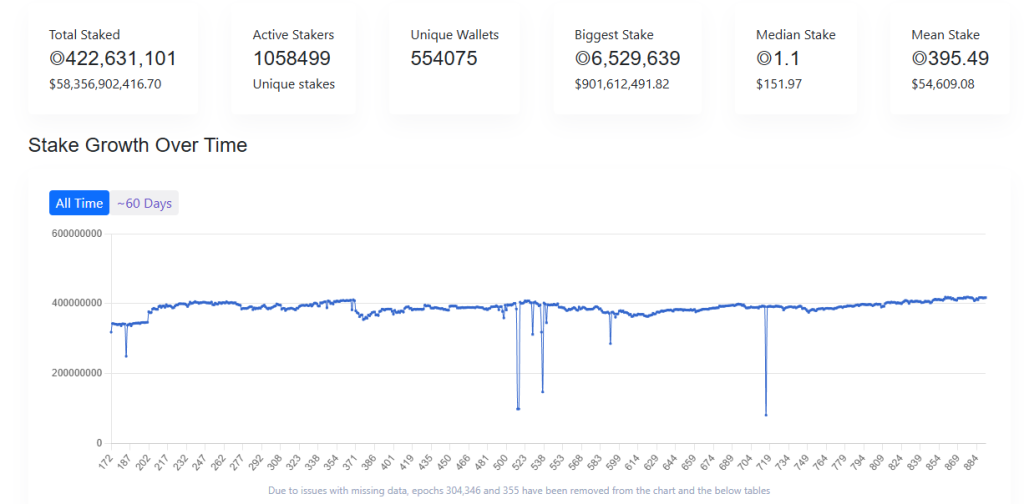
Source: solanacompass

Notably, the team argues that these accounts have seen no updates in years and have no liquidity. Additionally, they lack customization and control over staking rewards.

At the same time, institutions and digital asset treasuries (DATs) are asking for a bigger piece of the reward pie, the Solana Foundation’s Delegation Program (SFDP) is seeing a cut, and smaller validators have to scramble to find ways to generate revenue or attract stakers.

Pye says its solution is an upgrade to Solana’s native Staked accounts. Validators gain control over their staking rewards and time locks. Validator agreements move onchain as ‘transferable locked stake’ – they are locked but can be traded on secondary markets. These are split into a Principal Token and a Rewards Token (RT).

“The aim is to enable validators to offer more flexible and dynamic products, tapping into additional revenue opportunities while delivering greater utility to stakers,” the press release says. “Without the ability to structure term-based deals, reward loyalty, or provide additional utility–such as better accounting, rewards forwarding, or other features–many validators are left vulnerable to sudden outflows that can destabilize operations.”

Dan Albert, Solana Foundation’s Executive Director, commented that Pye’s “tradeable, fixed-term positions at the validator level represent a major unlock for both rewards discovery and capital efficiency in proof-of-stake networks, and open up new opportunities.”

You may also like:
Coinbase Launches Staking in New York After State Approval – ETH and SOL Yields Now Available
Coinbase has activated staking services for New York residents, allowing users to earn yields on Ethereum and Solana holdings for the first time. The rollout follows approval from state regulators under Governor Kathy Hochul's administration, ending a restriction that had separated New Yorkers from staking opportunities available to most other Americans. New York users can now stake ETH, SOL, and other supported assets directly through the platform, with rewards earned in the network's...
Disclaimer: The articles reposted on this site are sourced from public platforms and are provided for informational purposes only. They do not necessarily reflect the views of MEXC. All rights remain with the original authors. If you believe any content infringes on third-party rights, please contact service@support.mexc.com for removal. MEXC makes no guarantees regarding the accuracy, completeness, or timeliness of the content and is not responsible for any actions taken based on the information provided. The content does not constitute financial, legal, or other professional advice, nor should it be considered a recommendation or endorsement by MEXC.

You May Also Like

BFX Presale Raises $7.5M as Solana Holds $243 and Avalanche Eyes $1B Treasury — Best Cryptos to Buy in 2025
BFX Presale Raises $7.5M as Solana Holds $243 and Avalanche Eyes $1B Treasury — Best Cryptos to Buy in 2025

BFX presale hits $7.5M with tokens at $0.024 and 30% bonus code BLOCK30, while Solana holds $243 and Avalanche builds a $1B treasury to attract institutions.
Share
Blockchainreporter2025/09/18 01:07
Major Banks Rush to Get Crypto Charters in 2025

Major Banks Rush to Get Crypto Charters in 2025

The post Major Banks Rush to Get Crypto Charters in 2025 appeared on BitcoinEthereumNews.com. Key Highlights In the latest statement, the OCC revealed a major development that approves new federally chartered banks This might open the door for crypto and fintech companies to become regulated institutions An OCC official has raised his support for the authority of existing trust banks to hold digital assets for clients, stating that they have legally provided this custody service for decades and that crypto is not different  The U.S.’s leading banking regulator has revealed that many new federally chartered banks are going to be approved soon and stated that firms working with digital assets should have a clear regulatory framework to become regulated banks.  Our first public panel of the day: @USComptroller Jonathan Gould delivers a keynote and sits for a conversation to discuss the @USOCC’s modernization agenda and GENIUS Act implementation. Tune in to watch the livestream here: https://t.co/6gK6lZakdz — Blockchain Association (@BlockchainAssn) December 8, 2025 US Regulator Welcomes New Crypto-Friendly Banks Comptroller of the Currency’s head, Jonathan V. Gould, shared a statement at a Blockchain Association Summit on December 8, where he unveiled the regulator’s plan to integrate financial innovations into the existing financial infrastructure. In his official statement, he slammed the last 15 years of “completely stagnated” new bank formations by blaming regulators for discouraging applicants.  “Over the past 15 years, de novo chartering has completely stagnated. In the late 1990s, the OCC received over 100 de novo charter applications each year, and nearly 50 per year in the early 2000s. But from 2011 through 2024, the OCC received, on average, less than four charter applications per year,” he said. Jonathan V. Gould further added into his statement, “Following the financial crisis, there were years when the OCC received only one or two charter applications—as well as years when the OCC did not receive a…
Share
BitcoinEthereumNews2025/12/09 05:26
