This study evaluates a transformer-based framework for detecting anomalies in large-scale system logs. Experiments were conducted on four public datasets—HDFS, BGL, Spirit, and Thunderbird—using adaptive log-sequence generation to handle varying sequence lengths and data rates. The model architecture includes two transformer encoder layers with multi-head attention and was optimized using AdamW and OneCycleLR. Implemented in PyTorch and trained on an HPC system, the setup demonstrates an efficient and scalable approach for benchmarking log anomaly detection methods.This study evaluates a transformer-based framework for detecting anomalies in large-scale system logs. Experiments were conducted on four public datasets—HDFS, BGL, Spirit, and Thunderbird—using adaptive log-sequence generation to handle varying sequence lengths and data rates. The model architecture includes two transformer encoder layers with multi-head attention and was optimized using AdamW and OneCycleLR. Implemented in PyTorch and trained on an HPC system, the setup demonstrates an efficient and scalable approach for benchmarking log anomaly detection methods.

How Transformer Models Detect Anomalies in System Logs

2025/11/04 01:52

Abstract

1 Introduction

2 Background and Related Work

2.1 Different Formulations of the Log-based Anomaly Detection Task

2.2 Supervised v.s. Unsupervised

2.3 Information within Log Data

2.4 Fix-Window Grouping

2.5 Related Works

3 A Configurable Transformer-based Anomaly Detection Approach

3.1 Problem Formulation

3.2 Log Parsing and Log Embedding

3.3 Positional & Temporal Encoding

3.4 Model Structure

3.5 Supervised Binary Classification

4 Experimental Setup

4.1 Datasets

4.2 Evaluation Metrics

4.3 Generating Log Sequences of Varying Lengths

4.4 Implementation Details and Experimental Environment

5 Experimental Results

5.1 RQ1: How does our proposed anomaly detection model perform compared to the baselines?

5.2 RQ2: How much does the sequential and temporal information within log sequences affect anomaly detection?

5.3 RQ3: How much do the different types of information individually contribute to anomaly detection?

6 Discussion

7 Threats to validity

8 Conclusions and References

\

4 Experimental Setup

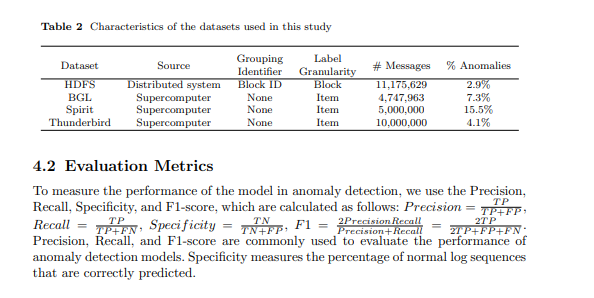
4.1 Datasets We evaluate our proposed approach and conduct experiments with four commonlyused public datasets: HDFS [8], Blue Gene/L (BGL), Spirit, and Thunderbird [32]. These datasets are commonly used in existing studies [1, 5, 12]. The HDFS dataset [8] is derived from the Amazon EC2 platform. The dataset comprises over 11 million log events, each linked to a block ID. This block ID allows us to partition the log data into sessions. The annotations are block-wise: each session is labeled as either normal or abnormal. In total, there are 575,061 log sessions, with 16,838 (2.9%) identified as anomalies. The BGL, Spirit, and Thunderbird datasets are recorded from supercomputer systems, from which they are named. Different from the HDFS dataset, all these datasets have log item-wise annotation. However, there is no block ID or other identifier to group the log items into sequences. The BGL dataset is recorded with a time span of 215 days, containing 4,747,963 log items, where 348,460 (7.3%) are labeled as anomalies. As the Spirit and Thunderbird datasets each contain more than 200 million log items, which is too large to process, we use subsets of 5 million and 10 million log items, respectively, as per the practices of previous works [7, 11, 15]. We split the datasets into an 80% training set and a 20% test set. For the HDFS dataset, we randomly shuffle the sessions to perform dataset splitting. For the remaining datasets, we divide them in accordance with the chronological order of logs. The summarised properties of datasets utilized in the evaluation and experiment of our study are presented in Table 2.

\
4.3 Generating Log Sequences of Varying Lengths

Except for the HDFS dataset, which has a block ID to group the logs into sequences, other datasets employed by our study have no identifier to group or split the whole log sequence into sub-sequences. In practice, the logs produced by systems and applications do not adhere to a fixed rate of generation. Using fixed-window or fixed-time grouping with a sliding window fails to adequately accommodate the variability in log generation and thus may lead to inaccurate detection of anomalies in real scenarios. Moreover, according to previous studies [1, 7, 15], the best grouping setting varies depending on the dataset, and these settings can significantly influence the performance of the anomaly detection model, making it challenging to compare the effectiveness of different anomaly detection methods. Therefore, we use a method to generate log sequences with varying lengths and utilize these sequences to train the model within our anomaly detection framework. In the process of log sequence generation, we determined specific parameters, including minimum and maximum sequence lengths, as well as a designated step size. The step size is used to control the interval of the first log events in log sequences. The length of each log sequence is randomly generated in the range of the minimum and the maximum length. We assume the log sequence of the minimum length can offer a minimum context for a possible anomaly. The step size controls the overlaps of sequences. The maximum length affects the number of parameters in the model, and step size decides the amount of samples in the dataset. They should be aligned with the data distribution and computational resources available. In the experiments conducted in this study, we set the minimum length as 128, the maximum length as 512, and the step size as 64 for the datasets without a grouping identifier.

\ 4.4 Implementation Details and Experimental Environment

In our experiments, the proposed transformer-based anomaly detection model has two layers of the transformer encoder. The number of attention heads is 12, and the dimension of the feedforward network layer within each transformer block is set to 2048. We use AdamW with an initial learning rate of 5e-4 as the optimization algorithm and employ the OneCycleLR learning rate scheduler to enable a better convergence. We selected these hyperparameters following standard practices while also considering computational efficiency. Our implementation is based on Python 3.11 and PyTorch 2.2.1. All the experiments are run on a high-performance computing (HPC) system. We use a computational node equipped with an Intel Gold 6148 Skylake @ 2.4 GHz CPU, 16GB RAM and an NVIDIA V100 GPU to run our experiments.

:::info Authors:

  1. Xingfang Wu
  2. Heng Li
  3. Foutse Khomh

:::

:::info This paper is available on arxiv under CC by 4.0 Deed (Attribution 4.0 International) license.

:::

\

Disclaimer: The articles reposted on this site are sourced from public platforms and are provided for informational purposes only. They do not necessarily reflect the views of MEXC. All rights remain with the original authors. If you believe any content infringes on third-party rights, please contact service@support.mexc.com for removal. MEXC makes no guarantees regarding the accuracy, completeness, or timeliness of the content and is not responsible for any actions taken based on the information provided. The content does not constitute financial, legal, or other professional advice, nor should it be considered a recommendation or endorsement by MEXC.

You May Also Like

Is Doge Losing Steam As Traders Choose Pepeto For The Best Crypto Investment?

Is Doge Losing Steam As Traders Choose Pepeto For The Best Crypto Investment?

The post Is Doge Losing Steam As Traders Choose Pepeto For The Best Crypto Investment? appeared on BitcoinEthereumNews.com. Crypto News 17 September 2025 | 17:39 Is dogecoin really fading? As traders hunt the best crypto to buy now and weigh 2025 picks, Dogecoin (DOGE) still owns the meme coin spotlight, yet upside looks capped, today’s Dogecoin price prediction says as much. Attention is shifting to projects that blend culture with real on-chain tools. Buyers searching “best crypto to buy now” want shipped products, audits, and transparent tokenomics. That frames the true matchup: dogecoin vs. Pepeto. Enter Pepeto (PEPETO), an Ethereum-based memecoin with working rails: PepetoSwap, a zero-fee DEX, plus Pepeto Bridge for smooth cross-chain moves. By fusing story with tools people can use now, and speaking directly to crypto presale 2025 demand, Pepeto puts utility, clarity, and distribution in front. In a market where legacy meme coin leaders risk drifting on sentiment, Pepeto’s execution gives it a real seat in the “best crypto to buy now” debate. First, a quick look at why dogecoin may be losing altitude. Dogecoin Price Prediction: Is Doge Really Fading? Remember when dogecoin made crypto feel simple? In 2013, DOGE turned a meme into money and a loose forum into a movement. A decade on, the nonstop momentum has cooled; the backdrop is different, and the market is far more selective. With DOGE circling ~$0.268, the tape reads bearish-to-neutral for the next few weeks: hold the $0.26 shelf on daily closes and expect choppy range-trading toward $0.29–$0.30 where rallies keep stalling; lose $0.26 decisively and momentum often bleeds into $0.245 with risk of a deeper probe toward $0.22–$0.21; reclaim $0.30 on a clean daily close and the downside bias is likely neutralized, opening room for a squeeze into the low-$0.30s. Source: CoinMarketcap / TradingView Beyond the dogecoin price prediction, DOGE still centers on payments and lacks native smart contracts; ZK-proof verification is proposed,…
Share
BitcoinEthereumNews2025/09/18 00:14
United States Monthly Budget Statement registered at $-173B above expectations ($-205B) in November

United States Monthly Budget Statement registered at $-173B above expectations ($-205B) in November

The post United States Monthly Budget Statement registered at $-173B above expectations ($-205B) in November appeared on BitcoinEthereumNews.com. Information on these pages contains forward-looking statements that involve risks and uncertainties. Markets and instruments profiled on this page are for informational purposes only and should not in any way come across as a recommendation to buy or sell in these assets. You should do your own thorough research before making any investment decisions. FXStreet does not in any way guarantee that this information is free from mistakes, errors, or material misstatements. It also does not guarantee that this information is of a timely nature. Investing in Open Markets involves a great deal of risk, including the loss of all or a portion of your investment, as well as emotional distress. All risks, losses and costs associated with investing, including total loss of principal, are your responsibility. The views and opinions expressed in this article are those of the authors and do not necessarily reflect the official policy or position of FXStreet nor its advertisers. The author will not be held responsible for information that is found at the end of links posted on this page. If not otherwise explicitly mentioned in the body of the article, at the time of writing, the author has no position in any stock mentioned in this article and no business relationship with any company mentioned. The author has not received compensation for writing this article, other than from FXStreet. FXStreet and the author do not provide personalized recommendations. The author makes no representations as to the accuracy, completeness, or suitability of this information. FXStreet and the author will not be liable for any errors, omissions or any losses, injuries or damages arising from this information and its display or use. Errors and omissions excepted. The author and FXStreet are not registered investment advisors and nothing in this article is intended to be investment…
Share
BitcoinEthereumNews2025/12/11 03:31