The post Fireblocks Processed $6T in Stablecoin Volume During 2025 Infrastructure Push appeared on BitcoinEthereumNews.com. Ted Hisokawa Jan 23, 2026 17:49 The post Fireblocks Processed $6T in Stablecoin Volume During 2025 Infrastructure Push appeared on BitcoinEthereumNews.com. Ted Hisokawa Jan 23, 2026 17:49

Fireblocks Processed $6T in Stablecoin Volume During 2025 Infrastructure Push

2026/01/24 08:57
3 min čtení
V případě připomínek nebo obav ohledně tohoto obsahu nás prosím kontaktujte na adrese crypto.news@mexc.com


Ted Hisokawa
Jan 23, 2026 17:49

Fireblocks reveals 300% YoY stablecoin growth, hitting $200B monthly volume as remittance giants MoneyGram and WorldRemit adopt blockchain rails.

Fireblocks processed $6 trillion in stablecoin transaction volume throughout 2025, representing a 300% year-over-year increase that signals institutional adoption has moved well beyond the experimental phase. The digital asset infrastructure provider now handles over $200 billion in stablecoin transactions monthly, according to a company retrospective published by co-founder Idan Ofrat.

The numbers tell a story of traditional finance warming to blockchain rails. MoneyGram, Zepz (parent company of WorldRemit and Sendwave), and Euronet’s Ria Money Transfer all went live on Fireblocks infrastructure during 2025. These aren’t crypto-native startups—they’re established remittance players collectively processing billions in cross-border payments annually.

Why Remittance Giants Are Making the Switch

The appeal for payment companies comes down to treasury efficiency. Rather than maintaining prefunded accounts across dozens of corridors, remittance providers can establish digital asset wallets and integrate with on/off ramp networks to manage liquidity in real-time. Stablecoins effectively become programmable working capital.

Crypto card issuers Kast and Rain are processing millions of transactions monthly using smart contracts for automated settlement. The use case has evolved from “faster payments” to complete treasury reimagination.

This shift creates new infrastructure demands. Cross-border stablecoin flows require policy enforcement in milliseconds, transaction monitoring across multiple chains and jurisdictions simultaneously, and 24/7 uptime that legacy banking rails don’t require.

Scaling Challenges Exposed

Fireblocks claims its platform now processes transactions 5x faster than previous benchmarks through architectural improvements including Solana throughput optimization, batching tools for operations like wallet sweeping, and faster signing algorithms. The company says it achieved 100 transactions per second capacity.

The Solana network stress-tested this infrastructure twice in 2025—first during a February transaction surge, then during October’s liquidation cascade. Both events served as public proof points for enterprise-grade blockchain operations under maximum load.

Embedded Wallets and the UX Problem

Fireblocks acquired embedded wallet provider Dynamic in October, betting that consumer-facing crypto applications need to feel like Venmo rather than MetaMask. The acquisition targets a specific friction point: blockchain complexity kills mainstream adoption.

Kraken’s Inky trading interface and Magic Eden’s cross-chain marketplace already use Dynamic-powered embedded accounts. Features like social login onboarding and gas sponsorship remove barriers that have historically limited crypto to technical users.

The company also launched an AI Suite that lets operations teams query infrastructure conversationally—investigating failed transactions or configuring workflows without specialized knowledge. With 50+ design partners testing the tool, the early pattern shows AI functioning as institutional knowledge distribution rather than replacement.

What Comes Next

Swift announced plans in January 2026 for a blockchain-based shared ledger following its digital asset trial, suggesting traditional finance infrastructure is preparing for hybrid on-chain/off-chain operations. The composable infrastructure market is projected to grow 24.9% annually through 2032.

For Fireblocks, the 23 product launches in 2025—including security posture management, a payments network, and a trust company—position the platform as full-stack infrastructure rather than a point solution. The question for 2026 is whether $6 trillion becomes the baseline or the peak.

Image source: Shutterstock

Source: https://blockchain.news/news/fireblocks-6-trillion-stablecoin-volume-2025-infrastructure
Prohlášení: Články sdílené na této stránce pochází z veřejných platforem a jsou poskytovány pouze pro informační účely. Nemusí nutně reprezentovat názory společnosti MEXC. Všechna práva náleží původním autorům. Pokud se domníváte, že jakýkoli obsah porušuje práva třetích stran, kontaktujte prosím crypto.news@mexc.com a my obsah odstraníme. Společnost MEXC nezaručuje přesnost, úplnost ani aktuálnost obsahu a neodpovídá za kroky podniknuté na základě poskytnutých informací. Obsah nepředstavuje finanční, právní ani jiné odborné poradenství, ani by neměl být považován za doporučení nebo podporu ze strany MEXC.

Mohlo by se vám také líbit

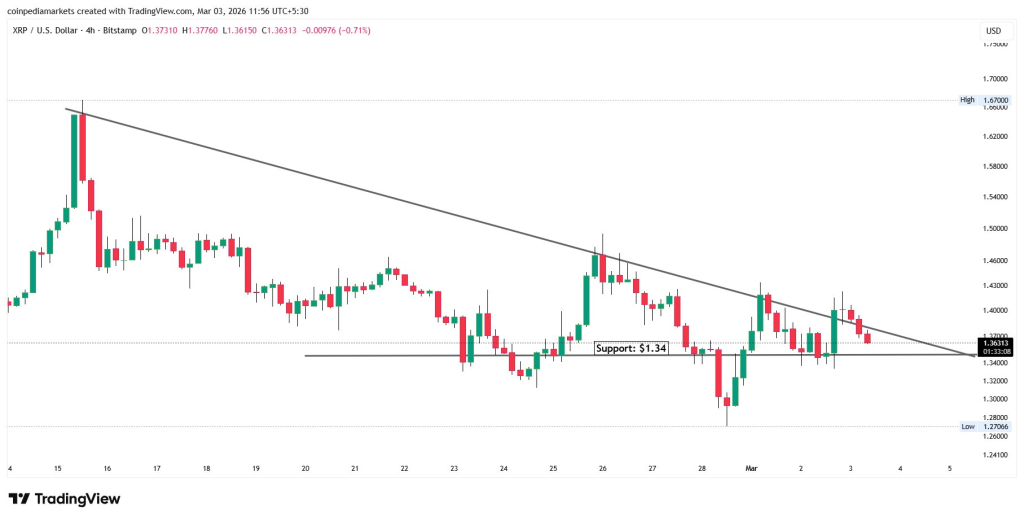
Warning Signs Flash for $XRP as $1.34 Support Gets Tested

Warning Signs Flash for $XRP as $1.34 Support Gets Tested

XRP lagged behind Bitcoin and Ethereum during yesterday’s relief bounce. In fact, BTC and ETH pushed higher over $70K and $2K respectively, but XRP only managed
Sdílet
Captainaltcoin2026/03/03 14:49
PiDex Testnet Launch: What It Means for Pi Network and Picoin Value

PiDex Testnet Launch: What It Means for Pi Network and Picoin Value

Pi Network’s decentralized exchange, PiDex, went live on the testnet, marking a significant technical milestone for the ecosystem. Despite the launch, the m
Sdílet
Hokanews2026/03/03 14:27
UK and US Seal $42 Billion Tech Pact Driving AI and Energy Future

UK and US Seal $42 Billion Tech Pact Driving AI and Energy Future

The post UK and US Seal $42 Billion Tech Pact Driving AI and Energy Future appeared on BitcoinEthereumNews.com. Key Highlights Microsoft and Google pledge billions as part of UK US tech partnership Nvidia to deploy 120,000 GPUs with British firm Nscale in Project Stargate Deal positions UK as an innovation hub rivaling global tech powers UK and US Seal $42 Billion Tech Pact Driving AI and Energy Future The UK and the US have signed a “Technological Prosperity Agreement” that paves the way for joint projects in artificial intelligence, quantum computing, and nuclear energy, according to Reuters. Donald Trump and King Charles review the guard of honour at Windsor Castle, 17 September 2025. Image: Kirsty Wigglesworth/Reuters The agreement was unveiled ahead of U.S. President Donald Trump’s second state visit to the UK, marking a historic moment in transatlantic technology cooperation. Billions Flow Into the UK Tech Sector As part of the deal, major American corporations pledged to invest $42 billion in the UK. Microsoft leads with a $30 billion investment to expand cloud and AI infrastructure, including the construction of a new supercomputer in Loughton. Nvidia will deploy 120,000 GPUs, including up to 60,000 Grace Blackwell Ultra chips—in partnership with the British company Nscale as part of Project Stargate. Google is contributing $6.8 billion to build a data center in Waltham Cross and expand DeepMind research. Other companies are joining as well. CoreWeave announced a $3.4 billion investment in data centers, while Salesforce, Scale AI, BlackRock, Oracle, and AWS confirmed additional investments ranging from hundreds of millions to several billion dollars. UK Positions Itself as a Global Innovation Hub British Prime Minister Keir Starmer said the deal could impact millions of lives across the Atlantic. He stressed that the UK aims to position itself as an investment hub with lighter regulations than the European Union. Nvidia spokesman David Hogan noted the significance of the agreement, saying it would…
Sdílet
BitcoinEthereumNews2025/09/18 02:22