WormHole is a novel algorithm designed for answering multiple shortest path queries efficiently across large-scale social and information networks. It offers sublinear query complexity, rapid setup (up to 100x faster than PLL and MLL), and strong accuracy guarantees. By storing exact paths on a small “core” subset of vertices, WormHole achieves both theoretical soundness and exceptional empirical performance—even on billion-edge graphs—making it a breakthrough in scalable network analysis.WormHole is a novel algorithm designed for answering multiple shortest path queries efficiently across large-scale social and information networks. It offers sublinear query complexity, rapid setup (up to 100x faster than PLL and MLL), and strong accuracy guarantees. By storing exact paths on a small “core” subset of vertices, WormHole achieves both theoretical soundness and exceptional empirical performance—even on billion-edge graphs—making it a breakthrough in scalable network analysis.

How WormHole Speeds Up Pathfinding in Billion-Edge Graphs

Abstract and 1. Introduction

1.1 Our Contribution

1.2 Setting

1.3 The algorithm

  1. Related Work

  2. Algorithm

    3.1 The Structural Decomposition Phase

    3.2 The Routing Phase

    3.3 Variants of WormHole

  3. Theoretical Analysis

    4.1 Preliminaries

    4.2 Sublinearity of Inner Ring

    4.3 Approximation Error

    4.4 Query Complexity

  4. Experimental Results

    5.1 WormHole𝐸, WormHole𝐻 and BiBFS

    5.2 Comparison with index-based methods

    5.3 WormHole as a primitive: WormHole𝑀

References

1.1 Our Contribution

We design a new algorithm, WormHole, that creates a data structure allowing us to answer multiple shortest path inquiries by exploiting the typical structure of many social and information networks. WormHole is simple, easy to implement, and theoretically backed. We provide several variants of it, each suitable for a different setting, showing excellent empirical results on a variety of network datasets. Below are some of its key features:

\ • Performance-accuracy tradeoff. To the best of our knowledge, ours is the first approximate sublinear shortest paths algorithm in large networks. The fact that we allow small additive error, gives rise to a trade-off between preprocessing time/space and per-inquiry time, and allows us to come

\ Figure 2: (a) a comparison of the footprint in terms of disk space for different methods. The indexing based methods did not terminate on graphs larger than these.For WormHole, we consider the sum of Cin and Cout binary files. Note that PLL here is the distance algorithm, solving a weaker problem. The red bar “Input" is the size of the
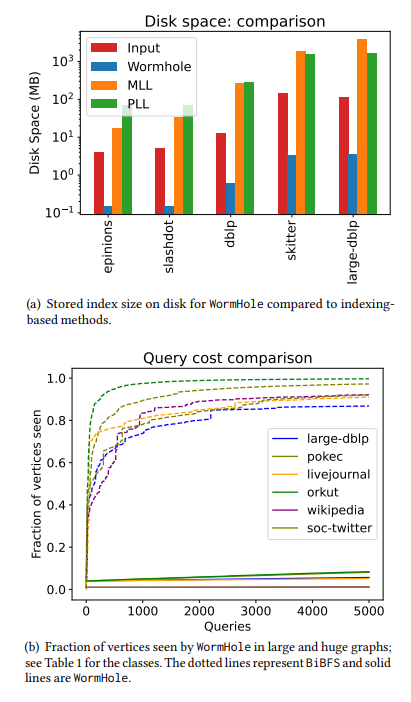
\ up with a solution with efficient preprocessing and fast perinquiry time. Notably, our most accurate (but slowest) variant, WormHole𝐸, has near-perfect accuracy: more than 90% of the inquiries are answered with no additive error, and in all networks, more than 99% of the inquiries are answered with additive error at most 2. See Table 3 for more details.

\ • Extremely rapid setup time. Our longest index construction time was just two minutes even for billion-edged graphs. For context, PLL and MLL timed out on half of the networks that we tested, and for moderately sized graphs where PLL and MLL did finish their runs, WormHole index construction was×100 faster. Namely, WormHole finished in seconds while PLL took hours. See Table 4 and Table 5. This rapid setup time is achieved due to the use of a sublinearly-sized index. For the largest networks we considered, it is sufficient to take an index of about 1% of the nodes to get small mean additive error – see Table 1. For smaller networks, it may be up to 6%.

\ • Fast inquiry time. Compared to BiBFS, the vanilla version WormHole𝐸 (without any index-based optimizations) is ×2 faster for almost all graphs and more than ×4 faster on the three largest graphs that we tested. A simple variant WormHole𝐻 achieves an order of magnitude improvement at some cost to accuracy: consistently 20× faster across almost all graphs, and more than 180× for the largest graph we have. See Table 3 for a full comparison. Indexing based methods typically answer inquiries in microseconds; both of the aforementioned variants are still in the millisecond regime.

\ • Combining WormHole and the state of the art. WormHole works by storing a small subset of vertices on which we compute the exact shortest paths. For arbitrary inquiries, we route our path through this subset, which we call the core. We use this insight to provide a third variant, WormHole𝑀 by implementing the state of the art for shortest paths, MLL, on the core. This achieves inquiry times that are comparable to MLL (with the same accuracy guarantee as WormHole𝐻 ) at a fraction of the setup cost, and runs for massive graphs where MLL does not terminate. We explore this combined approach in §5.3, and provide statistics in Table 6.

\ • Sublinear query complexity. The query complexity refers to the number of vertices queried by the algorithm. In a limited query access model where querying a node reveals its list of neighbors(see §1.2), the query complexity of our algorithm scales very well with the number of distance / shortest path inquiries made. To answer 5000 approximate shortest path inquiries, our algorithm only observes between 1% and 20% of the nodes for most networks. In comparison, BiBFS sees more than 90%of the graph to answer a few hundred shortest path inquiries. See Figure 2 and Figure 5 for a comparison.

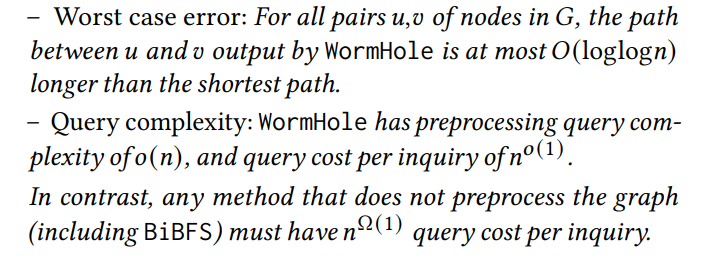
\ • Provable guarantees on error and performance. In §4 we prove a suite of theoretical results complementing and explaining the empirical performance. The results, stated informally below, are proved for the Chung-Lu model of random graphs with a power-law degree distribution [15–17].

\ Theorem 1.1 (Informal). In a Chung-Lu random graph𝐺 with power-law exponent 𝛽 ∈ (2,3) on 𝑛 vertices, WormHole has the following guarantees with high probability:

\
\

:::info Authors:

(1) Talya Eden, Bar-Ilan University (talyaa01@gmail.com);

(2) Omri Ben-Eliezer, MIT (omrib@mit.edu);

(3) C. Seshadhri, UC Santa Cruz (sesh@ucsc.edu).

:::


:::info This paper is available on arxiv under CC BY 4.0 license.

:::

\

Piyasa Fırsatı
Edge Logosu
Edge Fiyatı(EDGE)
$0.12672
$0.12672$0.12672
-3.27%
USD
Edge (EDGE) Canlı Fiyat Grafiği
Sorumluluk Reddi: Bu sitede yeniden yayınlanan makaleler, halka açık platformlardan alınmıştır ve yalnızca bilgilendirme amaçlıdır. MEXC'nin görüşlerini yansıtmayabilir. Tüm hakları telif sahiplerine aittir. Herhangi bir içeriğin üçüncü taraf haklarını ihlal ettiğini düşünüyorsanız, kaldırılması için lütfen service@support.mexc.com ile iletişime geçin. MEXC, içeriğin doğruluğu, eksiksizliği veya güncelliği konusunda hiçbir garanti vermez ve sağlanan bilgilere dayalı olarak alınan herhangi bir eylemden sorumlu değildir. İçerik, finansal, yasal veya diğer profesyonel tavsiye niteliğinde değildir ve MEXC tarafından bir tavsiye veya onay olarak değerlendirilmemelidir.

Ayrıca Şunları da Beğenebilirsiniz

Bitcoin Has Taken Gold’s Role In Today’s World, Eric Trump Says

Bitcoin Has Taken Gold’s Role In Today’s World, Eric Trump Says

Eric Trump on Tuesday described Bitcoin as a “modern-day gold,” calling it a liquid store of value that can act as a hedge to real estate and other assets. Related Reading: XRP’s Biggest Rally Yet? Analyst Projects $20+ In October 2025 According to reports, the remark came during a TV appearance on CNBC’s Squawk Box, tied to the launch of American Bitcoin, the mining and treasury firm he helped start. Company Holdings And Strategy Based on public filings and company summaries, American Bitcoin has accumulated 2,443 BTC on its balance sheet. That stash has been valued in the low hundreds of millions of dollars at recent spot prices. The firm mixes large-scale mining with the goal of holding Bitcoin as a strategic reserve, which it says will help it grow both production and asset holdings over time. Eric Trump’s comments were direct. He told viewers that institutions are treating Bitcoin more like a store of value than a fringe idea, and he warned firms that resist blockchain adoption. The tone was strong at times, and the line about Bitcoin being a modern equivalent of gold was used to frame American Bitcoin’s role as both miner and holder.   Eric Trump has said: bitcoin is modern-day gold — unusual_whales (@unusual_whales) September 16, 2025 How The Company Went Public American Bitcoin moved toward a public listing via an all-stock merger with Gryphon Digital Mining earlier this year, a deal that kept most of the original shareholders in control and positioned the new entity for a Nasdaq debut. Reports show that mining partner Hut 8 holds a large ownership stake, leaving the Trump family and other backers with a minority share. The listing brought fresh attention and capital to the firm as it began trading under the ticker ABTC. Market watchers say the firm’s public debut highlights two trends: mining companies are trying to grow by both producing and holding Bitcoin, and political ties are bringing more headlines to crypto firms. Some analysts point out that holding large amounts of Bitcoin on the balance sheet exposes a company to price swings, while supporters argue it aligns incentives between miners and investors. Related Reading: Ethereum Bulls Target $8,500 With Big Money Backing The Move – Details Reaction And Possible Risks Based on coverage of the launch, investors have reacted with both enthusiasm and caution. Supporters praise the prospect of a US-based miner that aims to be transparent and aggressive about building a reserve. Critics point to governance questions, possible conflicts tied to high-profile backers, and the usual risks of a volatile asset being held on corporate balance sheets. Eric Trump’s remark that Bitcoin has taken gold’s role in today’s world reflects both his belief in its value and American Bitcoin’s strategy of mining and holding. Whether that view sticks will depend on how investors and institutions respond in the months ahead. Featured image from Meta, chart from TradingView
Paylaş
NewsBTC2025/09/18 06:00
Tether CEO: AI Bubble Poses Biggest Risk to Bitcoin in 2026

Tether CEO: AI Bubble Poses Biggest Risk to Bitcoin in 2026

Tether CEO Paolo Ardoino has identified a potential AI-driven bubble as Bitcoin's biggest risk heading into 2026. However, he does not anticipate the same sharp corrections seen in previous market cycles, citing growing institutional adoption as a stabilizing force.
Paylaş
MEXC NEWS2025/12/19 16:05
Bearish Sentiment Spikes as Bitcoin Drops to $84.8K, Creating Potential Contrarian Signal

Bearish Sentiment Spikes as Bitcoin Drops to $84.8K, Creating Potential Contrarian Signal

Bearish sentiment is surging across social media platforms following Bitcoin's pullback to $84,800, according to blockchain analytics firm Santiment. Retail investors are pushing fearful narratives harder than bullish outlooks, creating a notable shift in market mood.
Paylaş
MEXC NEWS2025/12/19 15:56