Beyond BlackCat and Conti: Why the 888 Group Represents the New Era of Infrastructure Extortion
Can you recover from a breach if your systems stay online, but your source code is for sale? In 2025, data-only extortion incidents surged 11x as attackers shifted from locking systems to brokering proprietary data. While traditional ransomware focused on downtime, the “exfiltrate and auction” model used by the 888 group creates more permanent damage.
By stealing API credentials and network maps, these actors turn your internal infrastructure into a tradable asset. Simply restoring from backups won’t stop a data auction.
Key takeaways:
- Infrastructure extortion, led by the 888 group, is replacing “loud” ransomware, with data-only incidents surging 11x in 2025 by focusing on silent theft of technical blueprints.
- Critical infrastructure is heavily targeted, accounting for 50% of all global ransomware incidents in 2025, with manufacturing attacks seeing a 61% surge.
- The theft of Infrastructure-as-Code (IaC) files creates permanent confidentiality loss, unlike temporary lockouts, offering attackers a complete network map.
- The ESA breach of 700+ GB demonstrated a forensic failure, where an initial 888 exfiltration led to a second, successful attack by the Scattered Lapsus$ Hunters supergroup.
How Did Ransomware Giants Like Conti and BlackCat Set the Stage for Today’s Extortion?
To understand today’s shift toward infrastructure extortion, we must look at the giants who built the playbook. Groups like Conti and BlackCat weren’t just malware developers; they were global criminal enterprises that pioneered psychological pressure to maximize payouts.
The Conti Model: Orchestrated Paralysis
By 2021, Conti mastered the “lock-and-key” strategy. Their premise was simple: for critical sectors like healthcare, the cost of downtime is far more painful than the price of a ransom.
- The 2021 HSE Attack: Conti’s most infamous hit paralyzed the Irish National Health Service, forcing hospitals back to paper and pen.
- Double Extortion: They set the industry standard by stealing data before encrypting it, ensuring that even victims with perfect backups faced the threat of a massive data leak.
Conti’s Profile: Operated like a corporation, generating over $150 million in payouts from 1,000+ victims before geopolitics and internal leaks led to their decline.
BlackCat (ALPHV): The Technical Evolution
Emerging from the Conti fragmentations, BlackCat introduced a more sophisticated, professionalized RaaS platform.
- Rust Programming: Unlike predecessors using C++, BlackCat used Rust for its performance and its ability to evade reverse-engineering by security researchers.
- Triple Extortion: They didn’t stop at encryption and leaks. BlackCat added a third layer—DDoS attacks—to pummel a victim’s public infrastructure, cornering organizations from every possible angle.
RaaS Evolution: Conti vs. BlackCat
| Feature | Conti (Legacy) | BlackCat (ALPHV) |
| Language | C++ | Rust (Performance/Evasion focus) |
| Extortion | Double (Encryption + Leak) | Triple (Encryption + Leak + DDoS) |
| Affiliate Model | Standard Corporate Structure | High-tier, Professionalized Platform |
| Primary Targets | Healthcare & Government | High-Revenue Infrastructure |
The Death of “Loud” Attacks
Despite their success, both groups shared a fatal flaw: encryption is noisy. Mass file renaming and high CPU spikes are now easily caught by modern Endpoint Detection and Response (EDR) solutions.
As organizations move toward Zero Trust, the window for loud, encryption-heavy attacks is closing. This has paved the way for “silent” exfiltration-only groups like 888, who prioritize data theft over system paralysis to remain undetected.
Who is the 888 Group, and How Did They Become the New Data Broker Standard?
The 888 group represents a fundamental shift in cybercrime. Moving away from the complex engineering required for stable encryption, 888 operates as a high-end data and compromise broker. Their business model prioritizes the “silent” theft and auctioning of technical intellectual property over the public paralysis of systems.
The IntelBroker Nexus
The group’s success is deeply tied to the threat actor IntelBroker (identified as Kai Logan West). 888 is a prominent member of “CyberNiggers,” a racially branded hacking collective led by IntelBroker that specialized in siphoning massive data volumes from misconfigured cloud infrastructure and API endpoints. Together, they leveraged BreachForums to transform stolen data into a competitive auction market.
Milestone Timeline: The 888 Expansion
| Date | Target | Impact / Context |
| May 2024 | Decathlon | Exfiltration of sensitive retail data. |
| July 2024 | Shopify | Auctioned a database of 180,000 users for Monero. |
| Aug 2024 | BreachForums | IntelBroker takes ownership, streamlining 888’s auction model. |
| Late 2025 | Samsung / LG | Listed source code from South Korean industrial giants. |
| Dec 2025 | ESA | Exfiltrated 200 GB of engineering and satellite telemetry. |
Tactical Modus Operandi: Silent Infiltration
888’s hallmark is the total avoidance of “noisy” malware that triggers EDR alerts. Their attacks are fast, often concluding in minutes rather than weeks.
- Credential Hijacking: They bypass initial defenses by using legitimate credentials purchased from Initial Access Brokers (IABs) or harvested from infostealer logs.
- Cloud & API Focus: Instead of pivoting through local networks, they target collaborative platforms like Jira and Bitbucket, or misconfigured AWS S3/Azure Blob storage.
- Living off the Land: To exfiltrate data, they use standard IT utilities like RClone or Azure Copy. Because these tools are used by actual admins for backups, the theft blends perfectly into normal network traffic.
- The Auction Model: Rather than a private ransom note, 888 posts public listings. This creates a bidding war, ensuring monetization even if the victim refuses to negotiate.
The 2026 Shift: Pure exfiltration is the new “Gold Standard.” It is harder to detect, faster to execute, and avoids the “noisy” signatures of mass file encryption.
What Was the Catastrophic Lesson of the Dual ESA Breaches?
The dual strikes on the European Space Agency (ESA) in late 2025 and early 2026 serve as a grim blueprint for the “888 paradigm.” This wasn’t just a data leak; it was a multi-stage dismantling of infrastructure security that exposed the cumulative danger of persistent “digital insiders.”
Strike One: The 888 Group’s 200 GB Exfiltration
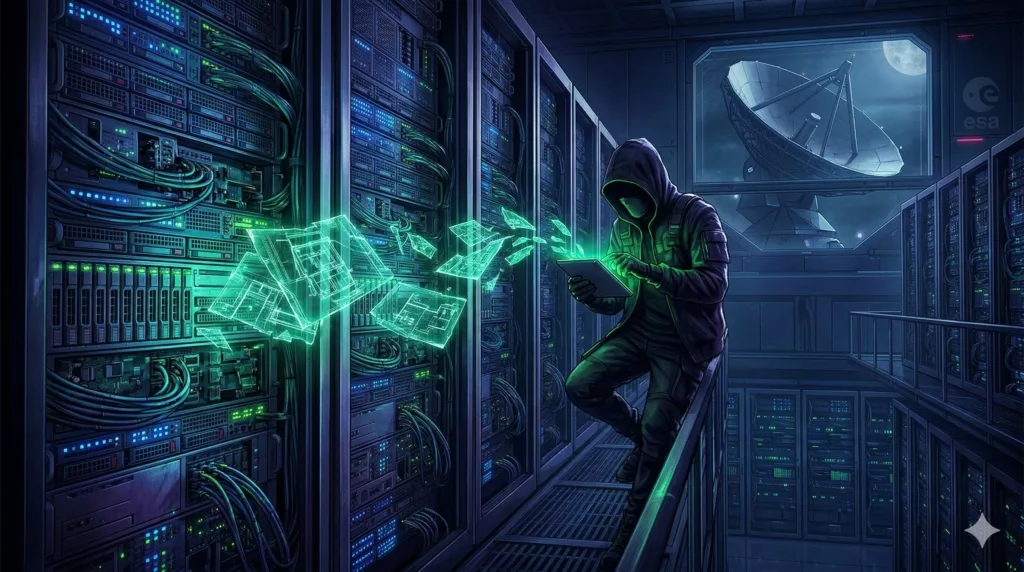
On December 26, 2025, the threat actor 888 auctioned 200 GB of data stolen from ESA’s collaborative engineering servers. While ESA initially downplayed the “unclassified” nature of the servers, the stolen material was functionally devastating. By targeting Bitbucket repositories and CI/CD pipelines, 888 didn’t just take files—they took the “blueprints” to ESA’s cloud network.
Strike Two: The Scattered Lapsus$ Hunters
Less than two weeks later, before ESA could fully remediate the first hole, a “supergroup” called the Scattered Lapsus$ Hunters (an alliance of Scattered Spider, Lapsus$, and ShinyHunters) struck again. They exfiltrated an additional 500 GB of mission-critical data by exploiting the unpatched vulnerabilities left behind by 888.
The Cumulative Impact: 700+ GB Compromised
| Asset Category | Stolen Data & Impact | Security Risk |
| Cloud Topology | Terraform & Ansible IaC files. | Full visibility into ESA’s network “map.” |
| DevOps Secrets | Hardcoded API tokens & Jenkins configs. | “Skeleton keys” for lateral movement. |
| Mission Specs | Satellite hardware schematics. | Weaponization of spacecraft telemetry. |
| Partner IP | Data from SpaceX, Airbus, & Thales. | Massive third-party supply chain liability. |
The Forensic Failure
The ESA disaster highlights a catastrophic gap in traditional incident response. By focusing on the forensics of the first event rather than the immediate hardening of the underlying infrastructure, ESA allowed a second predator to walk through an open door.
The 2026 Lesson: In an age of infrastructure extortion, a breach is rarely a “one-and-done” event. One group steals the keys; the next group moves in. If your remediation doesn’t include a total reset of Infrastructure-as-Code (IaC) and secrets, you are merely waiting for the second strike.
Why is “Unclassified” Information More Dangerous Than a System Lockout?
A recurring theme in the 888 group’s exploits is their focus on data officially labeled as “unclassified.” This term often creates a dangerous complacency in corporate security. However, in the world of infrastructure extortion, the silent theft of technical documentation is far more damaging than a temporary system lockout.
Why IaC Files are the Ultimate Prize
Traditional ransomware hits availability: pay the fee, get the key, and you’re back in business. But the theft of Infrastructure-as-Code (IaC) files (like the Terraform and Ansible data stolen from ESA) creates a permanent loss of confidentiality and integrity.
- The Blueprint Effect: Terraform files aren’t just docs; they are the literal blueprints of your cloud. They reveal internal IP addresses, administrative ports, and encryption parameters.
- The “No-Guess” Attack: With these files, an attacker doesn’t have to guess where your firewall is weak—they have the map. This allows for future “silent” strikes that bypass perimeters entirely.
Tactical Value of Stolen Technical Assets
| File Type | Value to Adversary | Damage Profile vs. Lockout |
| Terraform Files | Maps the entire cloud architecture. | Permanent. Bypasses future defenses. |
| API Tokens | Persistent “skeleton keys.” | Persistent. Enables lateral movement. |
| Source Code | Discovering zero-day vulnerabilities. | Strategic. Advantage for competitors/nations. |
| CI/CD Configs | Identifying build-process weaknesses. | Long-tail. Enables future supply chain poisoning. |
The “Silent Buyer” and the Nation-State Risk
When your system is locked, you know who did it. When your data is auctioned by 888, you never know who bought it. In 2026, there is a high probability that “unclassified” satellite telemetry and command structures aren’t being bought by petty criminals, but by nation-state APT groups.
For a state actor, this is “Zero-Day Intelligence.” It allows them to understand how to disrupt Earth observation systems or satellite command structures without firing a shot. This damage cannot be “fixed” with a patch; once your operational parameters are in an adversary’s hands, the strategic advantage of your system is compromised forever.
The 2026 Insight: Ransomware is a headache; infrastructure extortion is a terminal diagnosis. You can recover data from a backup, but you can’t “un-leak” your network’s DNA.
What Happens When Threat Actors Merge Into a “Supergroup”?
The secondary strike on the ESA marks the arrival of a dangerous new adversary: the “supergroup.” In 2025, three of the most lethal threat entities—Scattered Spider, Lapsus$, and ShinyHunters—merged their expertise into an integrated, multi-phase umbrella.
Tactical Synergy of the Alliance
This “situational alliance” creates a collective that traditional security operations find almost impossible to stop. By combining their strengths, they can execute complex, high-speed strikes that overwhelm incident responders.
- Scattered Spider (The Breachers): Masters of “vishing” (voice phishing) and SIM swapping. They manipulate IT help desks to bypass MFA and gain initial entry.
- Lapsus$ (The Extorters): Experts in insider recruitment and source code theft. They use public Telegram channels to amplify reputational damage and pressure victims.
- ShinyHunters (The Brokers): Specialists in large-scale data harvesting and managing massive auction platforms to monetize stolen assets.
Supergroup Contribution to the ESA Strike
| Branch | Core Competency | Role in ESA Attack |
| Scattered Spider | Identity abuse & MFA bypass. | Initial compromise of unpatched systems. |
| Lapsus$ | Source code & IP theft. | Exfiltration of partner data (e.g., SpaceX). |
| ShinyHunters | Large-scale data brokerage. | Monetization of 500 GB of mission docs. |
“The Com” and AI-Driven Vishing
The rise of the supergroup is fueled by a subculture known as “The Com.” This loosely federated community of hackers shares advanced social engineering techniques, but their most significant 2026 leap is the integration of AI-driven voice agents.
These AI models automate realistic “vishing” calls at a massive scale. They can mimic regional accents and adapt to a victim’s responses in real-time, making them far more deceptive than traditional phishing. By leveraging these agents, the Scattered Lapsus$ Hunters have successfully compromised major platforms like Okta and GitHub with minimal human effort.
The 2026 Warning: When hackers stop acting like lone wolves and start acting like a unified corporate entity, your defense must be equally integrated. A “forensic-only” response to one breach is an invitation for the next member of the supergroup to strike.
Which Critical Sectors Are Most Vulnerable to the New Era of Extortion?
The 888 group and its allies are at the forefront of a surge in extortion attacks targeting national resilience. In 2025, 50% of all global ransomware incidents targeted critical infrastructure—a staggering 34% year-over-year increase.
The Vulnerability of Manufacturing and Energy
Manufacturing is the primary target, with attacks surging by 61%. High-profile breaches at Jaguar Land Rover and Bridgestone proved that even brief shutdowns can cause hundreds of millions in losses.
In these sectors, exfiltration is used as “strategic leverage.” By stealing blueprints for production lines or schematics for electrical systems, attackers don’t just paralyze a factory; they threaten the company’s entire competitive future.
Critical Sector Threat Matrix (2025)
| Sector | Attack Growth | Top Threat Actors | Impact Profile |
| Manufacturing | +61% | Qilin, Clop, SafePay | Supply chain paralysis. |
| Healthcare | High Impact | RansomHub, Akira | System closures & patient risk. |
| Energy | Escalating | Play, 888 Group | OT targeting & blueprint theft. |
| Technology | Sustained | 888, Scattered Lapsus$ | Source code & IP theft. |
Supply Chain Weaponization: The Insightsoftware Precedent
888’s attack on Insightsoftware highlights the “second-order” risk of infrastructure extortion. By stealing the source code for the “Atlas” reporting solution and its private keys, 888 created a massive supply chain vulnerability affecting every enterprise using the software for financial reporting in Microsoft Dynamics.
Adversaries who purchase this data can monitor business logic and financial workflows across thousands of customer environments. This isn’t just a breach; it’s a portal for systemic financial fraud, with potential losses ranging from $5M to $50M per enterprise.
The 2026 Insight: When a vendor is hit, it’s not their data you should worry about—it’s the private keys and source code that give hackers a permanent “backdoor” into your own financial systems.
What Defensive Strategies Go Beyond Just a Decryption Key?
The ESA’s failure to prevent a second strike proves that “recovery-centric” playbooks are obsolete. When hackers stop encrypting files and start quietly stealing blueprints, your old disaster recovery plan won’t save you. You need to shift from recovery to exfiltration-centric resilience.
The Forensic Blind Spot
In 2026, the biggest threat is the “forensic expiration” problem. Because groups like 888 often steal data months before announcing an auction, the logs needed to investigate the breach have usually aged out. Without a “loud” encryption event to trigger alarms, attackers can maintain persistence for weeks, siphoning data at a slow, administrative pace that blends into normal traffic.
Essential Mitigations for Infrastructure Extortion
| Strategic Shift | Actionable 2026 Defense | Objective |
| Identity Hardening | Move to FIDO2 hardware keys; verify help desk callers. | Stop AI-vishing & MFA bypass. |
| Data Protection | Deploy Data Exfiltration Protection (DEP) tools. | Proactively block unauthorized egress. |
| IaC Hygiene | Purge hardcoded keys; use dynamic tokens. | Protect the “blueprints” of your cloud. |
| Intelligence | Real-time Dark Web & Telegram monitoring. | Find the breach before the auction starts. |
Protecting the “Digital DNA”
Traditional EDR is great at stopping malware but weak at stopping data theft. To counter “silent” actors, organizations must treat Infrastructure-as-Code (IaC) and CI/CD secrets as their most sensitive assets.
The 2026 Mandate: In the auction era, the first sign of a breach shouldn’t be a public post on BreachForums. If you aren’t monitoring data movement and dark web chatter, you aren’t defending—you’re just waiting for the invoice.
Conclusion: The Permanent Threat of Digital Blueprints
The rise of professional cybercrime groups like the 888 group and Scattered Lapsus$ Hunters marks a major shift in digital threats. These groups no longer just disrupt services for attention. Instead, they silently steal engineering and operational data. This data is the new ultimate commodity in the world of cybercrime.
Stealing “unclassified” information like cloud blueprints or satellite mission procedures gives hackers long-term control. They aren’t just causing temporary downtime; they are taking away years of strategic security. Protecting our infrastructure now means more than just keeping systems running. It means safeguarding the secrets and source code that keep those systems secure for the future.
Secure Your Data Assets
Identify your most sensitive unclassified engineering files and move them to a segmented, encrypted environment. Check our latest guide on infrastructure hardening to protect your blueprints from silent theft.
Frequently Asked Questions (FAQs)
- What is “infrastructure extortion,” and how is the 888 group changing the cyber threat landscape?
Infrastructure extortion is a shift from traditional ransomware’s focus on system downtime (encryption/lockout) to the silent theft and auctioning of technical blueprints, source code, and Infrastructure-as-Code (IaC) files. The 888 group leads this new era by prioritizing “silent” exfiltration over “noisy” encryption, turning internal infrastructure (like API credentials and network maps) into tradable assets on the dark web. - How do the tactics of the 888 group differ from those of legacy ransomware groups like Conti and BlackCat?
Traditional groups like Conti and BlackCat relied on “loud” attacks, using mass file encryption to cause system paralysis, which is often detected by modern Endpoint Detection and Response (EDR) solutions. The 888 group uses “silent” infiltration, relying on legitimate credentials (purchased from IABs) and “Living off the Land” techniques (using standard IT utilities like RClone) to siphon data slowly, blending into normal network traffic to avoid EDR detection. - Why are “unclassified” files and Infrastructure-as-Code (IaC) considered the ultimate prize for attackers like 888?
While traditional ransomware hits availability, the theft of IaC files (like Terraform and Ansible data) creates a permanent loss of confidentiality and integrity. These files are the literal blueprints of your cloud, revealing internal IP addresses, administrative ports, and encryption parameters. They give the attacker a complete “map,” enabling future “silent” strikes that bypass perimeters entirely, a problem that cannot be fixed with a simple patch or backup restore. - What were the two major strikes against the European Space Agency (ESA) that highlighted the new threat paradigm?
The ESA suffered a dual strike:- Strike One (888 Group): On December 26, 2025, 888 auctioned 200 GB of data, targeting Bitbucket repositories and CI/CD pipelines to steal network blueprints.
- Strike Two (Scattered Lapsus$ Hunters): Less than two weeks later, a “supergroup” alliance of Scattered Spider, Lapsus$, and ShinyHunters exploited the unpatched vulnerabilities left by 888 to exfiltrate an additional 500 GB of mission-critical data. The incident highlighted the danger of a forensic failure, where a remediation focused on the first event leaves the infrastructure open to a second, follow-on attack.
- What are the essential mitigations for organizations to achieve “exfiltration-centric resilience”?
To counter silent infrastructure extortion, organizations must shift from recovery to resilience with the following strategic actions:- Identity Hardening: Move to FIDO2 hardware keys and verify help desk callers to stop AI-vishing and MFA bypass.
- Data Protection: Deploy Data Exfiltration Protection (DEP) tools to proactively block unauthorized egress.
- IaC Hygiene: Purge hardcoded keys and use dynamic tokens to protect the cloud’s blueprints.
- Intelligence: Implement real-time Dark Web & Telegram monitoring to find the breach before the stolen data auction starts.
Ayrıca Şunları da Beğenebilirsiniz

Here’s How Much $100, $500, and $1,000 in Little Pepe (LILPEPE) Will Be Worth if the Price Hits $3 in 2026

Synopsys (SNPS) Stock — Elliott Investment Builds Multibillion-Dollar Stake