The advertising technology market grew from $791.95 billion in 2025 to $869.23 billion in 2026, an increase of approximately $77 billion in a single year. This The advertising technology market grew from $791.95 billion in 2025 to $869.23 billion in 2026, an increase of approximately $77 billion in a single year. This

AdTech’s 9.8% Annual Growth: From $791 Billion to $869 Billion in One Year

2026/03/08 05:21
Okuma süresi: 6 dk
Bu içerikle ilgili geri bildirim veya endişeleriniz için lütfen crypto.news@mexc.com üzerinden bizimle iletişime geçin.

The advertising technology market grew from $791.95 billion in 2025 to $869.23 billion in 2026, an increase of approximately $77 billion in a single year. This 9.8% annual growth rate, documented across reports from Grand View Research and MarketsandMarkets, represents consistent and substantial expansion in an industry that is already operating at near-trillion-dollar scale. Understanding what drives this rate of growth — and whether it is likely to be sustained — is important context for any organisation navigating the digital advertising ecosystem.

Putting 9.8% Annual Growth in Context

A 9.8% annual growth rate on a base of nearly $800 billion is a different proposition from the same percentage on a smaller market. At the scale of the global AdTech market, each percentage point of growth represents approximately $8 billion in new market value created annually. The $77 billion in incremental value added between 2025 and 2026 is comparable in magnitude to the entire marketing technology market for some mid-sized global regions.

AdTech’s 9.8% Annual Growth: From $791 Billion to $869 Billion in One Year

For context, the global software industry as a whole grows at approximately 10 to 12 percent annually, meaning AdTech is expanding at a pace broadly consistent with software sector norms — but from a base that is considerably larger than most individual software categories. This sustained growth at scale distinguishes AdTech from many mature technology markets where growth rates have moderated as markets saturate, and reflects the ongoing digital transformation of advertising budgets globally.

The Drivers Behind 9.8% Growth

The annual growth rate of the global AdTech market is not uniform across segments. Several specific drivers are contributing disproportionately to the overall expansion rate in the current period.

Programmatic advertising infrastructure continues to expand as digital advertising penetration deepens in markets where adoption was previously limited — Southeast Asia, Latin America, sub-Saharan Africa, and parts of Eastern Europe represent geographies where digital advertising ecosystems are growing rapidly, drawing investment in the technology infrastructure required to transact that advertising efficiently.

Connected television advertising represents one of the highest-growth segments within the broader AdTech market. As streaming platforms build out advertising-supported tiers and as linear television viewership continues to decline, the capital flowing into CTV AdTech infrastructure — ad servers, targeting platforms, measurement systems, and identity resolution tools adapted for the living room environment — is growing at rates significantly above the overall market average.

Retail media networks, which represent the fastest-growing new channel in digital advertising, are drawing substantial investment in specialised AdTech infrastructure. Retailers from Amazon to regional grocery chains are building advertising technology stacks to commercialise their first-party data and on-site inventory. This has created a new demand for AdTech solutions adapted to the retail context, expanding the total addressable market for AdTech providers.

What the Growth Rate Means for Platform Economics

The 9.8% growth rate has important implications for the competitive economics of the AdTech industry. At this pace of expansion, market participants who fail to grow at or above the market rate are effectively losing market share in absolute terms as well as relative ones. This creates constant pressure on established platforms to innovate, expand into new channels, and defend their core revenue streams against new entrants.

The major platform players — The Trade Desk, Google (DV360), Amazon DSP, and the major social platforms’ advertising systems — are all investing heavily in capabilities that extend their reach across channels including CTV, retail media, and digital audio. Smaller, specialised AdTech businesses are finding opportunities in the gaps between major platform capabilities, building point solutions in areas including alternative identity resolution, privacy-compliant measurement, and channel-specific optimisation.

Privacy Adaptation as a Growth Driver

Somewhat counterintuitively, the ongoing industry transition away from third-party cookies and legacy tracking methodologies is itself a driver of AdTech market growth. The requirement for advertisers, publishers, and technology providers to invest in new identity infrastructure, clean room technology, and measurement methodologies has created a sustained wave of technology expenditure that did not exist five years ago.

Privacy-enhancing technology for advertising — tools that enable effective targeting and measurement within privacy-preserving frameworks — has become a significant and growing segment of the overall AdTech market. The investment flowing into this category from both established providers and new entrants represents genuinely new market value that is contributing to the 9.8% annual growth figure. This dynamic mirrors what has been observed in the broader MarTech market, where regulatory and privacy pressures have driven investment rather than contraction.

AI-Driven Optimisation and Infrastructure Investment

Artificial intelligence and machine learning capabilities have become central to AdTech platform competition. Bidding algorithms, audience segmentation, creative optimisation, and fraud detection are all areas where AI capabilities are being deployed at scale, and the investment required to develop and maintain these capabilities is significant. The integration of large language models into advertising workflows — for creative generation, audience insight synthesis, and campaign strategy development — is adding a new layer of technology investment that is contributing to overall market growth.

The AI layer of AdTech investment represents a structural shift in the cost base of operating competitive advertising technology, as the computational requirements of AI-powered systems are substantially greater than those of rule-based predecessors. This has driven investment in AI infrastructure across both major platforms and specialised providers, adding to the total technology expenditure reflected in the overall AdTech market figure.

The Compound Effect: Small Percentages, Large Absolutes

One of the most important characteristics of a market growing at 9.8% on a base of nearly $800 billion is the compound effect of sustained growth at this rate. If the AdTech market maintains growth around this level, it will approach $1 trillion before 2028 and will cross $1.26 trillion by 2030, as projected in analyst forecasts. The longer-term trajectory toward $3.23 trillion by 2034 reflects compound growth at somewhat higher rates driven by deeper AI integration, global digital advertising penetration, and the expansion of programmatic advertising into currently underserved channels and geographies.

The current $869 billion scale of the global AdTech market is the cumulative result of more than a decade of sustained growth, and the 9.8% annual rate maintained from 2025 to 2026 suggests the underlying growth drivers remain intact. For technology investors, advertisers, publishers, and platform businesses, understanding this growth trajectory — its drivers, its sustainability, and its implications for competitive positioning — is essential to navigating the AdTech landscape effectively.
Comments
Piyasa Fırsatı
NEAR Logosu
NEAR Fiyatı(NEAR)
$1.2309
$1.2309$1.2309
+1.34%
USD
NEAR (NEAR) Canlı Fiyat Grafiği
Sorumluluk Reddi: Bu sitede yeniden yayınlanan makaleler, halka açık platformlardan alınmıştır ve yalnızca bilgilendirme amaçlıdır. MEXC'nin görüşlerini yansıtmayabilir. Tüm hakları telif sahiplerine aittir. Herhangi bir içeriğin üçüncü taraf haklarını ihlal ettiğini düşünüyorsanız, kaldırılması için lütfen crypto.news@mexc.com ile iletişime geçin. MEXC, içeriğin doğruluğu, eksiksizliği veya güncelliği konusunda hiçbir garanti vermez ve sağlanan bilgilere dayalı olarak alınan herhangi bir eylemden sorumlu değildir. İçerik, finansal, yasal veya diğer profesyonel tavsiye niteliğinde değildir ve MEXC tarafından bir tavsiye veya onay olarak değerlendirilmemelidir.

Ayrıca Şunları da Beğenebilirsiniz

Crucial ETH Unstaking Period: Vitalik Buterin’s Unwavering Defense for Network Security

Crucial ETH Unstaking Period: Vitalik Buterin’s Unwavering Defense for Network Security

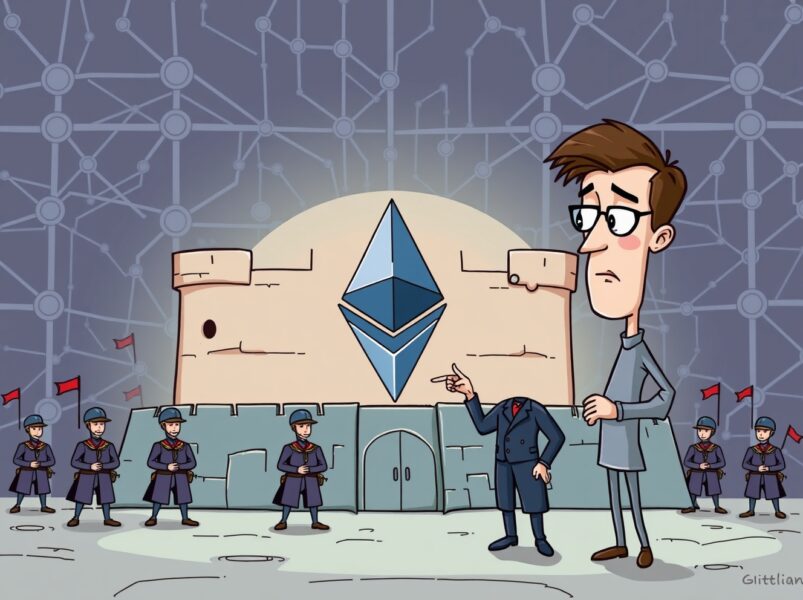
BitcoinWorld Crucial ETH Unstaking Period: Vitalik Buterin’s Unwavering Defense for Network Security Ever wondered why withdrawing your staked Ethereum (ETH) isn’t an instant process? It’s a question that often sparks debate within the crypto community. Ethereum founder Vitalik Buterin recently stepped forward to defend the network’s approximately 45-day ETH unstaking period, asserting its crucial role in safeguarding the network’s integrity. This lengthy waiting time, while sometimes seen as an inconvenience, is a deliberate design choice with profound implications for security. Why is the ETH Unstaking Period a Vital Security Measure? Vitalik Buterin’s defense comes amidst comparisons to other networks, like Solana, which boast significantly shorter unstaking times. He drew a compelling parallel to military operations, explaining that an army cannot function effectively if its soldiers can simply abandon their posts at a moment’s notice. Similarly, a blockchain network requires a stable and committed validator set to maintain its security. The current ETH unstaking period isn’t merely an arbitrary delay. It acts as a critical buffer, providing the network with sufficient time to detect and respond to potential malicious activities. If validators could instantly exit, it would open doors for sophisticated attacks, jeopardizing the entire system. Currently, Ethereum boasts over one million active validators, collectively staking approximately 35.6 million ETH, representing about 30% of the total supply. This massive commitment underpins the network’s robust security model, and the unstaking period helps preserve this stability. Network Security: Ethereum’s Paramount Concern A shorter ETH unstaking period might seem appealing for liquidity, but it introduces significant risks. Imagine a scenario where a large number of validators, potentially colluding, could quickly withdraw their stake after committing a malicious act. Without a substantial delay, the network would have limited time to penalize them or mitigate the damage. This “exit queue” mechanism is designed to prevent sudden validator exodus, which could lead to: Reduced decentralization: A rapid drop in active validators could concentrate power among fewer participants. Increased vulnerability to attacks: A smaller, less stable validator set is easier to compromise. Network instability: Frequent and unpredictable changes in validator numbers can lead to performance issues and consensus failures. Therefore, the extended period is not a bug; it’s a feature. It’s a calculated trade-off between immediate liquidity for stakers and the foundational security of the entire Ethereum ecosystem. Ethereum vs. Solana: Different Approaches to Unstaking When discussing the ETH unstaking period, many point to networks like Solana, which offers a much quicker two-day unstaking process. While this might seem like an advantage for stakers seeking rapid access to their funds, it reflects fundamental differences in network architecture and security philosophies. Solana’s design prioritizes speed and immediate liquidity, often relying on different consensus mechanisms and validator economics to manage security risks. Ethereum, on the other hand, with its proof-of-stake evolution from proof-of-work, has adopted a more cautious approach to ensure its transition and long-term stability are uncompromised. Each network makes design choices based on its unique goals and threat models. Ethereum’s substantial value and its role as a foundational layer for countless dApps necessitate an extremely robust security posture, making the current unstaking duration a deliberate and necessary component. What Does the ETH Unstaking Period Mean for Stakers? For individuals and institutions staking ETH, understanding the ETH unstaking period is crucial for managing expectations and investment strategies. It means that while staking offers attractive rewards, it also comes with a commitment to the network’s long-term health. Here are key considerations for stakers: Liquidity Planning: Stakers should view their staked ETH as a longer-term commitment, not immediately liquid capital. Risk Management: The delay inherently reduces the ability to react quickly to market volatility with staked assets. Network Contribution: By participating, stakers contribute directly to the security and decentralization of Ethereum, reinforcing its value proposition. While the current waiting period may not be “optimal” in every sense, as Buterin acknowledged, simply shortening it without addressing the underlying security implications would be a dangerous gamble for the network’s reliability. In conclusion, Vitalik Buterin’s defense of the lengthy ETH unstaking period underscores a fundamental principle: network security cannot be compromised for the sake of convenience. It is a vital mechanism that protects Ethereum’s integrity, ensuring its stability and trustworthiness as a leading blockchain platform. This deliberate design choice, while requiring patience from stakers, ultimately fortifies the entire ecosystem against potential threats, paving the way for a more secure and reliable decentralized future. Frequently Asked Questions (FAQs) Q1: What is the main reason for Ethereum’s long unstaking period? A1: The primary reason is network security. A lengthy ETH unstaking period prevents malicious actors from quickly withdrawing their stake after an attack, giving the network time to detect and penalize them, thus maintaining stability and integrity. Q2: How long is the current ETH unstaking period? A2: The current ETH unstaking period is approximately 45 days. This duration can fluctuate based on network conditions and the number of validators in the exit queue. Q3: How does Ethereum’s unstaking period compare to other blockchains? A3: Ethereum’s unstaking period is notably longer than some other networks, such as Solana, which has a two-day period. This difference reflects varying network architectures and security priorities. Q4: Does the unstaking period affect ETH stakers? A4: Yes, it means stakers need to plan their liquidity carefully, as their staked ETH is not immediately accessible. It encourages a longer-term commitment to the network, aligning staker interests with Ethereum’s stability. Q5: Could the ETH unstaking period be shortened in the future? A5: While Vitalik Buterin acknowledged the current period might not be “optimal,” any significant shortening would likely require extensive research and network upgrades to ensure security isn’t compromised. For now, the focus remains on maintaining robust network defenses. Found this article insightful? Share it with your friends and fellow crypto enthusiasts on social media to spread awareness about the critical role of the ETH unstaking period in Ethereum’s security! To learn more about the latest Ethereum trends, explore our article on key developments shaping Ethereum’s institutional adoption. This post Crucial ETH Unstaking Period: Vitalik Buterin’s Unwavering Defense for Network Security first appeared on BitcoinWorld.
Paylaş
Coinstats2025/09/18 15:30
White House adviser: Cryptocurrency bill is "very close" to passage

White House adviser: Cryptocurrency bill is "very close" to passage

PANews reported on June 18 that according to Jinshi, a US White House adviser said that the cryptocurrency bill is "very close" to passage, which will create demand for the
Paylaş
PANews2025/06/18 23:52
SEC approves Grayscale’s multi-crypto fund with XRP, SOL and ADA

SEC approves Grayscale’s multi-crypto fund with XRP, SOL and ADA

GDLC's approval coincides with SEC adopting generic listing standards for crypto ETFs, which would expedite the launch process.
Paylaş
Coinstats2025/09/18 10:26