

‘This System Wasn’t Built For Me’: Black Founders Became Investors To Change Venture Capital
Editor’s note: This article is the second in a three-part series on the state of venture investment to Black-founded startups in 2026. Driving these reports is data from Crunchbase’s Diversity Spotlight feature, which offers insight into diversity in startups’ and investment firms’ leadership teams. Read Part 1, exploring the data on funding to Black founders, here. Part 3 will be published next week.
Only around $942 million — or just 0.32% of total U.S. venture funding — went to startups with a Black founder or co-founder last year, per Crunchbase data. That’s one of the lowest shares in years, and down more than two-thirds from just three years prior.
This year has started off on a slightly rosier note, with $643 million raised by U.S.-based startups with a Black founder or co-founder as of May 20. The majority of that was raised in the first quarter, marking the most raised in a single quarter since Q2 2022, when $653 million was raised by Black founders or co-founders.
The consistently low numbers have led some Black founders to turn to investing in an effort to help level the playing field. Crunchbase News talked with two such founders to hear more about their experiences in raising capital and what they’ve learned from investing.
Clarence Bethea
Clarence Bethea founded Upsie, an extended warranty startup, in 2014. He went on to raise nearly $30 million in venture capital before the startup was ultimately acquired by Akko in 2024.
The process of raising capital for a St. Paul, Minnesota-based startup as a Black founder was arduous, he recalls, describing it as being especially “very hard in the beginning.”
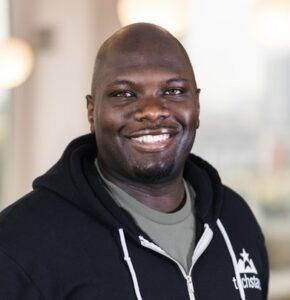 Clarence Bethea, managing partner at What VCs Won’t Say. (Courtesy photo)
“I believe that raising money for anyone is very difficult. When you add in race, gender, and proximity, it becomes even more difficult,” he told Crunchbase News in an email interview. “… I often tell founders, raising that first million will be your hardest. Do I believe that race played a factor [in making it harder to raise capital]? Yes! Because it plays a factor in every part of my life.”
It didn’t take long for Bethea to come to a distinct realization: The system was never designed with everyone in mind.
“This system wasn’t built for me, and I knew that from day one,” he reflects. Yet, rather than allowing that structural reality to become a barrier, he shifted his focus toward mastery.
“My focus quickly became about learning and understanding the game of venture capital,” he said. “I didn’t want the fact that it wasn’t for me to get in the way of being a part of it.”
Bethea later made the leap into venture capital itself. In 2023, he joined True Ventures, one of Upsie’s backers, as an investor and entrepreneur-in-residence. The move, he said, was motivated partly “by the people,” and wanting to be in an environment where he was “encouraged to learn deeply about the industry and how to look at deals.”
But it was also driven by a deeper mission to alter the very dynamics he faced on the other side of the table.
“I wanted to be a voice for founders who either looked like me, weren’t in-network and didn’t match the normal ‘pedigree’ of a founder,” he said.
Stepping into the investor’s shoes provided Bethea with a dual perspective, he said, both validating his instincts as an entrepreneur and revealing new dimensions of the fundraising puzzle.
Becoming a VC “confirmed some things that I knew were true as a founder, but it also opened my eyes to ways founders can improve their chances,” Bethea said.
From his vantage point as an investor, he routinely witnessed what he described as the same avoidable mistakes being made by talented teams. That realization prompted him to move on from his role at True Ventures earlier this year and became the catalyst for his current venture, “What VCs Won’t Say.”
Bethea describes the initiative as an “always-on” educational platform, course and live-programming series designed to give early-stage entrepreneurs clear, unfiltered insight into the real mechanics of company building and venture fundraising.
Built on “lived experience,” the platform equips founders with more than 75 high-level videos and 90 workbook pages in an effort to demystify how venture decisions are actually made, what makes a pitch fundable, and how to approach fundraising strategically. The impact is already tangible, according to Bethea, as it’s helped two founders raise millions so far using its frameworks.
Ultimately, his time in the venture capital trenches has left him looking toward the future with a striking amount of hope.
“I’m more optimistic than ever before,” he said, pointing to technological shifts as a potential massive equalizer for underrepresented builders.
“AI brings down the walls of building an MVP, talking to customers, and starting to gain traction,” he said. “That’s really exciting for founders who don’t fit the normal founder stereotype. But we have to get better at the game of venture.”
Cortney Woodruff
Over the years, Cortney Woodruff has founded and raised venture capital for two startups: Trainersvault, an online platform that provides software services to personal trainers, and Assemble, an online learning platform that provides online courses taught by notable, Black innovators that was co-founded by actor Jesse Williams.
Those experiences led him to conclude that while building a company is universally grueling, the playing field is far from level. Reflecting on his early days as an entrepreneur, he notes that “raising venture capital is hard for almost everyone, especially first-time founders,” given that investors must make highly risky decisions with limited information. Yet, he simultaneously observed a stark disparity in how different founders are evaluated.
 Cortney Woodruff, co-founder & CEO of Assemble. (Courtesy photo)
“I often felt young minority founders were expected to arrive as finished products,” Woodruff told Crunchbase News in an email interview. “There seemed to be less patience, less coaching, less developmental support. I watched founders receive years of benefit-of-the-doubt capital while learning on the job. Many minority founders are expected to prove everything upfront.”
This friction became undeniable during pitches for his first company, Trainersvalut. Despite walking into meetings with customers and real revenue traction, Woodruff recalls that he and his team often left “feeling like we were still being evaluated as an idea rather than a business.”
He came to that determination after a number of confusing rejections. While founders would naturally assume they are competing on product, execution and traction, Woodruff eventually concluded that it’s usually more related to familiarity.
“Many investors are looking for patterns they’ve seen before,” he said. “If your background, network, school, or story doesn’t fit those patterns, you often have to produce significantly more evidence before receiving the same conviction.
“That realization changed how I viewed entrepreneurship and venture capital,” Woodruff added.
Driven by a desire to learn more about how decisions were made from the other side of the table, Woodruff began angel investing. The move pulled back the curtain on the industry’s inner workings, confirming just how deeply venture capital relies on pattern recognition to signal success.
“What surprised me was how much venture capital is driven by pattern recognition,” he said. “Investors are trying to identify signals that increase the probability of success. The challenge is that those signals are often informed by prior successes, which can unintentionally narrow the range of founders and ideas that receive attention.”
Sitting in the investor’s chair also reframed his perspective on institutional bias. As a founder, it is easy to view every rejection as personal or discriminatory, but underwriting deals revealed to him just how difficult these choices are. Today, Woodruff views the industry’s shortcomings in diversity through a systemic lens rather than an individual one.
“The people who talk about bias often underestimate the role of networks, while the people who talk about networks often underestimate the role of bias,” he said. “Most investors are not waking up trying to exclude people. However, they are often sourcing opportunities from familiar circles, relying on familiar signals, and backing founders who feel familiar to them. Over time, those patterns compound.”
This concentration of networks helps explain why venture capital continually underinvests in Black founders. Because VC is fundamentally relationship-driven — reliant on referrals, universities and existing investor circles — homogeneous networks naturally yield homogeneous deal flow.
“I don’t think the issue is simply that investors don’t want to fund Black founders,” Woodruff said. “I think many investors never encounter a sufficiently diverse set of founders in the first place.”
In his view, the resulting disparity isn’t always about who eventually gets a check, but who is given the grace to stumble and iterate. Throughout his years in the ecosystem, Woodruff said he has routinely watched founders with stronger traction receive less enthusiasm than those with stronger narratives.
“The difference is often not who gets funded eventually. The difference is who receives patience, coaching, introductions, and the opportunity to grow into the founder investors believe they can become,” he said.
Now, Woodruff uses his position to bridge that gap, treating mentorship and network access as critical forms of capital. He focuses on guiding founders through an unfamiliar system, helping them avoid missteps, and opening doors to rooms they otherwise wouldn’t enter.
When looking toward the industry’s future, his outlook is balanced by both optimism and pragmatism. Woodruff is heartened that conversations around representation are more visible than ever and that technology has drastically lowered the barrier to entry for small teams building meaningful businesses. Yet, he recognizes that “systems change slowly. Networks evolve slowly. Institutions evolve slowly.”
Ultimately, he rejects the premise that venture capital can be fundamentally reengineered for fairness.
“I don’t think venture capital was designed to be equitable. It was designed to generate returns,” Woodruff said. Instead, he believes the real paradigm shift will come from diversifying the perspectives of those who write the checks.
“If every investment committee has similar backgrounds, similar networks, and similar reference points, they will naturally gravitate toward similar founders and similar ideas. I don’t believe the economics of venture capital need to change as much as the pattern recognition does,” he said. “The most successful investors in the future may be the ones who can recognize extraordinary opportunities in places others have been trained to overlook.”
Related Crunchbase query:
- Funding To US Black-Founded Companies In 2026
Related reading:
- Crunchbase Data: Venture Dollars For Black Startup Founders Stay Scarce Despite AI Funding Boom
- Share Of Startup Funding For Black Founders Hits Multiyear Low
- Funding To Black Startup Founders Quadrupled In Past Year, But Remains Elusive
Illustration: Dom Guzman


Ayrıca Şunları da Beğenebilirsiniz

3 Beaten-Down Stocks That Could Roar Back in June

First Iranian Oil Moves Past US Blockade Ahead Of Deal Signing

3 Stocks That Have Made Long-Term Investors Rich (and Could Do It Again)


Popüler Haberler
Daha fazla
