

Ripple is bringing its regulated RLUSD stablecoin to MENA’s biggest crypto market
Ripple is pushing its dollar-backed stablecoin into Turkey, betting that one of the world’s most active digital-asset markets is ready for a more regulated version of the digital dollars already used to navigate currency weakness and limited access to traditional dollar savings.
On June 2, the Brad Garlinghouse-led company announced that its US dollar-pegged stablecoin, RLUSD, is now available to institutional clients in Turkey through integration agreements with local cryptocurrency platforms BiLira, Bitexen, and Bitlo.
The stakes for capturing market share are exceptionally high. Turkey handled nearly $200 billion in annual crypto transactions, almost four times the United Arab Emirates’ $53 billion, making it the dominant crypto economy in the Middle East and North Africa, according to blockchain data firm Chainalysis.
Ripple targets Turkey’s dollar demand
The rollout places RLUSD inside the domestic order books of three established Turkish gateways.
Ripple executives are aggressively targeting corporate and institutional liquidity, positioning the token as a compliance-first alternative to incumbent stablecoins that currently dominate the offshore market.
Since its global launch in late 2024, RLUSD has scaled to a $1.7 billion market capitalization. Ripple’s strategy in Turkey focuses not on retail day traders, but on capturing high-value corporate flows that require strict regulatory certainty.
Jack McDonald, senior vice president of stablecoins at Ripple, noted that the asset is designed to serve as a bridge for enterprise operations. He noted:
By integrating directly with domestic service providers such as BiLira, Bitexen, and Bitlo, Ripple provides a regulated entry point for domestic institutions that require stringent audit standards to hold digital dollars on their corporate balance sheets or to use them for cross-border supplier payments.
Mustafa Alpay, CEO at Bitlo, said:
Market shaped by domestic pressure
Meanwhile, market observers have noted that Turkey’s outsized role in the global crypto ecosystem is not solely the result of typical retail speculation.
Instead, it sits at the intersection of speculative trading, robust dollar demand, and profound macroeconomic pressure.
According to Chainalysis, Turkey completely dominates the MENA region in digital asset value received.
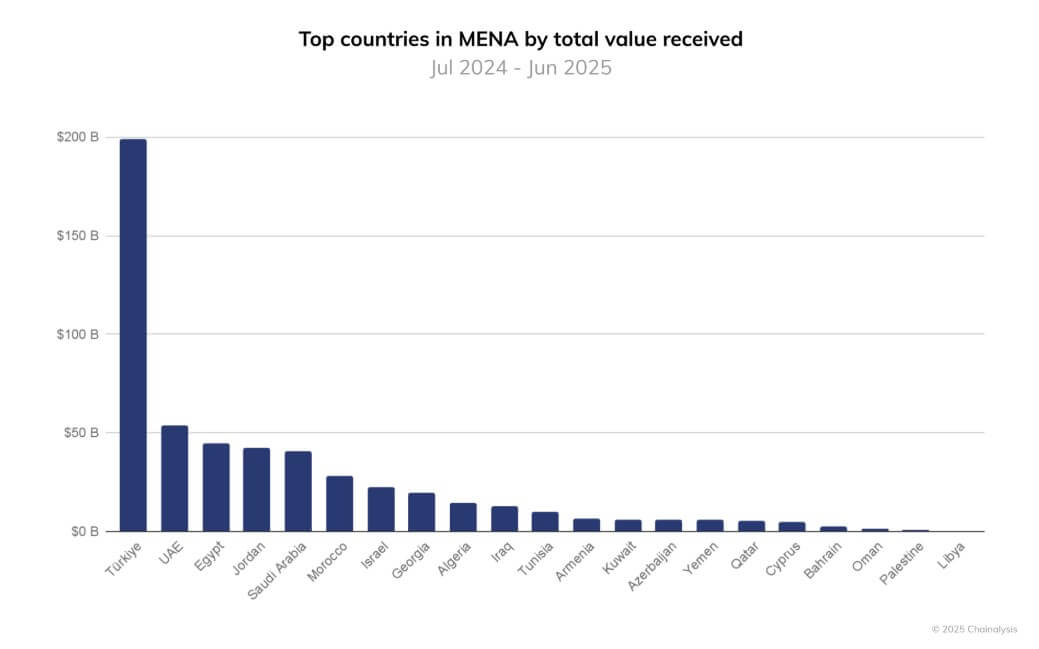 Turkey Dominates MENA Crypto Transactions (Source: Chainalysis)
More recently, data from TRM Labs showed that Turkey rose to become the fifth-largest global market for retail crypto activity in the first quarter of 2026.
The report showed that Turkey generated $40 billion in crypto volume during that three-month period while broader global retail participation contracted by 11%.
This made Turkey one of the few major global markets to expand during a quarter contraction driven by macroeconomic tightening and reduced retail participation.
For a nominal $1.64 trillion economy, the velocity of capital moving into stablecoins and digital assets reflects deep structural challenges.
With the Turkish lira facing persistent devaluation and domestic monetary environments remaining constrained, dollar-denominated crypto assets have become a functional rail for capital preservation.
However, labeling the market solely as a vehicle of economic necessity misses the full picture.
The high transaction volumes reflect a dual-track digital economy: while some users and corporations rely on digital dollars to hedge against inflation and manage working capital, a massive segment of the market remains highly engaged in speculative trading across decentralized networks.
Turkey's crypto regulatory effort gives Ripple an opening
Ripple’s entry into Turkey is timed against a backdrop of shifting sovereign oversight. As Turkey tightens supervision of its digital asset sector, global firms offering compliance-heavy products are finding a clearer route into the market.
The regulatory environment shifted fundamentally in July 2024, when amendments to the Capital Markets Law introduced stringent licensing requirements for crypto asset service providers operating within the country.
The Capital Markets Board effectively forced platforms to either formalize their operations, enhance trade surveillance, or exit the jurisdiction.
That oversight is now extending aggressively into taxation. In March 2026, Reuters reported that Turkey’s ruling AK Party proposed comprehensive legislation to levy a 10% withholding tax on crypto gains realized on authorized platforms, along with a 0.03% transaction levy on service providers.
By structuring tax collection at the exchange level and requiring platforms to act as fiduciary withholding agents that calculate and remit taxes quarterly, the Turkish government is cementing the role of licensed domestic exchanges while heavily penalizing the use of offshore alternatives.
Speaking on this, Reece Merrick, a senior executive officer at Ripple, said:
For a company like Ripple, which builds its product suite around institutional compliance and regulatory rigor, these barriers to entry act as a competitive moat.
It allows RLUSD to pitch itself to local exchanges not just as a trading pair, but as a fully auditable asset that aligns with Ankara’s tightening oversight and operational mandates.
RLUSD gives Ripple a broader institutional wedge
The Turkish rollout is part of a broader effort to embed RLUSD across Ripple’s institutional financial products, creating an ecosystem that extends well beyond spot-market liquidity.
According to first-quarter 2026 data from digital asset research firm Messari, RLUSD closed the quarter with a $340.3 million market capitalization natively issued on the XRP Ledger (XRPL), representing a 45% quarter-over-quarter increase.
This growth is heavily tied to Ripple's positioning of the stablecoin across its treasury management, prime brokerage, institutional custody, and payment rails.
Simultaneously, institutional demand for on-chain collateral is accelerating. Messari noted that the total market capitalization for real-world assets (RWAs) on the XRPL reached $2.25 billion by the end of Q1 2026, surging 124% from the previous quarter.
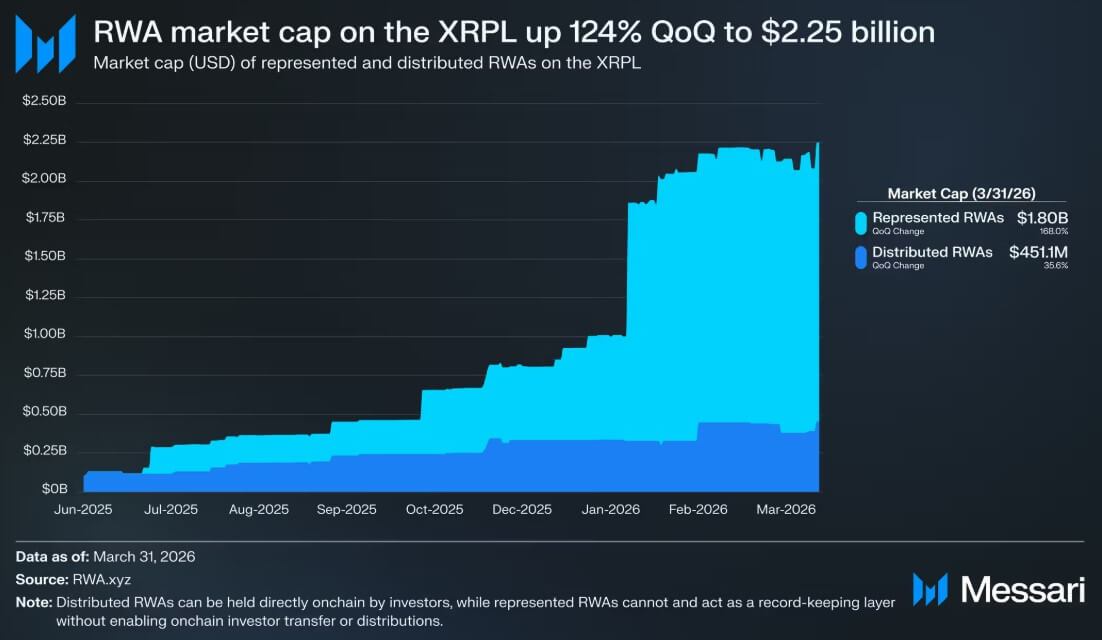 XRPL's Real World Assets (Source: Messari)
As traditional financial instruments like private credit and money market funds are tokenized, they require a reliable, dollar-pegged settlement asset to function properly on-chain.
This ecosystem expansion directly impacts the network's underlying infrastructure. While Ripple aims to limit direct volatility exposure for its institutional stablecoin users, increased enterprise activity on the XRPL inherently drives utility for XRP, the network's native asset.
By offering a compliant digital dollar, Ripple is providing the necessary fiat-pegged liquidity to power higher-level institutional decentralized finance operations without relying on unsustainable business development incentives or fragmented centralized exchange liquidity.
University partnership adds local infrastructure
To anchor its commercial expansion, Ripple is simultaneously building physical and academic infrastructure within the country.
Alongside the exchange integrations, Ripple announced that Istanbul Technical University (ITU) has joined its global University Blockchain Research Initiative. The partnership would be funded directly by RLUSD allocations.
The firm said the partnership will also establish an XRPL validator node on the ITU campus and finance graduate fellowships and advanced blockchain research.
While the academic partnership secures a local footprint beyond exchange listings, the core narrative remains commercial.
For Ripple, Turkey offers a critical test of whether a regulated dollar stablecoin can compete in a market where demand for digital dollars already exists, but regulators are drawing tighter boundaries around how that demand is met.
The post Ripple is bringing its regulated RLUSD stablecoin to MENA’s biggest crypto market appeared first on CryptoSlate.


Ayrıca Şunları da Beğenebilirsiniz

Drift Protocol Crashes 40.5% Despite $24M Market Cap: What the Data Reveals

Pi Network Surprise: June Mining Rate Rises as the Algorithm Adjusts Behind the Scenes

One Of Frank Sinatra’s Most Famous Albums Is Back In The Spotlight


Popüler Haberler
Daha fazla
