

Kaspa Whale Scandal – Founder Defends the Buyer While Community Gets Hurt
Kaspa (KAS) is growing even as its price stays low. The network has now processed over 2.17 billion transactions and passed 540,000 wallets. More people are using it.
New tools are also coming online. Kaskad, Kaspa’s first lending platform, launched its governance token on MEXC. That opens the door to DeFi services built around KAS. The network is also getting ready for the Toccata hard fork. That is a big upgrade that will add native tokens and programmability.
Even with all this, the KAS price is trading near $0.030 and down almost 1% in the last day. The gap between what the network is doing and what the price is doing has people talking. Fresh criticism about the project’s leadership and how much influence large holders have has also popped up again on social media.
Kaspa Whale Controversy Sparks Community Debate
Community member Shai Wyborski reignited a heated discussion after criticizing what he described as the founder’s defense of a major whale investor. In his post, Wyborski said that influential buyers were allowed to do things that hurt the wider community.
Yet those same people kept getting support from key figures in the project. He claimed this pushed other large investors away and left control in the hands of just a small group.
This complaint touches on an old worry in crypto: whether big holders have too much say over market mood and where a project heads. People are listening because the KAS price is still near multi-year lows, even as the network keeps growing.
For some investors, this debate raises real questions. Who runs things? How open is the project? And are smaller holders getting enough attention as the network matures?
Dormant KAS Supply Hits Record High as Holders Refuse to Sell
A separate data point shared by Kaspa Daily paints a very different picture. The latest on-chain metrics show that 47.64% of all circulating KAS has not moved for more than one year.
Back in late 2023, that number was around 15%. So the share of untouched supply has more than tripled in the last two and a half years.
What makes this interesting is that dormant supply kept growing even as the KAS price fell from about $0.20 down to $0.03. A lot of long-term holders chose not to sell, even after a steep drop.
That means less supply is floating around on the market. It also shows strong belief from the people who own it. Nearly half of all KAS coins in circulation have not moved. That creates a scarcity situation. And that could matter later if demand ever comes back.
Key Catalysts Supporting the KAS Price
One of the biggest developments for Kaspa is the launch of Kaskad, the network’s first native lending protocol. Built on the Igra Layer 2 network, Kaskad allows users to borrow stablecoins using KAS as collateral.
Its governance token, KSKD, was listed on MEXC on May 25. The platform targets yields between 8% and 12%, giving KAS holders new utility beyond simple transfers. A functioning lending market can increase capital efficiency and create additional demand for the asset.
Another big event is the Toccata hard fork. It is expected to go live sometime between June 5 and June 20. The upgrade will add native KRC-20 tokens and covenant programming. That moves Kaspa beyond just sending payments and opens it up to many more kinds of apps. The final test phase is already done, so there is less worry about things going wrong.
Supply numbers also look good. Kaspa’s circulating supply is about 27.48 billion coins. That is over 95% of its maximum supply of roughly 28.7 billion. New coins keep slowing down under the network’s Chromatic Phase schedule, and new issuance is expected to hit near zero by late 2026. Unlike many other Layer 1 networks that have big token unlocks ahead, Kaspa has very little future dilution.
Even so, the mood in the wider market is still a problem. Bitcoin dominance is high near 59%. The Fear & Greed Index is at 36. Those conditions have hurt a lot of altcoins.
Related Kaspa News: Kaspa Crashes 74% After Last Hard Fork: Can Toccata Ugrade Finally Save KAS Price in June?
Kaspa Price Analysis: Is a Reversal Starting?
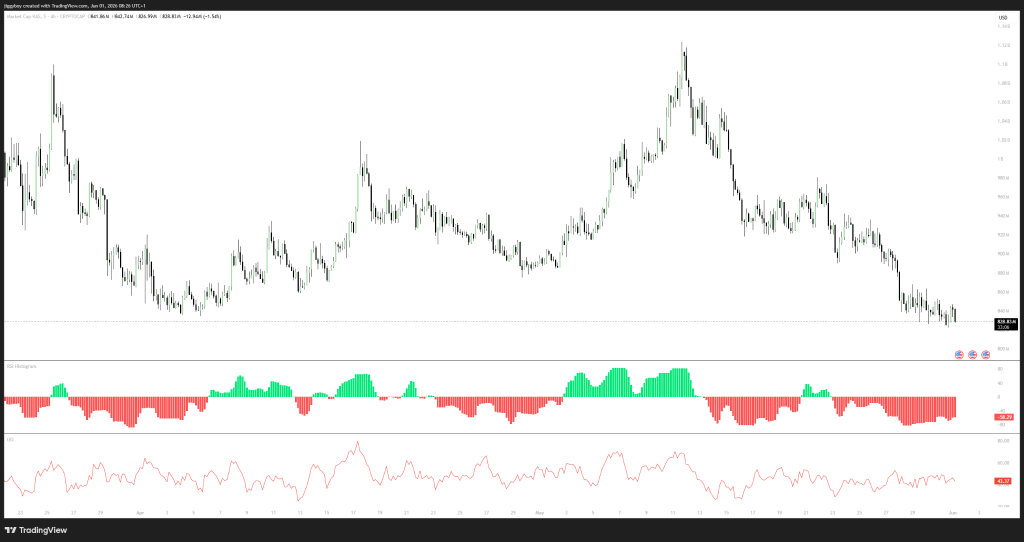
We had a look at the KAS chart, and price action remains under pressure after a prolonged downtrend. Market value has dropped from over $1.1 billion in mid-May to about $828 million now. Lower highs and lower lows keep showing up on the chart. That tells you sellers are still running the show.
But the momentum numbers are starting to look a little better. The RSI histogram is still negative, but the bars are not as sharp as they were during past sell-offs.
 Source: Tradingview.com
The RSI itself has climbed back to 43 after spending time closer to oversold levels. That matches what Kaspa Daily pointed out as bullish divergence. Momentum has improved, even though the price has gone nowhere.
For buyers, the first job is to take back resistance near $0.035 to $0.040. A clean break above that zone could open the road to $0.05. If selling pressure continues, support remains near the $0.03 level, which has become an important psychological area for Kaspa.
With almost half of the circulating supply dormant, new demand generated by the Toccata upgrade or growing DeFi activity could have an outsized effect on the KAS price over the coming months.
Frequently Asked Questions

Kaspa reaching $5 is possible, but it would require a market capitalization well above $100 billion based on its circulating supply. Achieving that level would likely depend on massive adoption, successful ecosystem growth, and a strong crypto bull market.
Kaspa attracts investors with its fast BlockDAG technology, fair launch model, and upcoming smart contract capabilities. However, it remains a high-risk asset due to price volatility and the challenge of expanding adoption beyond its current user base.
Subscribe to our YouTube channel for daily crypto updates, market insights, and expert analysis.
The post Kaspa Whale Scandal – Founder Defends the Buyer While Community Gets Hurt appeared first on CaptainAltcoin.


Ayrıca Şunları da Beğenebilirsiniz
Trump admin dismantles law enforcement while 'no one is watching'

WisdomTree Appoints John Whelan as Head of Strategy for Digital Assets
Crypto fund outflows $1.67 billion: Bitcoin Sheds $1.44B as Rotation Begins


Popüler Haberler
Daha fazla
