New Hampshire has become the first state in the United States to include "digital gold" Bitcoin in its state fiscal reserves, establishing a legal status and policy framework for Bitcoin. According to the drafter of the bill, the core purpose of this policy is to provide the state fiscal system with a tool to hedge against inflation and diversify its investment portfolio.New Hampshire has become the first state in the United States to include "digital gold" Bitcoin in its state fiscal reserves, establishing a legal status and policy framework for Bitcoin. According to the drafter of the bill, the core purpose of this policy is to provide the state fiscal system with a tool to hedge against inflation and diversify its investment portfolio.

New Hampshire signed the first state Bitcoin reserve bill in the United States. More crypto legislation is ready to be enacted, which may set off a trend of imitation by other states.
2025/05/07 15:19
Okuma süresi: 8 dk
Bu içerikle ilgili geri bildirim veya endişeleriniz için lütfen crypto.news@mexc.com üzerinden bizimle iletişime geçin.

New Hampshire signed the first state Bitcoin reserve bill in the United States. More crypto legislation is ready to be enacted, which may set off a trend of imitation by other states.

Author: Weilin, PANews

New Hampshire, USA is the birthplace of the Bretton Woods Agreement. In July 1944, representatives from 44 countries held the United Nations and Allied Monetary and Financial Conference at the Mount Washington Hotel in Bretton Woods Park, New Hampshire, USA, establishing a fixed exchange rate system pegged to the US dollar and gold, and laying the foundation for the US dollar's status as a global reserve currency.

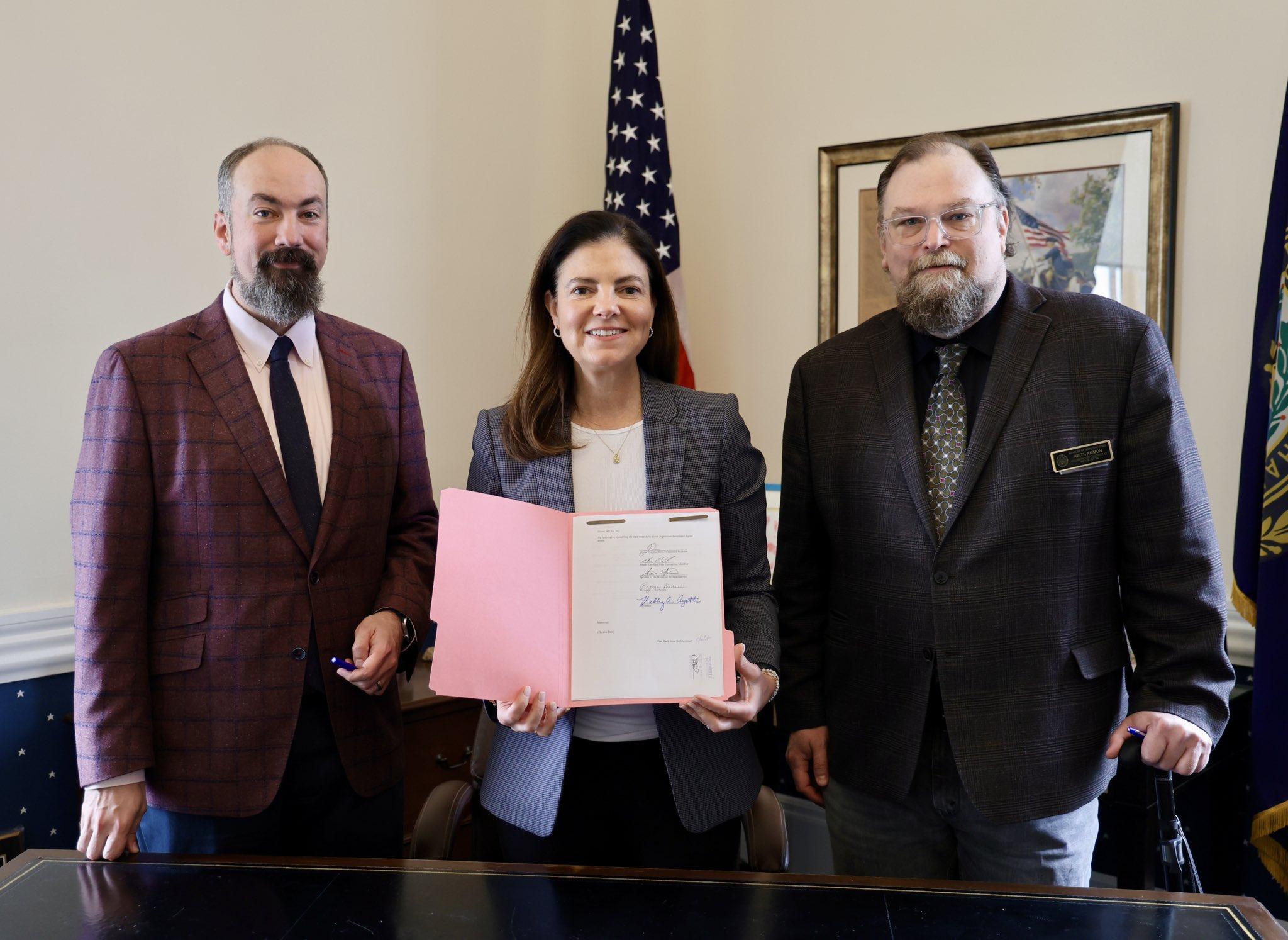
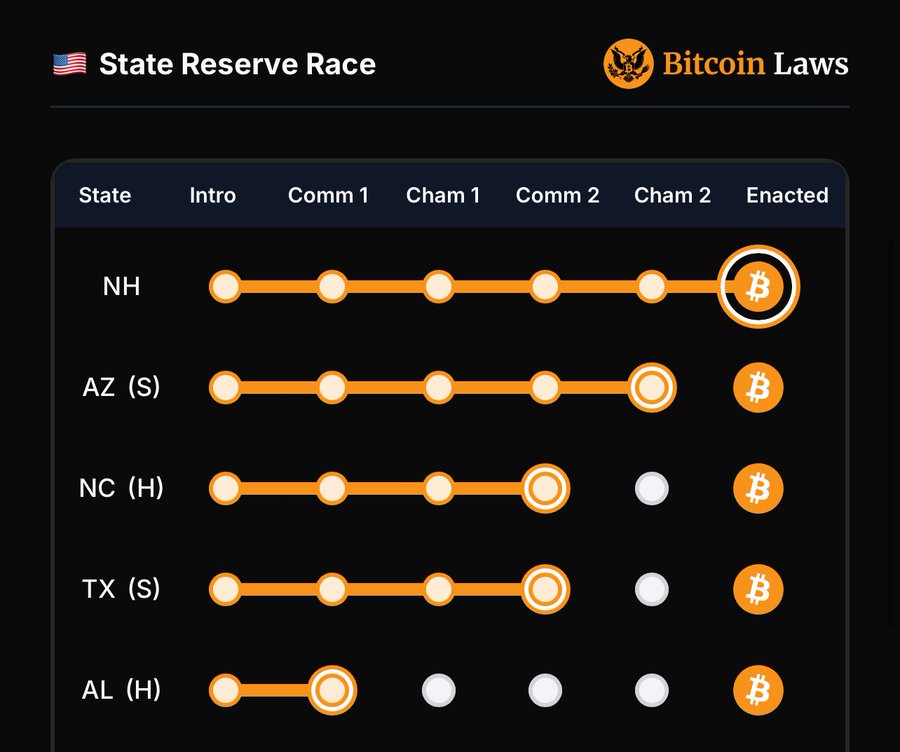
After more than 80 years, on the evening of May 6, New Hampshire became the first state in the United States to include "digital gold" Bitcoin in the state's fiscal reserves, establishing a legal status and policy framework for Bitcoin. New Hampshire Governor Kelly Ayotte officially signed the HB 302 bill, announcing that the state will establish a "strategic Bitcoin reserve" and allocate no more than 5% of the state's fiscal funds to hold precious metals, Bitcoin and other digital assets with a market value of more than $500 billion (currently only Bitcoin meets the criteria).
New Hampshire signed the first state Bitcoin reserve bill in the United States. More crypto legislation is ready to be enacted, which may set off a trend of imitation by other states.

New Hampshire Signs HB 302: The First State Bitcoin Strategic Reserve Bill in the U.S.

At the federal level in the United States, President Trump signed an executive order on March 6, 2025 to formally establish a strategic Bitcoin reserve and other cryptocurrencies. Although crypto-supportive lawmakers in various states have drafted state-level Bitcoin strategic reserve bills, they have encountered resistance in the near future.

But on May 6, New Hampshire made history with the bill, dubbed HB 302. The New Hampshire Treasury holds about $3.6 billion in funds in its latest annual report, meaning the state can buy up to about $181 million worth of precious metals or Bitcoin.

The bill was first sponsored by several Republican congressmen, including Congressman Keith Ammon (drafter of the bill), Calvin Beaulier, Mark Warden, Jason Osborne, and state senators Daryl Abbas and Kevin Avard. Based on the version provided by the advocacy organization Satoshi Action, the bill has been simplified to make it easier to understand, accept, and implement in the legislative process.

Under the bill, the New Hampshire Treasury Department is authorized to invest in Bitcoin and other digital assets with a market value of more than $500 billion. Currently, only Bitcoin can meet this market value threshold. According to the drafters of the bill, the core purpose of this policy is to provide the state fiscal system with a tool to hedge against inflation and diversify its investment portfolio.

The law requires that any Bitcoin or digital assets included in the reserve must be held in custody within the U.S. regulatory system, including multi-signature wallets controlled by state governments, qualified custodians, or U.S. listed traded products (ETPs). This move is intended to provide taxpayers with the highest level of security, long-term stability, fiscal responsibility, and transparency.

From idea to legislation: A review of the passage of HB 302
New Hampshire signed the first state Bitcoin reserve bill in the United States. More crypto legislation is ready to be enacted, which may set off a trend of imitation by other states.

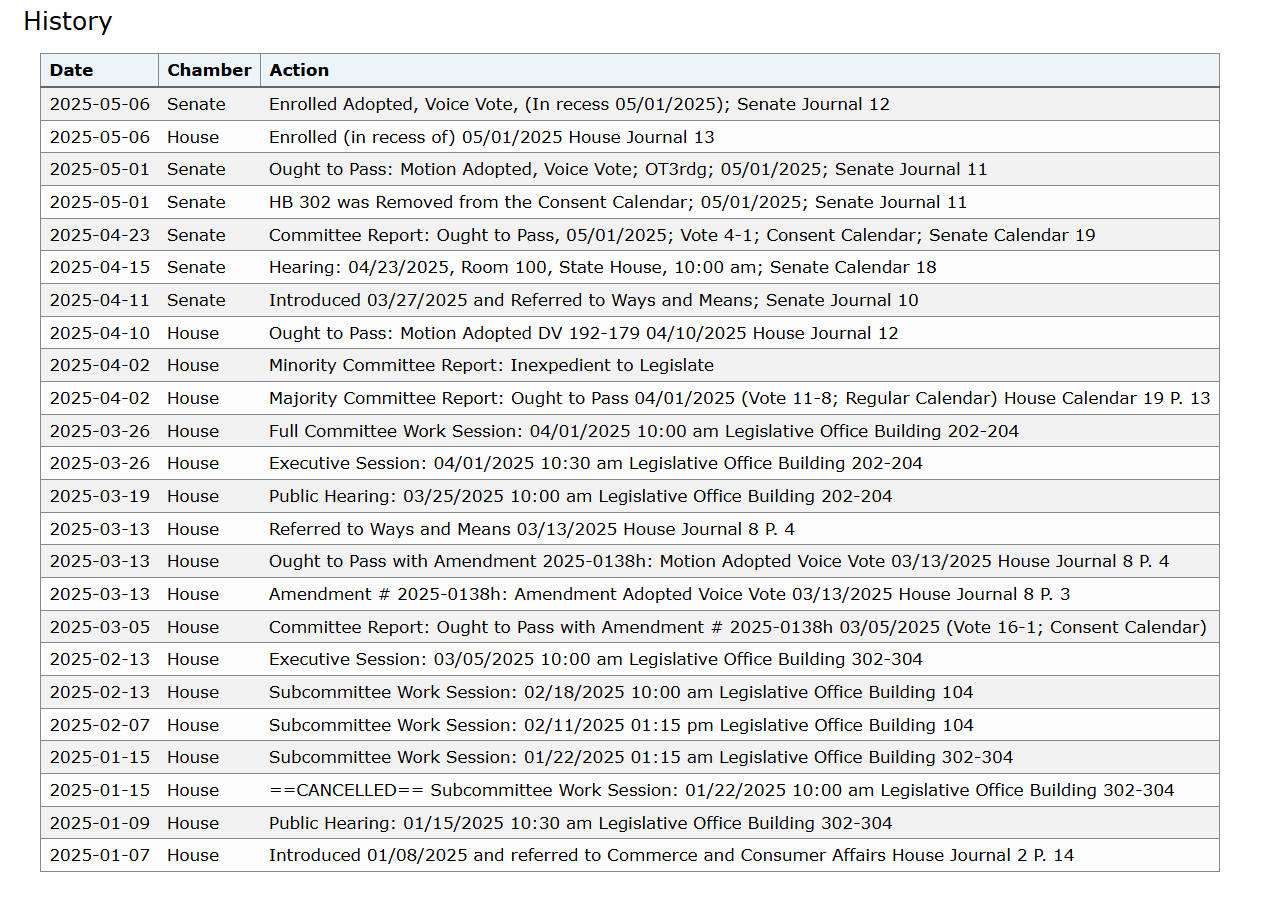
HB 302 was introduced into the House of Representatives in January. In New Hampshire, for a bill to be passed, it must first be drafted. The draft can be proposed by the 400 members of the House of Representatives or the 24 senators in the New Hampshire General Court. If the head of a state agency, the governor, citizens or interest groups want to propose legislation, they must find a member of the House to serve as a sponsor.

The bill then goes to the legislature: the drafted bill is first sent to the clerk of the Senate or the House of Representatives, depending on the chamber the senator is from. The bill is formally introduced when the House of Representatives passes a motion to consider the bill by number only.

After that, all bills referred to committees must have public hearings unless two-thirds of the members present agree to suspend the rules. New Hampshire is one of the few states that requires public hearings for all bills.

The next step is the bill and committee deliberation: Committee deliberations are held in executive session, and a majority of committee members must be present to take action. The public can observe the final vote. The committee submits a report to the House Clerk, with a conclusion of "Ought to pass", "Ought to pass as amended", "Inexpedient to legislate", "Refer to interim study", or "Re-refer to Committee"

The bill is then considered in the House: after the committee report is published in the Parliamentary Calendar, the bill can be considered the next day. Major amendments proposed by the committee must be listed in the Calendar. All bills must pass both the House and Senate in exactly the same text before they can be sent to the Governor for signature. After the bill is passed by both houses, it is sent to the Committee on Enrolled Bills for registration and format review.

The bill is ultimately accepted or rejected. If the Legislative Assembly has not yet adjourned, the governor has five days to decide whether to sign the bill, veto it, or not sign it.

Earlier on May 4, according to documents on the Arizona official website, Arizona Governor Katie Hobbs vetoed Senate Bill 1025 (SB 1025), which would have allowed public funds to be invested in virtual currencies. Hobbs said in her veto statement that the Arizona Retirement System is one of the strongest retirement systems in the United States, thanks to its sound and wise investment strategy. She emphasized that the state's retirement funds are not suitable for trying unproven investments such as virtual currencies.

On May 6, Florida House Bill 487 and Senate Bill 550 were "indefinitely postponed and withdrawn for consideration" on May 3. The two bills were originally intended to allow the state treasury to invest up to 10% of public funds in Bitcoin to establish a state-level crypto reserve. However, the Florida Legislature did not pass the relevant legislation before the end of the meeting on May 2, and has officially withdrawn from the state-level Bitcoin reserve bill competition. Similar bills have also failed in South Dakota, Montana and other places.

It may trigger a nationwide imitation. The core promoter, Congressman Keith, still has two encryption bills to be reviewed

HB 302 is not only a breakthrough in local fiscal strategy, but is also considered a new benchmark for digital asset policies in states across the United States. Dennis Porter, CEO and co-founder of Satoshi Action, celebrated: "Satoshi Action drafted the model, New Hampshire wrote it into law, and now financial directors across the country can follow this roadmap. HB 302 proves that you can diversify reserves and safeguard the future of state finances while protecting taxpayer funds - while embracing the most secure currency network on the planet. New Hampshire not only passed a bill, it sparked a movement."

Satoshi Action is a nonprofit policy organization dedicated to promoting Bitcoin-friendly legislation and helped draft the model for this bill. Across the country, the organization has helped promote the passage of six Bitcoin-supportive laws and has facilitated the introduction of more than 20 Bitcoin Reserve Acts, continuing to promote robust, bipartisan policy development in the digital asset space.

Behind the implementation of HB 302 is a group of legislators who have long supported digital assets. Among them, Congressman Keith Ammon is the drafter of the bill. He represents the 40th District of Hillsborough and has always played a role as a promoter in the legislative process. He is also the chairman of the New Hampshire Blockchain Council and a member of the Commerce and Consumer Affairs Committee. In addition, Jason Osborne, the majority leader of the State House of Representatives, and Ian Huyett, a member of the New Hampshire Blockchain Council, also played a key role in the deliberation of the bill.

It is worth mentioning that HB 302 is just one of the many crypto-friendly bills that Keith is promoting. Keith currently has two other Bitcoin and blockchain-related bills in progress, both of which have passed the House of Representatives and are currently under review in the Senate:

HB310 proposes to establish a commission to study the possibility of creating a regulatory framework for stablecoins, tokenized real-world assets, and blockchain-based trusts in New Hampshire. Currently under consideration in the Senate; House status: passed/passed with amendments. Last hearing on April 29, 2025.

Keith said the privacy issue of stablecoins is of vital importance to him and he plans to have in-depth discussions with relevant experts in Wyoming.

HB639 is a bill on the use of blockchain and digital currency and related disputes. The bill adds a new chapter called "Blockchain Basic Laws" to the New Hampshire legal system, aiming to establish a new legal framework to protect the rights and interests of blockchain technology and its users. It is currently under review in the Senate and has been passed/adopted by the House of Representatives. The last hearing will be on April 29, 2025.

The bill is based half on the model provided by Satoshi Action and the other half on the advice of other experts. The bill is currently facing some resistance in the Senate, as some environmentalists are concerned about the noise pollution and environmental impact of crypto mining.

In general, with the official signing of HB 302, New Hampshire has not only taken a key step in fiscal policy, but also opened up a new situation for the legalization of Bitcoin in public asset allocation. The implementation of this bill not only demonstrates the state's policy foresight in the field of digital finance, but may also inspire other states to follow suit, which may become an important historical process in the era of digital currency.

Piyasa Fırsatı
Moonveil Logosu
Moonveil Fiyatı(MORE)
$0,0001738
$0,0001738$0,0001738
-%10,78
USD
Moonveil (MORE) Canlı Fiyat Grafiği
Sorumluluk Reddi: Bu sitede yeniden yayınlanan makaleler, halka açık platformlardan alınmıştır ve yalnızca bilgilendirme amaçlıdır. MEXC'nin görüşlerini yansıtmayabilir. Tüm hakları telif sahiplerine aittir. Herhangi bir içeriğin üçüncü taraf haklarını ihlal ettiğini düşünüyorsanız, kaldırılması için lütfen crypto.news@mexc.com ile iletişime geçin. MEXC, içeriğin doğruluğu, eksiksizliği veya güncelliği konusunda hiçbir garanti vermez ve sağlanan bilgilere dayalı olarak alınan herhangi bir eylemden sorumlu değildir. İçerik, finansal, yasal veya diğer profesyonel tavsiye niteliğinde değildir ve MEXC tarafından bir tavsiye veya onay olarak değerlendirilmemelidir.

Ayrıca Şunları da Beğenebilirsiniz

Tether Backs Ark Labs’ $5.2 Million Bet on Bitcoin’s Stablecoin Revival

Tether Backs Ark Labs’ $5.2 Million Bet on Bitcoin’s Stablecoin Revival

The post Tether Backs Ark Labs’ $5.2 Million Bet on Bitcoin’s Stablecoin Revival appeared on BitcoinEthereumNews.com. In brief Ark Labs secured backing from Tether
Paylaş
BitcoinEthereumNews2026/03/12 21:44
Summarize Any Stock’s Earnings Call in Seconds Using FMP API

Summarize Any Stock’s Earnings Call in Seconds Using FMP API

Turn lengthy earnings call transcripts into one-page insights using the Financial Modeling Prep APIPhoto by Bich Tran Earnings calls are packed with insights. They tell you how a company performed, what management expects in the future, and what analysts are worried about. The challenge is that these transcripts often stretch across dozens of pages, making it tough to separate the key takeaways from the noise. With the right tools, you don’t need to spend hours reading every line. By combining the Financial Modeling Prep (FMP) API with Groq’s lightning-fast LLMs, you can transform any earnings call into a concise summary in seconds. The FMP API provides reliable access to complete transcripts, while Groq handles the heavy lifting of distilling them into clear, actionable highlights. In this article, we’ll build a Python workflow that brings these two together. You’ll see how to fetch transcripts for any stock, prepare the text, and instantly generate a one-page summary. Whether you’re tracking Apple, NVIDIA, or your favorite growth stock, the process works the same — fast, accurate, and ready whenever you are. Fetching Earnings Transcripts with FMP API The first step is to pull the raw transcript data. FMP makes this simple with dedicated endpoints for earnings calls. If you want the latest transcripts across the market, you can use the stable endpoint /stable/earning-call-transcript-latest. For a specific stock, the v3 endpoint lets you request transcripts by symbol, quarter, and year using the pattern: https://financialmodelingprep.com/api/v3/earning_call_transcript/{symbol}?quarter={q}&year={y}&apikey=YOUR_API_KEY here’s how you can fetch NVIDIA’s transcript for a given quarter: import requestsAPI_KEY = "your_api_key"symbol = "NVDA"quarter = 2year = 2024url = f"https://financialmodelingprep.com/api/v3/earning_call_transcript/{symbol}?quarter={quarter}&year={year}&apikey={API_KEY}"response = requests.get(url)data = response.json()# Inspect the keysprint(data.keys())# Access transcript contentif "content" in data[0]: transcript_text = data[0]["content"] print(transcript_text[:500]) # preview first 500 characters The response typically includes details like the company symbol, quarter, year, and the full transcript text. If you aren’t sure which quarter to query, the “latest transcripts” endpoint is the quickest way to always stay up to date. Cleaning and Preparing Transcript Data Raw transcripts from the API often include long paragraphs, speaker tags, and formatting artifacts. Before sending them to an LLM, it helps to organize the text into a cleaner structure. Most transcripts follow a pattern: prepared remarks from executives first, followed by a Q&A session with analysts. Separating these sections gives better control when prompting the model. In Python, you can parse the transcript and strip out unnecessary characters. A simple way is to split by markers such as “Operator” or “Question-and-Answer.” Once separated, you can create two blocks — Prepared Remarks and Q&A — that will later be summarized independently. This ensures the model handles each section within context and avoids missing important details. Here’s a small example of how you might start preparing the data: import re# Example: using the transcript_text we fetched earliertext = transcript_text# Remove extra spaces and line breaksclean_text = re.sub(r'\s+', ' ', text).strip()# Split sections (this is a heuristic; real-world transcripts vary slightly)if "Question-and-Answer" in clean_text: prepared, qna = clean_text.split("Question-and-Answer", 1)else: prepared, qna = clean_text, ""print("Prepared Remarks Preview:\n", prepared[:500])print("\nQ&A Preview:\n", qna[:500]) With the transcript cleaned and divided, you’re ready to feed it into Groq’s LLM. Chunking may be necessary if the text is very long. A good approach is to break it into segments of a few thousand tokens, summarize each part, and then merge the summaries in a final pass. Summarizing with Groq LLM Now that the transcript is clean and split into Prepared Remarks and Q&A, we’ll use Groq to generate a crisp one-pager. The idea is simple: summarize each section separately (for focus and accuracy), then synthesize a final brief. Prompt design (concise and factual) Use a short, repeatable template that pushes for neutral, investor-ready language: You are an equity research analyst. Summarize the following earnings call sectionfor {symbol} ({quarter} {year}). Be factual and concise.Return:1) TL;DR (3–5 bullets)2) Results vs. guidance (what improved/worsened)3) Forward outlook (specific statements)4) Risks / watch-outs5) Q&A takeaways (if present)Text:<<<{section_text}>>> Python: calling Groq and getting a clean summary Groq provides an OpenAI-compatible API. Set your GROQ_API_KEY and pick a fast, high-quality model (e.g., a Llama-3.1 70B variant). We’ll write a helper to summarize any text block, then run it for both sections and merge. import osimport textwrapimport requestsGROQ_API_KEY = os.environ.get("GROQ_API_KEY") or "your_groq_api_key"GROQ_BASE_URL = "https://api.groq.com/openai/v1" # OpenAI-compatibleMODEL = "llama-3.1-70b" # choose your preferred Groq modeldef call_groq(prompt, temperature=0.2, max_tokens=1200): url = f"{GROQ_BASE_URL}/chat/completions" headers = { "Authorization": f"Bearer {GROQ_API_KEY}", "Content-Type": "application/json", } payload = { "model": MODEL, "messages": [ {"role": "system", "content": "You are a precise, neutral equity research analyst."}, {"role": "user", "content": prompt}, ], "temperature": temperature, "max_tokens": max_tokens, } r = requests.post(url, headers=headers, json=payload, timeout=60) r.raise_for_status() return r.json()["choices"][0]["message"]["content"].strip()def build_prompt(section_text, symbol, quarter, year): template = """ You are an equity research analyst. Summarize the following earnings call section for {symbol} ({quarter} {year}). Be factual and concise. Return: 1) TL;DR (3–5 bullets) 2) Results vs. guidance (what improved/worsened) 3) Forward outlook (specific statements) 4) Risks / watch-outs 5) Q&A takeaways (if present) Text: <<< {section_text} >>> """ return textwrap.dedent(template).format( symbol=symbol, quarter=quarter, year=year, section_text=section_text )def summarize_section(section_text, symbol="NVDA", quarter="Q2", year="2024"): if not section_text or section_text.strip() == "": return "(No content found for this section.)" prompt = build_prompt(section_text, symbol, quarter, year) return call_groq(prompt)# Example usage with the cleaned splits from Section 3prepared_summary = summarize_section(prepared, symbol="NVDA", quarter="Q2", year="2024")qna_summary = summarize_section(qna, symbol="NVDA", quarter="Q2", year="2024")final_one_pager = f"""# {symbol} Earnings One-Pager — {quarter} {year}## Prepared Remarks — Key Points{prepared_summary}## Q&A Highlights{qna_summary}""".strip()print(final_one_pager[:1200]) # preview Tips that keep quality high: Keep temperature low (≈0.2) for factual tone. If a section is extremely long, chunk at ~5–8k tokens, summarize each chunk with the same prompt, then ask the model to merge chunk summaries into one section summary before producing the final one-pager. If you also fetched headline numbers (EPS/revenue, guidance) earlier, prepend them to the prompt as brief context to help the model anchor on the right outcomes. Building the End-to-End Pipeline At this point, we have all the building blocks: the FMP API to fetch transcripts, a cleaning step to structure the data, and Groq LLM to generate concise summaries. The final step is to connect everything into a single workflow that can take any ticker and return a one-page earnings call summary. The flow looks like this: Input a stock ticker (for example, NVDA). Use FMP to fetch the latest transcript. Clean and split the text into Prepared Remarks and Q&A. Send each section to Groq for summarization. Merge the outputs into a neatly formatted earnings one-pager. Here’s how it comes together in Python: def summarize_earnings_call(symbol, quarter, year, api_key, groq_key): # Step 1: Fetch transcript from FMP url = f"https://financialmodelingprep.com/api/v3/earning_call_transcript/{symbol}?quarter={quarter}&year={year}&apikey={api_key}" resp = requests.get(url) resp.raise_for_status() data = resp.json() if not data or "content" not in data[0]: return f"No transcript found for {symbol} {quarter} {year}" text = data[0]["content"] # Step 2: Clean and split clean_text = re.sub(r'\s+', ' ', text).strip() if "Question-and-Answer" in clean_text: prepared, qna = clean_text.split("Question-and-Answer", 1) else: prepared, qna = clean_text, "" # Step 3: Summarize with Groq prepared_summary = summarize_section(prepared, symbol, quarter, year) qna_summary = summarize_section(qna, symbol, quarter, year) # Step 4: Merge into final one-pager return f"""# {symbol} Earnings One-Pager — {quarter} {year}## Prepared Remarks{prepared_summary}## Q&A Highlights{qna_summary}""".strip()# Example runprint(summarize_earnings_call("NVDA", 2, 2024, API_KEY, GROQ_API_KEY)) With this setup, generating a summary becomes as simple as calling one function with a ticker and date. You can run it inside a notebook, integrate it into a research workflow, or even schedule it to trigger after each new earnings release. Free Stock Market API and Financial Statements API... Conclusion Earnings calls no longer need to feel overwhelming. With the Financial Modeling Prep API, you can instantly access any company’s transcript, and with Groq LLM, you can turn that raw text into a sharp, actionable summary in seconds. This pipeline saves hours of reading and ensures you never miss the key results, guidance, or risks hidden in lengthy remarks. Whether you track tech giants like NVIDIA or smaller growth stocks, the process is the same — fast, reliable, and powered by the flexibility of FMP’s data. Summarize Any Stock’s Earnings Call in Seconds Using FMP API was originally published in Coinmonks on Medium, where people are continuing the conversation by highlighting and responding to this story
Paylaş
Medium2025/09/18 14:40
PayPal USD Expands to TRON Network via LayerZero

PayPal USD Expands to TRON Network via LayerZero

The post PayPal USD Expands to TRON Network via LayerZero appeared on BitcoinEthereumNews.com. This content is provided by a sponsor. PRESS RELEASE. September 18, 2025 – Geneva, Switzerland – TRON DAO, the community-governed DAO dedicated to accelerating the decentralization of the internet through blockchain technology and decentralized applications (dApps), announced today that PayPal USD will be available on the TRON network through Stargate Hydra as a permissionless token, […] Source: https://news.bitcoin.com/paypal-usd-expands-to-tron-network-via-layerzero/
Paylaş
BitcoinEthereumNews2025/09/18 23:12