On-chain data has identified a massive ETH transfer linked to Ethereum co-founder Jeffrey Wilcke, raising immediate concerns about potential insider selling pressureOn-chain data has identified a massive ETH transfer linked to Ethereum co-founder Jeffrey Wilcke, raising immediate concerns about potential insider selling pressure

ICYMI: Ethereum Co-Founder Has Been Moving ETH To Exchanges, Here’s How Much

2026/03/12 03:00
3 min read
For feedback or concerns regarding this content, please contact us at crypto.news@mexc.com

On-chain data has identified a massive ETH transfer linked to Ethereum co-founder Jeffrey Wilcke, raising immediate concerns about potential insider selling pressure on the already fragile market. Blockchain analytics platform Arkham Intelligence flagged the large-scale transaction, drawing widespread attention across the crypto community.

Ethereum Co-Founder Moves $158 Million In ETH To Kraken

On March 7, roughly 79,358 ETH, valued at $158.9 million at the time, was moved from a cluster of wallets linked to Wilcke to Kraken, one of the world’s largest crypto exchanges. The transaction was routed through three separate source wallets, 0x16Cb7E, 0xe9c8, and 0xC90C8, before consolidating into a single intermediary address, 0x38a2C. After which, the intermediary wallet transferred the total amount to Kraken within a few hours. 
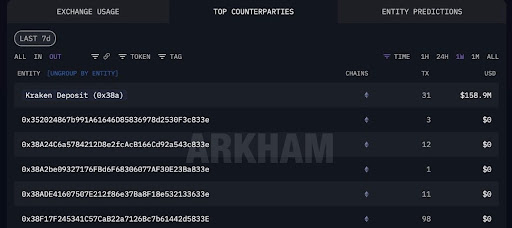
Ethereum flows

What makes this movement even more compelling is that these same wallet addresses had deposited 105,736 ETH, valued at approximately $262.07 million, to Kraken about 10 months ago, when the cryptocurrency was trading around $2,600. The multiple deposit transfers have fueled speculation that Wilcke may be repositioning or preparing to sell a significant portion of his holdings. 
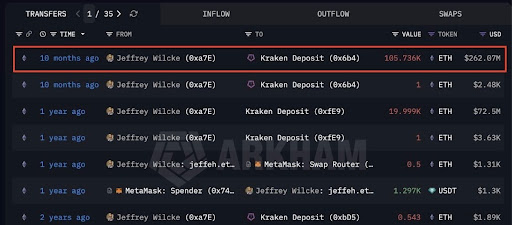
Ethereum deposits

Typically, large-scale deposits of this magnitude at exchanges are widely interpreted by market participants as a signal of possible selling activity ahead. Moreover, this pattern of deposit suggests a deliberate approach to offloading ETH holdings to prevent market volatility. Rather than making one large deposit, Wilcke appears to be spreading his transactions across multiple time periods. This strategy is common among whales looking to sell, as it helps reduce market impact and prevent sudden price drops. 

Despite the large transfer, the Ethereum price remains above $2,000, down more than 6% in the past week. The transaction has also reduced Wilcke’s considerable holdings to 15,737 ETH, valued at approximately $31,832,190, according to Arkham Intelligence. 

ETH Insider Moves Compound Amid Fragile Market

Wilcke’s latest ETH deposit lands against a backdrop of other high-profile Ethereum figures trimming their positions. Most notably, Vitalik Buterin, the founder of Ethereum, had earmarked and later sold over 16,384 ETH, worth more than $45 million at the time in February.

Buterin had publicly stated that the proceeds from the sales would fund open-source software and hardware development focused on sectors such as finance, governance, and biotech. His transparency stands in stark contrast to the ambiguity surrounding Wilcke’s recent ETH transfers. 

Regardless of the underlying purpose behind each transaction, the combined weight of these high-profile insider sell-offs could place significant downward pressure on Ethereum’s price. ETH is currently struggling to hold the $2,000 psychological level, and such strong volatility from sell-offs could trigger further declines and shake investor confidence. Analysts have also projected more downside ahead for the cryptocurrency, especially if it breaks the $2,000 level. 

Ethereum price chart from Tradingview.com
Disclaimer: The articles reposted on this site are sourced from public platforms and are provided for informational purposes only. They do not necessarily reflect the views of MEXC. All rights remain with the original authors. If you believe any content infringes on third-party rights, please contact crypto.news@mexc.com for removal. MEXC makes no guarantees regarding the accuracy, completeness, or timeliness of the content and is not responsible for any actions taken based on the information provided. The content does not constitute financial, legal, or other professional advice, nor should it be considered a recommendation or endorsement by MEXC.

You May Also Like

The Channel Factories We’ve Been Waiting For

The Channel Factories We’ve Been Waiting For

The post The Channel Factories We’ve Been Waiting For appeared on BitcoinEthereumNews.com. Visions of future technology are often prescient about the broad strokes while flubbing the details. The tablets in “2001: A Space Odyssey” do indeed look like iPads, but you never see the astronauts paying for subscriptions or wasting hours on Candy Crush.  Channel factories are one vision that arose early in the history of the Lightning Network to address some challenges that Lightning has faced from the beginning. Despite having grown to become Bitcoin’s most successful layer-2 scaling solution, with instant and low-fee payments, Lightning’s scale is limited by its reliance on payment channels. Although Lightning shifts most transactions off-chain, each payment channel still requires an on-chain transaction to open and (usually) another to close. As adoption grows, pressure on the blockchain grows with it. The need for a more scalable approach to managing channels is clear. Channel factories were supposed to meet this need, but where are they? In 2025, subnetworks are emerging that revive the impetus of channel factories with some new details that vastly increase their potential. They are natively interoperable with Lightning and achieve greater scale by allowing a group of participants to open a shared multisig UTXO and create multiple bilateral channels, which reduces the number of on-chain transactions and improves capital efficiency. Achieving greater scale by reducing complexity, Ark and Spark perform the same function as traditional channel factories with new designs and additional capabilities based on shared UTXOs.  Channel Factories 101 Channel factories have been around since the inception of Lightning. A factory is a multiparty contract where multiple users (not just two, as in a Dryja-Poon channel) cooperatively lock funds in a single multisig UTXO. They can open, close and update channels off-chain without updating the blockchain for each operation. Only when participants leave or the factory dissolves is an on-chain transaction…
Share
BitcoinEthereumNews2025/09/18 00:09
Stablecoins firm as Mastercard enables stablecoin settlement

Stablecoins firm as Mastercard enables stablecoin settlement

The post Stablecoins firm as Mastercard enables stablecoin settlement appeared on BitcoinEthereumNews.com. What Mastercard’s Crypto Partner Program is and how it
Share
BitcoinEthereumNews2026/03/12 10:44
South Africa launches HIV vaccine trial

South Africa launches HIV vaccine trial

South Africa HIV vaccine trial efforts are advancing after researchers launched the first locally developed HIV vaccine study on the continent.   South Africa expands
Share
Furtherafrica2026/03/12 09:30