

Oil Prices Hit Multi-Year Highs as Middle East Conflict Threatens Gulf Supply

TLDR
- Brent crude rose over 4% to $88.85/bbl Friday; WTI jumped 5.3% to $85.31/bbl
- WTI posted its biggest single-day gain since May 2020, up 8.5% on Thursday
- Qatar’s Energy Minister warned Gulf countries could halt production within days
- UBS analysts say oil could exceed $90/bbl if Strait of Hormuz disruptions continue
- Rising oil prices are pushing bond yields higher and weighing on stocks
Oil prices surged again on Friday, adding to sharp gains from the day before, as traders grew more worried about energy supply disruptions in the Middle East.
Brent crude futures rose about 4% to $88.85 per barrel. West Texas Intermediate climbed 5.3% to $85.31 per barrel. Both benchmarks have now gained for five straight trading days. Brent is up 19% over that stretch, while WTI has risen 25%.
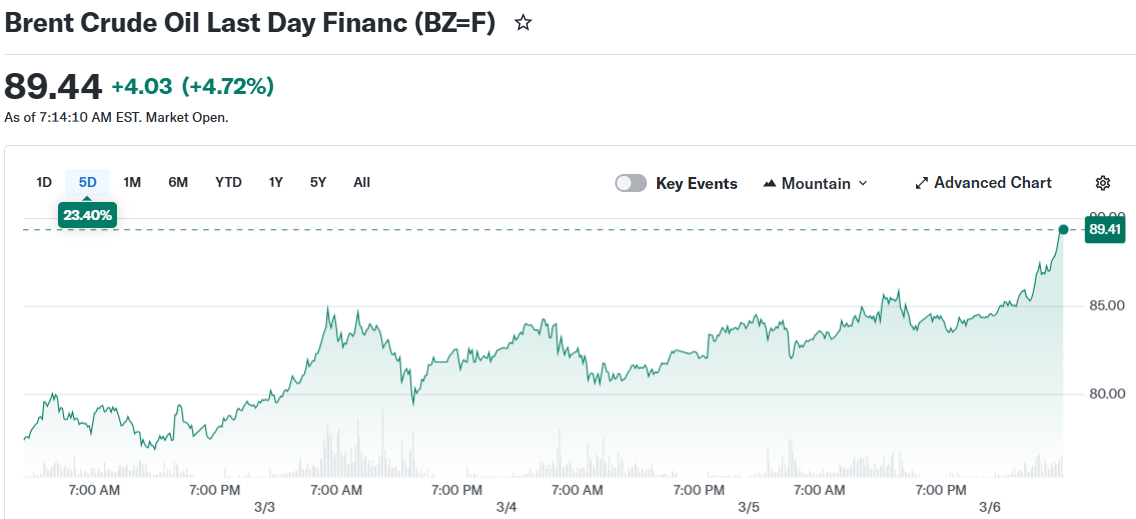 Brent Crude Oil Last Day Financ (BZ=F)
On Thursday, WTI posted its largest single-day gain since May 2020, rising around 8.5%. That move rattled broader financial markets.
Deutsche Bank strategist Jim Reid said the oil rally has pushed investors to reduce their expectations for future interest rate cuts. That has sent bond yields higher on both sides of the Atlantic, while stocks and bonds both fell.
Why Traders Are Worried About Supply
The concern centers on the Strait of Hormuz, a narrow waterway through which roughly 20% of the world’s oil supply passes. Ongoing fighting between Iran and joint U.S.-Israeli forces has raised fears the strait could be closed.
Qatar’s Energy Minister Saad al-Kaabi told the Financial Times on Friday that war in the Middle East could force Persian Gulf countries to halt energy production within days. He warned oil could spike to $150 a barrel if that happens.
Analysts at UBS wrote in a note that they do not see current oil prices as a “stable equilibrium.” If shipping disruptions persist or energy infrastructure is further damaged, prices could move above $90 per barrel, they said.
UBS analysts Mark Haefele and Giovanni Staunovo added that if hostilities stop, prices are likely to fall back, with Brent returning to the $60 to $70 per barrel range.
The U.S. moved to ease some pressure by announcing it would allow the sale of Russian oil to India for 30 days. The U.S. Treasury Department is also expected to announce steps aimed at managing energy prices through financial markets, according to Reuters.
What It Means for Inflation and Rate Cuts
Some investors are now worried that higher oil prices could push up inflation in the U.S., which could delay Federal Reserve interest rate cuts. U.S. bond yields have already moved higher in response, putting pressure on stocks.
UBS analysts said oil prices would need to stay elevated for several months before they would “materially affect growth or inflation.”
However, there are few signs the fighting is slowing. Israel launched strikes at Hezbollah targets in Lebanon and hit Tehran on Friday, while Iran’s Revolutionary Guards launched drones and missiles at Tel Aviv.
The post Oil Prices Hit Multi-Year Highs as Middle East Conflict Threatens Gulf Supply appeared first on CoinCentral.
You May Also Like

Community Banks, Crypto Industry ‘Are Allies’ In CLARITY Act Clash: Exec

Liquidity shock? LIT drops 16% after Justin Sun pulls funds from Lighter
