TLDR Stifel Financial predicts Bitcoin could fall to $38,000, a 43% drop from current levels around $65,000 The call is based on a 15-year trendline connecting TLDR Stifel Financial predicts Bitcoin could fall to $38,000, a 43% drop from current levels around $65,000 The call is based on a 15-year trendline connecting

Bitcoin (BTC) Price Prediction: Stifel Predicts a Drop to $38,000 Using 15 Years of Crash Data

2026/02/26 16:57
4 min read
For feedback or concerns regarding this content, please contact us at crypto.news@mexc.com

TLDR

  • Stifel Financial predicts Bitcoin could fall to $38,000, a 43% drop from current levels around $65,000
  • The call is based on a 15-year trendline connecting the bottom of every major Bitcoin crash since 2010
  • Bitcoin’s correlation with the Nasdaq 100 is now 0.78, meaning it moves more like a tech stock than a hedge
  • U.S. spot Bitcoin ETFs have seen $3.8 billion in outflows over five weeks, including $2.1 billion from BlackRock’s IBIT
  • Bulls counter with targets ranging from $170,000 (JPMorgan) to $250,000 (Tom Lee at Fundstrat)

Stifel Financial, a 136-year-old investment bank, says Bitcoin could fall to $38,000. That would be a 43% decline from its current price near $65,000, and a 70% drop from the October 2025 peak of $126,000.
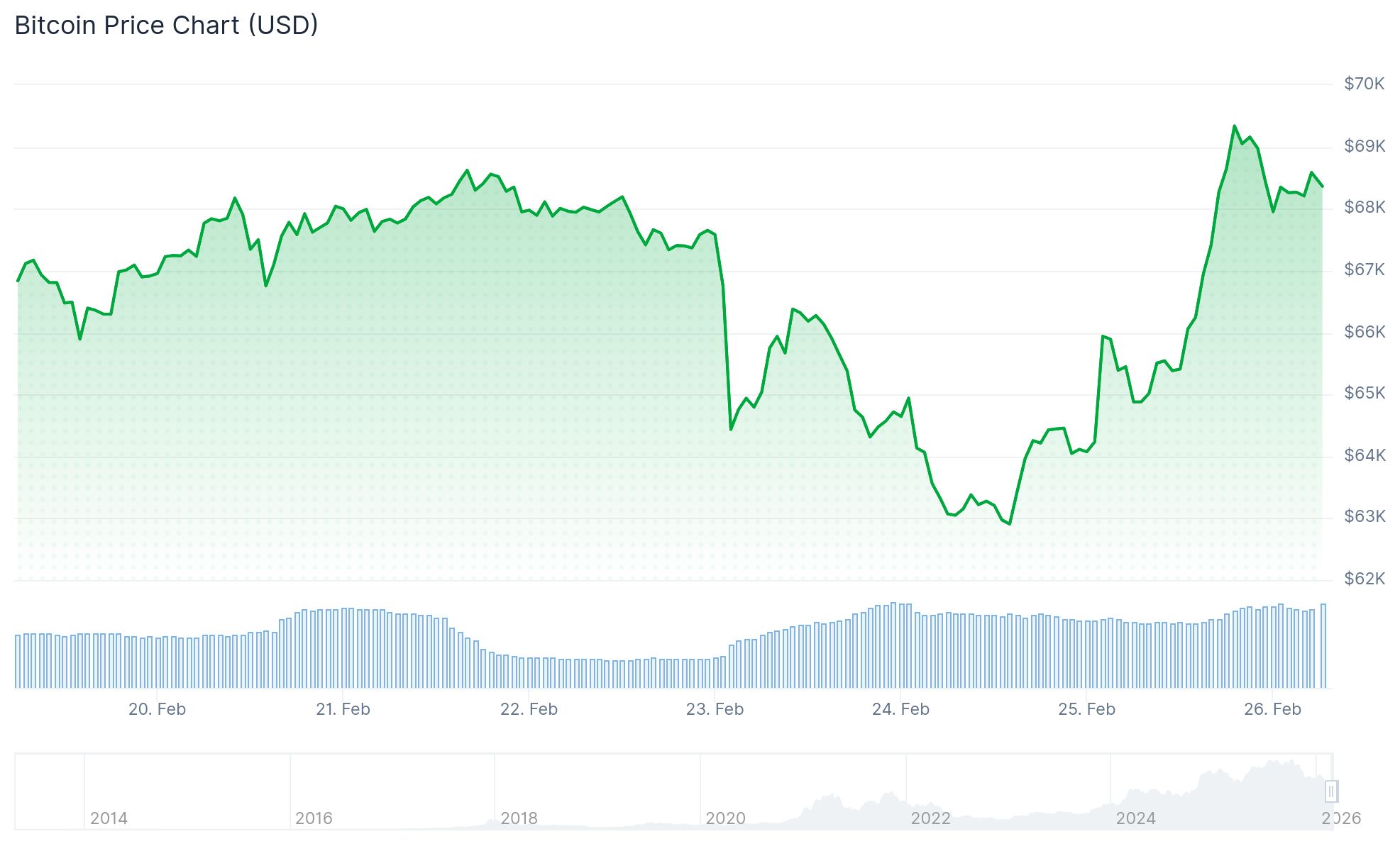
Bitcoin (BTC) PriceBitcoin (BTC) Price

The call comes from Stifel’s chief equity strategist, Barry Bannister. His team drew a trendline through the lowest point of every major Bitcoin crash since 2010 and extended it forward.

The crashes in 2011, 2015, 2018, and 2022 each had different depths, but the floors kept rising over time. That upward-sloping line, when extended to today, lands at $38,000.

Bitcoin dropped 93% in 2011, 84% in 2015, and 83% in 2018. The 2022 crash stopped at around $15,500. Each time, long-term holders bought in at higher levels, raising the floor.

Stifel is not calling this a definitive crash. The firm says the conditions that stopped previous crashes from going deeper are not showing up yet.

Bitcoin Acting More Like a Tech Stock

Bitcoin was once seen as a hedge against a weakening dollar. That relationship has changed.

The Dollar Index dropped nearly 10% in 2025 and another 1% in early 2026, yet Bitcoin fell alongside it instead of rising. Bannister calls this the “Benjamin Button” problem.

Bitcoin’s correlation with the Nasdaq 100 now sits at 0.78. When tech stocks sell off, Bitcoin tends to sell off with them.

The Fed cut rates modestly in December 2025 but kept a hawkish tone. Kevin Warsh’s nomination as Fed Chair points to restrictive policy continuing through 2027. Global M2 money supply is also contracting, reducing the pool of speculative money in markets.

U.S. spot Bitcoin ETFs have logged $3.8 billion in outflows over five weeks. BlackRock’s IBIT alone lost $2.1 billion during that period.

The CLARITY Act, which would have given institutional investors more regulatory certainty, stalled in January after Coinbase withdrew support over stablecoin yield provisions.

What Bitcoin Bulls Are Saying

Not everyone agrees with Stifel’s outlook. JPMorgan sees Bitcoin reaching $170,000 within 6 to 12 months, based on a comparison with gold on a volatility-adjusted basis.

Analyst Nikolaos Panigirtzoglou says Bitcoin is trading roughly $68,000 below fair value relative to gold. He describes it as a mechanical exercise rather than a firm forecast.

Tom Lee at Fundstrat is targeting $200,000 to $250,000 by end of 2026. He points to the April 2024 halving, which historically leads to a price peak 12 to 18 months later.

Arthur Hayes, former BitMEX CEO, also expects Bitcoin to pass $200,000, citing what he sees as stealth quantitative easing from the Fed through Reserve Management Purchases.

Previous bearish calls have overshot before. In 2022, analysts warned of $10,000, but Bitcoin bottomed at $15,760.

Stifel identifies $54,000 as the key breakdown level. A fall through that price could open the path to $45,000, and then $38,000. A move above $58,000 to $60,000 would weaken the bearish case.

Bitcoin is currently sitting near $65,000, with $3.8 billion in ETF outflows recorded over the past five weeks.

The post Bitcoin (BTC) Price Prediction: Stifel Predicts a Drop to $38,000 Using 15 Years of Crash Data appeared first on CoinCentral.

Disclaimer: The articles reposted on this site are sourced from public platforms and are provided for informational purposes only. They do not necessarily reflect the views of MEXC. All rights remain with the original authors. If you believe any content infringes on third-party rights, please contact crypto.news@mexc.com for removal. MEXC makes no guarantees regarding the accuracy, completeness, or timeliness of the content and is not responsible for any actions taken based on the information provided. The content does not constitute financial, legal, or other professional advice, nor should it be considered a recommendation or endorsement by MEXC.

You May Also Like

Satoshi-Era Mt. Gox’s 1,000 Bitcoin Wallet Suddenly Reactivated

Satoshi-Era Mt. Gox’s 1,000 Bitcoin Wallet Suddenly Reactivated

The post Satoshi-Era Mt. Gox’s 1,000 Bitcoin Wallet Suddenly Reactivated appeared on BitcoinEthereumNews.com. X account @SaniExp, which belongs to the founder of the Timechain Index explorer, has published data showing that a dormant BTC wallet was activated after hibernating for six years. However, it was set up 13 years ago, according to the tweet — the time when Satoshi Nakamoto’s shadow was still casting itself around, so to speak. The X post states that the tweet belongs to infamous early Bitcoin exchange Mt. Gox, which suffered from a major hack in the early 2010s, and last year it began paying out compensation to clients who lost their crypto in that hack. The deadline was eventually extended to October 2025. Mt. Gox’s wallet with 1,000 BTC reactivated The above-mentioned data source shared a screenshot from the Timechain Index explorer, showing multiple transactions marked as confirmed and moving a total of 1,000 Bitcoins. This amount of crypto is valued at $116,195,100 at the time of the initiated transaction. Last year, Mt. Gox began to move the remains of its gargantuan funds to pay out compensations to its creditors. Earlier this year, it also made several massive transactions to partner exchanges to distribute funds to Mt. Gox investors. All of the compensations were promised to be paid out by Oct. 31, 2025. The aforementioned transaction is likely preparation for another payout. The exchange was hacked for several years due to multiple unnoticed security breaches, and in 2014, when the site went offline, 744,408 Bitcoins were reported stolen. Source: https://u.today/satoshi-era-mtgoxs-1000-bitcoin-wallet-suddenly-reactivated
Share
BitcoinEthereumNews2025/09/18 10:18
The U.S. Department of Defense has appointed a former DOGE official as Chief Data Officer to lead efforts in the field of AI.
The U.S. Department of Defense has appointed a former DOGE official as Chief Data Officer to lead efforts in the field of AI.

PANews reported on March 7 that, according to Reuters, the U.S. Department of Defense has appointed computer scientist Gavin Kliger as chief data officer. Kliger
Share
PANews2026/03/07 21:00
Fed Makes First Rate Cut of the Year, Lowers Rates by 25 Bps

Fed Makes First Rate Cut of the Year, Lowers Rates by 25 Bps

The post Fed Makes First Rate Cut of the Year, Lowers Rates by 25 Bps appeared on BitcoinEthereumNews.com. The Federal Reserve has made its first Fed rate cut this year following today’s FOMC meeting, lowering interest rates by 25 basis points (bps). This comes in line with expectations, while the crypto market awaits Fed Chair Jerome Powell’s speech for guidance on the committee’s stance moving forward. FOMC Makes First Fed Rate Cut This Year With 25 Bps Cut In a press release, the committee announced that it has decided to lower the target range for the federal funds rate by 25 bps from between 4.25% and 4.5% to 4% and 4.25%. This comes in line with expectations as market participants were pricing in a 25 bps cut, as against a 50 bps cut. This marks the first Fed rate cut this year, with the last cut before this coming last year in December. Notably, the Fed also made the first cut last year in September, although it was a 50 bps cut back then. All Fed officials voted in favor of a 25 bps cut except Stephen Miran, who dissented in favor of a 50 bps cut. This rate cut decision comes amid concerns that the labor market may be softening, with recent U.S. jobs data pointing to a weak labor market. The committee noted in the release that job gains have slowed, and that the unemployment rate has edged up but remains low. They added that inflation has moved up and remains somewhat elevated. Fed Chair Jerome Powell had also already signaled at the Jackson Hole Conference that they were likely to lower interest rates with the downside risk in the labor market rising. The committee reiterated this in the release that downside risks to employment have risen. Before the Fed rate cut decision, experts weighed in on whether the FOMC should make a 25 bps cut or…
Share
BitcoinEthereumNews2025/09/18 04:36