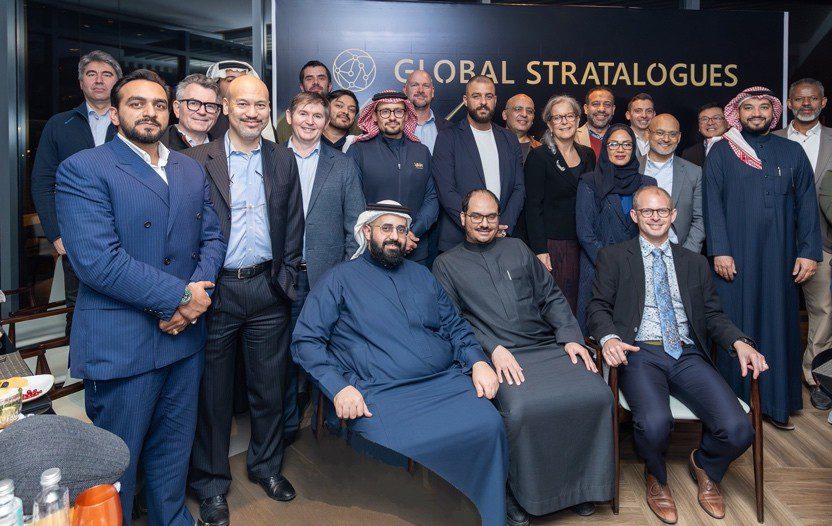
Global Stratalogues Advanced Air Mobility Roundtable in Riyadh
Two strategic reports translate digital asset policy and Advanced Air Mobility into scalable, investable infrastructure models.
In early 2026, Global Stratalogues marked the launch of two major reports in two of the world’s most strategically significant convening arenas: World Economic Forum week in Davos and the World Defense Show in Riyadh, reinforcing its emphasis on structured public–private dialogue and implementation-oriented policy design.
While distinct in sector focus, digital asset governance in Davis and Advanced Air Mobility (AAM) in Riyadh, both reports share a common institutional thesis: transformative technologies only reach scale when governance, infrastructure, and capital frameworks evolve in parallel.
Global Stratalogues Welcoming Dinner for Global Airports Forum hosted by Nabil Arnous of Innovation City
Davos: From Digital Asset Innovation to Governance at Scale
Held alongside the World Economic Forum in Davos from 19–22 January, the 9th Annual Global Blockchain Business Council (GBBC) Blockchain Central at the Mountain Plaza Hotel and the Belvedere provided the setting for the launch of Digital Assets Policy Roundtable: A Turning Point for Digital Asset Governance.
The report synthesizes insights from a closed-door policy roundtable convened in Singapore under the Chatham House Rule. By launching the report in Davos, the findings were placed squarely within the broader context of global economic governance—bridging regional regulatory dialogue in Asia with international policy coordination.
Tom Wright, Investigative Journalist and Co-author of Billion Dollar Whale speaks at Global Stratalogues in Singapore
Building the Institutional Backbone of the Digital Asset Economy
The report identifies several structural fault lines shaping the next phase of digital asset adoption including cross-border interoperability, DAO accountability and enforceable governance, integration of AI-enabled compliance tools, and Regulatory arbitrage and cross-border enforcement gaps.
A central concept emerging from the Singapore discussions was “compliance by design.” Rather than retrofitting supervisory controls after deployment, contributors argued that auditability, legal certainty, and supervisory access must be embedded directly into infrastructure architecture. Participants converged on scalable tokenization depends on enforceable rights and regulatory-grade data integrity. Without these, institutional adoption remains structurally constrained.
Riyadh: Advanced Air Mobility as Infrastructure, Not Experiment
In Riyadh, Global Stratalogues launched Advanced Air Mobility in the Gulf at the World Defense Show in Riyadh, positioning AAM within the Kingdom’s broader infrastructure and industrial transformation agenda.
The report captures outcomes from a closed-door roundtable held on 16 December 2025 during the Global Airports Forum in Riyadh. The report charts a framework for transforming AAM “from aspiration into investable infrastructure.”
Moderated by Oscar Wendel, Founder and Chairman of Global Stratalogues, alongside Fawaz AlSaleh, Managing Director of Aeronautica, the discussion anchored AAM within operational aviation realities. A central conclusion was that AAM is not simply an aircraft innovation story but a multi-layered investment ecosystem. As the report notes, viable deployment requires phased corridor pilots, regulatory sandboxes, and structured public–private partnerships to achieve commercial scale while safeguarding safety and public trust.
Hassan Al-Johani, Vice President of Business Development at Neo Space Group (NSG) said:
“What distinguished the Riyadh discussion was its operational realism: a shared commitment to moving Advanced Air Mobility from concept to implementation. The depth of discussion reflected a clear shift from visionary narratives to practical questions around regulation, infrastructure integration, and commercial viability.”
The report situates Saudi Arabia’s ambitions within a wider GCC context while identifying the Kingdom’s opportunity to position itself as a reference market for regulated, large-scale AAM deployment aligned with Vision 2030 objectives
Daniyal Qureshi, Co-founder of Global Airports Forum, commented: “As a platform focused on the future of airport ecosystems, Global Airports Forum was pleased to host a discussion that treated Advanced Air Mobility as an infrastructure and systems challenge—not just an aircraft innovation. The outcomes reinforce the importance of coordinated planning between regulators, airports, and industry to ensure safe, scalable, and commercially viable AAM deployment.”
The report concludes with a practical roadmap for the next phase of development, including the formation of a dedicated national AAM task force, phased corridor pilots under regulator oversight, investment in modular vertiport infrastructure, workforce training pipelines, and transparent publication of operational data to build confidence and refine standards over time.
From Innovation Narrative to Institutional Architecture
In both Singapore (digital assets) and Riyadh (Advanced Air Mobility), the underlying roundtables ensured that discussions were not merely thematic but structured around governance design, implementation pathways, and capital formation.
The launches in Davos and Riyadh reflect a coherent Global Stratalogues positioning. Whether addressing digital assets or Advanced Air Mobility, the emphasis is on: Governance frameworks that match technological complexity. In Davos, digital asset governance was framed as an issue of financial architecture and supervisory design. In Riyadh, Advanced Air Mobility was reframed as a systems-integration challenge requiring coordinated infrastructure investment.
The 9th Annual Blockchain Central Davos was held at the Mountain Plaza Hotel and the Belvedere in partnership with Global Stratalogues
Both reports move beyond enthusiasm for innovation toward the harder, structural questions: Who regulates? Who finances? Who integrates? Who bears liability? And how do frameworks scale beyond pilot projects?
As global capital increasingly seeks clarity in emerging technology sectors, the answer in both cases is the same: innovation without governance stalls; governance aligned with infrastructure attracts investment. Through its dual launches in Davos and Riyadh, Global Stratalogues has signaled a deliberate pivot, from dialogue to governance, and from ambition to implementation.
The reports are available for download on: www.GlobalStratalogues.com
About Global Stratalogues
Global Stratalogues is an independent international forum and think tank that convenes senior leaders from government, industry, finance, and academia to support implementation-focused dialogue aligned with national transformation agendas. Global Stratalogues works closely with governments, public institutions, strategic partners, and industry stakeholders to translate long-term vision into executable frameworks across priority sectors. Through closed-door, Chatham House Rule roundtables and published event reports, Global Stratalogues supports evidence-based policymaking, investor confidence, and public–private coordination for next-generation technologies deployed at scale. Previous Global Stratalogues roundtables have been held at the UK House of Lords and House of Commons, in Davos, with Qatar Financial Center (QFC) alongside the Qatar Economic Forum, in Venice, Singapore, at the UN in Geneva, and at the French Ministry of Economy in Paris.
www.GlobalStratalogues.com