China went to shut the door on yuan-pegged stablecoins, with the central bank and seven regulators issuing a joint ban on unapproved stablecoin and tokenised RWAChina went to shut the door on yuan-pegged stablecoins, with the central bank and seven regulators issuing a joint ban on unapproved stablecoin and tokenised RWA

Why Is Crypto Crashing in February 2026? China Slams the Door on Stablecoins and Galaxy Buys the Dip, but DeepSnitch AI is Still Gearing for 1000x Run in Q1 After Launch

2026/02/09 23:30
8 min read

China went to shut the door on yuan-pegged stablecoins, with the central bank and seven regulators issuing a joint ban on unapproved stablecoin and tokenised RWA issuance while steering activity toward the digital yuan. Days later, in early February, Galaxy Digital authorised a $200M share buyback after posting a $482M quarterly loss and seeing its stock fall 25% in a month.

So, why is crypto crashing right now? Two forces smashing into each other: regulatory compression from the East and leverage liquidations across the West. BTC tumbled to a low near $60,300. Coinbase stock is down 36%, and Strategy posted a $12.4B quarterly loss. The crypto market crash explained in a nutshell is: too much leverage chasing too little substance.

But DeepSnitch AI has raised above $1.5M at $0.03906, with five AI agents already live, staking active, and full launch bearing down. When the question is why is crypto crashing, the sharper question might be, what’s still being built to last and to climb like no other token?

China’s stablecoin crackdown collides with Galaxy’s $200M buyback and cascading leverage liquidations

China’s ban is the latest strike in a deliberate multi-year project to centralise all digital currency activity under the e-CNY. Former CIC Managing Director Winston Ma confirmed the rule covers both onshore (CNY) and offshore (CNH) yuan markets. Beijing briefly flirted with allowing private stablecoins in August 2025, reversed course by September, and in January 2026 approved banks to pay interest on digital yuan wallets. The carrot was the e-CNY interest, and this ban is the stick.

And Galaxy’s $200M buyback is sending mixed signals, as CEO Mike Novogratz insists the company enters 2026 from a position of strength. But it’s also worth noting a $241M annual loss for 2025, shares down 25% in a month, and Strategy posting a $12.4B quarterly loss, as mining stocks like MARA are off roughly 27% over 30 days.

Here’s the crypto market crash explained plainly: overleveraged institutions unwinding into regulatory headwinds. For large-cap holders, this is a painful grind. But if you’re watching this and thinking about pre-market entries, the conditions are arguably ideal, particularly when a project like DeepSnitch AI is shipping live tools at a price that hasn’t absorbed any of the macro turbulence yet.

Why is crypto crashing? Token comparison to evaluate what’s worth buying in early 2026

1. DeepSnitch AI

If Bitcoin price updates are dampening your mood lately, you’re in good company. Every headline seems to amplify fear, and eking out trades on the majors has become a patience test. But that’s exactly why more traders are rotating attention toward presales instead of fighting the chop.

DeepSnitch AI has been one of the standouts with all this in mind, and even with the broader market wobbling. The presale keeps powering forward, having now locked in $1.5M at a $0.03906 entry. This momentum is easy to spot for what it could entail, namely, a moonshot token with the potential to rake in incredible rewards on the back of its utility.

Once live, the platform will run five AI agents, or “snitches,” designed by expert on-chain analysts to help retail traders equip themselves with an information edge, guidance, and certainty-in-trading (as much as you can have) like never before. And there’s no doubt about the credibility of DeepSnitch AI, as the platform is already shipping tools built to audit contracts, score risk, and track sentiment in real time.

Actually using it is refreshingly simple, as early holders who already have access to the platform will know well.

As Galaxy needs a $200M buyback programme to prop up its share price, DeepSnitch AI needs a tiny fraction of that capital to send its price multiples higher at presale scale. The crash is temporary, but the tools are permanent, and this token isn’t going anywhere. Instead, it has a 1000x run on the cards after it launches, and that launch is days away at the time of writing. 

2. Tron

While everything else was getting hammered, Tron did what Tron does and managed to survive. On February 6, TRX was trading at around $0.274 after a modest 1.2% uptick, outpacing a market that was broadly treading water. As the dominant settlement layer for USDT, Tron’s transactional utility gives it a floor that most altcoins can only dream of. 

If TRX holds above $0.269, a retest of $0.281 looks feasible. But forecasts paint a sobering picture of roughly $0.268 by year-end, which is essentially sideways. And China’s freshly minted stablecoin ban introduces a genuine wildcard, where if regulatory pressure trickles into the Asian stablecoin corridors where Tron dominates, the knock-on effects could cap any recovery before it gets going. 

Tron is resilient, absolutely. But it’s not a moonshot from here.

3. Stellar

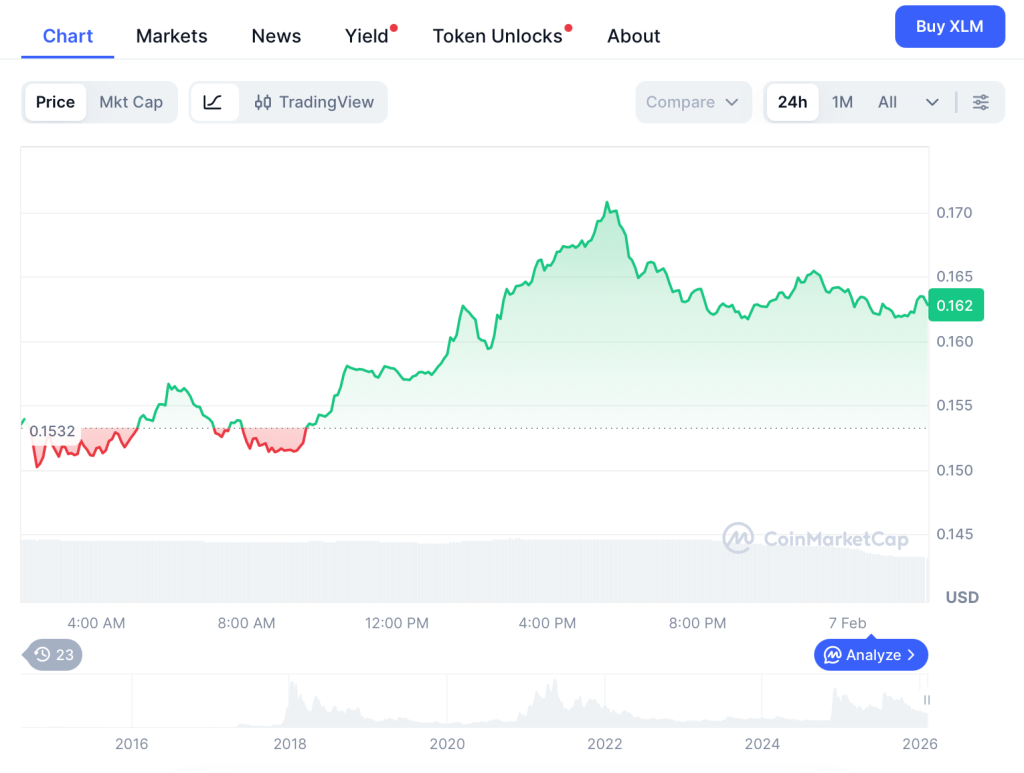
Stellar had the more dramatic day of the two, surging around 12% to $0.165 on February 6, caught in a violent market-wide short squeeze that liquidated above $954M in shorts across the board. XLM’s 96.9% correlation with the S&P 500 confirms this was a macro wave, full stop, not a Stellar-specific moment. 

The cross-border payments infrastructure underneath is elegant and genuinely useful for remittance corridors, and the network has been reliable for years. But the token has been one of the most frustrating underperformers relative to its thesis in all of crypto. 

From here, roughly $0.18 by year-end, or about 11% upside, is projected. If XLM holds above the $0.1538 pivot, a test of the 7-day SMA near $0.174 is in play. But if you’re asking why is crypto crashing and trying to figure out where to deploy capital for maximum impact, 11% annualised is not the answer. 

A pre-launch AI presale at $0.03906 with live utility, uncapped staking, and imminent launch is an entirely different opportunity, and it’s all DeepSnitch AI’s.
Final say

China is banning stablecoins, as Galaxy is buying back stock after a $241M annual loss. Leverage liquidations are still cascading, too. When the question is why is crypto crashing?, the answer is always some version of too much leverage meeting too little substance. 

DeepSnitch AI is the direct counter to this, with powerful tools, many of which have already shipped internally, and pre-market pricing where the downside is anchored by what’s already been built and the upside has no ceiling.

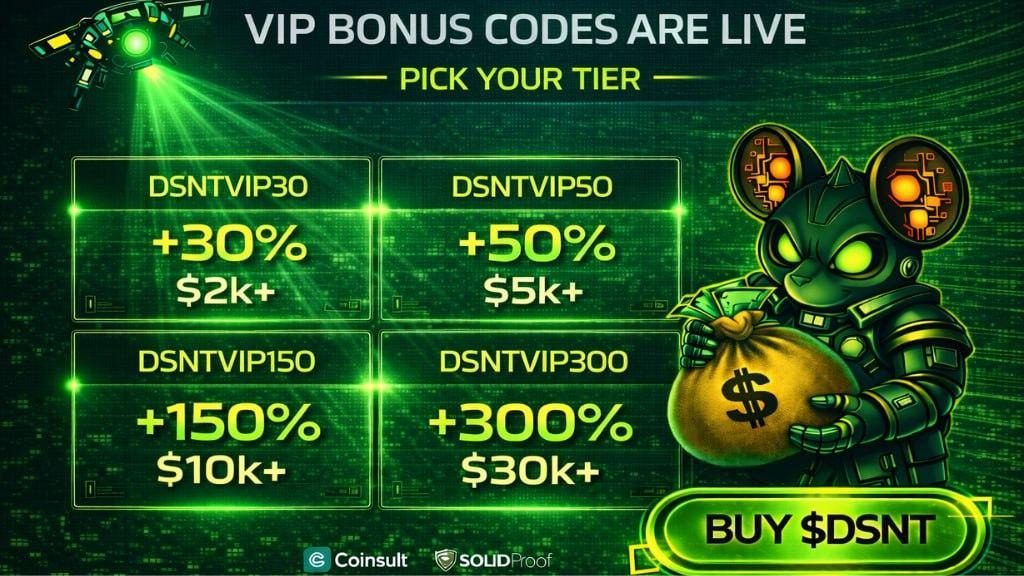
The price of $0.03906 won’t stick around for long with the presale already clearing $1.5M. Buyers committing $30K or more can amplify their exposure using a host of bonus codes, all available on the website.

Lock in your early-stage entry on the official website, and stay ahead of the launch via X and Telegram.
FAQs

Why is crypto crashing in February 2026? 

The crash is coming, at least in part, from leverage liquidations, Bitcoin ETF outflows topping $690M weekly, and fresh regulatory tightening, including China’s comprehensive ban on yuan-pegged stablecoins and tokenised RWAs. But DeepSnitch AI’s presale operates outside this dynamic, offering a pre-market entry insulated from the risk-off sentiment dragging established tokens down. 

Is it smart to buy crypto during a market crash? 

Historically, crashes produce the strongest entry points for projects with real utility. DeepSnitch AI’s presale at $0.03906 offers asymmetric upside still, and if the crypto market crash explained could be summed up in one line, it’s this: overleveraged positions unwind, quality projects survive, and early holders benefit most. DeepSnitch AI is built for exactly this.

What does China’s stablecoin ban mean for the crypto market? 

China banned all unapproved yuan-pegged stablecoins and tokenised RWAs, pushing digital currency activity toward the state-controlled e-CNY. This could pressure Asian stablecoin corridors relevant to TRX and XLM, but it has no direct impact on AI-focused projects like DeepSnitch AI, which derives its value from platform utility and adoption rather than fiat-pegged token flows. If you’re asking why is crypto crashing and what’s immune to the answer, utility-driven presales are a strong place to look.

DISCLAIMER: CAPTAINALTCOIN DOES NOT ENDORSE INVESTING IN ANY PROJECT MENTIONED IN SPONSORED ARTICLES. EXERCISE CAUTION AND DO THOROUGH RESEARCH BEFORE INVESTING YOUR MONEY. CaptainAltcoin takes no responsibility for its accuracy or quality. This content was not written by CaptainAltcoin’s team. We strongly advise readers to do their own thorough research before interacting with any featured companies. The information provided is not financial or legal advice. Neither CaptainAltcoin nor any third party recommends buying or selling any financial products. Investing in crypto assets is high-risk; consider the potential for loss. Any investment decisions made based on this content are at the sole risk of the readCaptainAltcoin is not liable for any damages or losses from using or relying on this content.

The post Why Is Crypto Crashing in February 2026? China Slams the Door on Stablecoins and Galaxy Buys the Dip, but DeepSnitch AI is Still Gearing for 1000x Run in Q1 After Launch appeared first on CaptainAltcoin.


Disclaimer: The articles reposted on this site are sourced from public platforms and are provided for informational purposes only. They do not necessarily reflect the views of MEXC. All rights remain with the original authors. If you believe any content infringes on third-party rights, please contact service@support.mexc.com for removal. MEXC makes no guarantees regarding the accuracy, completeness, or timeliness of the content and is not responsible for any actions taken based on the information provided. The content does not constitute financial, legal, or other professional advice, nor should it be considered a recommendation or endorsement by MEXC.

You May Also Like

Altcoin Rally Will Come Only When This Coin Makes ATH

Altcoin Rally Will Come Only When This Coin Makes ATH

The post Altcoin Rally Will Come Only When This Coin Makes ATH appeared on BitcoinEthereumNews.com. The crypto market is buzzing with talk of an altcoin season, but one prominent analyst says the true rally will only come after Ethereum hits a new all-time high. According to renowned crypto analyst Benjamin Cowen, a genuine altcoin season, like those seen in late 2017 and 2021, depends on three key conditions. The first is for Ethereum to not just break its all-time high (ATH), but to sustain a durable price above it. The second is a decline in Bitcoin dominance. And the third is the emergence of clear signs of crypto market rotation. Cowen emphasizes that Ethereum’s movement is the single most important factor for triggering a major altcoin season. He believes the current calls for an altcoin season are premature because Ethereum has yet to achieve a lasting ATH. Sponsored Sponsored Cowen expects Ethereum might briefly push above the $5,000 mark but must “check back in” with its 21-week exponential moving average (EMA) during a correction to build a robust rally. Cowen also believes an altcoin season is unlikely in October. Historically, Bitcoin dominance has seen its biggest monthly increase in October, rising by an average of 5%. He says the market should only expect an altcoin season after Bitcoin dominance begins to decline and a clear rotation into altcoins begins. Cowen also shared his outlook for the top of the current bull cycle. He explained that past cycles have tended to peak in the fourth quarter of the year following a halving, a pattern seen in 2013, 2017, and 2021. This suggests that the current cycle’s peak will likely arrive in the fourth quarter of this year. In terms of days, the current rally is 1,041 days old, while the previous two cycles topped out at 1,059 and 1,067 days, respectively. Cowen’s Forecast for the Coming…
Share
BitcoinEthereumNews2025/09/19 20:48
AI Data Centers: Unleashing Billions in a Revolutionary Tech Investment Wave

AI Data Centers: Unleashing Billions in a Revolutionary Tech Investment Wave

BitcoinWorld AI Data Centers: Unleashing Billions in a Revolutionary Tech Investment Wave In the rapidly evolving digital landscape, where breakthroughs are measured in petabytes and processing power, a monumental shift is underway that echoes the early days of crypto innovation: the unprecedented investment in AI Data Centers. Just as blockchain technology reshaped our understanding of decentralized finance, artificial intelligence is now redefining infrastructure, demanding colossal resources and attracting billions in capital. For those plugged into Bitcoin World, understanding this seismic shift isn’t just about tracking tech trends; it’s about recognizing the foundational changes that will power the next generation of digital economies and potentially influence everything from trading algorithms to network security. Understanding the AI Data Centers Phenomenon The sheer scale of capital flowing into AI Data Centers is staggering. Recent reports, like the purported $100 billion commitment for OpenAI’s compute infrastructure, highlight a level of investment previously unimaginable. These aren’t your typical server farms; AI Data Centers are highly specialized facilities, optimized for the intensive computational demands of machine learning models. They require: Massive GPU Clusters: Unlike traditional CPUs, GPUs are adept at parallel processing, crucial for training complex AI models. Advanced Cooling Systems: The heat generated by these powerful processors necessitates sophisticated cooling solutions. High-Bandwidth Networking: Moving vast datasets between servers and storage requires ultra-fast network infrastructure. Sustainable Power Solutions: The energy consumption is immense, driving demand for greener and more efficient power sources. These facilities are the bedrock upon which the future of AI will be built, enabling everything from advanced generative AI to autonomous systems. The race to build and expand these centers signifies a profound belief in AI’s transformative power and its potential to reshape global industries. Fueling the Future: The Surge in AI Infrastructure Beyond the physical walls of AI Data Centers, the entire AI Infrastructure ecosystem is experiencing an unprecedented surge. This includes not only the hardware—like NVIDIA’s cutting-edge GPUs and custom AI chips from companies like Google and Amazon—but also the intricate software layers, specialized networking solutions, and robust cybersecurity measures required to protect and manage these complex systems. The demand for this infrastructure is driven by: Rapid AI Model Development: As models grow larger and more sophisticated, so does their computational appetite. Enterprise AI Adoption: Businesses across sectors are integrating AI, from customer service chatbots to predictive analytics, requiring scalable infrastructure. Cloud AI Services: Major cloud providers (AWS, Azure, GCP) are heavily investing to offer AI-as-a-service, making powerful AI accessible to more users. This comprehensive build-out of AI Infrastructure is not merely about capacity; it’s about creating a resilient, efficient, and secure foundation that can support the next wave of AI innovation, making it a critical area for observation for anyone tracking major tech shifts and their impact on the digital economy. Decoding the Massive AI Investment Landscape The sheer volume of AI Investment is perhaps the most telling sign of the times. We’re witnessing a multi-faceted financial commitment from venture capitalists, tech giants, and even sovereign wealth funds. This isn’t just about funding startups; it’s about strategic long-term plays in foundational technology, reflecting a global belief in AI’s inevitable dominance. Consider the following aspects of this investment surge: Corporate Spending: Tech titans like Microsoft, Google, and Amazon are pouring billions into their AI divisions and infrastructure, securing their positions at the forefront. Startup Funding: AI startups continue to attract massive rounds, often with valuations soaring into the billions before product launch, indicating high market confidence. Government Initiatives: Nations are recognizing AI as a strategic imperative, allocating funds for research, development, and infrastructure to maintain competitive edges. This influx of capital is creating a self-reinforcing cycle: more investment leads to more innovation, which in turn attracts more investment. The implications for the global economy, including sectors relevant to cryptocurrency, are profound, as this AI Investment fuels new applications and potentially new digital assets. Is This the New AI Gold Rush? The term ‘AI Gold Rush‘ is frequently used, and for good reason. The parallels to historical periods of rapid expansion and wealth creation are striking. From the California Gold Rush to the dot-com boom, moments of transformative technology often spark frenzied activity. Today, the ‘gold’ is computational power, data, and skilled expertise, driving an unprecedented scramble for resources. What defines this AI Gold Rush? Rapid Value Creation: Companies leveraging AI are seeing exponential growth in valuation and market cap, often outpacing traditional industries. Intense Competition: The race to acquire resources—compute, talent, data—is fierce, leading to soaring costs and aggressive acquisition strategies. Speculative Investment: While much investment is strategic, there’s also an element of speculative capital chasing the next big AI breakthrough, reminiscent of past tech booms. Infrastructure Scramble: The urgent need for robust AI Infrastructure is creating immense opportunities for hardware manufacturers, cloud providers, and energy companies. While the opportunities are immense, like any gold rush, there are inherent risks. Over-speculation, unsustainable business models, and the potential for market correction are factors that savvy investors, including those in the crypto space, are carefully monitoring. The long-term winners will be those who build sustainable value amidst the frenzy. Navigating the AI Talent Shuffle: Challenges and Opportunities Amidst the hardware and capital, the human element—AI Talent—remains arguably the most critical and most expensive resource. The demand for skilled AI engineers, researchers, and data scientists far outstrips supply, leading to unprecedented competition for top professionals. The article’s mention of $100,000 visa fees is a stark illustration of how far companies are willing to go to secure the best minds globally. The AI Talent shuffle presents: Skyrocketing Salaries: Top AI professionals command salaries rivaling executive compensation, reflecting their value. Global Competition: Companies are recruiting globally, leading to brain drain concerns in some regions and fostering international talent wars. Upskilling Imperative: Existing workforces face pressure to adapt and acquire AI-related skills to remain relevant in an evolving job market. Ethical Considerations: As AI becomes more powerful, the need for ethical AI developers who understand its societal impact becomes paramount for responsible innovation. This intense focus on AI Talent acquisition and development underscores that while machines may be learning, human ingenuity and expertise are still the ultimate drivers of innovation in this transformative field. For crypto enthusiasts, understanding the flow of this talent can indicate where the next wave of innovation in decentralized AI or blockchain-AI integration might emerge, shaping future projects and ecosystems. The narrative of billions being poured into AI Data Centers and the broader AI Infrastructure is not just a fleeting headline; it’s a foundational story shaping the future of technology. From the strategic AI Investment driving unprecedented growth to the intense competition defining the AI Gold Rush, and the crucial scramble for AI Talent, every aspect points to a paradigm shift. As discussed on Bitcoin World’s ‘Equity’ podcast, this isn’t merely an expansion; it’s a redefinition of what’s possible, impacting every industry, including the burgeoning world of digital assets. The coming years will undoubtedly reveal the full extent of AI’s transformative power, making this a pivotal moment for observation and strategic engagement. To learn more about the latest AI market trends, explore our article on key developments shaping AI features and institutional adoption. This post AI Data Centers: Unleashing Billions in a Revolutionary Tech Investment Wave first appeared on BitcoinWorld.
Share
Coinstats2025/09/27 01:55
England’s Titanic Hitters Cruise Past Ireland In First T20 At Malahide

England’s Titanic Hitters Cruise Past Ireland In First T20 At Malahide

The post England’s Titanic Hitters Cruise Past Ireland In First T20 At Malahide appeared on BitcoinEthereumNews.com. DUBLIN, IRELAND – SEPTEMBER 17: Phil Salt of England hits out for six runs watched by Ireland wicketkeeper Lorcan Tucker during the first T20 International match between Ireland and England at Malahide Cricket Club on September 17, 2025 in Dublin, Ireland. (Photo by Gareth Copley/Getty Images) Getty Images England continued their brutal form in T20 internationals after they beat Ireland on Wednesday in the first of a three-match series. A trip across the Irish sea was a gentle introduction for stand-in captain Jacob Bethell as his side completed a comprehensive four-wicket win over the Green and Whites within the attractive environment of Malahide Castle and Gardens. England have now scored over 500 runs in the last two T20s. They mauled South Africa at Manchester last Tuesday, recording the highest score by a Full Member nation in the format. Phil Salt, who belted 141 at Old Trafford, fell 11 runs short of another century in his quest to be the best T20 batter in the world. Salt swiped his bat against his pad in anger as he walked off, but he has smashed a combined 12 sixes and 25 fours in those knocks. Ireland had batted well, scoring 25 boundaries after a relatively subdued powerplay. Lorcan Tucker averages over 40 in Test cricket, and his multi-format skills had a breezy outing here. The wicketkeeper hit a splendid 55 as he put on a stand of 123 with Harry Tector, who made 63. The only black mark against England was the bowling effort. Adil Rashid suffered more than usual in the truncated series against the Proteas, and he chucked in some ropey deliveries in North Dublin too. Jamie Overton has taken himself out of red-ball selection, but he was wayward in length. Sam Curran, England’s bits and pieces specialist, didn’t have his…
Share
BitcoinEthereumNews2025/09/18 07:53