

Arthur Hayes Puts $100K On Hyperliquid (HYPE) Outrunning Every $1B+ Altcoin
Arthur Hayes is turning a long-running debate about Hyperliquid into a price-denominated wager, staking $100,000 that HYPE will beat every altcoin with a $1 billion-plus market cap over a defined window.
“Since HYPE is bad Kyle Samani let’s make a bet,” Hayes wrote on X. “I bet that from 00:00 UTC 10 Feb 2026 to 00:00 UTC 31 July 2026 $HYPE will out perform any shitcoin >$1bn mcap on coingecko in USD terms. You choose your champion. Loser donates $100k to a charity of the winner’s choice.”
Hayes’ post landed in the wake of a pointed takedown from Multicoin Capital co-founder Kyle Samani, who called Hyperliquid “in most respects everything wrong with crypto,” while listing objections “Founder literally fled his home country to build, openly facilitates crime and terror, closed source, permissioned.”
Why Hyperliquid Could Be Superior
The sparring unfolded alongside a separate thread of bullish commentary on Hyperliquid’s push into non-crypto derivatives via HIP-3, a product line that has begun listing equity and commodity perpetuals. Blockworks analyst Shaunda Devens, whose research was shared by Jon Charbonneau, argued that HIP-3 is already pulling meaningful activity outside pure crypto flow.
In devens’ analysis of HIP-3 silver perpetuals versus CME/COMEX Micro Silver futures, Hyperliquid is framed less as a meme-driven venue and more as an attempt to build an always-on, order-driven derivatives market for traditional underlyings. The report notes that “TradFi instruments now [account for] 31% of venue volume” with “daily notional above $5B,” positioning the silver contract as a stress test of whether those markets can hold up when the underlying is moving fast.
“Pre-crash, Hyperliquid was competitive at top-of-book for the sizes that dominate perp flow,” the report said, citing a 2.4 bps median spread versus 3 bps on COMEX, and “median slippage was 0.5 bps from the benchmark.” But it also emphasized the capacity gap: roughly “~$230k within ±5 bps on Hyperliquid vs. ~$13M on COMEX,” a difference that matters as clip sizes rise.
That trade-off sharpened during a violent silver selloff, when the report says both venues degraded but Hyperliquid developed a heavier execution tail. It cites a brief dislocation of more than 400 bps versus the benchmark before mean reversion via funding, and notes that “1% of Hyperliquid trades printed >50 bps from mid, vs. none on COMEX.”
Hayes’ wager effectively reframes the dispute: not whether Hyperliquid is philosophically “good” or “bad,” but whether its growth narrative, especially around 24/7 access to non-crypto risk, translates into token outperformance relative to large-cap peers.
If the next six months validate the thesis embedded in HIP-3: tight execution for retail-weighted flow, continuous trading when legacy venues are closed, and a path to less cycle-sensitive revenue, HYPE’s relative performance becomes a simple scoreboard. If not, the bet offers a high-visibility way for critics to test whether the market is pricing substance or momentum.
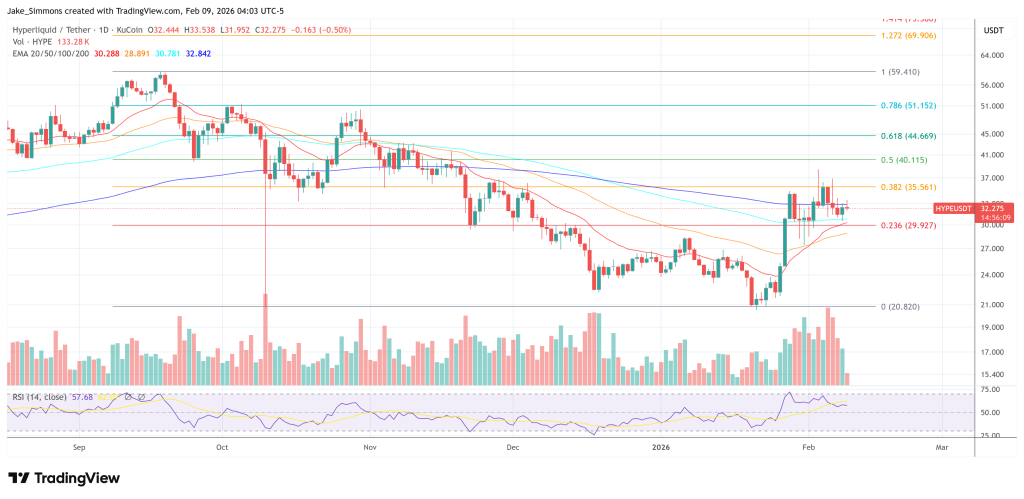
At press time, HYPE traded at $32.275.


You May Also Like

Not a loophole: Singapore AI export controls let China tap US AI legally

Exclusive interview with Smokey The Bera, co-founder of Berachain: How the innovative PoL public chain solves the liquidity problem and may be launched in a few months

Chainlink Whale Activity Rises While Price Bleeds for 7 Straight Months



