Decentralized exchange GMX is believed to have suffered a major exploit, with over $42 million in digital assets reportedly drained from its vaults, according to data from DeBank. The incident appears to involve a suspicious outflow of funds. Over $42 million was transferred from GMX Vault-related contracts to a single wallet address: 0xdf3340a436c27655ba62f8281565c9925c3a5221. The funds are now being bridged from Arbitrum, a Layer 2 Ethereum scaling network, back to the Ethereum mainnet—a common tactic used by attackers to obfuscate and launder stolen assets. . @GMX_IO has been exploited for ~$42M. The exploiter has bridged ~$9.6M worth of cryptos to #Ethereum . pic.twitter.com/SKTC1ubVEI — PeckShield Inc. (@peckshield) July 9, 2025 According to blockchain security firm PeckShield, the attacker has already bridged around $9.6 million worth of crypto assets from Arbitrum to the Ethereum network, suggesting a potential attempt to obfuscate and launder the stolen funds across chains. Suspected Smart Contract Vulnerability The nature of the incident is still under investigation, but on-chain data indicates it was likely a targeted exploit or smart contract vulnerability rather than a user error or regular withdrawal. The GMX team has not yet released an official statement confirming the breach or outlining any steps being taken in response. DeBank, a leading blockchain data analytics platform, was among the first to report the anomaly, describing the event as a “significant abnormal outflow.” The affected contracts are linked to GMX’s vault infrastructure, which is designed to manage liquidity for leveraged trading and derivatives products on the platform. As of the time of writing, no white hat intervention or recovery transactions have been observed. Community and Market Reaction The address involved in the exploit continues to move funds, increasing concern over the likelihood of recovery. Community members and independent security researchers are tracking the wallet activity in real time, hoping for further clarity and potential mitigation. This incident marks one of the larger DeFi-related exploits of the year and comes amid ongoing concerns about the security of cross-chain protocols and smart contract platforms. The GMX token (GMX) saw a sharp drop in price down to $12.51 at press time following the initial reports, reflecting market uncertainty around the scope and resolution of the exploit. More updates are expected as the GMX team investigates and releases an official statement. Security Update From GMX The GLP pool of GMX V1 on Arbitrum has experienced an exploit. Approximately $40M in tokens has been transferred from the GLP pool to an unknown wallet. Security has always been a core priority for GMX, with the GMX smart contracts undergoing numerous audits from top security… — GMX 🫐 (@GMX_IO) July 9, 2025Decentralized exchange GMX is believed to have suffered a major exploit, with over $42 million in digital assets reportedly drained from its vaults, according to data from DeBank. The incident appears to involve a suspicious outflow of funds. Over $42 million was transferred from GMX Vault-related contracts to a single wallet address: 0xdf3340a436c27655ba62f8281565c9925c3a5221. The funds are now being bridged from Arbitrum, a Layer 2 Ethereum scaling network, back to the Ethereum mainnet—a common tactic used by attackers to obfuscate and launder stolen assets. . @GMX_IO has been exploited for ~$42M. The exploiter has bridged ~$9.6M worth of cryptos to #Ethereum . pic.twitter.com/SKTC1ubVEI — PeckShield Inc. (@peckshield) July 9, 2025 According to blockchain security firm PeckShield, the attacker has already bridged around $9.6 million worth of crypto assets from Arbitrum to the Ethereum network, suggesting a potential attempt to obfuscate and launder the stolen funds across chains. Suspected Smart Contract Vulnerability The nature of the incident is still under investigation, but on-chain data indicates it was likely a targeted exploit or smart contract vulnerability rather than a user error or regular withdrawal. The GMX team has not yet released an official statement confirming the breach or outlining any steps being taken in response. DeBank, a leading blockchain data analytics platform, was among the first to report the anomaly, describing the event as a “significant abnormal outflow.” The affected contracts are linked to GMX’s vault infrastructure, which is designed to manage liquidity for leveraged trading and derivatives products on the platform. As of the time of writing, no white hat intervention or recovery transactions have been observed. Community and Market Reaction The address involved in the exploit continues to move funds, increasing concern over the likelihood of recovery. Community members and independent security researchers are tracking the wallet activity in real time, hoping for further clarity and potential mitigation. This incident marks one of the larger DeFi-related exploits of the year and comes amid ongoing concerns about the security of cross-chain protocols and smart contract platforms. The GMX token (GMX) saw a sharp drop in price down to $12.51 at press time following the initial reports, reflecting market uncertainty around the scope and resolution of the exploit. More updates are expected as the GMX team investigates and releases an official statement. Security Update From GMX The GLP pool of GMX V1 on Arbitrum has experienced an exploit. Approximately $40M in tokens has been transferred from the GLP pool to an unknown wallet. Security has always been a core priority for GMX, with the GMX smart contracts undergoing numerous audits from top security… — GMX 🫐 (@GMX_IO) July 9, 2025

[LIVE] Suspected Exploit Hits GMX Exchange: Over $42M Drained from Vaults – DeBank Reports

2 min read

Decentralized exchange GMX is believed to have suffered a major exploit, with over $42 million in digital assets reportedly drained from its vaults, according to data from DeBank.

The incident appears to involve a suspicious outflow of funds. Over $42 million was transferred from GMX Vault-related contracts to a single wallet address: 0xdf3340a436c27655ba62f8281565c9925c3a5221.

The funds are now being bridged from Arbitrum, a Layer 2 Ethereum scaling network, back to the Ethereum mainnet—a common tactic used by attackers to obfuscate and launder stolen assets.

According to blockchain security firm PeckShield, the attacker has already bridged around $9.6 million worth of crypto assets from Arbitrum to the Ethereum network, suggesting a potential attempt to obfuscate and launder the stolen funds across chains.

Suspected Smart Contract Vulnerability

The nature of the incident is still under investigation, but on-chain data indicates it was likely a targeted exploit or smart contract vulnerability rather than a user error or regular withdrawal.

The GMX team has not yet released an official statement confirming the breach or outlining any steps being taken in response.

DeBank, a leading blockchain data analytics platform, was among the first to report the anomaly, describing the event as a “significant abnormal outflow.”

The affected contracts are linked to GMX’s vault infrastructure, which is designed to manage liquidity for leveraged trading and derivatives products on the platform. As of the time of writing, no white hat intervention or recovery transactions have been observed.

Community and Market Reaction

The address involved in the exploit continues to move funds, increasing concern over the likelihood of recovery. Community members and independent security researchers are tracking the wallet activity in real time, hoping for further clarity and potential mitigation.

This incident marks one of the larger DeFi-related exploits of the year and comes amid ongoing concerns about the security of cross-chain protocols and smart contract platforms.

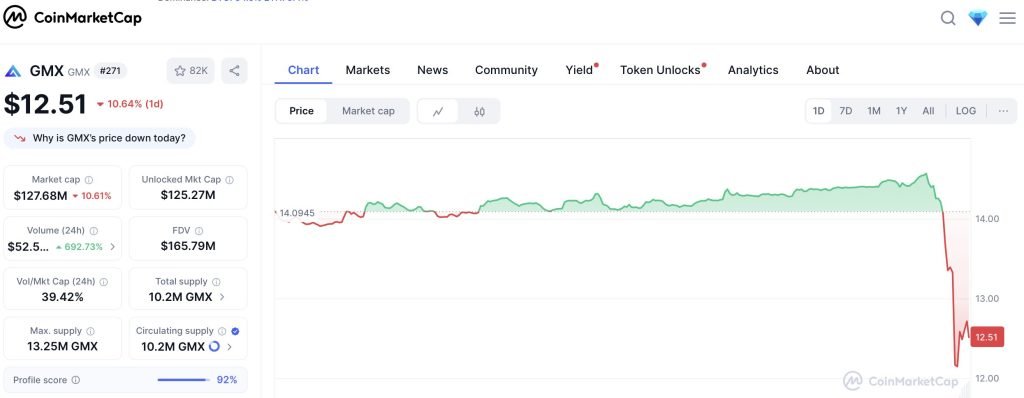
The GMX token (GMX) saw a sharp drop in price down to $12.51 at press time following the initial reports, reflecting market uncertainty around the scope and resolution of the exploit.
More updates are expected as the GMX team investigates and releases an official statement.

Security Update From GMX

Disclaimer: The articles reposted on this site are sourced from public platforms and are provided for informational purposes only. They do not necessarily reflect the views of MEXC. All rights remain with the original authors. If you believe any content infringes on third-party rights, please contact service@support.mexc.com for removal. MEXC makes no guarantees regarding the accuracy, completeness, or timeliness of the content and is not responsible for any actions taken based on the information provided. The content does not constitute financial, legal, or other professional advice, nor should it be considered a recommendation or endorsement by MEXC.

You May Also Like

Woman shot 5 times by DHS to stare down Trump at State of the Union address

Woman shot 5 times by DHS to stare down Trump at State of the Union address

A House Democrat has invited Marimar Martinez to attend President Donald Trump's State of the Union address in Washington, D.C., after she was shot by Customs and
Share
Rawstory2026/02/06 03:36
China Blocks Nvidia’s RTX Pro 6000D as Local Chips Rise

China Blocks Nvidia’s RTX Pro 6000D as Local Chips Rise

The post China Blocks Nvidia’s RTX Pro 6000D as Local Chips Rise appeared on BitcoinEthereumNews.com. China Blocks Nvidia’s RTX Pro 6000D as Local Chips Rise China’s internet regulator has ordered the country’s biggest technology firms, including Alibaba and ByteDance, to stop purchasing Nvidia’s RTX Pro 6000D GPUs. According to the Financial Times, the move shuts down the last major channel for mass supplies of American chips to the Chinese market. Why Beijing Halted Nvidia Purchases Chinese companies had planned to buy tens of thousands of RTX Pro 6000D accelerators and had already begun testing them in servers. But regulators intervened, halting the purchases and signaling stricter controls than earlier measures placed on Nvidia’s H20 chip. Image: Nvidia An audit compared Huawei and Cambricon processors, along with chips developed by Alibaba and Baidu, against Nvidia’s export-approved products. Regulators concluded that Chinese chips had reached performance levels comparable to the restricted U.S. models. This assessment pushed authorities to advise firms to rely more heavily on domestic processors, further tightening Nvidia’s already limited position in China. China’s Drive Toward Tech Independence The decision highlights Beijing’s focus on import substitution — developing self-sufficient chip production to reduce reliance on U.S. supplies. “The signal is now clear: all attention is focused on building a domestic ecosystem,” said a representative of a leading Chinese tech company. Nvidia had unveiled the RTX Pro 6000D in July 2025 during CEO Jensen Huang’s visit to Beijing, in an attempt to keep a foothold in China after Washington restricted exports of its most advanced chips. But momentum is shifting. Industry sources told the Financial Times that Chinese manufacturers plan to triple AI chip production next year to meet growing demand. They believe “domestic supply will now be sufficient without Nvidia.” What It Means for the Future With Huawei, Cambricon, Alibaba, and Baidu stepping up, China is positioning itself for long-term technological independence. Nvidia, meanwhile, faces…
Share
BitcoinEthereumNews2025/09/18 01:37
WLFI Drops 20% Weekly as Price Tests the Crucial $0.113 Support

WLFI Drops 20% Weekly as Price Tests the Crucial $0.113 Support

On Thursday, February 5, World Liberty Financial (WLFI) is continuing its decline and is trading at $0.1281, decreased by 5.89% in the past day. The token has lost
Share
Tronweekly2026/02/06 03:00