The goal of this article is to show the fundamental differences between CPU threads and GPU threads. It will also show how GPUs deliberately simplify per-thread control to pack in far more parallelism. The goal of a SW thread is to create parallel execution flows in software so it can exploit the available HW threads.The goal of this article is to show the fundamental differences between CPU threads and GPU threads. It will also show how GPUs deliberately simplify per-thread control to pack in far more parallelism. The goal of a SW thread is to create parallel execution flows in software so it can exploit the available HW threads.

GPUs Trade Complexity for Massive Parallelism: What Every Machine Learning Engineer Should Know

2025/11/27 13:54
8 min read

\ One of the most important constructs in programming languages is parallelism. Without some form of parallel execution, programs would run considerably slower than they do today. In the industry, parallel execution units are not reserved exclusively for software; both legacy and modern hardware rely heavily on parallel execution units. From multithreading to multicores to clusters to GPU-accelerated systems, parallelism appears in many shapes and sizes. After all, it makes little sense to serialize solving problems that do not depend on each other.

While hardware execution units have parallelism built in, it is the role of system and application developers to fully exploit the machine by understanding its underlying architectures. The goal of this article is to show the fundamental differences between CPU threads and GPU threads, and how GPUs deliberately simplify per-thread control to pack in far more parallelism, which is vital for writing efficient application software targeting modern heterogeneous systems such as CPU–GPU platforms—especially in machine learning and other throughput‑heavy workloads.

Before that, this article will briefly review the basics of hardware and software threads and how programming languages and operating systems abstract them (i) to make life easier for developers and (ii) to hide architectural changes as hardware evolves across generations.

Hardware vs. Software Threads

A high-end CPU like the AMD Ryzen Threadripper PRO 7995WX features 96 cores and 192 threads (2 threads per core). In a multicore design, those 96 cores can each run an independent workload without interfering with one another’s execution resources (to some degree), while the two hardware threads on a core share many of that core’s internal execution units. The extra hardware thread primarily serves to hide latency: when hardware thread A stalls waiting on a memory access, hardware thread B can run and keep the core busy. This approach exists because compute throughput has grown far faster than main-memory latency improvements, even with deep cache hierarchies. Without such forms of concurrency, a large fraction of CPU execution units would sit idle while waiting for data. For simplicity (and as a gross oversimplification), this article will refer to any form of parallel hardware execution unit as a hardware (HW) thread.

While HW thread configurations are fixed in silicon, software (SW) threads are created and scheduled at multiple layers—from applications to language runtimes to operating systems. The goal of a SW thread is to create parallel execution flows in software so it can exploit the available HW threads. Even on hardware that exposes only a single HW thread (common in embedded systems), it is still beneficial to structure software with parallel execution flows for latency hiding: when SW thread A blocks waiting for data from some memory or I/O resource, the system can run SW thread B instead, keeping the CPU productively busy. Whether to preempt thread B or let it continue is a separate scheduling and prioritization question, and a full treatment of those policies lies outside the scope of this article.

A DMV Analogy for Threads

When you enter a DMV (Department of Motor Vehicles) to apply or renew a license or to register or transfer a vehicle title, there are DMV agents waiting to serve you and applicants arriving with different needs. In this analogy, a DMV agent corresponds to a hardware (HW) thread, and a DMV applicant corresponds to a software (SW) thread.

Each DMV agent is versatile enough to handle different tasks (like a general-purpose CPU core) and occasionally needs to query a centralized system to verify a person’s identity or a vehicle’s record (similar to fetching data from main memory into cache). While the social norm at the DMV is to make small talk, the agent would be more efficient if, while waiting for a slow response from the central system in Washington, DC, they temporarily switched to processing the next person in line. That, however, introduces complexity: correctly matching the returned documents to the original applicant (state and context management), potentially sending the second person back to the waiting area when the first person’s data finally arrives (preemption and rescheduling), and handling cases where the second person is a minor dependent on the first (dependency and ordering constraints). Suddenly, small talk feels a lot less stressful than building a correct scheduling and dependency-tracking system in real life.

Why CPU Cores Are So Complex

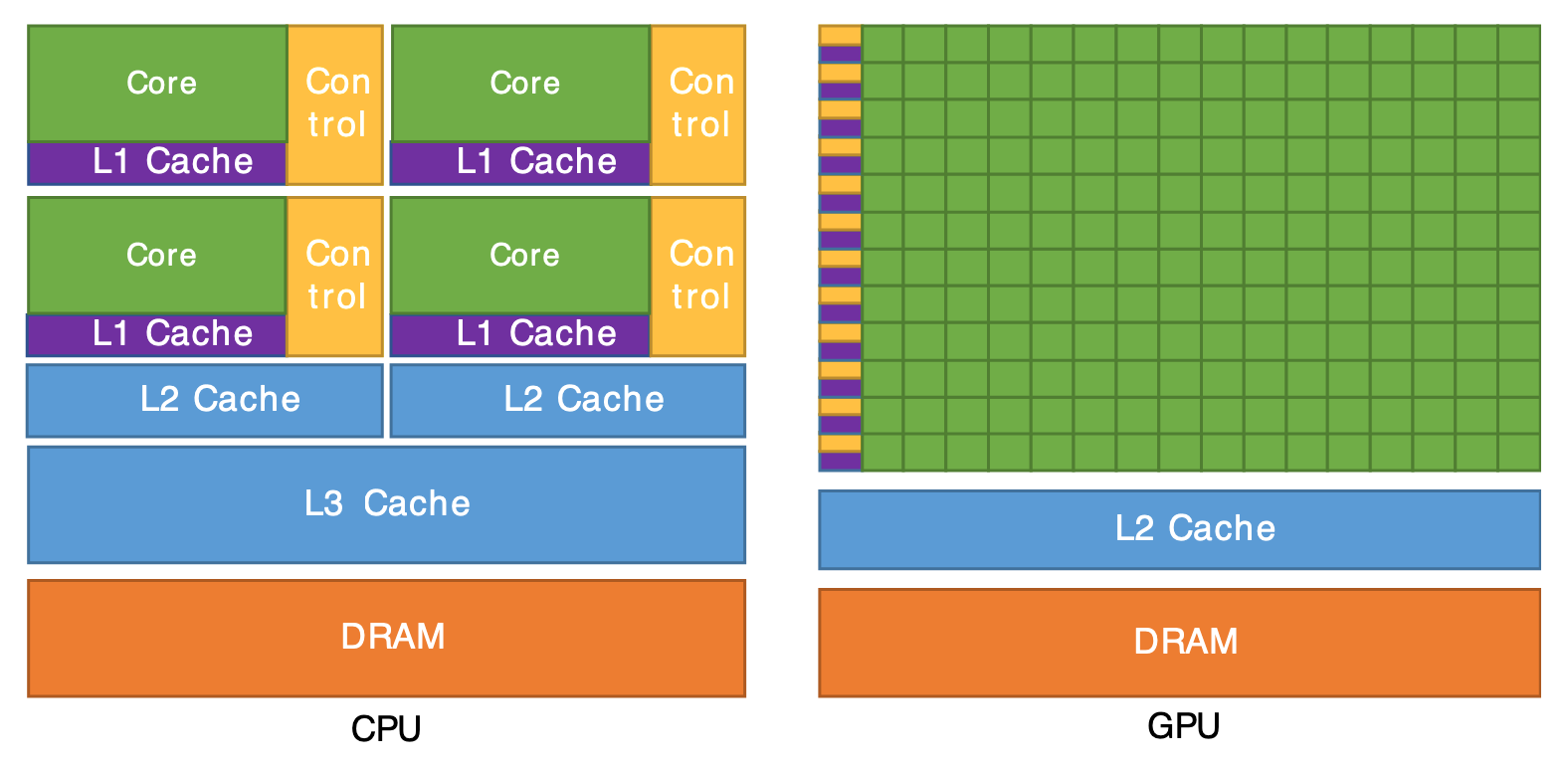
As you can see, having a single versatile agent perform many different tasks fully independently increases complexity and requires a complete toolkit at each station: printer, scanner, camera, imaging device, biometric reader, cash register, payment terminal, signature pad, and more. In much the same way, each CPU core integrates its own hardware structures to support execution, including arithmetic and logic units (ALUs), a control unit (CU), registers, a program counter, decoders, and other supporting components, and the picture becomes even more complex once superscalar pipelines, out-of-order execution, and branch prediction enter the scene.

\ Cornell Virtual Workshop > Understanding GPU Architecture …
\

How GPU Threads Avoid This Complexity

The most common resolution used on desktop screens is 1920 × 1080, which works out to a little over 2 million pixels per frame. At even a modest 12 frames per second—the point where the human eye starts to reliably perceive motion rather than a slideshow—that already implies updating roughly 24 million pixels per second. Now imagine trying to do that purely on a general-purpose CPU: even with all 192 hardware threads on a high‑end part, you are asking it to iterate over that pixel stream on the order of 100,000+ times per second on hardware that was never optimized for this style of massively data-parallel, bandwidth-heavy work.

CPUs invest enormous silicon budget in superscalar issue, out-of-order execution, register renaming, and branch prediction to squeeze more instruction-level parallelism out of irregular control flow. Those mechanisms are fantastic for general-purpose code with lots of branches and data reuse, but they do almost nothing for a workload that simply needs to push billions of mostly independent pixels or activations through a fixed pipeline every second. In that regime, GPUs win by trading these complex control features for many more simple arithmetic units and much higher memory bandwidth.”

From 192 CPU Threads to 20K GPU Threads

Going back to the DMV analogy: a 192‑thread CPU is like having 192 very smart, overqualified DMV agents in one building. Each agent is great at juggling odd cases, reordering subtasks, and guessing which form you will need next, but there are still only 192 of them, and each one is running their own personal workflow.

A GPU, by contrast, is like building a giant hall with something like 20,000 junior agents. They are not nearly as clever individually, but they all work in lockstep rows, following the same instruction at the same time: ‘everyone check box A on your form now, everyone stamp field B now, everyone move your form to the next station now.’ Because there are so many of them doing the same simple steps on different forms, the total number of applications they can push through the system dwarfs what the 192 genius agents can do, even though each junior agent is much simpler.

Instead of burning transistors on out‑of‑order schedulers, big branch predictors, and per‑thread book‑keeping, a GPU spends most of its area on lots of very simple lanes and the hardware to march them forward together. You still have control logic, of course, but it is much more “everyone in this warp does this instruction now” than “let each thread speculate and reorder on its own.” That makes each thread pretty dumb compared to a CPU thread, but because you can afford to run tens or hundreds of thousands of them at once, you hide latency by always having another warp ready to go, rather than by building a tiny superscalar brain that tries to be clever about a handful of instructions.

What This Means for Machine Learning Engineers

For machine learning engineers, this boils down to choosing the right mental model for the hardware being targeted. CPU threads are few, powerful, and optimized for complex, branchy logic, so they shine on orchestration, preprocessing, and latency-sensitive control paths. GPU threads are tiny, numerous, and designed to run in lockstep on simple kernels, so they excel at the dense, regular math that dominates training and inference. Writing fast ML code means structuring workloads so that CPUs handle the “clever” coordination work and GPUs chew through the massive, uniform tensor operations—aligning your threading model, memory access patterns, and kernel design with the radically different way GPU threads extract parallelism.

References

  1. https://www.amd.com/content/dam/amd/en/documents/partner-hub/ryzen/ryzen-consumer-master-quick-reference-competitive.pdf
  2. Superscalar Architecture - Scaler Topicshttps://www.scaler.com/topics/superscalar-architecture/
  3. https://cvw.cac.cornell.edu/gpu-architecture/gpu-characteristics/design \n

\

Market Opportunity
Polytrade Logo
Polytrade Price(TRADE)
$0.03831
$0.03831$0.03831
+1.80%
USD
Polytrade (TRADE) Live Price Chart
Disclaimer: The articles reposted on this site are sourced from public platforms and are provided for informational purposes only. They do not necessarily reflect the views of MEXC. All rights remain with the original authors. If you believe any content infringes on third-party rights, please contact service@support.mexc.com for removal. MEXC makes no guarantees regarding the accuracy, completeness, or timeliness of the content and is not responsible for any actions taken based on the information provided. The content does not constitute financial, legal, or other professional advice, nor should it be considered a recommendation or endorsement by MEXC.
Tags:

You May Also Like

8.18 Million Solana Committed on CME as SOL Options Prepare to Go Live

8.18 Million Solana Committed on CME as SOL Options Prepare to Go Live

Solana open interest rockets 6% on CME
Share
Coinstats2025/09/18 04:05
Lovable AI’s Astonishing Rise: Anton Osika Reveals Startup Secrets at Bitcoin World Disrupt 2025

Lovable AI’s Astonishing Rise: Anton Osika Reveals Startup Secrets at Bitcoin World Disrupt 2025

BitcoinWorld Lovable AI’s Astonishing Rise: Anton Osika Reveals Startup Secrets at Bitcoin World Disrupt 2025 Are you ready to witness a phenomenon? The world of technology is abuzz with the incredible rise of Lovable AI, a startup that’s not just breaking records but rewriting the rulebook for rapid growth. Imagine creating powerful apps and websites just by speaking to an AI – that’s the magic Lovable brings to the masses. This groundbreaking approach has propelled the company into the spotlight, making it one of the fastest-growing software firms in history. And now, the visionary behind this sensation, co-founder and CEO Anton Osika, is set to share his invaluable insights on the Disrupt Stage at the highly anticipated Bitcoin World Disrupt 2025. If you’re a founder, investor, or tech enthusiast eager to understand the future of innovation, this is an event you cannot afford to miss. Lovable AI’s Meteoric Ascent: Redefining Software Creation In an era where digital transformation is paramount, Lovable AI has emerged as a true game-changer. Its core premise is deceptively simple yet profoundly impactful: democratize software creation. By enabling anyone to build applications and websites through intuitive AI conversations, Lovable is empowering the vast majority of individuals who lack coding skills to transform their ideas into tangible digital products. This mission has resonated globally, leading to unprecedented momentum. The numbers speak for themselves: Achieved an astonishing $100 million Annual Recurring Revenue (ARR) in less than a year. Successfully raised a $200 million Series A funding round, valuing the company at $1.8 billion, led by industry giant Accel. Is currently fielding unsolicited investor offers, pushing its valuation towards an incredible $4 billion. As industry reports suggest, investors are unequivocally “loving Lovable,” and it’s clear why. This isn’t just about impressive financial metrics; it’s about a company that has tapped into a fundamental need, offering a solution that is both innovative and accessible. The rapid scaling of Lovable AI provides a compelling case study for any entrepreneur aiming for similar exponential growth. The Visionary Behind the Hype: Anton Osika’s Journey to Innovation Every groundbreaking company has a driving force, and for Lovable, that force is co-founder and CEO Anton Osika. His journey is as fascinating as his company’s success. A physicist by training, Osika previously contributed to the cutting-edge research at CERN, the European Organization for Nuclear Research. This deep technical background, combined with his entrepreneurial spirit, has been instrumental in Lovable’s rapid ascent. Before Lovable, he honed his skills as a co-founder of Depict.ai and a Founding Engineer at Sana. Based in Stockholm, Osika has masterfully steered Lovable from a nascent idea to a global phenomenon in record time. His leadership embodies a unique blend of profound technical understanding and a keen, consumer-first vision. At Bitcoin World Disrupt 2025, attendees will have the rare opportunity to hear directly from Osika about what it truly takes to build a brand that not only scales at an incredible pace in a fiercely competitive market but also adeptly manages the intense cultural conversations that inevitably accompany such swift and significant success. His insights will be crucial for anyone looking to understand the dynamics of high-growth tech leadership. Unpacking Consumer Tech Innovation at Bitcoin World Disrupt 2025 The 20th anniversary of Bitcoin World is set to be marked by a truly special event: Bitcoin World Disrupt 2025. From October 27–29, Moscone West in San Francisco will transform into the epicenter of innovation, gathering over 10,000 founders, investors, and tech leaders. It’s the ideal platform to explore the future of consumer tech innovation, and Anton Osika’s presence on the Disrupt Stage is a highlight. His session will delve into how Lovable is not just participating in but actively shaping the next wave of consumer-facing technologies. Why is this session particularly relevant for those interested in the future of consumer experiences? Osika’s discussion will go beyond the superficial, offering a deep dive into the strategies that have allowed Lovable to carve out a unique category in a market long thought to be saturated. Attendees will gain a front-row seat to understanding how to identify unmet consumer needs, leverage advanced AI to meet those needs, and build a product that captivates users globally. The event itself promises a rich tapestry of ideas and networking opportunities: For Founders: Sharpen your pitch and connect with potential investors. For Investors: Discover the next breakout startup poised for massive growth. For Innovators: Claim your spot at the forefront of technological advancements. The insights shared regarding consumer tech innovation at this event will be invaluable for anyone looking to navigate the complexities and capitalize on the opportunities within this dynamic sector. Mastering Startup Growth Strategies: A Blueprint for the Future Lovable’s journey isn’t just another startup success story; it’s a meticulously crafted blueprint for effective startup growth strategies in the modern era. Anton Osika’s experience offers a rare glimpse into the practicalities of scaling a business at breakneck speed while maintaining product integrity and managing external pressures. For entrepreneurs and aspiring tech leaders, his talk will serve as a masterclass in several critical areas: Strategy Focus Key Takeaways from Lovable’s Journey Rapid Scaling How to build infrastructure and teams that support exponential user and revenue growth without compromising quality. Product-Market Fit Identifying a significant, underserved market (the 99% who can’t code) and developing a truly innovative solution (AI-powered app creation). Investor Relations Balancing intense investor interest and pressure with a steadfast focus on product development and long-term vision. Category Creation Carving out an entirely new niche by democratizing complex technologies, rather than competing in existing crowded markets. Understanding these startup growth strategies is essential for anyone aiming to build a resilient and impactful consumer experience. Osika’s session will provide actionable insights into how to replicate elements of Lovable’s success, offering guidance on navigating challenges from product development to market penetration and investor management. Conclusion: Seize the Future of Tech The story of Lovable, under the astute leadership of Anton Osika, is a testament to the power of innovative ideas meeting flawless execution. Their remarkable journey from concept to a multi-billion-dollar valuation in record time is a compelling narrative for anyone interested in the future of technology. By democratizing software creation through Lovable AI, they are not just building a company; they are fostering a new generation of creators. His appearance at Bitcoin World Disrupt 2025 is an unmissable opportunity to gain direct insights from a leader who is truly shaping the landscape of consumer tech innovation. Don’t miss this chance to learn about cutting-edge startup growth strategies and secure your front-row seat to the future. Register now and save up to $668 before Regular Bird rates end on September 26. To learn more about the latest AI market trends, explore our article on key developments shaping AI features. This post Lovable AI’s Astonishing Rise: Anton Osika Reveals Startup Secrets at Bitcoin World Disrupt 2025 first appeared on BitcoinWorld.
Share
Coinstats2025/09/17 23:40
EIGEN pumps to three-month high with boost from AI agents

EIGEN pumps to three-month high with boost from AI agents

The post EIGEN pumps to three-month high with boost from AI agents appeared on BitcoinEthereumNews.com. Eigen Cloud (EIGEN) pumped to a three-month high, boosted by its role as a data supplier to AI agents. EIGEN rallied by 33% for the past day, logging 67% gains for the past 90 days.  Eigen Cloud (EIGEN) was the latest breakout token during the current altcoin season. It gained 33.8% in the past day, to trade at a three-month peak of $2.03. The token attempted a recovery after its rebranding in June.  EIGEN broke out to a three-month peak, following its addition to Google’s AI agent payment framework. | Source: CoinGecko. EIGEN open interest also jumped to over $130M, the highest level in the past six months. The token still has limited positions on Hyperliquid, with just nine whales betting on its direction. Five of those positions are shorting EIGEN, and are carrying unrealized losses after the recent breakout. Eigen Cloud rallied after becoming part of Google’s AI agent payment initiative. As Cryptopolitan previously reported, Google opened a toolset for safe, verifiable payments coming directly from AI agents.  Google’s AP2 protocol included Eigen as a platform for safe, verified transactions originating with AI agents.  We’re excited to be a launch partner for @GoogleCloud‘s new Agent Payments Protocol (AP2), a standard that gives AI agents the ability to transact with trust and accountability. At EigenCloud, our focus is on verifiability. As our founder @sreeramkannan said: AP2 helps create… https://t.co/Fx90rTJuhm pic.twitter.com/0Vil6yLdkf — EigenCloud (@eigenlayer) September 16, 2025 The new use case for Eigen arrives as older Web3 and DeFi projects seek to pivot to new use cases. Other AP2 partners from the crypto space include Coinbase and the Ethereum Foundation. Most of the payment and e-commerce platforms offer fiat handling, while Eigen’s verifiable transaction data target crypto payments and transfers. The market for AI agent transactions is estimated at over $27B,…
Share
BitcoinEthereumNews2025/09/18 18:29