More than 65 organizations across the U.S. crypto sector have urged President Donald Trump to intervene in the prosecution of Tornado Cash developer RomanMore than 65 organizations across the U.S. crypto sector have urged President Donald Trump to intervene in the prosecution of Tornado Cash developer Roman

Trump Urged to Drop Roman Storm Charges by 65+ Crypto Groups

More than 65 organizations across the U.S. crypto sector have urged President Donald Trump to intervene in the prosecution of Tornado Cash developer Roman Storm, arguing that the case represents a broader threat to software development and the country’s standing in digital finance.

The joint letter, sent on November 20 and signed by leading industry associations, DeFi builders, investors, and research groups, calls on federal agencies to deliver immediate regulatory and tax clarity while ending what the group describes as “regulation by prosecution.”
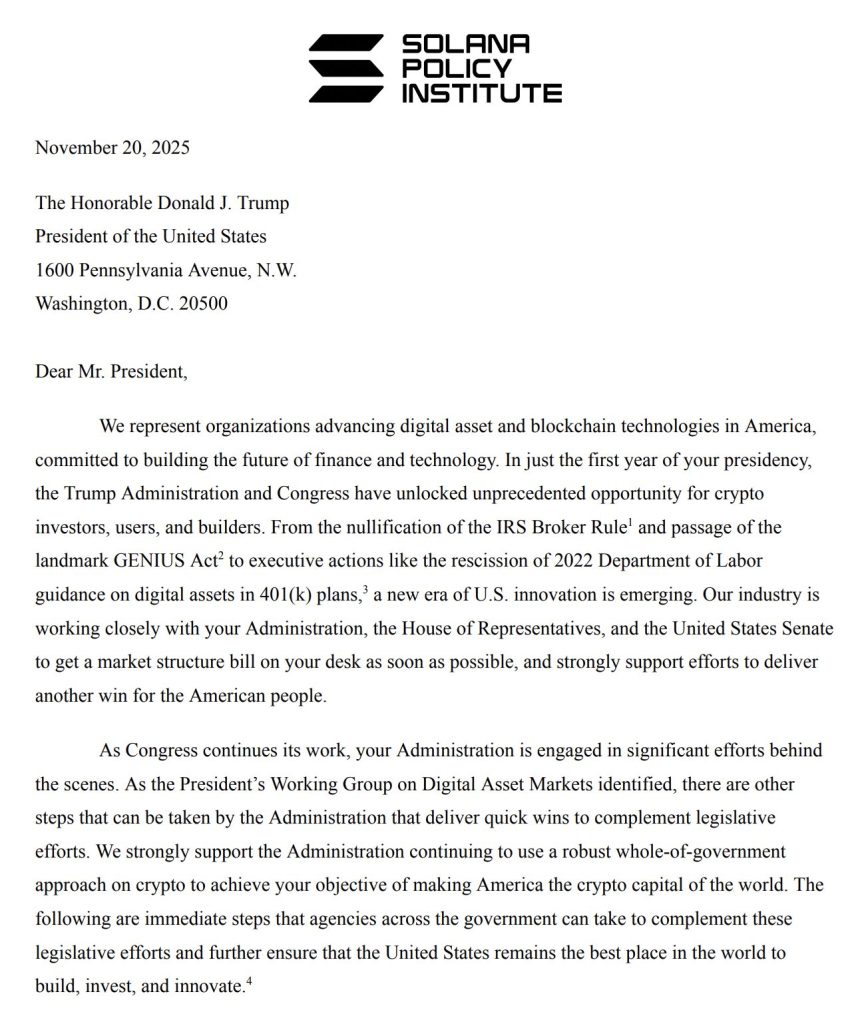
Source: Solana Policy Institute

Developers Say Open-Source Code Is Not a Crime as They Push DOJ to End Storm Case

The appeal marks one of the largest coordinated policy pushes from the crypto industry since Trump returned to the White House.

The letter credits the administration for a series of actions over the past year, including the nullification of the IRS broker rule, passage of the GENIUS Act, and the reversal of earlier restrictions on the use of digital assets in retirement plans.

It argues that those steps have opened the door for new economic activity, but says several unresolved issues continue to push developers and businesses overseas.

A central request in the letter is that the Department of Justice dismiss the remaining charges against Roman Storm.

Storm was convicted in August 2025 on one count of conspiracy to operate an unlicensed money transmitting business. The conviction carries a maximum sentence of five years.

The jury did not reach a verdict on two more serious allegations involving money laundering and sanctions violations, resulting in a partial mistrial.

Prosecutors have not yet confirmed whether they will retry him on those counts. Storm remains free on bail while post-trial motions and a possible appeal move forward.

The signatories argue that Storm’s work on Tornado Cash represents the writing of open-source software rather than the operation of a money service.

They point to recent Department of Justice guidance issued earlier this year, which stated that prosecutors should not bring unlicensed money transmitting charges against developers of decentralized software.

While that policy does not apply retroactively, Storm’s lawyers are expected to reference it as part of their ongoing legal challenge.

Advocacy Groups Urge Trump to Prioritize Developer Protections and Modernize Crypto Policy

Pressure from crypto advocacy groups has intensified in recent months. In April, the DeFi Education Fund sent a letter to White House crypto adviser David Sacks calling the Roman Storm case a “lawless prosecution” and warning it could deter developers from building permissionless tools.

That message gained support from industry figures including Fred Ehrsam, Matt Huang, and Tim Beiko, who argued that earlier FinCEN guidance stated noncustodial software developers should not be classified as money transmitters, placing the current case at odds with established policy.

Storm’s legal process is still active. An August court filing set deadlines for post-trial motions through November, while prosecutors said they will later decide whether to retry him on unresolved counts.

According to the Free Roman Storm campaign, supporters have raised $5.3 million of a $7 million goal to fund his defense.

The joint industry letter to President Trump extends beyond Storm’s situation.

It urges the Treasury and IRS to issue long-delayed tax guidance on staking rewards, mining rewards, cross-chain transfers, airdrops, forks, and rebases, areas the groups say have suffered from uncertainty and pushed activity offshore.

The signatories also request confirmation that using crypto as collateral for loans is not taxable and that digital asset donations should receive the same treatment as stock donations.

They further call on the SEC and CFTC to provide interim rules that protect open-source, permissionless development while broader regulatory frameworks remain unfinished.

Updated FinCEN guidance reaffirming that noncustodial blockchain software falls outside the Bank Secrecy Act is also a key demand.

The letter arrives during a period of increased executive focus on digital assets. Trump has already issued pardons to several prominent figures in the sector this year, including Ross Ulbricht, Changpeng Zhao, and Arthur Hayes.

The administration has also framed digital asset growth as a priority for U.S. economic competitiveness and has pushed agencies to adopt a coordinated framework for crypto oversight.


Market Opportunity
OFFICIAL TRUMP Logo
OFFICIAL TRUMP Price(TRUMP)
$4.928
$4.928$4.928
-1.06%
USD
OFFICIAL TRUMP (TRUMP) Live Price Chart
Disclaimer: The articles reposted on this site are sourced from public platforms and are provided for informational purposes only. They do not necessarily reflect the views of MEXC. All rights remain with the original authors. If you believe any content infringes on third-party rights, please contact service@support.mexc.com for removal. MEXC makes no guarantees regarding the accuracy, completeness, or timeliness of the content and is not responsible for any actions taken based on the information provided. The content does not constitute financial, legal, or other professional advice, nor should it be considered a recommendation or endorsement by MEXC.

You May Also Like

Why Bitcoin’s Bear Case Is Suddenly Back on the Table

Why Bitcoin’s Bear Case Is Suddenly Back on the Table

Fear, Liquidity, and Market Structure Collide at a Critical Moment Bitcoin has spent most of January 2026 trading under pressure, slipping below key psycho
Share
Medium2026/01/20 20:55
USD/JPY drops to near 157.80 as US-EU disputes batter US Dollar

USD/JPY drops to near 157.80 as US-EU disputes batter US Dollar

The post USD/JPY drops to near 157.80 as US-EU disputes batter US Dollar appeared on BitcoinEthereumNews.com. The USD/JPY pair is down 0.2% to near 157.80 during
Share
BitcoinEthereumNews2026/01/20 21:27
MetaMask Token: Exciting Launch Could Be Sooner Than Expected

MetaMask Token: Exciting Launch Could Be Sooner Than Expected

BitcoinWorld MetaMask Token: Exciting Launch Could Be Sooner Than Expected The cryptocurrency community is buzzing with exciting news: a native MetaMask token might arrive sooner than many anticipated. This development could reshape how users interact with the popular Web3 wallet and the broader decentralized ecosystem. It signals a significant step forward for one of the most widely used tools in the blockchain space. What’s Fueling the MetaMask Token Buzz? Joseph Lubin, the CEO of ConsenSys, the company behind MetaMask, recently shared insights that ignited this excitement. According to reports from The Block, Lubin indicated that a MetaMask token could launch ahead of previous expectations. This isn’t the first time the idea has surfaced; Dan Finlay, one of MetaMask’s founders, had previously mentioned the possibility of issuing such a token. ConsenSys has been a pivotal player in the Ethereum ecosystem, developing essential infrastructure and applications. MetaMask, their flagship wallet, serves millions of users, providing a gateway to decentralized applications (dApps), NFTs, and various blockchain networks. Therefore, any move to introduce a native token is a major event for the entire Web3 community. Why is a MetaMask Token So Anticipated? The prospect of a MetaMask token generates immense interest because it could introduce new layers of utility and community governance. Users often speculate about the benefits such a token could offer. Here are some key reasons for the high anticipation: Governance Rights: A token could empower users to participate in the future direction and development of MetaMask. This means voting on new features, upgrades, or even changes to the platform’s policies. Ecosystem Rewards: Tokens might be distributed as rewards for active participation, using certain features, or contributing to the MetaMask community. This incentivizes engagement and loyalty. Enhanced Utility: The token could unlock premium features, reduce transaction fees, or provide exclusive access to services within the MetaMask ecosystem or partnered dApps. Decentralization: Introducing a token often aligns with the broader Web3 ethos of decentralization, distributing control and ownership among its users rather than centralizing it within ConsenSys. Consequently, a token launch is seen as a way to deepen user involvement and foster a more robust, community-driven ecosystem around the wallet. Exploring the Potential Impact of a MetaMask Token The introduction of a MetaMask token could have far-reaching implications for the decentralized finance (DeFi) and Web3 landscape. Firstly, it could set a new standard for how popular infrastructure tools engage with their user base. By providing a tangible stake, MetaMask might strengthen its position as a community-governed platform. Moreover, a token could significantly boost the wallet’s visibility and adoption, attracting new users eager to participate in its governance or benefit from its utility. This could also lead to innovative integrations with other blockchain projects, creating a more interconnected and efficient Web3 experience. Ultimately, the success of such a token will depend on its design, utility, and how effectively it engages the global MetaMask community. What Challenges Could a MetaMask Token Face? While the excitement is palpable, launching a MetaMask token also presents several challenges that ConsenSys must navigate carefully. One primary concern is regulatory scrutiny. The classification of cryptocurrency tokens varies across jurisdictions, and ensuring compliance is crucial for long-term success. Furthermore, designing a fair and equitable distribution model is paramount. Ensuring that the token provides genuine utility beyond mere speculation will be another hurdle. A token must integrate seamlessly into the MetaMask experience and offer clear value to its holders. Additionally, managing community expectations and preventing market manipulation will require robust strategies. Addressing these challenges effectively will be key to the token’s sustainable growth and positive reception. What’s Next for the MetaMask Ecosystem? The prospect of a MetaMask token signals an evolving strategy for ConsenSys and the future of Web3 wallets. It reflects a growing trend where foundational tools seek to empower their communities through tokenization. Users are keenly watching for official announcements regarding the token’s mechanics, distribution, and launch timeline. This development could solidify MetaMask’s role not just as a wallet, but as a central pillar of decentralized identity and interaction. The potential for a sooner-than-expected launch adds an element of urgency and excitement, encouraging users to stay informed about every new detail. It represents a significant milestone for a platform that has become synonymous with accessing the decentralized web. Conclusion The hints from ConsenSys CEO Joseph Lubin regarding an earlier launch for the MetaMask token have undoubtedly captured the attention of the entire crypto world. This potential development promises to bring enhanced governance, utility, and community engagement to millions of MetaMask users. While challenges exist, the underlying potential for a more decentralized and user-driven ecosystem is immense. The coming months will likely reveal more about this highly anticipated token, marking a new chapter for one of Web3’s most vital tools. Frequently Asked Questions (FAQs) Q1: What is a MetaMask token? A MetaMask token would be a native cryptocurrency issued by ConsenSys, the company behind the MetaMask wallet. It is expected to offer various utilities, including governance rights, rewards, and access to special features within the MetaMask ecosystem. Q2: Why is ConsenSys considering launching a MetaMask token? ConsenSys is likely exploring a token launch to further decentralize the MetaMask platform, empower its user community with governance rights, incentivize active participation, and potentially unlock new forms of utility and growth for the ecosystem. Q3: What benefits could users gain from a MetaMask token? Users could gain several benefits, such as the ability to vote on MetaMask’s future developments, earn rewards for using the wallet, access exclusive features, or potentially reduce transaction fees. It also provides a direct stake in the platform’s success. Q4: When is the MetaMask token expected to launch? While no official launch date has been confirmed, ConsenSys CEO Joseph Lubin has indicated that the launch could happen sooner than previously expected. The exact timeline remains subject to official announcements from ConsenSys. Q5: How would a MetaMask token impact the broader Web3 ecosystem? A MetaMask token could significantly impact Web3 by setting a precedent for user-owned and governed infrastructure tools. It could drive further decentralization, foster innovation, and strengthen the connection between users and the platforms they rely on, ultimately contributing to a more robust and participatory decentralized internet. To learn more about the latest crypto market trends, explore our article on key developments shaping Ethereum institutional adoption. This post MetaMask Token: Exciting Launch Could Be Sooner Than Expected first appeared on BitcoinWorld.
Share
Coinstats2025/09/19 15:40