Bitcoin’s momentum has weakened sharply, and the market has slipped into one of its most bearish phases of the year, according to the latest CryptoQuant weekly report. Sentiment has deteriorated quickly as Bitcoin hovers dangerously close to the $100,000 level. The shift began after the October 10 “Big Liquidation” event, which drained upward momentum and pushed several key indicators into bearish territory. Spot demand contracted earlier in October, while growth in stablecoin liquidity—a key driver of market inflows—slowed sharply. Together, these factors have created a fragile environment in which Bitcoin’s price struggles to sustain meaningful support. A Market Losing Its Grip on Momentum CryptoQuant’s Bull Score Index reflects the extent of the downturn. Earlier in October, when Bitcoin reached its all-time high of $126,000, the index stood at a strongly optimistic reading of 80. That optimism evaporated quickly as Bitcoin slipped below $100,000 for the first time since June. The index has now fallen to 20, indicating an extremely bearish environment. The steep decline shows how quickly the market has shifted from aggressive buying to hesitation and caution, with fewer new inflows and weaker spot demand contributing to the downward pressure. Long-Term Holders Unload at Rare Levels One of the most concerning signs in the report is the behaviour of long-term holders. Over the past month, they have sold roughly 815,000 BTC, marking their heaviest distribution since January 2024. This selling occurred as Bitcoin pushed into the $118,000 to $121,000 range, a moment when spot demand had already begun to fade. In earlier phases of the cycle, strong demand from ETFs, institutional traders, and retail buyers was sufficient to absorb heavy selling from long-term holders. That buffer is now absent. Instead, the combination of steady supply from long-term holders and weakening demand is placing clear downward pressure on the market, raising the risk of further price deterioration. Profit-Taking Stays Strong, but Capitulation Is Absent Profit realization remains elevated. On November 7, investors locked in approximately $3 billion in net profits, mirroring the aggressive selling seen throughout October. Despite the heavy profit-taking, the market has yet to show signs of capitulation. Realized losses remain extremely low, suggesting that holders are not panic-selling even as price support weakens. This dynamic—strong profits but minimal losses—indicates that the market has not formed a bottom. Historically, price floors emerge only after losses rise and weak hands exit the market, a pattern that has not yet appeared. The Battle at the 365-Day Moving Average Bitcoin’s current struggle centres on the 365-day moving average, which sits near $102,000. This line has served as the ultimate support level throughout the current bull cycle and was one of the last major indicators to turn bearish during the 2021–2022 transition into a prolonged downturn. Bitcoin has now dipped below this level several times—a warning sign not seen earlier in this cycle. If the price continues to close beneath the 365-day average, the risk of a deeper correction grows considerably. CryptoQuant notes that the next areas of meaningful support lie lower, suggesting that failure to reclaim this moving average could accelerate a broader market decline. Bitcoin now stands at a key juncture. With momentum fading, long-term holders selling heavily, and spot demand failing to keep pace, the market’s ability to stabilize depends heavily on whether Bitcoin can reclaim its 365-day moving average. The coming weeks may determine whether this is a temporary pullback or the start of a more severe correctionBitcoin’s momentum has weakened sharply, and the market has slipped into one of its most bearish phases of the year, according to the latest CryptoQuant weekly report. Sentiment has deteriorated quickly as Bitcoin hovers dangerously close to the $100,000 level. The shift began after the October 10 “Big Liquidation” event, which drained upward momentum and pushed several key indicators into bearish territory. Spot demand contracted earlier in October, while growth in stablecoin liquidity—a key driver of market inflows—slowed sharply. Together, these factors have created a fragile environment in which Bitcoin’s price struggles to sustain meaningful support. A Market Losing Its Grip on Momentum CryptoQuant’s Bull Score Index reflects the extent of the downturn. Earlier in October, when Bitcoin reached its all-time high of $126,000, the index stood at a strongly optimistic reading of 80. That optimism evaporated quickly as Bitcoin slipped below $100,000 for the first time since June. The index has now fallen to 20, indicating an extremely bearish environment. The steep decline shows how quickly the market has shifted from aggressive buying to hesitation and caution, with fewer new inflows and weaker spot demand contributing to the downward pressure. Long-Term Holders Unload at Rare Levels One of the most concerning signs in the report is the behaviour of long-term holders. Over the past month, they have sold roughly 815,000 BTC, marking their heaviest distribution since January 2024. This selling occurred as Bitcoin pushed into the $118,000 to $121,000 range, a moment when spot demand had already begun to fade. In earlier phases of the cycle, strong demand from ETFs, institutional traders, and retail buyers was sufficient to absorb heavy selling from long-term holders. That buffer is now absent. Instead, the combination of steady supply from long-term holders and weakening demand is placing clear downward pressure on the market, raising the risk of further price deterioration. Profit-Taking Stays Strong, but Capitulation Is Absent Profit realization remains elevated. On November 7, investors locked in approximately $3 billion in net profits, mirroring the aggressive selling seen throughout October. Despite the heavy profit-taking, the market has yet to show signs of capitulation. Realized losses remain extremely low, suggesting that holders are not panic-selling even as price support weakens. This dynamic—strong profits but minimal losses—indicates that the market has not formed a bottom. Historically, price floors emerge only after losses rise and weak hands exit the market, a pattern that has not yet appeared. The Battle at the 365-Day Moving Average Bitcoin’s current struggle centres on the 365-day moving average, which sits near $102,000. This line has served as the ultimate support level throughout the current bull cycle and was one of the last major indicators to turn bearish during the 2021–2022 transition into a prolonged downturn. Bitcoin has now dipped below this level several times—a warning sign not seen earlier in this cycle. If the price continues to close beneath the 365-day average, the risk of a deeper correction grows considerably. CryptoQuant notes that the next areas of meaningful support lie lower, suggesting that failure to reclaim this moving average could accelerate a broader market decline. Bitcoin now stands at a key juncture. With momentum fading, long-term holders selling heavily, and spot demand failing to keep pace, the market’s ability to stabilize depends heavily on whether Bitcoin can reclaim its 365-day moving average. The coming weeks may determine whether this is a temporary pullback or the start of a more severe correction

Bitcoin Tests Key Support as Bearish Momentum Deepens and Long-Term Holders Unload 815K BTC: CryptoQuant

2025/11/14 00:01
3 min read
For feedback or concerns regarding this content, please contact us at crypto.news@mexc.com

Bitcoin’s momentum has weakened sharply, and the market has slipped into one of its most bearish phases of the year, according to the latest CryptoQuant weekly report.

Sentiment has deteriorated quickly as Bitcoin hovers dangerously close to the $100,000 level. The shift began after the October 10 “Big Liquidation” event, which drained upward momentum and pushed several key indicators into bearish territory.

Spot demand contracted earlier in October, while growth in stablecoin liquidity—a key driver of market inflows—slowed sharply. Together, these factors have created a fragile environment in which Bitcoin’s price struggles to sustain meaningful support.

A Market Losing Its Grip on Momentum

CryptoQuant’s Bull Score Index reflects the extent of the downturn. Earlier in October, when Bitcoin reached its all-time high of $126,000, the index stood at a strongly optimistic reading of 80. That optimism evaporated quickly as Bitcoin slipped below $100,000 for the first time since June.
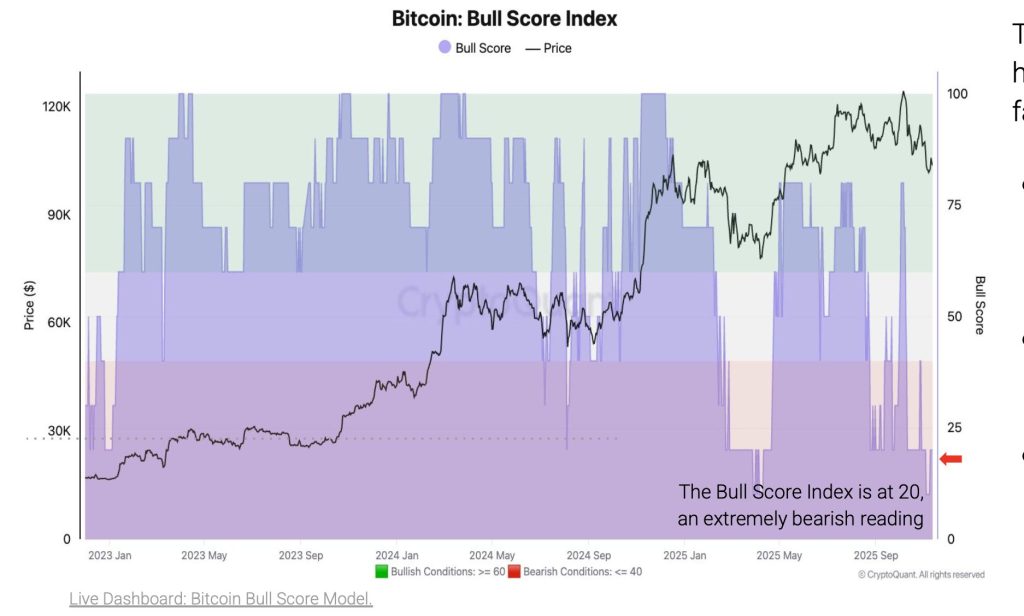
The index has now fallen to 20, indicating an extremely bearish environment. The steep decline shows how quickly the market has shifted from aggressive buying to hesitation and caution, with fewer new inflows and weaker spot demand contributing to the downward pressure.

Long-Term Holders Unload at Rare Levels

One of the most concerning signs in the report is the behaviour of long-term holders. Over the past month, they have sold roughly 815,000 BTC, marking their heaviest distribution since January 2024. This selling occurred as Bitcoin pushed into the $118,000 to $121,000 range, a moment when spot demand had already begun to fade.

In earlier phases of the cycle, strong demand from ETFs, institutional traders, and retail buyers was sufficient to absorb heavy selling from long-term holders. That buffer is now absent. Instead, the combination of steady supply from long-term holders and weakening demand is placing clear downward pressure on the market, raising the risk of further price deterioration.

Profit-Taking Stays Strong, but Capitulation Is Absent

Profit realization remains elevated. On November 7, investors locked in approximately $3 billion in net profits, mirroring the aggressive selling seen throughout October. Despite the heavy profit-taking, the market has yet to show signs of capitulation.

Realized losses remain extremely low, suggesting that holders are not panic-selling even as price support weakens. This dynamic—strong profits but minimal losses—indicates that the market has not formed a bottom. Historically, price floors emerge only after losses rise and weak hands exit the market, a pattern that has not yet appeared.

The Battle at the 365-Day Moving Average

Bitcoin’s current struggle centres on the 365-day moving average, which sits near $102,000. This line has served as the ultimate support level throughout the current bull cycle and was one of the last major indicators to turn bearish during the 2021–2022 transition into a prolonged downturn.

Bitcoin has now dipped below this level several times—a warning sign not seen earlier in this cycle. If the price continues to close beneath the 365-day average, the risk of a deeper correction grows considerably.

CryptoQuant notes that the next areas of meaningful support lie lower, suggesting that failure to reclaim this moving average could accelerate a broader market decline.

Bitcoin now stands at a key juncture. With momentum fading, long-term holders selling heavily, and spot demand failing to keep pace, the market’s ability to stabilize depends heavily on whether Bitcoin can reclaim its 365-day moving average. The coming weeks may determine whether this is a temporary pullback or the start of a more severe correction.

Disclaimer: The articles reposted on this site are sourced from public platforms and are provided for informational purposes only. They do not necessarily reflect the views of MEXC. All rights remain with the original authors. If you believe any content infringes on third-party rights, please contact crypto.news@mexc.com for removal. MEXC makes no guarantees regarding the accuracy, completeness, or timeliness of the content and is not responsible for any actions taken based on the information provided. The content does not constitute financial, legal, or other professional advice, nor should it be considered a recommendation or endorsement by MEXC.

You May Also Like

T7X Launches Regulated Launchpad for Tokenized Real-World Asset Securities

T7X Launches Regulated Launchpad for Tokenized Real-World Asset Securities

SHERIDAN, Wyo., March  18, 2026  (GLOBE NEWSWIRE) -- T7X announces the launch of the T7X Launchpad, a digital issuance platform designed to support the crea
Share
CryptoReporter2026/03/18 20:49
Why The Green Bay Packers Must Take The Cleveland Browns Seriously — As Hard As That Might Be

Why The Green Bay Packers Must Take The Cleveland Browns Seriously — As Hard As That Might Be

The post Why The Green Bay Packers Must Take The Cleveland Browns Seriously — As Hard As That Might Be appeared on BitcoinEthereumNews.com. Jordan Love and the Green Bay Packers are off to a 2-0 start. Getty Images The Green Bay Packers are, once again, one of the NFL’s better teams. The Cleveland Browns are, once again, one of the league’s doormats. It’s why unbeaten Green Bay (2-0) is a 8-point favorite at winless Cleveland (0-2) Sunday according to betmgm.com. The money line is also Green Bay -500. Most expect this to be a Packers’ rout, and it very well could be. But Green Bay knows taking anyone in this league for granted can prove costly. “I think if you look at their roster, the paper, who they have on that team, what they can do, they got a lot of talent and things can turn around quickly for them,” Packers safety Xavier McKinney said. “We just got to kind of keep that in mind and know we not just walking into something and they just going to lay down. That’s not what they going to do.” The Browns certainly haven’t laid down on defense. Far from. Cleveland is allowing an NFL-best 191.5 yards per game. The Browns gave up 141 yards to Cincinnati in Week 1, including just seven in the second half, but still lost, 17-16. Cleveland has given up an NFL-best 45.5 rushing yards per game and just 2.1 rushing yards per attempt. “The biggest thing is our defensive line is much, much improved over last year and I think we’ve got back to our personality,” defensive coordinator Jim Schwartz said recently. “When we play our best, our D-line leads us there as our engine.” The Browns rank third in the league in passing defense, allowing just 146.0 yards per game. Cleveland has also gone 30 straight games without allowing a 300-yard passer, the longest active streak in the NFL.…
Share
BitcoinEthereumNews2025/09/18 00:41
Edges higher ahead of BoC-Fed policy outcome

Edges higher ahead of BoC-Fed policy outcome

The post Edges higher ahead of BoC-Fed policy outcome appeared on BitcoinEthereumNews.com. USD/CAD gains marginally to near 1.3760 ahead of monetary policy announcements by the Fed and the BoC. Both the Fed and the BoC are expected to lower interest rates. USD/CAD forms a Head and Shoulder chart pattern. The USD/CAD pair ticks up to near 1.3760 during the late European session on Wednesday. The Loonie pair gains marginally ahead of monetary policy outcomes by the Bank of Canada (BoC) and the Federal Reserve (Fed) during New York trading hours. Both the BoC and the Fed are expected to cut interest rates amid mounting labor market conditions in their respective economies. Inflationary pressures in the Canadian economy have cooled down, emerging as another reason behind the BoC’s dovish expectations. However, the Fed is expected to start the monetary-easing campaign despite the United States (US) inflation remaining higher. Investors will closely monitor press conferences from both Fed Chair Jerome Powell and BoC Governor Tiff Macklem to get cues about whether there will be more interest rate cuts in the remainder of the year. According to analysts from Barclays, the Fed’s latest median projections for interest rates are likely to call for three interest rate cuts by 2025. Ahead of the Fed’s monetary policy, the US Dollar Index (DXY), which tracks the Greenback’s value against six major currencies, holds onto Tuesday’s losses near 96.60. USD/CAD forms a Head and Shoulder chart pattern, which indicates a bearish reversal. The neckline of the above-mentioned chart pattern is plotted near 1.3715. The near-term trend of the pair remains bearish as it stays below the 20-day Exponential Moving Average (EMA), which trades around 1.3800. The 14-day Relative Strength Index (RSI) slides to near 40.00. A fresh bearish momentum would emerge if the RSI falls below that level. Going forward, the asset could slide towards the round level of…
Share
BitcoinEthereumNews2025/09/18 01:23