Taiwan edged closer to a formal Bitcoin policy this week after Premier Cho Jung-tai and Central Bank Governor Yang Chin-long signaled support—at a minimum—for studying Bitcoin as a strategic reserve asset, accelerating pro-BTC rulemaking, and piloting treasury exposure using government-seized coins. The push was catalyzed by tech legislator Ko Ju-chun, who published the commitments following […]Taiwan edged closer to a formal Bitcoin policy this week after Premier Cho Jung-tai and Central Bank Governor Yang Chin-long signaled support—at a minimum—for studying Bitcoin as a strategic reserve asset, accelerating pro-BTC rulemaking, and piloting treasury exposure using government-seized coins. The push was catalyzed by tech legislator Ko Ju-chun, who published the commitments following […]

Taiwan Goes Bitcoin: Govt Eyes Strategic Reserve And Treasury Pilot

Taiwan edged closer to a formal Bitcoin policy this week after Premier Cho Jung-tai and Central Bank Governor Yang Chin-long signaled support—at a minimum—for studying Bitcoin as a strategic reserve asset, accelerating pro-BTC rulemaking, and piloting treasury exposure using government-seized coins.

The push was catalyzed by tech legislator Ko Ju-chun, who published the commitments following an interpellation at the Legislative Yuan’s Finance Committee on November 11, 2025, and by statements amplified by Bitcoin infrastructure firm JAN3. While no statutory change has yet been enacted, the on-record commitments mark Taiwan’s clearest move to date toward integrating Bitcoin into sovereign asset and regulatory strategy.

Taiwan Signals Bitcoin Pivot

In remarks and posts summarizing the session, JAN3 called it “a major milestone for Bitcoin in Asia,” saying “the Premier and Central Bank of Taiwan have agreed to study Bitcoin as a strategic reserve, draft pro-Bitcoin regulations, and pilot BTC treasury holdings starting with seized Bitcoin,” crediting Ko’s initiative and support from JAN3 CEO Samson Mow.

Ko posted via X: “Taiwan breakthrough! Premier & CBC commit to: study Bitcoin as strategic reserve, draft BTC-friendly rules in 6 mos [and] pilot BTC treasury holdings—starting with inventorying seized BTC awaiting auction!”

The Finance Committee exchange—posted in full by Ko—centered on two immediate deliverables. First, an inventory and year-end audit of all Bitcoin already confiscated by Taiwan’s judicial authorities, with a view to refraining from near-term disposals and using the stock as a controlled treasury pilot.

In Ko’s words: “can we take a step back and discuss whether we can continue to hold these confiscated virtual currencies that do not need to be returned, like other countries?” Premier Cho responded that “an inventory is necessary […] I can say that we’ll give everyone an answer by the end of the year,” while Governor Yang agreed to provide a “detailed report before the end of the year” setting out both pros and cons of a Bitcoin strategic reserve.

Those pledges imply a structured report from the Central Bank and Executive Yuan by December 31, 2025, and an inter-agency audit of seized-asset balances over the same window. Second, the committee pressed for a regulatory calendar.

Ko asked for a six-month window to deliver “BTC-friendly rules,” tying the request to Taiwan’s broader Virtual Asset Service Provider framework and a pending special law that would consolidate licensing, market-conduct, and stablecoin oversight.

The Financial Supervisory Commission (FSC) has been working toward that endpoint: a Draft Act disclosed this spring would require VASP approvals, allow certain financial institutions to run concurrent virtual-asset businesses, and set licensing and internal-control baselines. Business groups and legal commentators have since described the measure as Taiwan’s most comprehensive crypto bill to date and the likely vehicle for any Bitcoin-treasury and custody standards that may emerge from the pilot.

Ko’s case for strategic reserves blended macro and market structure points. He noted that Taiwan’s sovereign asset mix is heavily concentrated in US dollar assets—citing earlier Central Bank testimony—and warned that NT$ appreciation versus USD erodes purchasing power for domestic institutions, pointing to an FSC brief that tied this year’s NT$ moves to depressed bank profits.

He argued BTC should be treated as additive—“gold and Bitcoin […] are not mutually exclusive; they can coexist”—and emphasized declining BTC volatility alongside liquidity and seizure-resistance considerations in extreme scenarios. That framing mirrors his public campaign throughout 2025, in which he floated allocations ranging from 0.1% of GDP to as much as 5% of reserves as part of a diversified basket alongside gold and FX.

The seized-Bitcoin pilot is the near-term hinge. Taiwan has periodically auctioned confiscated crypto; Ko contended that a 2024 batch, if retained, would have appreciated materially given BTC’s price path, and he urged the Executive Yuan to treat such balances as policy sandboxes for custody, accounting, risk, and disclosure—before any net-new purchases are contemplated.

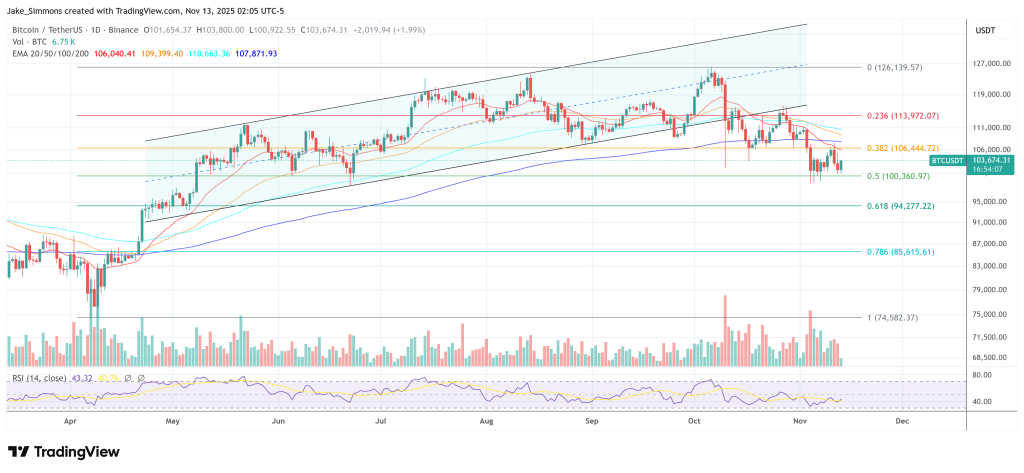
At press time, BTC traded at $103,674.
Bitcoin price
Market Opportunity
Choise.com Logo
Choise.com Price(CHO)
$0.00211
$0.00211$0.00211
+0.95%
USD
Choise.com (CHO) Live Price Chart
Disclaimer: The articles reposted on this site are sourced from public platforms and are provided for informational purposes only. They do not necessarily reflect the views of MEXC. All rights remain with the original authors. If you believe any content infringes on third-party rights, please contact service@support.mexc.com for removal. MEXC makes no guarantees regarding the accuracy, completeness, or timeliness of the content and is not responsible for any actions taken based on the information provided. The content does not constitute financial, legal, or other professional advice, nor should it be considered a recommendation or endorsement by MEXC.

You May Also Like

Crypto Market Cap Edges Up 2% as Bitcoin Approaches $118K After Fed Rate Trim

Crypto Market Cap Edges Up 2% as Bitcoin Approaches $118K After Fed Rate Trim

The global crypto market cap rose 2% to $4.2 trillion on Thursday, lifted by Bitcoin’s steady climb toward $118,000 after the Fed delivered its first interest rate cut of the year. Gains were measured, however, as investors weighed the central bank’s cautious tone on future policy moves. Bitcoin last traded 1% higher at $117,426. Ether rose 2.8% to $4,609. XRP also gained, rising 2.9% to $3.10. Fed Chair Jerome Powell described Wednesday’s quarter-point reduction as a risk-management step, stressing that policymakers were in no hurry to speed up the easing cycle. His comments dampened expectations of more aggressive cuts, limiting enthusiasm across risk assets. Traders Anticipated Fed Rate Trim, Leaving Little Room for Surprise Rally The Federal Open Market Committee voted 11-to-1 to lower the benchmark lending rate to a range of 4.00% to 4.25%. The sole dissent came from newly appointed governor Stephen Miran, who pushed for a half-point cut. Traders were largely prepared for the move. Futures markets tracked by the CME FedWatch tool had assigned a 96% probability to a 25 basis point cut, making the decision widely anticipated. That advance positioning meant much of the potential boost was already priced in, creating what analysts described as a “buy the rumour, sell the news” environment. Fed Rate Decision Creates Conditions for Crypto, But Traders Still Hold Back Andrew Forson, president of DeFi Technologies, said lower borrowing costs would eventually steer more money toward digital assets. “A lower cost of capital indicates more capital flows into the digital assets space because the risk hurdle rate for money is lower,” he noted. He added that staking products and blockchain projects could become attractive alternatives to traditional bonds, offering both yield and appreciation. Despite the cut, crypto markets remained calm. Open interest in Bitcoin futures held steady and no major liquidation cascades followed the Fed’s decision. Analysts pointed to Powell’s language and upcoming economic data as the key factors for traders before building larger positions. Powell’s Caution Tempers Immediate Impact of Fed Rate Move on Crypto Markets History also suggests crypto rallies after rate cuts often take time. When the Fed eased in Dec. 2024, Bitcoin briefly surged 5% cent before consolidating, with sustained gains arriving only weeks later. This time, market watchers are bracing for a similar pattern. Powell’s insistence on caution, combined with uncertainty around inflation and growth, has kept short-term volatility muted even as sentiment for risk assets improves. BitMine’s Tom Lee this week predicted that Bitcoin and Ether could deliver “monster gains” in the next three months if the Fed continues on an easing path. His view echoes broader expectations that liquidity-sensitive assets will outperform once the cycle gathers pace. For now, the crypto sector has digested the Fed’s move with restraint. Traders remain focused on signals from the central bank’s October meeting to determine whether Wednesday’s step marks the beginning of a broader policy shift or just a one-off adjustment
Share
CryptoNews2025/09/18 13:14
Vitalik Buterin Reveals Ethereum’s (ETH) Future Plans – Here’s What’s Planned

Vitalik Buterin Reveals Ethereum’s (ETH) Future Plans – Here’s What’s Planned

The post Vitalik Buterin Reveals Ethereum’s (ETH) Future Plans – Here’s What’s Planned appeared on BitcoinEthereumNews.com. Ethereum founder Vitalik Buterin presented the network’s new roadmap, which includes its short-, medium-, and long-term goals, at the Developer Conference held in Japan today. Scalability, cross-layer compatibility, privacy, and security were the prominent topics in Buterin’s speech. Buterin stated that the short-term focus will be on increasing gas limits on the Ethereum mainnet (L1). He said that tools such as block-level access lists, ZK-EVMs, gas price restructuring, and slot optimization will be used in this context. The goal is to maintain the network’s decentralization while increasing scalability. The medium-term goal is to enable trustless asset transfers between Layer-2 (L2) networks and achieve faster transaction finality. In this context, “Stage 2 Rollup” solutions, proof-of-conduct combinations, and optimizations for reading data from L1 are on the agenda. Furthermore, network optimizations such as shortening slot times, fast finality protocols, and erasure coding are planned to improve user experience and security. Buterin emphasized that privacy is a priority for both the short and medium term. Zero-knowledge (ZK) proofs, anonymous pools, encrypted voting, and scrambling network solutions are highlighted to protect the privacy of users’ on-chain payments, voting, DeFi transactions, and account changes. Furthermore, secure execution environments, secret query techniques, and the ability to conceal fraudulent requests and data access patterns are also targeted when reading data from the chain. Buterin’s long-term vision highlights a minimalist, secure, and simple Ethereum. This roadmap includes resistance to the risks posed by quantum computers, securing the protocol with mathematical methods (formal verification), and transitioning to ideal cryptographic solutions. Buterin stated that these strategic steps will transform Ethereum into a more scalable, user-friendly, and secure infrastructure. With the strengthening of L2 networks, more users will be able to use Ethereum with less trust assumptions. The ultimate goal is for Ethereum to become a reliable foundational infrastructure for global…
Share
BitcoinEthereumNews2025/09/18 15:57
Market data: ICP rose 4.54% intraday, while GLM fell 5.44% intraday.

Market data: ICP rose 4.54% intraday, while GLM fell 5.44% intraday.

PANews reported on January 16th that, according to OKX market data, the top gainers of the day are: ICP at $4.494, up 4.54%; CHZ at $0.0579, up 4.19%; CRV at $0
Share
PANews2026/01/16 10:00
