Bitcoin is days from printing another daily “death cross” — the 50-day simple moving average slipping beneath the 200-day — but analyst Kevin (Kev Capital TA) argues the label misleads more than it informs. In a November 12 video breakdown titled “BTC Daily Death Cross — How It Works And What To Expect,” he contends that every daily death cross of this cycle has coincided with the late stages — and, in practice, the lows — of multi-month corrective phases. “Don’t fall for the posts that say, ‘Oh my god, death cross on the daily, we’re going down 80%.’ That’s not how these have played out,” he says. “Remember, moving averages are lagging indicators […] the move that caused the cross has already occurred.” What The Bitcoin Death Cross Means The framing is data-driven and distinctly cyclical. This market, he stresses, has not behaved like 2017 or 2020–2021, when vertical advances never allowed the 50-day to undercut the 200-day during the advance. Instead, 2023–2025 has featured long pauses of 114 to 174 days, with price grinding sideways-to-down before pushing higher again. Each of those pauses bent the 50-day lower long enough for a cross, and each cross clustered near the end of the corrective window. “This cycle we have seen these consistent, right, 150, 160-plus days of corrective periods […] and with that causes the moving averages to act differently,” he says. Related Reading: Bitcoin “Arguably Undervalued,” Says Analytics Firm: Here’s Why Kevin revisits the three prior crosses. In 2023, after the brutal post-$30k range that followed the breakout from bear-market lows, the death cross “marked the lows […] basically the end of the correction.” Bitcoin chopped for roughly a month, then embarked on what he calls “the biggest rally of the cycle,” carrying from roughly $25k to $73k as altcoins “went berserk […] 5x to 8x, some 10x.” The 2024 instance came after the mid-cycle top in March and a year-long grind into the US election window. A single “16% candle on one day” stabbed into the lows a few days before the cross; the cross itself arrived after the damage, followed by two months of chop and then a Q4 recovery bid amid “the election exuberance” and a “dovish” turn in Fed rhetoric, pushing Bitcoin “to about $110k.” The third case, in Q1 2025, was even cleaner. As markets corrected from late-December/early-January peaks amid tariff fears and froth, the 50-under-200 print “literally marked the bottom of the correction,” with an immediate recovery. He characterizes 2025 as a year of reclamation rather than expansion: “We barely made a new all-time high […] that’s just kind of been 2025 in a nutshell,” which explains “why sentiment is just so bad.” The core mechanism is lag. Because the 50- and 200-day SMAs average past prices, their cross reflects a move already completed. “Almost 100% of the time when a death cross occurs, you do get a retrace back up into your moving averages,” Kevin says, adding that the key question is whether Bitcoin’s bounce merely tags that cluster or reclaims it with authority. He highlights a specific line in the sand: “Can it reclaim the $106.8k level on weekly closes? If Bitcoin can reclaim its daily moving averages […] and its $106.8k level on weekly closes, Bitcoin should have the opportunity at making a new all-time high.” Failure would argue that “the four-year cycle just played out normally and Bitcoin just had a really weak cycle,” with altcoins never delivering a classic “alt season.” What Comes Next For BTC? The analyst leans into the present confusion. He notes a schism among four-year-cycle adherents over whether the clock should be measured from the bottom or from the halving, and he points to evidence of distribution from long-term holders: “Whales that have been holding since the Satoshi era [are] offloading their Bitcoin.” Even so, he frames spot resilience as non-trivial: “Pretty surprised that Bitcoin is still hanging around at $105k given the fact that it’s had that much sell pressure […] back in earlier days when Bitcoin was topping out and whales were offloading, Bitcoin was going through 50% corrections.” Related Reading: Bitcoin Path To $1 Million Clears With OG Sellers Fading: Dave Weisberger The broader macro backdrop is part of the story. This has been “a restrictive monetary policy environment where liquidity was being sucked out of the system and rates were just too restrictive,” with AI-led equities absorbing risk flows. “The NASDAQ and S&P have been making new all-time highs for multiple years,” he says, while the Russell “barely broke out to a new all-time high a few weeks ago.” In other words, crypto’s underperformance is not isolated. What comes next, in Kevin’s view, is a clean market test. The daily death cross is “a day or two away,” likely into the weekend, and traders should expect a response toward the moving averages. The decisive stage is whether price can then clear the stack — “our 200 SMA, our 200 EMA, our 100 EMA, and even this 50 SMA” — and convert the $106.8k weekly close level back into support. “If we can do that […] Bitcoin absolutely has an opportunity to go make a new high,” he says. “If we can’t […] then obviously things are not going to be looking too good.” He cautions that incoming macro prints and central-bank rhetoric could “throw a wrench into things,” but he returns to the same empirical anchor: “This has happened three times this cycle already. Here’s exactly how the data works. Here’s what’s happened.” The punchline is less apocalyptic than the name implies. Four death crosses in one cycle is unprecedented for Bitcoin during an advance, and the last three coincided with late-stage corrective lows rather than trend collapses. As Kevin puts it: “The death cross everyone fears has marked every bottom so far.” The signal that “refuses to kill Bitcoin” is set to flash again; the pathology of the move afterward — rejection at the averages versus a decisive reclaim and weekly hold above $106.8k — will tell the real story. At press time, BTC traded at $103,540. Featured image created with DALL.E, chart from TradingView.comBitcoin is days from printing another daily “death cross” — the 50-day simple moving average slipping beneath the 200-day — but analyst Kevin (Kev Capital TA) argues the label misleads more than it informs. In a November 12 video breakdown titled “BTC Daily Death Cross — How It Works And What To Expect,” he contends that every daily death cross of this cycle has coincided with the late stages — and, in practice, the lows — of multi-month corrective phases. “Don’t fall for the posts that say, ‘Oh my god, death cross on the daily, we’re going down 80%.’ That’s not how these have played out,” he says. “Remember, moving averages are lagging indicators […] the move that caused the cross has already occurred.” What The Bitcoin Death Cross Means The framing is data-driven and distinctly cyclical. This market, he stresses, has not behaved like 2017 or 2020–2021, when vertical advances never allowed the 50-day to undercut the 200-day during the advance. Instead, 2023–2025 has featured long pauses of 114 to 174 days, with price grinding sideways-to-down before pushing higher again. Each of those pauses bent the 50-day lower long enough for a cross, and each cross clustered near the end of the corrective window. “This cycle we have seen these consistent, right, 150, 160-plus days of corrective periods […] and with that causes the moving averages to act differently,” he says. Related Reading: Bitcoin “Arguably Undervalued,” Says Analytics Firm: Here’s Why Kevin revisits the three prior crosses. In 2023, after the brutal post-$30k range that followed the breakout from bear-market lows, the death cross “marked the lows […] basically the end of the correction.” Bitcoin chopped for roughly a month, then embarked on what he calls “the biggest rally of the cycle,” carrying from roughly $25k to $73k as altcoins “went berserk […] 5x to 8x, some 10x.” The 2024 instance came after the mid-cycle top in March and a year-long grind into the US election window. A single “16% candle on one day” stabbed into the lows a few days before the cross; the cross itself arrived after the damage, followed by two months of chop and then a Q4 recovery bid amid “the election exuberance” and a “dovish” turn in Fed rhetoric, pushing Bitcoin “to about $110k.” The third case, in Q1 2025, was even cleaner. As markets corrected from late-December/early-January peaks amid tariff fears and froth, the 50-under-200 print “literally marked the bottom of the correction,” with an immediate recovery. He characterizes 2025 as a year of reclamation rather than expansion: “We barely made a new all-time high […] that’s just kind of been 2025 in a nutshell,” which explains “why sentiment is just so bad.” The core mechanism is lag. Because the 50- and 200-day SMAs average past prices, their cross reflects a move already completed. “Almost 100% of the time when a death cross occurs, you do get a retrace back up into your moving averages,” Kevin says, adding that the key question is whether Bitcoin’s bounce merely tags that cluster or reclaims it with authority. He highlights a specific line in the sand: “Can it reclaim the $106.8k level on weekly closes? If Bitcoin can reclaim its daily moving averages […] and its $106.8k level on weekly closes, Bitcoin should have the opportunity at making a new all-time high.” Failure would argue that “the four-year cycle just played out normally and Bitcoin just had a really weak cycle,” with altcoins never delivering a classic “alt season.” What Comes Next For BTC? The analyst leans into the present confusion. He notes a schism among four-year-cycle adherents over whether the clock should be measured from the bottom or from the halving, and he points to evidence of distribution from long-term holders: “Whales that have been holding since the Satoshi era [are] offloading their Bitcoin.” Even so, he frames spot resilience as non-trivial: “Pretty surprised that Bitcoin is still hanging around at $105k given the fact that it’s had that much sell pressure […] back in earlier days when Bitcoin was topping out and whales were offloading, Bitcoin was going through 50% corrections.” Related Reading: Bitcoin Path To $1 Million Clears With OG Sellers Fading: Dave Weisberger The broader macro backdrop is part of the story. This has been “a restrictive monetary policy environment where liquidity was being sucked out of the system and rates were just too restrictive,” with AI-led equities absorbing risk flows. “The NASDAQ and S&P have been making new all-time highs for multiple years,” he says, while the Russell “barely broke out to a new all-time high a few weeks ago.” In other words, crypto’s underperformance is not isolated. What comes next, in Kevin’s view, is a clean market test. The daily death cross is “a day or two away,” likely into the weekend, and traders should expect a response toward the moving averages. The decisive stage is whether price can then clear the stack — “our 200 SMA, our 200 EMA, our 100 EMA, and even this 50 SMA” — and convert the $106.8k weekly close level back into support. “If we can do that […] Bitcoin absolutely has an opportunity to go make a new high,” he says. “If we can’t […] then obviously things are not going to be looking too good.” He cautions that incoming macro prints and central-bank rhetoric could “throw a wrench into things,” but he returns to the same empirical anchor: “This has happened three times this cycle already. Here’s exactly how the data works. Here’s what’s happened.” The punchline is less apocalyptic than the name implies. Four death crosses in one cycle is unprecedented for Bitcoin during an advance, and the last three coincided with late-stage corrective lows rather than trend collapses. As Kevin puts it: “The death cross everyone fears has marked every bottom so far.” The signal that “refuses to kill Bitcoin” is set to flash again; the pathology of the move afterward — rejection at the averages versus a decisive reclaim and weekly hold above $106.8k — will tell the real story. At press time, BTC traded at $103,540. Featured image created with DALL.E, chart from TradingView.com

Bitcoin Death Cross Is Coming: Don’t Be Fooled By The Name

2025/11/13 19:00

Bitcoin is days from printing another daily “death cross” — the 50-day simple moving average slipping beneath the 200-day — but analyst Kevin (Kev Capital TA) argues the label misleads more than it informs.

In a November 12 video breakdown titled “BTC Daily Death Cross — How It Works And What To Expect,” he contends that every daily death cross of this cycle has coincided with the late stages — and, in practice, the lows — of multi-month corrective phases. “Don’t fall for the posts that say, ‘Oh my god, death cross on the daily, we’re going down 80%.’ That’s not how these have played out,” he says. “Remember, moving averages are lagging indicators […] the move that caused the cross has already occurred.”

What The Bitcoin Death Cross Means

The framing is data-driven and distinctly cyclical. This market, he stresses, has not behaved like 2017 or 2020–2021, when vertical advances never allowed the 50-day to undercut the 200-day during the advance. Instead, 2023–2025 has featured long pauses of 114 to 174 days, with price grinding sideways-to-down before pushing higher again.

Each of those pauses bent the 50-day lower long enough for a cross, and each cross clustered near the end of the corrective window. “This cycle we have seen these consistent, right, 150, 160-plus days of corrective periods […] and with that causes the moving averages to act differently,” he says.

Kevin revisits the three prior crosses. In 2023, after the brutal post-$30k range that followed the breakout from bear-market lows, the death cross “marked the lows […] basically the end of the correction.” Bitcoin chopped for roughly a month, then embarked on what he calls “the biggest rally of the cycle,” carrying from roughly $25k to $73k as altcoins “went berserk […] 5x to 8x, some 10x.”

The 2024 instance came after the mid-cycle top in March and a year-long grind into the US election window. A single “16% candle on one day” stabbed into the lows a few days before the cross; the cross itself arrived after the damage, followed by two months of chop and then a Q4 recovery bid amid “the election exuberance” and a “dovish” turn in Fed rhetoric, pushing Bitcoin “to about $110k.”

The third case, in Q1 2025, was even cleaner. As markets corrected from late-December/early-January peaks amid tariff fears and froth, the 50-under-200 print “literally marked the bottom of the correction,” with an immediate recovery. He characterizes 2025 as a year of reclamation rather than expansion: “We barely made a new all-time high […] that’s just kind of been 2025 in a nutshell,” which explains “why sentiment is just so bad.”
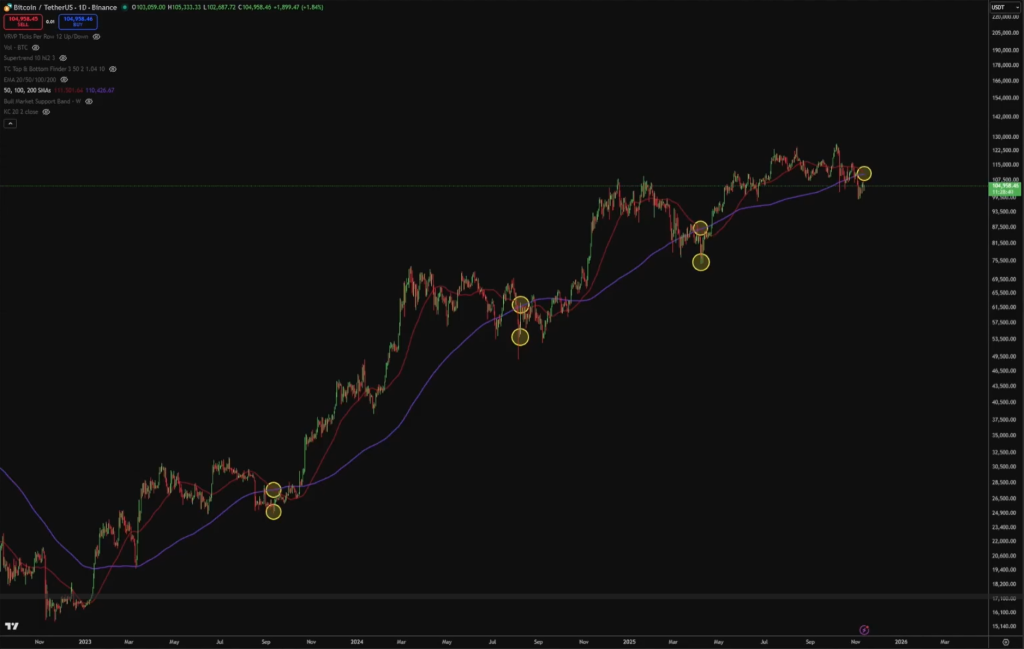
Bitcoin death cross history this cycle

The core mechanism is lag. Because the 50- and 200-day SMAs average past prices, their cross reflects a move already completed. “Almost 100% of the time when a death cross occurs, you do get a retrace back up into your moving averages,” Kevin says, adding that the key question is whether Bitcoin’s bounce merely tags that cluster or reclaims it with authority.

He highlights a specific line in the sand: “Can it reclaim the $106.8k level on weekly closes? If Bitcoin can reclaim its daily moving averages […] and its $106.8k level on weekly closes, Bitcoin should have the opportunity at making a new all-time high.” Failure would argue that “the four-year cycle just played out normally and Bitcoin just had a really weak cycle,” with altcoins never delivering a classic “alt season.”

What Comes Next For BTC?

The analyst leans into the present confusion. He notes a schism among four-year-cycle adherents over whether the clock should be measured from the bottom or from the halving, and he points to evidence of distribution from long-term holders: “Whales that have been holding since the Satoshi era [are] offloading their Bitcoin.” Even so, he frames spot resilience as non-trivial: “Pretty surprised that Bitcoin is still hanging around at $105k given the fact that it’s had that much sell pressure […] back in earlier days when Bitcoin was topping out and whales were offloading, Bitcoin was going through 50% corrections.”

The broader macro backdrop is part of the story. This has been “a restrictive monetary policy environment where liquidity was being sucked out of the system and rates were just too restrictive,” with AI-led equities absorbing risk flows. “The NASDAQ and S&P have been making new all-time highs for multiple years,” he says, while the Russell “barely broke out to a new all-time high a few weeks ago.” In other words, crypto’s underperformance is not isolated.

What comes next, in Kevin’s view, is a clean market test. The daily death cross is “a day or two away,” likely into the weekend, and traders should expect a response toward the moving averages. The decisive stage is whether price can then clear the stack — “our 200 SMA, our 200 EMA, our 100 EMA, and even this 50 SMA” — and convert the $106.8k weekly close level back into support.

“If we can do that […] Bitcoin absolutely has an opportunity to go make a new high,” he says. “If we can’t […] then obviously things are not going to be looking too good.” He cautions that incoming macro prints and central-bank rhetoric could “throw a wrench into things,” but he returns to the same empirical anchor: “This has happened three times this cycle already. Here’s exactly how the data works. Here’s what’s happened.”

The punchline is less apocalyptic than the name implies. Four death crosses in one cycle is unprecedented for Bitcoin during an advance, and the last three coincided with late-stage corrective lows rather than trend collapses. As Kevin puts it: “The death cross everyone fears has marked every bottom so far.” The signal that “refuses to kill Bitcoin” is set to flash again; the pathology of the move afterward — rejection at the averages versus a decisive reclaim and weekly hold above $106.8k — will tell the real story.

At press time, BTC traded at $103,540.
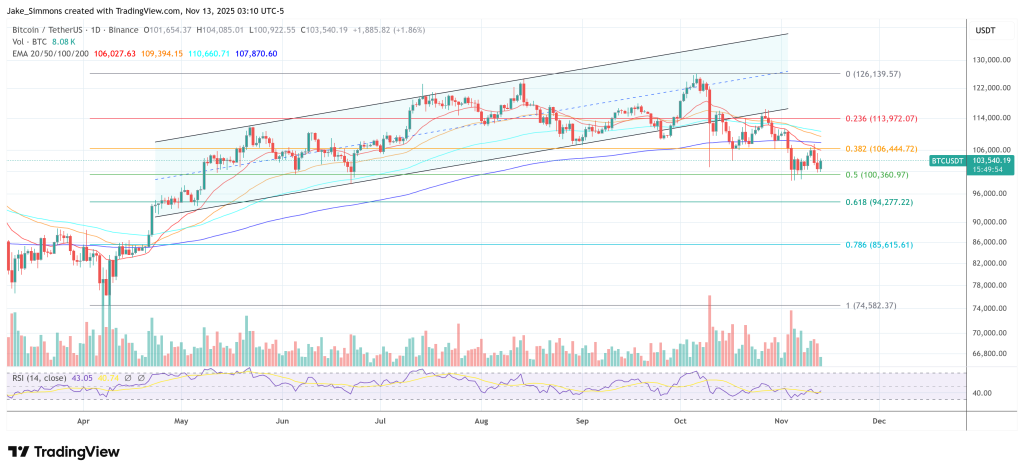
Bitcoin price
Market Opportunity
CROSS Logo
CROSS Price(CROSS)
$0.13772
$0.13772$0.13772
-1.81%
USD
CROSS (CROSS) Live Price Chart
Disclaimer: The articles reposted on this site are sourced from public platforms and are provided for informational purposes only. They do not necessarily reflect the views of MEXC. All rights remain with the original authors. If you believe any content infringes on third-party rights, please contact service@support.mexc.com for removal. MEXC makes no guarantees regarding the accuracy, completeness, or timeliness of the content and is not responsible for any actions taken based on the information provided. The content does not constitute financial, legal, or other professional advice, nor should it be considered a recommendation or endorsement by MEXC.

You May Also Like

Is Putnam Global Technology A (PGTAX) a strong mutual fund pick right now?

Is Putnam Global Technology A (PGTAX) a strong mutual fund pick right now?

The post Is Putnam Global Technology A (PGTAX) a strong mutual fund pick right now? appeared on BitcoinEthereumNews.com. On the lookout for a Sector – Tech fund? Starting with Putnam Global Technology A (PGTAX – Free Report) should not be a possibility at this time. PGTAX possesses a Zacks Mutual Fund Rank of 4 (Sell), which is based on various forecasting factors like size, cost, and past performance. Objective We note that PGTAX is a Sector – Tech option, and this area is loaded with many options. Found in a wide number of industries such as semiconductors, software, internet, and networking, tech companies are everywhere. Thus, Sector – Tech mutual funds that invest in technology let investors own a stake in a notoriously volatile sector, but with a much more diversified approach. History of fund/manager Putnam Funds is based in Canton, MA, and is the manager of PGTAX. The Putnam Global Technology A made its debut in January of 2009 and PGTAX has managed to accumulate roughly $650.01 million in assets, as of the most recently available information. The fund is currently managed by Di Yao who has been in charge of the fund since December of 2012. Performance Obviously, what investors are looking for in these funds is strong performance relative to their peers. PGTAX has a 5-year annualized total return of 14.46%, and is in the middle third among its category peers. But if you are looking for a shorter time frame, it is also worth looking at its 3-year annualized total return of 27.02%, which places it in the middle third during this time-frame. It is important to note that the product’s returns may not reflect all its expenses. Any fees not reflected would lower the returns. Total returns do not reflect the fund’s [%] sale charge. If sales charges were included, total returns would have been lower. When looking at a fund’s performance, it…
Share
BitcoinEthereumNews2025/09/18 04:05
Fed Decides On Interest Rates Today—Here’s What To Watch For

Fed Decides On Interest Rates Today—Here’s What To Watch For

The post Fed Decides On Interest Rates Today—Here’s What To Watch For appeared on BitcoinEthereumNews.com. Topline The Federal Reserve on Wednesday will conclude a two-day policymaking meeting and release a decision on whether to lower interest rates—following months of pressure and criticism from President Donald Trump—and potentially signal whether additional cuts are on the way. President Donald Trump has urged the central bank to “CUT INTEREST RATES, NOW, AND BIGGER” than they might plan to. Getty Images Key Facts The central bank is poised to cut interest rates by at least a quarter-point, down from the 4.25% to 4.5% range where they have been held since December to between 4% and 4.25%, as Wall Street has placed 100% odds of a rate cut, according to CME’s FedWatch, with higher odds (94%) on a quarter-point cut than a half-point (6%) reduction. Fed governors Christopher Waller and Michelle Bowman, both Trump appointees, voted in July for a quarter-point reduction to rates, and they may dissent again in favor of a large cut alongside Stephen Miran, Trump’s Council of Economic Advisers’ chair, who was sworn in at the meeting’s start on Tuesday. It’s unclear whether other policymakers, including Kansas City Fed President Jeffrey Schmid and St. Louis Fed President Alberto Musalem, will favor larger cuts or opt for no reduction. Fed Chair Jerome Powell said in his Jackson Hole, Wyoming, address last month the central bank would likely consider a looser monetary policy, noting the “shifting balance of risks” on the U.S. economy “may warrant adjusting our policy stance.” David Mericle, an economist for Goldman Sachs, wrote in a note the “key question” for the Fed’s meeting is whether policymakers signal “this is likely the first in a series of consecutive cuts” as the central bank is anticipated to “acknowledge the softening in the labor market,” though they may not “nod to an October cut.” Mericle said he…
Share
BitcoinEthereumNews2025/09/18 00:23
Will XRP Price Increase In September 2025?

Will XRP Price Increase In September 2025?

Ripple XRP is a cryptocurrency that primarily focuses on building a decentralised payments network to facilitate low-cost and cross-border transactions. It’s a native digital currency of the Ripple network, which works as a blockchain called the XRP Ledger (XRPL). It utilised a shared, distributed ledger to track account balances and transactions. What Do XRP Charts Reveal? […]
Share
Tronweekly2025/09/18 00:00