A technical debate erupted on X after on-chain analyst Willy Woo published what he called a “DUMMIES GUIDE TO BEING QUANTUM SAFE,” urging Bitcoin holders to migrate coins away from Taproot addresses (bc1p) to SegWit bc1q or older P2PKH/P2SH formats and to avoid spending until post-quantum protections are available. How To Make Bitcoin “Quantum-Safe” “In […]A technical debate erupted on X after on-chain analyst Willy Woo published what he called a “DUMMIES GUIDE TO BEING QUANTUM SAFE,” urging Bitcoin holders to migrate coins away from Taproot addresses (bc1p) to SegWit bc1q or older P2PKH/P2SH formats and to avoid spending until post-quantum protections are available. How To Make Bitcoin “Quantum-Safe” “In […]

Expert Reveals Bitcoin Quantum Survival Plan: Here’s What You Can Do

2025/11/13 04:00
3 min read
For feedback or concerns regarding this content, please contact us at crypto.news@mexc.com

A technical debate erupted on X after on-chain analyst Willy Woo published what he called a “DUMMIES GUIDE TO BEING QUANTUM SAFE,” urging Bitcoin holders to migrate coins away from Taproot addresses (bc1p) to SegWit bc1q or older P2PKH/P2SH formats and to avoid spending until post-quantum protections are available.

How To Make Bitcoin “Quantum-Safe”

“In the past it was about protecting your PRIVATE KEY (your seed phrase). In the age of big scary quantum computers (BSQC) that are coming, you need to protect your PUBLIC KEY also. Basically a BSQC can figure out your private key from a public key. The present day taproot addresses (the latest format) are NOT safe, these are addresses starting with “bc1p” and they embed the public key into the address, not good,” Woo wrote on Nov. 11.

His argument hinges on a well-understood distinction in Bitcoin script types: Taproot (P2TR) encodes a public key directly in the output and address, while legacy formats like P2PKH/P2SH and SegWit P2WPKH hash the public key and reveal it only when coins are spent. That architectural difference matters in a future where a sufficiently powerful quantum computer could derive a private key from a revealed public key. Independent references note that P2TR indeed carries a public key in the output, whereas P2PKH conceals it until spend time.

Woo’s interim playbook is blunt: move UTXOs to bc1q (or “1”/“3”) addresses, continue receiving to that address, but “NEVER send BTC out of it” until Bitcoin ships a quantum-resistant upgrade—at which point holders should move during low congestion, minimizing the window in which a public key is exposed in the mempool: “Send your BTC into the new quantum safe address when the network is NOT congested, once you send, you reveal the private key for a short time. It’s unlikely a BSQC will steal your coins in that short window.”

He also warned that P2PK “Satoshi-era” outputs are most at risk and suggested that lost coins with prior spending history could be vulnerable. “Satoshi’s 1M coins using an ancient P2PK address will be stolen (unless a future softfork freezes them),” he wrote, adding that ETFs, treasuries, and exchange cold storage “can be quantum resistant if the custodians take action” well before any soft fork.

Woo characterized industry expectations as “2030 onwards” for the arrival of “Q-Day,” while stressing that standards for quantum resistance are already rolling out across the wider cryptography space.

Former Bitcoin Core maintainer Jonas Schnelli agreed with the hygiene but pushed back on the framing. He called Woo’s plan a prudent mitigation for unspent coins—“P2PKH gives you years of protection while Taproot exposes your pubkey immediately”—yet rejected the term “quantum safe.”

In Schnelli’s view, the moment any spend is broadcast, “your pubkey hits the mempool. A quantum attacker could crack your key and RBF double-spend before your transaction confirms (~10 minutes).” He concluded: “It’s a smart precaution, not a permanent solution.”

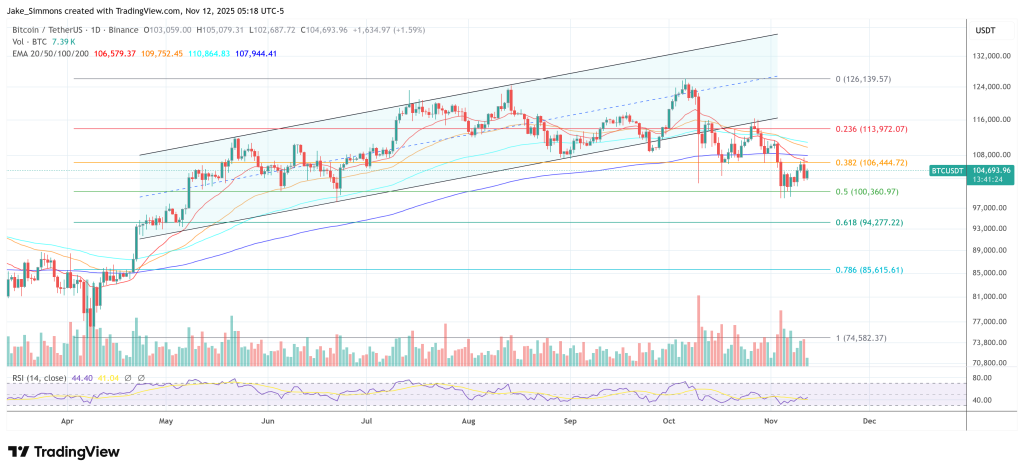
At press time, BTC traded at $104,693.
Bitcoin price
Disclaimer: The articles reposted on this site are sourced from public platforms and are provided for informational purposes only. They do not necessarily reflect the views of MEXC. All rights remain with the original authors. If you believe any content infringes on third-party rights, please contact crypto.news@mexc.com for removal. MEXC makes no guarantees regarding the accuracy, completeness, or timeliness of the content and is not responsible for any actions taken based on the information provided. The content does not constitute financial, legal, or other professional advice, nor should it be considered a recommendation or endorsement by MEXC.

You May Also Like

Let insiders trade – Blockworks

Let insiders trade – Blockworks

The post Let insiders trade – Blockworks appeared on BitcoinEthereumNews.com. This is a segment from The Breakdown newsletter. To read more editions, subscribe ​​“The most valuable commodity I know of is information.” — Gordon Gekko, Wall Street Ten months ago, FBI agents raided Shayne Coplan’s Manhattan apartment, ostensibly in search of evidence that the prediction market he founded, Polymarket, had illegally allowed US residents to place bets on the US election. Two weeks ago, the CFTC gave Polymarket the green light to allow those very same US residents to place bets on whatever they like. This is quite the turn of events — and it’s not just about elections or politics. With its US government seal of approval in hand, Polymarket is reportedly raising capital at a valuation of $9 billion — a reflection of the growing belief that prediction markets will be used for much more than betting on elections once every four years. Instead, proponents say prediction markets can provide a real service to the world by providing it with better information about nearly everything. I think they might, too — but only if insiders are free to participate. Yesterday, for example, Polymarket announced new betting markets on company earnings reports, with a promise that it would improve the information that investors have to work with.  Instead of waiting three months to find out how a company is faring, investors could simply watch the odds on Polymarket.  If the probability of an earnings beat is rising, for example, investors would know at a glance that things are going well. But that will only happen if enough of the people betting actually know how things are going. Relying on the wisdom of crowds to magically discern how a business is doing won’t add much incremental knowledge to the world; everyone’s guesses are unlikely to average out to the truth. If…
Share
BitcoinEthereumNews2025/09/18 05:16
T7X Launches Regulated Launchpad for Tokenized Real-World Asset Securities

T7X Launches Regulated Launchpad for Tokenized Real-World Asset Securities

SHERIDAN, Wyo., March  18, 2026  (GLOBE NEWSWIRE) -- T7X announces the launch of the T7X Launchpad, a digital issuance platform designed to support the crea
Share
CryptoReporter2026/03/18 20:49
Why The Green Bay Packers Must Take The Cleveland Browns Seriously — As Hard As That Might Be

Why The Green Bay Packers Must Take The Cleveland Browns Seriously — As Hard As That Might Be

The post Why The Green Bay Packers Must Take The Cleveland Browns Seriously — As Hard As That Might Be appeared on BitcoinEthereumNews.com. Jordan Love and the Green Bay Packers are off to a 2-0 start. Getty Images The Green Bay Packers are, once again, one of the NFL’s better teams. The Cleveland Browns are, once again, one of the league’s doormats. It’s why unbeaten Green Bay (2-0) is a 8-point favorite at winless Cleveland (0-2) Sunday according to betmgm.com. The money line is also Green Bay -500. Most expect this to be a Packers’ rout, and it very well could be. But Green Bay knows taking anyone in this league for granted can prove costly. “I think if you look at their roster, the paper, who they have on that team, what they can do, they got a lot of talent and things can turn around quickly for them,” Packers safety Xavier McKinney said. “We just got to kind of keep that in mind and know we not just walking into something and they just going to lay down. That’s not what they going to do.” The Browns certainly haven’t laid down on defense. Far from. Cleveland is allowing an NFL-best 191.5 yards per game. The Browns gave up 141 yards to Cincinnati in Week 1, including just seven in the second half, but still lost, 17-16. Cleveland has given up an NFL-best 45.5 rushing yards per game and just 2.1 rushing yards per attempt. “The biggest thing is our defensive line is much, much improved over last year and I think we’ve got back to our personality,” defensive coordinator Jim Schwartz said recently. “When we play our best, our D-line leads us there as our engine.” The Browns rank third in the league in passing defense, allowing just 146.0 yards per game. Cleveland has also gone 30 straight games without allowing a 300-yard passer, the longest active streak in the NFL.…
Share
BitcoinEthereumNews2025/09/18 00:41