In order to verify the effect of generating data variety in instance segmentation, this part tests DiverGen on the LVIS dataset. Experiments show that improving data diversity—through category, prompt, and model variation—drives sustained accuracy improvements, but increasing data quantity alone eventually plateaus or lowers performance.In order to verify the effect of generating data variety in instance segmentation, this part tests DiverGen on the LVIS dataset. Experiments show that improving data diversity—through category, prompt, and model variation—drives sustained accuracy improvements, but increasing data quantity alone eventually plateaus or lowers performance.

Data Diversity Matters More Than Data Quantity in AI

2025/11/12 00:06
4 min read
For feedback or concerns regarding this content, please contact us at crypto.news@mexc.com

Abstract and 1 Introduction

  1. Related Work

  2. Our Proposed DiverGen

    3.1. Analysis of Data Distribution

    3.2. Generative Data Diversity Enhancement

    3.3. Generative Pipeline

  3. Experiments

    4.1. Settings

    4.2. Main Results

    4.3. Ablation Studies

  4. Conclusions, Acknowledgments, and References

\ Appendix

A. Implementation Details

B. Visualization

4.1. Settings

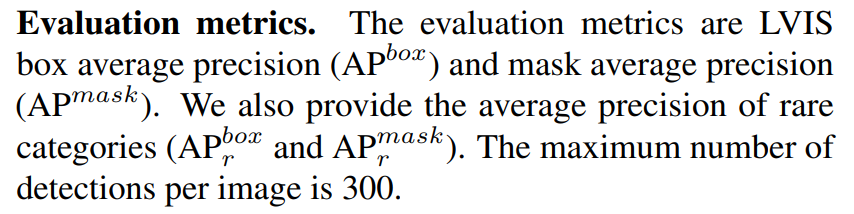
Datasets. We choose LVIS [8] for our experiments. LVIS is a large-scale instance segmentation dataset, containing 164k images with approximately two million high-quality annotations of instance segmentation and object detection. LVIS dataset uses images from COCO 2017 [15] dataset, but redefines the train/val/test splits, with around 100k images in the training set and around 20k images in the validation set. The annotations in LVIS cover 1,203 categories, with a typical long-tailed distribution of categories, so LVIS further divides the categories into frequent, common, and rare based on the frequency of each category in the dataset. We use the official LVIS training split and the validation split.

\
\

4.2. Main Results

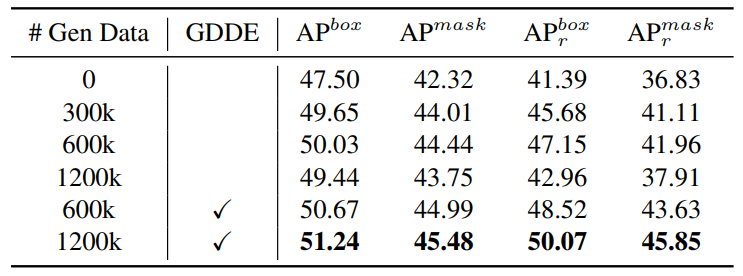
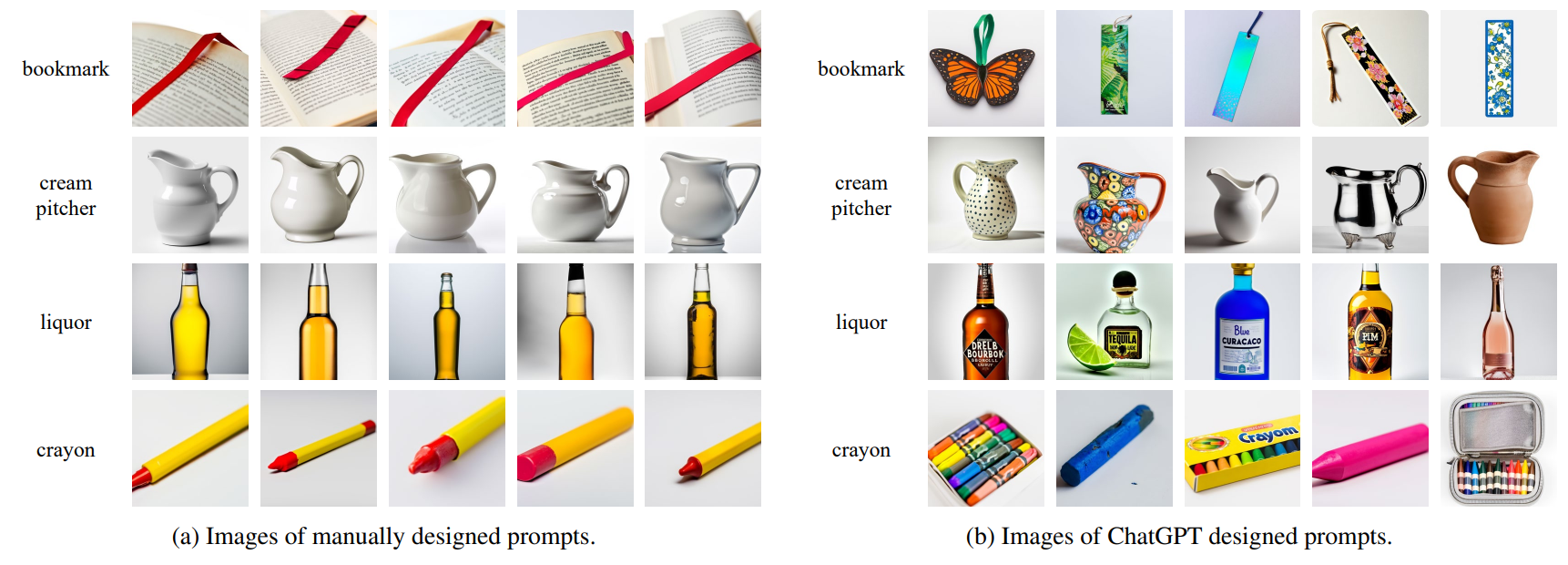
Data diversity is more important than quantity. To investigate the impact of different scales of generative data, we use generative data of varying scales as paste data sources. We construct three datasets using only DeepFloyd-IF [24] with manually designed prompts, all containing original LVIS 1,203 categories, but with per-category quantities of 0.25k, 0.5k, and 1k, resulting in total dataset scales of 300k, 600k, and 1,200k. As shown in Table 3, we find that using generative data improves model performance compared to the baseline. However, as the dataset scale increases, the model performance initially improves but then declines. The model performance using 1,200k data is lower than that using 600k data. Due to the limited number of manually designed prompts, the generative model produces similar data, as shown in Figure 4a. Consequently, the model can not gain benefits from more data. However, when using our proposed Generative Data Diversity Enhancement (GDDE), due to the increased data diversity, the model trained with 1,200k images achieves better results than using 600k images, with an improvement of 1.21 box AP and 1.04 mask AP. Moreover, when using the same data scale of 600k, the mask AP increased by 0.64 AP and the box AP increased by 0.55 AP when using GDDE compared to not using it. The results demonstrate that data diversity is more important than quantity. When the scale of data is small, increasing the quantity of data can improve model performance, which we consider is an indirect way of increasing data diversity. However, this simplistic approach of solely increasing quantity to increase diversity has an upper limit. When it reaches this limit, explicit data diversity enhancement strategies become necessary to maintain the trend of model performance improvement.

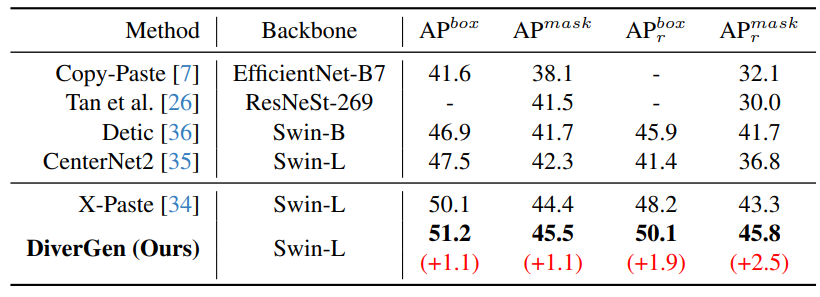
\ Comparison with previous methods. We compare DiverGen with previous data-augmentation related methods in Table 4. Compared to the baseline CenterNet2 [35], our method significantly improves, increasing box AP by +3.7 and mask AP by +3.2. Regarding rare categories, our method surpasses the baseline with +8.7 in box AP and +9.0 in mask AP. Compared to the previous strong model X-Paste [34], we outperform it with +1.1 in box AP and +1.1 in mask AP of all categories, and +1.9 in box AP and +2.5 in mask AP of rare categories. It is worth mentioning that, X-Paste utilizes both generative data and web-retrieved data as paste data sources during training, while our method exclusively uses generative data as the paste data source. We achieve this by designing diversity enhancement strategies, further unlocking the potential of generative models.

\ Figure 4. Examples of generative data using different prompts. By using prompts designed by ChatGPT, the diversity of generated images in terms of shapes, textures, etc. can be significantly improved.
\ Table 3. Results of different scales of generative data. When using the same data scale, models using our proposed GDDE can achieve higher performance than those without it, showing that data diversity is more important than quantity.

\ Table 4. Comparison with previous methods on LVIS val set.

\

:::info Authors:

(1) Chengxiang Fan, with equal contribution from Zhejiang University, China;

(2) Muzhi Zhu, with equal contribution from Zhejiang University, China;

(3) Hao Chen, Zhejiang University, China (haochen.cad@zju.edu.cn);

(4) Yang Liu, Zhejiang University, China;

(5) Weijia Wu, Zhejiang University, China;

(6) Huaqi Zhang, vivo Mobile Communication Co..

(7) Chunhua Shen, Zhejiang University, China (chunhuashen@zju.edu.cn).

:::


:::info This paper is available on arxiv under CC BY-NC-ND 4.0 Deed (Attribution-Noncommercial-Noderivs 4.0 International) license.

:::

\

Disclaimer: The articles reposted on this site are sourced from public platforms and are provided for informational purposes only. They do not necessarily reflect the views of MEXC. All rights remain with the original authors. If you believe any content infringes on third-party rights, please contact crypto.news@mexc.com for removal. MEXC makes no guarantees regarding the accuracy, completeness, or timeliness of the content and is not responsible for any actions taken based on the information provided. The content does not constitute financial, legal, or other professional advice, nor should it be considered a recommendation or endorsement by MEXC.
Tags:

You May Also Like

Bitcoin ETFs Surge with 20,685 BTC Inflows, Marking Strongest Week

Bitcoin ETFs Surge with 20,685 BTC Inflows, Marking Strongest Week

TLDR Bitcoin ETFs recorded their strongest weekly inflows since July, reaching 20,685 BTC. U.S. Bitcoin ETFs contributed nearly 97% of the total inflows last week. The surge in Bitcoin ETF inflows pushed holdings to a new high of 1.32 million BTC. Fidelity’s FBTC product accounted for 36% of the total inflows, marking an 18-month high. [...] The post Bitcoin ETFs Surge with 20,685 BTC Inflows, Marking Strongest Week appeared first on CoinCentral.
Share
Coincentral2025/09/18 02:30
ZEC Rally and G Coin — Two Altcoin Setups Worth Watching

ZEC Rally and G Coin — Two Altcoin Setups Worth Watching

The post ZEC Rally and G Coin — Two Altcoin Setups Worth Watching appeared on BitcoinEthereumNews.com. The crypto market has started the week on a bullish footing
Share
BitcoinEthereumNews2026/03/19 00:58
IP Hits $11.75, HYPE Climbs to $55, BlockDAG Surpasses Both with $407M Presale Surge!

IP Hits $11.75, HYPE Climbs to $55, BlockDAG Surpasses Both with $407M Presale Surge!

The post IP Hits $11.75, HYPE Climbs to $55, BlockDAG Surpasses Both with $407M Presale Surge! appeared on BitcoinEthereumNews.com. Crypto News 17 September 2025 | 18:00 Discover why BlockDAG’s upcoming Awakening Testnet launch makes it the best crypto to buy today as Story (IP) price jumps to $11.75 and Hyperliquid hits new highs. Recent crypto market numbers show strength but also some limits. The Story (IP) price jump has been sharp, fueled by big buybacks and speculation, yet critics point out that revenue still lags far behind its valuation. The Hyperliquid (HYPE) price looks solid around the mid-$50s after a new all-time high, but questions remain about sustainability once the hype around USDH proposals cools down. So the obvious question is: why chase coins that are either stretched thin or at risk of retracing when you could back a network that’s already proving itself on the ground? That’s where BlockDAG comes in. While other chains are stuck dealing with validator congestion or outages, BlockDAG’s upcoming Awakening Testnet will be stress-testing its EVM-compatible smart chain with real miners before listing. For anyone looking for the best crypto coin to buy, the choice between waiting on fixes or joining live progress feels like an easy one. BlockDAG: Smart Chain Running Before Launch Ethereum continues to wrestle with gas congestion, and Solana is still known for network freezes, yet BlockDAG is already showing a different picture. Its upcoming Awakening Testnet, set to launch on September 25, isn’t just a demo; it’s a live rollout where the chain’s base protocols are being stress-tested with miners connected globally. EVM compatibility is active, account abstraction is built in, and tools like updated vesting contracts and Stratum integration are already functional. Instead of waiting for fixes like other networks, BlockDAG is proving its infrastructure in real time. What makes this even more important is that the technology is operational before the coin even hits exchanges. That…
Share
BitcoinEthereumNews2025/09/18 00:32