Memecoins Fall to July Lows While Bitcoin & Ether Drive Market Bounce Back

The recent cryptocurrency market turmoil has significantly impacted meme tokens, leading their collective valuation to plummet to levels unseen since July. After a sharp decline prompted by Friday’s broad crypto market correction, memecoin capitalization has experienced a notable dip, signaling a possible shift in retail investor enthusiasm. Meanwhile, other sectors such as NFTs and established cryptocurrencies have shown resilience and quick recoveries amid the turbulence.
- The memecoin sector’s market cap fell to $44 billion on October 11, a 40% drop in just one day.
- As of now, the market stabilizes around $57 billion, down from recent peaks.
- Major memecoins like Dogecoin, Shiba Inu, and Pepe experienced weekly losses exceeding 13%, with some plunging over 20%.
- Other crypto sectors, including NFTs and Bitcoin, rebounded swiftly after initial sell-offs.
- Ethereum and Bitcoin have regained significant ground, with ETH surpassing $4,000 and BTC trading above $111,000.
The recent downturn in memecoins reflects the broader volatility affecting the cryptocurrency markets, with their collective value dropping by almost 40% from the previous day’s peak. CoinMarketCap reports that on October 11, the memecoin sector dipped to approximately $44 billion, marking a significant correction from the $72 billion level seen prior. A modest recovery followed, pushing the combined valuation back to about $53 billion on October 12, reaching levels last observed before the summer’s Solana-based memecoin frenzy.
Over the past four months, meme tokens maintained robust retail interest, predominantly driven by ecosystems on Solana and BNB Chain. However, the recent sharp decline signals a potential change in market momentum. Currently, the entire memecoin sector trades at roughly $57 billion, indicating a cautious stance among investors.
Top memecoins struggle to recover after Friday’s downturn
The top 10 memecoins, which constitute over 82% of the sector’s total market value, are collectively valued at around $47 billion. At present, these tokens are all in the red across both 24-hour and weekly charts. Popular tokens like Dogecoin (DOGE), Shiba Inu (SHIB), and Pepe (PEPE) reported weekly losses exceeding 13%. Other tokens such as Bonk (BONK) and Floki (FLOKI) fell by over 20%. Even the memecoin inspired by former U.S. President Donald Trump has seen a 20% decline over the week.
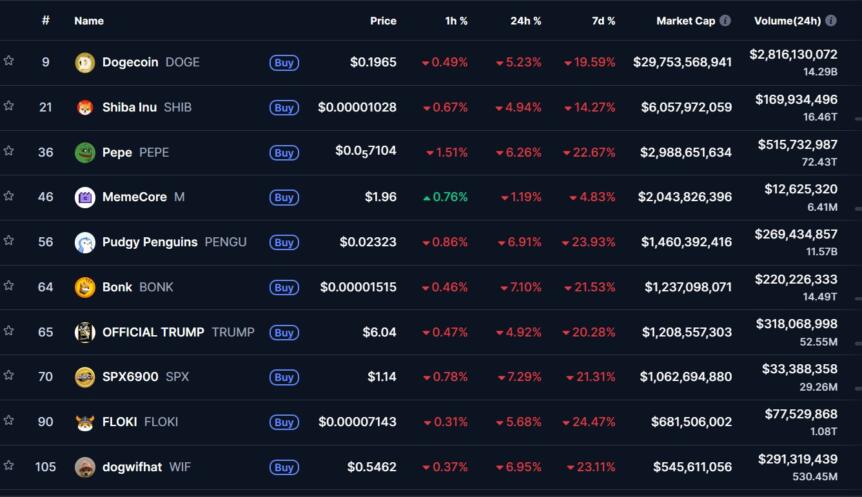 Top memecoins down by double-digit percentages. Source: CoinMarketCap
Related: High-leverage crypto trader James Wynn liquidated again, this time for $4.8M
Other crypto sectors stabilize quickly after the crash
While memecoins are still feeling the impact of recent market declines, other segments such as NFTs and established cryptocurrencies have shown rapid resilience. Just a day after the market correction, the NFT space began bouncing back, recouping approximately 10% of its value loss after a 20% drop that erased about $1.2 billion from the sector.
Crypto ETFs also demonstrated quick recovery, with fresh inflows following the initial outflows triggered by the market sell-off. Notably, Bitcoin spot ETFs saw net inflows of $102 million, and Ether ETFs gained $236 million in the same period.
Leading cryptocurrencies also rebounded significantly. Bitcoin, which briefly dipped below $102,000, is now trading above $111,000. Similarly, Ether, which fell below $3,700, recovered to over $4,000, indicating strong institutional interest and investor confidence returning to the market.
Magazine: Sharplink executive expresses shock over BTC and ETH ETF holdings: Joseph Chalom
This article was originally published as Memecoins Fall to July Lows While Bitcoin & Ether Drive Market Bounce Back on Crypto Breaking News – your trusted source for crypto news, Bitcoin news, and blockchain updates.
You May Also Like
Wormhole Unleashes W 2.0 Tokenomics for a Connected Blockchain Future

BitGo wins BaFIN nod to offer regulated crypto trading in Europe
BitGo’s move creates further competition in a burgeoning European crypto market that is expected to generate $26 billion revenue this year, according to one estimate. BitGo, a digital asset infrastructure company with more than $100 billion in assets under custody, has received an extension of its license from Germany’s Federal Financial Supervisory Authority (BaFin), enabling it to offer crypto services to European investors. The company said its local subsidiary, BitGo Europe, can now provide custody, staking, transfer, and trading services. Institutional clients will also have access to an over-the-counter (OTC) trading desk and multiple liquidity venues.The extension builds on BitGo’s previous Markets-in-Crypto-Assets (MiCA) license, also issued by BaFIN, and adds trading to the existing custody, transfer and staking services. BitGo acquired its initial MiCA license in May 2025, which allowed it to offer certain services to traditional institutions and crypto native companies in the European Union.Read more