Stablecoins as Cash Equivalents: What FASB Could Change
Overview
The Financial Accounting Standards Board is considering guidance that could allow certain digital assets, including qualifying stablecoins, to be treated as cash equivalents under existing U.S. GAAP principles. The proposal does not declare stablecoins to be cash and does not automatically make USDC, USDT or every dollar-pegged token eligible. Instead, FASB is clarifying how the existing definition of cash equivalents could apply when a digital asset has appropriate reserves, reliable convertibility and qualifying contractual redemption rights.
That distinction matters because stablecoins as cash equivalents would be an accounting classification, not a declaration that stablecoins carry the same economic risk as insured bank deposits. FASB's deliberations have focused on the amount and composition of reserves, direct on-demand redemption with the issuer and compliance with relevant laws and regulations. The project also proposes enhanced disclosure of significant classes of cash equivalents.
The potential corporate impact is larger than a technical accounting change. Stablecoins are increasingly being used in payments, cross-border settlement and treasury workflows. If certain tokens can satisfy cash-equivalent criteria, CFOs and treasury teams may be able to evaluate them as part of corporate liquidity rather than as a separate crypto allocation. However, the guidance remains proposed, and accounting eligibility would not remove issuer, reserve, redemption, blockchain or regulatory risk.
Key Takeaways
- FASB is clarifying when certain digital assets may meet the existing cash-equivalent definition.
- The proposal does not automatically classify all stablecoins as cash.
- Reserve quality and direct contractual redemption rights are central to the analysis.
- Cash-equivalent treatment could make stablecoins more practical for corporate treasury and settlement.
- Enhanced disclosure means qualifying stablecoins would not simply disappear inside a generic cash balance.
What Does FASB Actually Propose for Stablecoins?
FASB's project addresses a problem that existing accounting guidance did not originally anticipate: some digital assets are designed to behave economically like highly liquid dollar instruments, yet their legal structure and redemption mechanisms can differ significantly from traditional bank deposits or money-market products.
Rather than creating a completely new category called “digital cash,” FASB has taken a principles-based approach. It is considering illustrative examples under Topic 230, Statement of Cash Flows, to show how the existing cash-equivalent definition should be applied to certain digital assets.
The analysis emphasizes several characteristics, including reserve composition and the nature of a holder's contractual right to obtain cash directly from the issuer.
This means a token trading at $1.00 on an exchange would not qualify simply because its market price appears stable. The accounting question is deeper: Can the reporting company reliably convert the asset into a known amount of cash, with insignificant risk of changes in value?
For related background on the accounting proposal, see MEXC's analysis of stablecoins as cash equivalents and what FASB proposes.
Can Stablecoins Really Be Classified as Cash Equivalents?
Potentially, but only when the facts support the classification.
FASB's current framework preserves the existing definition rather than making “stablecoin” itself an accounting category. A company would therefore need to evaluate the specific asset it holds and the contractual rights attached to that holding.
Three questions are especially important:
- What supports the token? Reserve amount, quality and liquidity matter.
- Can the holder redeem directly? Contractual access to the issuer is materially different from relying only on an exchange.
- Is the redemption amount known? A token expected to trade near $1 is not necessarily the same as a legally enforceable right to receive $1.
This is why market stability is not the same as contractual cash convertibility.
A stablecoin can trade around par for years and still have a weaker accounting case if a corporate holder lacks enforceable direct redemption rights or if reserve assets introduce material value uncertainty.
Why Redemption Rights Matter More Than a $1 Price
Stablecoin markets often focus on whether a token remains close to its peg. Accounting analysis has to consider what happens underneath that market price.
Imagine two tokens that both trade at $1.
One is backed by high-quality liquid assets, gives the holder an enforceable right to redeem directly with the issuer on demand and returns a known amount of cash.
The other maintains its price mainly through secondary-market liquidity and arbitrage but gives the holder no direct redemption relationship with the issuer.
From a trader's perspective, both may look stable during normal markets. From a treasury perspective, they are materially different assets.
That distinction becomes especially important during stress. Exchange liquidity can deteriorate, market makers can withdraw and token prices can temporarily move away from par. A direct contractual redemption right potentially provides a separate path to cash.
FASB's approach therefore pushes corporate stablecoin analysis away from one simple question—
“Does it stay at $1?”
—and toward a more institutional one:
“What legally and economically guarantees my path from this token back into cash?”
Stablecoins as Cash Equivalents Could Change Treasury Decisions
Corporate stablecoin adoption has often been discussed through payments. Companies can use blockchain networks to move value outside conventional banking windows, settle cross-border obligations and potentially reduce the amount of cash pre-positioned with intermediaries.
Accounting classification adds another layer.
If an eligible stablecoin can be treated within cash and cash equivalents, a treasury team may no longer need to view every stablecoin balance primarily as a separate crypto investment. It could instead form part of the company's broader liquidity architecture, subject to the company's own accounting policy and risk controls.
That changes the operational question from:
“Should the company invest in crypto?”
to something closer to:
“Which settlement instruments can the company safely use within its liquidity stack?”
Possible use cases include supplier settlement, intercompany transfers, treasury rebalancing and cross-border working-capital movements.
The accounting change alone would not force businesses to adopt these tools. Corporate treasury policies can be more conservative than GAAP, while auditors, lenders and boards may impose additional requirements. But reducing classification uncertainty could remove one source of institutional friction.
Stablecoins vs Traditional Cash Equivalents
Stablecoins can share some characteristics with existing cash-management instruments while retaining very different risk structures.
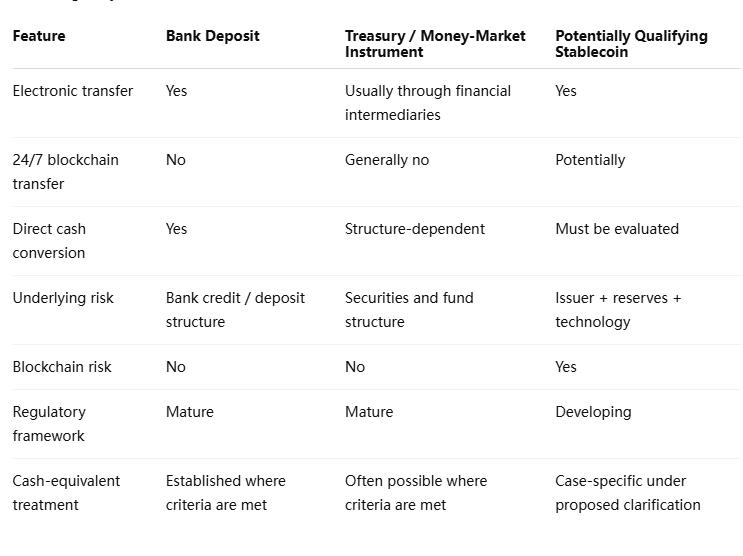
The accounting category therefore does not erase economic differences.
A stablecoin that qualifies as a cash equivalent could still expose its holder to private-key or custody issues, blockchain outages, issuer operations and reserve-management risk. A bank deposit carries a different legal claim and may benefit from deposit-protection frameworks that do not apply to stablecoins.
Same accounting presentation does not mean same risk profile.
Why Disclosure May Matter as Much as Classification
One of the more important parts of FASB's project receives less attention than the stablecoin headline. The Board also decided to require disclosure of significant classes and related amounts of cash equivalents.
That means corporate stablecoin adoption could become more visible rather than less visible.
Suppose a company eventually reports $2 billion in cash and cash equivalents. If stablecoins form a material part of that balance, enhanced disclosure could allow investors to distinguish those holdings from bank deposits, money-market instruments and other short-term assets.
This matters because two companies with identical headline cash balances may have materially different liquidity profiles depending on what sits inside that number.
The disclosure requirement can therefore solve an important tension. Stablecoins may qualify for accounting treatment consistent with their liquidity characteristics, while investors still receive information needed to evaluate their distinct risks.
For analysts, the future question may not simply be “How much cash does the company hold?” but “What forms of cash-like instruments make up that liquidity?”
Could USDC or USDT Qualify?
The proposal should not be interpreted as an official designation of individual stablecoins.
FASB is establishing an accounting framework, not publishing a whitelist. A company applying the guidance would need to examine the relevant token, reserve structure, redemption contract, issuer relationship and applicable regulations.
This distinction becomes important for institutional holders because their rights may differ from those of ordinary secondary-market users. A company with direct issuer access may have a different redemption position from a retail holder who can only sell a token on an exchange.
Consequently:
- a stable price alone is insufficient;
- a well-known brand alone is insufficient;
- large market capitalization alone is insufficient;
- exchange liquidity alone is insufficient.
The legal and economic relationship between holder and issuer matters.
This also means the same token could require more nuanced analysis than a simple sector-wide rule suggests. Companies need to evaluate their own facts and circumstances rather than assuming that every dollar-denominated token receives identical treatment.
How Could Accounting Treatment Affect Corporate Payments?
The connection between accounting and payment adoption is indirect but powerful.
Stablecoin infrastructure has already begun integrating into enterprise treasury systems and payment platforms. The operational case is straightforward: digital dollars can move continuously, settle on blockchain networks and support programmable transfers.
But an enterprise payment rail is easier to adopt when the accounting department knows how to report the asset that moves through it.
If qualifying stablecoins can sit within cash equivalents, finance teams may be able to integrate payment usage with ordinary cash-management policies more naturally. A company might receive a stablecoin from a customer, retain it temporarily for operational settlement and redeploy it to another supplier without treating the entire workflow as a separate crypto investment program.
That could reduce the gap between stablecoin payment infrastructure and stablecoin balance-sheet infrastructure.
It is still not a complete solution. Tax treatment, treasury mandates, counterparty limits and jurisdiction-specific regulation remain separate questions. Accounting clarification removes one obstacle; it does not remove all of them.
MEXC View: Stablecoin Adoption Is Becoming a Treasury Question
The most important shift is that stablecoin adoption is moving beyond the crypto department. As digital dollars enter ERP platforms, payment networks and corporate settlement systems, decisions increasingly involve CFOs, controllers, auditors and treasury committees.
FASB's work fits directly into that transition.
A corporate treasurer does not only ask whether a blockchain transfer is faster. The treasurer asks how the asset is classified, whether it is available during stress, who owes the redemption obligation, how it appears in liquidity reports and whether it satisfies internal cash-management policy.
If stablecoins as cash equivalents become workable under final guidance, the winners are likely to be products that combine blockchain functionality with strong reserve quality, legally clear redemption and institutional operational access.
The long-term competitive question may therefore shift from which stablecoin has the largest crypto trading volume to which stablecoin can most convincingly function inside conventional corporate liquidity management.
Risks and Limitations
The accounting proposal should not be interpreted as a broad institutional endorsement of stablecoins.
- Proposal risk: FASB's current work remains subject to due process and final guidance can differ.
- Issuer risk: cash-equivalent classification does not eliminate exposure to the entity responsible for reserves and redemption.
- Reserve risk: asset quality and liquidity still matter during stress.
- Redemption risk: exchange liquidity is not the same as an enforceable issuer redemption right.
- Operational risk: blockchain transfers introduce wallet, custody and network risks.
- Policy risk: a company may meet GAAP requirements but still prohibit stablecoins under its own treasury policy.
- Audit judgment: classification requires evidence and may need continuing reassessment.
The proposed disclosure requirements also mean companies should not assume that cash-equivalent treatment makes stablecoin exposure invisible to investors. Material holdings may instead receive clearer presentation.
Stablecoins Could Enter Corporate Cash—Under Strict Terms
The significance of stablecoins as cash equivalents is not that FASB is preparing to declare digital tokens equivalent to dollars. The more precise development is that accounting standard setters are confronting a new category of assets that can combine near-par value, direct redemption and high liquidity with blockchain-native settlement.
FASB's proposed approach preserves a demanding test. A token's label and market peg are not enough. Reserve composition, direct contractual redemption rights, convertibility into a known amount of cash and applicable regulation all become part of the assessment.
If the guidance becomes final, the consequences could extend beyond financial-statement presentation. Corporate treasury teams would have a clearer accounting framework for deciding whether certain stablecoins can participate in cash management, working-capital movements and settlement workflows. That could complement the enterprise payment infrastructure already being developed around regulated stablecoins.
However, accounting classification cannot remove underlying economic risk. A stablecoin remains dependent on its issuer, reserves, redemption architecture and technology even when it appears within the same financial-statement category as other cash equivalents.
The structural change is therefore not “crypto becomes cash.” It is that some digital settlement instruments may become sufficiently cash-like for conventional accounting frameworks to evaluate them alongside traditional liquidity tools. If that happens, stablecoin adoption could increasingly be driven by treasury utility rather than crypto-market speculation.
Sources
MEXC On-Chain Daily Report — Stablecoins May Be Classified as Cash Equivalents:
https://www.mexc.com/en-GB/learn/article/mexc-on-chain-daily-report-stablecoins-may-be-classified-as-cash-equivalents/1
Financial Accounting Standards Board — Cash Equivalents: Disclosure Enhancement and Classification of Certain Digital Assets:
https://fasb.org/projects/current-projects/classification-of-certain-digital-assets-as-cash-equivalents-423255
FASB Project History — Cash Equivalents and Certain Digital Assets:
https://fasb.org/projects/current-projects/projects-history/cash-equivalents%E2%80%94disclosure-enhancement-and-classification-of-certain-digital-assets-423255
FASB April 15, 2026 Board Meeting Minutes:
https://storage.fasb.org/Crypto2S-Minutes-20260415.pdf
Risk Disclaimer: This article is for reference only and does not constitute investment advice. The cryptocurrency market is highly volatile. Please make decisions cautiously based on your individual circumstances.


You May Also Like

Hong Kong Solana ETF: Can SOL Follow Bitcoin's Path?
Why Is ZEC Rising? Zcash Rebounds as Quantum-Security Narrative Gains Attention