

EMCD Partners with STABUL to Bridge Traditional Finance and Crypto Markets


The crypto industry is witnessing a shift toward platforms that combine blockchain innovation with traditional financial services. EMCD, one of the world’s top 7 Bitcoin mining pools, has announced plans to add STABUL Finance to its exchange offerings, expanding access to stablecoins and tokenized real-world assets for its 400,000+ users.
EMCD’s Evolution Beyond Mining
EMCD started in 2017 as a Bitcoin mining pool and has grown into a comprehensive crypto-financial platform serving users across 80+ countries. The company recently won “Crypto Mining Pool of the Year” at the FinanceFeeds Awards 2025, recognizing its evolution from a simple mining service to an integrated financial ecosystem.
The platform operates with a current hashrate of 23.67 EH/s and ranks as the largest mining pool in Eastern Europe, providing 1.9% of Bitcoin’s global hashrate. What sets EMCD apart is its “closed capital loop” approach, where users can mine cryptocurrency, earn yield through savings accounts, trade peer-to-peer, and soon spend through a crypto debit card – all within one platform.
EMCD’s Coinhold feature offers up to 14% annual percentage yield (APY) on cryptocurrency holdings, significantly higher than traditional bank savings rates of 1-2%. The platform achieves this through a conservative approach where funds serve as liquidity for internal exchanges rather than high-risk DeFi protocols, maintaining a seven-year track record without security breaches or user fund losses.
STABUL’s Fourth-Generation Trading Technology
STABUL Finance operates as a specialized decentralized exchange focused exclusively on stablecoins and tokenized real-world assets. The platform uses what it calls a “fourth-generation” automated market maker (AMM) that builds upon previous technologies like Uniswap and Curve.
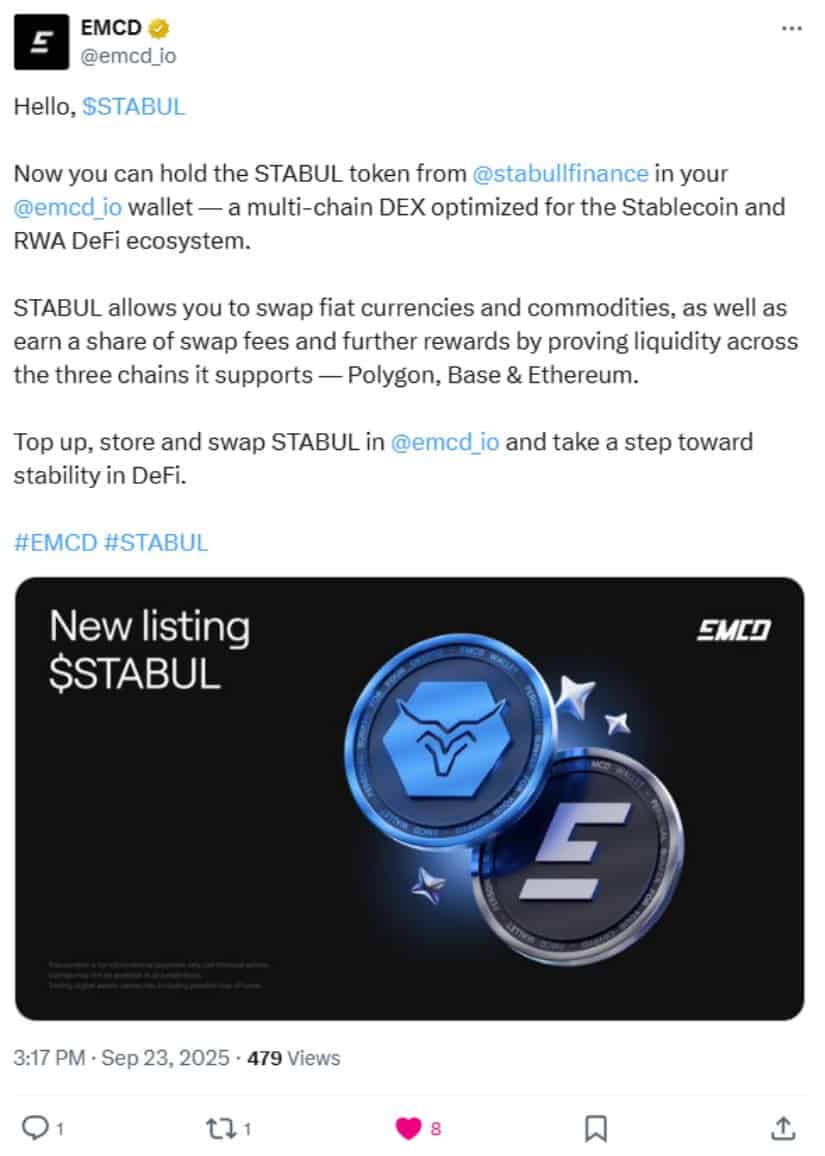
Source:@emcd_io
The key innovation lies in STABUL’s oracle-driven liquidity model. Instead of spreading liquidity evenly across all price points, STABUL concentrates liquidity around real-world foreign exchange and commodity prices using off-chain price feeds. This approach reduces slippage and impermanent loss for traders while providing better execution than general-purpose exchanges.
STABUL supports multiple fiat-backed stablecoins including Brazilian Real (BRZ), Euro (EURS), Japanese Yen (GYEN), and tokenized gold (PAXG). The platform operates across Ethereum, Polygon, and Base networks using Chainlink’s Cross-Chain Interoperability Protocol to maintain unified token supply.
The Strategic Partnership Impact
The EMCD-STABUL partnership addresses a significant market gap. While non-USD currencies account for over 40% of global forex trading, less than 1% of on-chain volume involves non-USD stablecoins. This partnership gives EMCD’s 400,000 KYC-verified users access to efficient stablecoin and commodity swaps through STABUL’s platform.
For EMCD users, this integration means seamless access to international currencies and tokenized assets without leaving their primary platform. Users earning cryptocurrency through mining can convert to stable assets, earn yield through Coinhold, and eventually spend through the upcoming EMCD Card – creating a complete financial ecosystem.
The timing aligns with EMCD’s broader expansion plans. The company offers zero percent mining fees through 2025 and is preparing to launch its crypto debit card, which will connect directly to users’ USDT balances for spending at any Visa or Mastercard merchant.
Market Position and Growth
EMCD has processed over $68 million through its Coinhold savings feature and maintains customer satisfaction ratings averaging 4.6 out of 5 stars on review platforms. The platform supports mining for Bitcoin, Litecoin, Dogecoin, Ethereum Classic, Dash, and Kaspa, with daily payouts and fees starting at 1.5%.
The company’s “EMCD Complex” service allows users to purchase and remotely operate ASIC mining hardware hosted on EMCD’s infrastructure, with zero pool fees through 2025. This fully managed mining solution has gained popularity in Latin America, Eastern Europe, and Southeast Asia.
STABUL Finance emerged from discussions with stablecoin issuers who identified the lack of dedicated liquidity venues for non-USD stablecoins and tokenized assets. The platform processed over $2 million in stablecoin swaps during its six-month beta testing phase before launching publicly.
Regulatory Compliance and Security
Both platforms prioritize regulatory compliance in an increasingly scrutinized industry. EMCD maintains AML/CTF compliance and uses advanced encryption, two-factor authentication, and distributed storage systems. The platform employs ISO 27000 standards and operates a dedicated Cyber Security Incident Response Team.
STABUL undergoes regular security audits and operates bug bounty programs to identify vulnerabilities. The platform focuses on governance through a consortium of stablecoin issuers and liquidity providers, ensuring sustainable operations as the tokenized asset market grows.
The partnership comes as global stablecoin circulation has doubled over the past 18 months, with regulatory frameworks emerging in the European Union, United Kingdom, Hong Kong, and Singapore to provide clearer operational guidelines.
The Web 2.5 Future
The EMCD-STABUL partnership exemplifies the Web 2.5 approach – combining crypto innovation with traditional financial accessibility. This model addresses one of crypto’s biggest challenges: fragmentation across multiple platforms for different services.
Users can now mine cryptocurrency, earn competitive yields, access international currencies, and prepare for real-world spending through a single, regulated platform. This integration reduces transaction costs, eliminates the need for multiple accounts, and provides institutional-grade security for retail users.
The partnership positions both companies to capitalize on the growing demand for stablecoin infrastructure as major corporations like Visa, Stripe, and BlackRock enter the tokenized asset space.
Building Tomorrow’s Digital Finance
EMCD and STABUL represent the maturing crypto industry’s move toward practical, user-focused solutions. By combining mining infrastructure, yield generation, currency exchange, and payment capabilities, they’re creating the foundation for mainstream crypto adoption.
This partnership demonstrates how specialized DeFi protocols can scale through established platforms with strong compliance and user bases. As the industry continues evolving toward practical utility, such collaborations may become the standard for bringing sophisticated blockchain technology to everyday users.
You May Also Like

Solana Overtakes Ethereum In Trillion-Dollar Sector, Is There A New King In Town?

Shiba Inu Price Steady as Kusama’s X Silence Sparks Speculation
