Bitcoin continues to struggle below the $70,000 threshold, reflecting persistent market pressure after weeks of volatility and weak recovery attempts. Despite occasionalBitcoin continues to struggle below the $70,000 threshold, reflecting persistent market pressure after weeks of volatility and weak recovery attempts. Despite occasional

Bitcoin Realized Losses Dominate – Bear Market Pressure Intensifies

2026/02/11 09:00
3분 읽기

Bitcoin continues to struggle below the $70,000 threshold, reflecting persistent market pressure after weeks of volatility and weak recovery attempts. Despite occasional rebounds from the $60,000 region, upside momentum remains limited, suggesting that demand has yet to return in a meaningful way. Market sentiment has shifted toward caution, with traders increasingly focused on downside risk rather than breakout potential.

Recent on-chain analysis from Darkfost indicates that realized losses are still dominating market activity. This imbalance implies that a large portion of investors entered positions near recent highs and are now exiting at a loss. Such behavior typically emerges during late-stage corrections, when conviction weakens, and participants prioritize capital preservation over long-term positioning.

Notably, some digital asset treasuries and large investors who accumulated Bitcoin at significantly higher levels are also reducing exposure. While this does not necessarily indicate structural capitulation, it reinforces the perception that confidence remains fragile. Historically, phases where realized losses outweigh profits often coincide with transitional market periods, either preceding deeper corrections or setting the stage for eventual accumulation.

Realized Losses Signal Ongoing Market Stress

On-chain analysis shared by Darkfost highlights a notable deterioration in Bitcoin’s profit-to-loss dynamics. The realized profit-to-loss ratio currently stands near 0.25, meaning that for every $1 of profit realized on-chain, roughly $4 in losses are being locked in. Such a skewed balance reflects a market still processing recent drawdowns, where a significant portion of participants are exiting underwater positions rather than securing gains.

Bitcoin Daily Realized Profit Loss Ratio | Source: Darkfost

The seven-day moving average of this ratio is now approaching levels typically associated with bear market conditions. This shift suggests that short-term sentiment remains fragile and that selling pressure continues to dominate recent transaction flows. For context, the annual average ratio sits around 6.33, indicating that, over longer horizons, profit realization still outweighs losses due to the inertia embedded in yearly data.

Importantly, realized profits have recently begun to slightly exceed losses after several weeks of persistent deficit, hinting at tentative stabilization rather than confirmed recovery. Historically, periods characterized by panic selling or capitulation can extend for months, particularly during broader bearish phases.

For a durable recovery to emerge, this ongoing purge of weaker hands must likely conclude, allowing unrealized profits to rebuild and restore investor confidence.

Bitcoin Price Tests Key Support After Sharp Breakdown

Bitcoin’s recent price structure reflects a clear deterioration in momentum, with the asset now struggling around the $68,000–$70,000 region after a sharp decline from late-2025 highs. The chart shows a decisive breakdown below intermediate support levels that had previously held during consolidation phases, confirming a transition from corrective pullback to a more pronounced bearish trend.
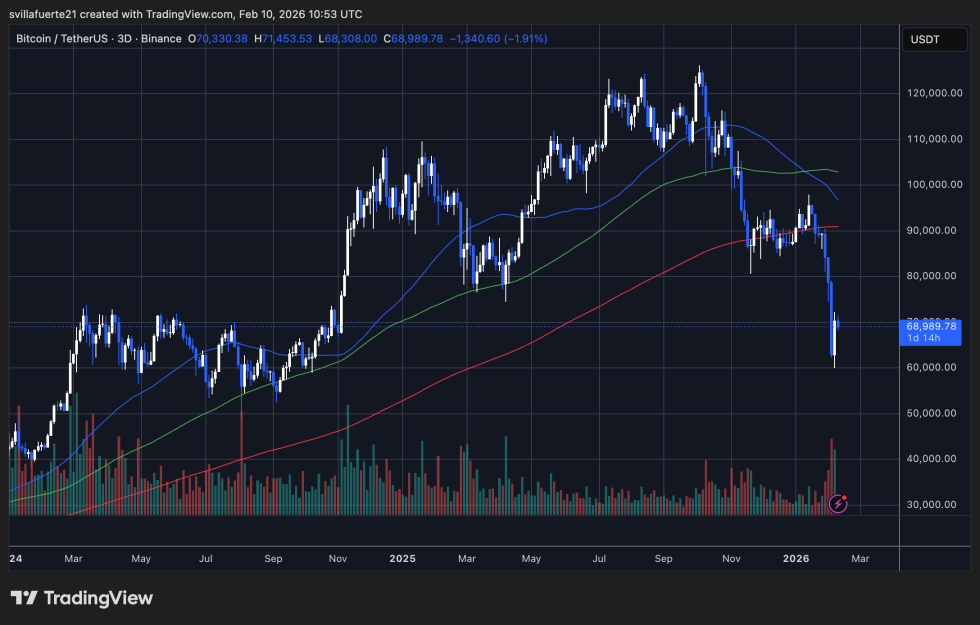
BTC consolidates around key level | Source: BTCUSDT chart on TradingView

Price action has also slipped below the short- and medium-term moving averages, both of which are now sloping downward. This configuration typically signals sustained selling pressure rather than a temporary retracement. Meanwhile, the longer-term moving average continues to flatten, suggesting that macro trend support has not yet fully failed but is increasingly under threat.

Volume behavior adds another layer of caution. The latest selloff was accompanied by a noticeable increase in trading activity, often interpreted as distribution rather than passive drift lower. Such spikes frequently appear during liquidation cascades or institutional repositioning.

From a technical standpoint, the $60,000–$65,000 range now stands out as the next critical demand zone. Holding above this region could stabilize sentiment and allow for consolidation. Failure to defend it, however, would likely confirm deeper bear-market continuation rather than a simple correction phase.

Featured image from ChatGPT, chart from TradingView.com 

면책 조항: 본 사이트에 재게시된 글들은 공개 플랫폼에서 가져온 것으로 정보 제공 목적으로만 제공됩니다. 이는 반드시 MEXC의 견해를 반영하는 것은 아닙니다. 모든 권리는 원저자에게 있습니다. 제3자의 권리를 침해하는 콘텐츠가 있다고 판단될 경우, service@support.mexc.com으로 연락하여 삭제 요청을 해주시기 바랍니다. MEXC는 콘텐츠의 정확성, 완전성 또는 시의적절성에 대해 어떠한 보증도 하지 않으며, 제공된 정보에 기반하여 취해진 어떠한 조치에 대해서도 책임을 지지 않습니다. 본 콘텐츠는 금융, 법률 또는 기타 전문적인 조언을 구성하지 않으며, MEXC의 추천이나 보증으로 간주되어서는 안 됩니다.

추천 콘텐츠

Aave V4 roadmap signals end of multichain sprawl

Aave V4 roadmap signals end of multichain sprawl

The post Aave V4 roadmap signals end of multichain sprawl appeared on BitcoinEthereumNews.com. Aave Labs has released its official launch roadmap for V4, laying out the final steps ahead of the major upgrade’s Q4 mainnet launch.  Alongside new architectural and security improvements, the roadmap introduces a fundamental shift in how user balances are tracked and highlights a strategic pullback from economically underperforming deployments across layer-2 and alternative layer-1 networks. The V4 release moves away from aTokens’ rebasing-style mechanics toward ERC-4626-style share accounting, a change that promises cleaner integrations, easier tax treatment, and better compatibility with downstream DeFi infrastructure.  In a recent technical development update, Aave Labs confirmed that “tokenization is to remain optional and built using ERC 4626 vaults,” and that internal accounting will eliminate the use of exchange rates or scaled balances. The goal is to “further improve the overall reliability of the protocol.” ERC-4626 is a widely adopted Ethereum standard that expresses user deposits as shares of a vault rather than balances that grow over time. In Aave V3, aTokens accrue interest by increasing a user’s balance directly — behavior that resembles rebasing tokens and often confuses integrations and portfolio accounting tools.  By contrast, ERC-4626 tracks yield through a rising price-per-share metric, leaving token balances unchanged. The result is more predictable behavior for integrators, auditors and tax software, as well as a clearer cost basis for users. The roadmap also outlines a series of release milestones, including a formal codebase publication, a public testnet launch with a redesigned interface, and the completion of a multi-layered security review involving formal verification and manual audits. Aave Labs said the roadmap reflects the protocol’s “final stages of review, testing, and deployment,” and that additional documentation and launch preparation materials will be released in the coming weeks. But the most pointed strategic shift comes not from the codebase, but from Aave’s own governance forums. “Aave…
공유하기
BitcoinEthereumNews2025/09/18 07:40
Wormhole Token Surges After Tokenomics Reset and W Reserve Launch
Wormhole Token Surges After Tokenomics Reset and W Reserve Launch

Wormhole, a leading interoperability protocol that enables asset transfers across multiple blockchains, has announced significant updates to its native tokenomics. These changes include the introduction of a token reserve and enhanced incentives for stakers, which could influence the protocol’s governance structure, as voting power is tied to the stake of Wormhole tokens. In a recent [...]
공유하기
Crypto Breaking News2025/09/18 03:18
Grayscale’s Multi-Crypto Exchange-Traded Product Gets SEC Approval

Grayscale’s Multi-Crypto Exchange-Traded Product Gets SEC Approval

Grayscale’s multi-crypto ETP receives SEC approval, offering new investment opportunities. SEC’s new crypto ETF standards could lead to dozens of launches. GDLC fund includes Bitcoin, Ether, XRP, Solana, and Cardano exposure. The U.S. Securities and Exchange Commission (SEC) has officially approved Grayscale’s Digital Large Cap Fund (GDLC), marking a significant development for the cryptocurrency industry. This fund will become the first multi-crypto asset exchange-traded product (ETP) available on the market, providing investors exposure to five prominent cryptocurrencies-Bitcoin, Ether, XRP, Solana, and Cardano. According to Grayscale’s CEO, Peter Mintzberg, the approval signals a significant milestone for both the company and the broader crypto industry. He has thanked the SEC Crypto Task Force for working hard on providing the much-needed regulatory clarity to the sector. This accreditation comes after it was previously delayed earlier in the year, as the SEC had put off the conversion of GDLC on the over-the-counter fund to a tradable ETF on NYSE Arca in the communal view of seeking additional examination. Grayscale Digital Large Cap Fund $GDLC was just approved for trading along with the Generic Listing Standards. The Grayscale team is working expeditiously to bring the FIRST multi #crypto asset ETP to market with Bitcoin, Ethereum, XRP, Solana, and Cardano#BTC #ETH $XRP $SOL… — Peter Mintzberg (@PeterMintzberg) September 17, 2025 The latest update on Grayscale’s website shows that GDLC has a net asset value of $57.7 per share and that its assets under management exceed $915 million. Multi-crypto investment is a much-needed diversification of an already fast-expanding digital asset market. Also Read: The Secret Behind $RLUSD’s Success: Building a Stablecoin for the Global Economy The SEC’s Accelerated Approval Process and Broader Impact on Crypto ETFs In addition to approving Grayscale’s fund, the SEC also introduced a new development for crypto ETF issuers. The agency approved, on an accelerated basis, the generic listing standards for cryptocurrency ETFs. This action should make the approval process less challenging, which will result in the introduction of a large number of new crypto ETFs, most of which may track such assets as XRP, Solana, and even Dogecoin. SEC Chairman Paul Atkins pointed out that these revised listing standards would enhance investor access to digital assets and innovation in the capital markets. Eric Balchunas, a senior ETF analyst at Bloomberg, says that the introduction of these standards will lead to the introduction of more than 100 crypto ETFs next year. This approval is in line with the SEC’s larger endeavors to simplify the regulations surrounding cryptocurrencies and related products, which may result in new opportunities for investors in the digital asset sector. It highlights a growing recognition of crypto’s place within traditional financial markets and could pave the way for a more robust crypto ETF market in the future. Also Read: Bitcoin, Ethereum and Solana Make Major Moves: Top Crypto Trends You Can’t Miss The post Grayscale’s Multi-Crypto Exchange-Traded Product Gets SEC Approval appeared first on 36Crypto.
공유하기
Coinstats2025/09/18 15:29