Oil Markets Surge as Iran Rejects Trump’s Claims of Diplomatic Engagement
Key Highlights
- Crude markets recovered Tuesday following an 11% plunge Monday, pushing Brent above $102 per barrel
- Tehran rejected President Trump’s assertion that diplomatic discussions were in progress
- The critical Strait of Hormuz waterway stays mostly blocked, eliminating 20% of worldwide oil shipments
- Market analysts forecast prices will remain in the $85–$110 range until normal shipping resumes
- Nations including Slovenia, Chile, Japan, and the Philippines have implemented fuel restrictions or rationing measures
Crude oil markets staged a significant recovery Tuesday following Monday’s dramatic decline. Brent crude advanced to approximately $102 per barrel, while West Texas Intermediate gained roughly 3% to reach about $90.
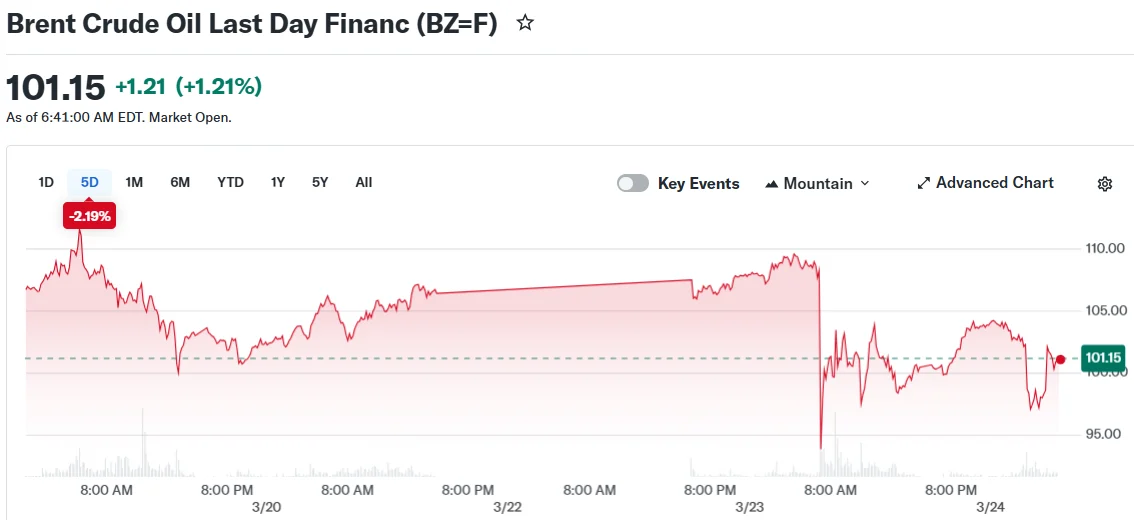 Brent Crude Oil Last Day Financ (BZ=F)
This contradiction immediately reversed the downward momentum.
The primary concern continues to center on the Strait of Hormuz. This critical shipping channel links the Persian Gulf to international oil markets and typically facilitates approximately 20% of the world’s petroleum exports. Tehran has maintained a near-total blockade since tensions with Washington and Israel intensified.
Brent has surged approximately 40% during this month alone, fueled by concerns that the standoff could trigger sustained energy scarcity. Diesel and aviation fuel costs have escalated even more dramatically than crude benchmarks.
Worldwide Consequences Intensify
Nations across the globe are confronting the crisis’s repercussions. Slovenia became the inaugural European Union member to implement fuel rationing protocols. Chile plans to increase fuel prices by as much as 50%. Japan mandated a comprehensive assessment of its petroleum supply infrastructure.
Across Asia, China’s leading refinery operator announced it would prioritize domestic distribution. The Philippines cautioned that aviation fuel shortages could force flight cancellations, calling it a “distinct possibility.”
New Zealand introduced weekly tax rebates for approximately 150,000 households to offset escalating energy expenses.
Goldman Sachs cautioned that prolonged supply disruptions would ultimately require demand destruction to restore market equilibrium.
Diplomatic Communications Stay Ambiguous
Trump had earlier threatened military strikes against Iran’s energy sector unless the Strait reopened completely within 48 hours. He subsequently extended that deadline by five days. He also floated the possibility of joint U.S.-Iranian management of the waterway, suggesting it could reopen “very soon.”
Iran’s deputy parliamentary leader stated the Strait would not return to its former operational status and ruled out negotiations with Washington.
Tehran is reportedly examining communications from Washington transmitted through third-party channels, according to CBS News citing a senior Iranian government source. Energy installations in Isfahan, located in central Iran, were also targeted during weekend attacks.
Saudi Arabia informed the United States it stands ready to attack Iran if its own electrical and water infrastructure becomes targeted. Intelligence reports indicate Saudi Crown Prince Mohammed bin Salman is approaching a decision on potential military participation.
RBC Capital Markets analysts observed that actual vessel movements — not political rhetoric — would ultimately dictate developments in physical commodity markets.
A limited number of ships have successfully navigated through the Persian Gulf recently, though the vast majority of Strait traffic remains suspended.
Macquarie Group energy analyst Vikas Dwivedi suggested that even if hostilities subside, oil prices will likely maintain a floor between $85 and $90, with gradual movement back toward $110 until the Strait returns to full operational capacity.
The post Oil Markets Surge as Iran Rejects Trump’s Claims of Diplomatic Engagement appeared first on Blockonomi.
Potrebbe anche piacerti

VGTEL in Strategic Talks to Acquire Consciousness-Focused Health-Tech Platform

Top 10 free crypto cloud mining platforms in 2026