

CGSMFI 2.0 Aims to Strengthen Microfinance Liquidity
Strengthening Microfinance Liquidity: A CX Perspective on CGSMFI 2.0
The Government of India’s launch of the Credit Guarantee Scheme for Microfinance Institutions 2.0 (CGSMFI-2.0) introduces a targeted intervention aimed at addressing persistent liquidity constraints in the microfinance sector. The initiative, acknowledged by the Microfinance Industry Network (MFIN), is designed to catalyze bank lending to microfinance institutions (MFIs) by reducing credit risk through a structured guarantee mechanism.
The timing of the scheme is notable. While the sector has shown measurable improvement in portfolio quality—reflected in declining delinquency ratios—access to institutional funding has tightened significantly over the past two years. This disconnect between improving asset quality and declining credit flow has had direct consequences on the availability of formal credit for underserved populations. Industry estimates suggest that millions of borrowers have lost access to credit due to constrained liquidity, underscoring the systemic nature of the issue.
Customer Experience in Microfinance: Beyond Interfaces
In the context of microfinance, customer experience (CX) is intrinsically linked to access, continuity, and trust. Unlike traditional retail banking, where experience enhancements often focus on digital interfaces or omnichannel engagement, microfinance customers prioritize reliability—specifically, the ability to access credit when needed.
The sector’s increasing adoption of digital tools—ranging from mobile-based onboarding to data-driven credit assessments—has raised customer expectations around speed and transparency. However, these front-end improvements can only deliver value if supported by stable backend funding mechanisms.
Liquidity constraints introduce friction that is often invisible in digital workflows but acutely felt in customer outcomes. Delayed disbursements, reduced loan availability, and inconsistent engagement cycles undermine the trust that MFIs have historically built through community-based models. For CX leaders, this highlights a critical insight: experience design in financial services must account for the resilience of underlying financial infrastructure.
Interpreting MFIN’s Strategic Position
As an industry body, MFIN’s response to CGSMFI-2.0 reflects its broader mandate to advocate for systemic stability rather than individual institutional advantage. Its engagement with policymakers suggests a long-term strategy centered on ecosystem enablement—ensuring that MFIs, particularly smaller and mid-sized players, can continue to operate sustainably.
The scheme aligns with a key structural need: rebalancing risk perception among banks. Despite improvements in credit quality, MFIs have faced reduced access to funding, indicating a persistent risk aversion among lenders. By introducing a credit guarantee framework, the government effectively shares a portion of this risk, incentivizing banks to re-engage with the sector.
Dr. Alok Misra, CEO and Director, MFIN, noted that while the sector has strengthened its adherence to responsible lending practices, liquidity constraints have remained the primary bottleneck. He emphasized that the scheme is expected to unlock funding and ensure continued access to affordable credit for low-income households.
From a CX standpoint, this strategic alignment is significant. Ensuring liquidity is not merely a financial objective—it is a prerequisite for maintaining consistent and reliable customer engagement.
How CGSMFI 2.0 Works: Enabling Credit Flow Through Risk Sharing
At its core, CGSMFI-2.0 functions as a risk-sharing mechanism designed to encourage institutional lending to MFIs. By providing partial credit guarantees on loans extended by banks, the scheme reduces the perceived risk associated with lending to microfinance institutions, particularly those with limited balance sheet strength.
This model has several operational implications. First, it stabilizes the flow of capital into the sector, reducing dependency on volatile funding cycles. Second, it enables MFIs to plan their lending operations with greater predictability, improving alignment between capital availability and customer demand.
The scheme also creates an enabling environment for technology investments. With better access to funding, MFIs are having an easier position to allocate resources toward digital transformation initiatives. Such as automated underwriting, mobile servicing platforms, and data analytics capabilities—that enhance both operational efficiency and customer engagement.
CX Impact: Consistency, Reliability, and Reduced Friction
The most immediate CX impact of CGSMFI-2.0, in fact, lies in the restoration of consistency across customer journeys. For borrowers, access to credit is often time-sensitive, linked to livelihood cycles, emergencies, or small business needs. Interruptions in credit availability can have cascading effects on financial stability.
By improving liquidity, the scheme enables MFIs to maintain regular lending cycles, ensuring that customers can access funds when required. This predictability is a critical driver of trust, particularly in segments where financial resilience is limited.
Operationally, reduced funding pressure allows institutions to shift focus from risk containment to service enhancement. This can translate into faster approval processes, improved turnaround times, and more transparent communication with customers.
The scheme also supports the principles of responsible finance, which are central to customer experience in microfinance. By reinforcing disciplined lending practices while enabling growth, it helps balance accessibility with sustainability—an essential consideration in serving vulnerable populations.
Industry-Wide Implications: Toward Resilient Credit Ecosystems
The introduction of CGSMFI-2.0 signals a broader trend toward policy-driven stabilization mechanisms in financial services. As sectors navigate economic volatility and shifting risk dynamics, such interventions are likely to play an increasingly important role in maintaining credit flow.
For the microfinance industry, the scheme may accelerate the adoption of standardized risk management practices and data-driven decision-making. Institutions that can effectively leverage improved liquidity while maintaining strong governance frameworks are likely to gain a competitive advantage.
There are also implications for market dynamics. Smaller MFIs, which have been disproportionately affected by funding constraints, may regain their operational capacity, contributing to a more balanced competitive landscape. This, in turn, can enhance customer choice and access—key dimensions of customer experience.
The Road Ahead: Integrating Policy, Technology, and CX
The launch of CGSMFI-2.0 underscores the interconnected nature of policy, financial infrastructure, and customer experience. For CX leaders, it reinforces the need to adopt a holistic approach—one that considers not only digital interfaces but also the systemic factors that enable service delivery.
As liquidity conditions improve, the focus is likely to shift toward leveraging this stability to drive innovation. MFIs may increase investments in digital platforms, expand data-driven credit models, and enhance customer engagement strategies. These developments have the potential to transform the microfinance experience, making it more accessible, efficient, and responsive to customer needs.
However, the long-term impact of the scheme will depend on its execution and adoption. Sustained collaboration between policymakers, financial institutions, and industry bodies will be essential to ensure that the intended benefits translate into tangible outcomes for customers.
Ultimately, the success of CGSMFI-2.0 will be measured not only by the volume of credit disbursed but by its ability to restore and strengthen trust among borrowers. In the context of microfinance, where relationships are foundational, this trust is the cornerstone of customer experience.
For CX and digital transformation leaders, the message is clear: resilient infrastructure is not a backend concern—it is central to delivering meaningful and reliable customer experiences.
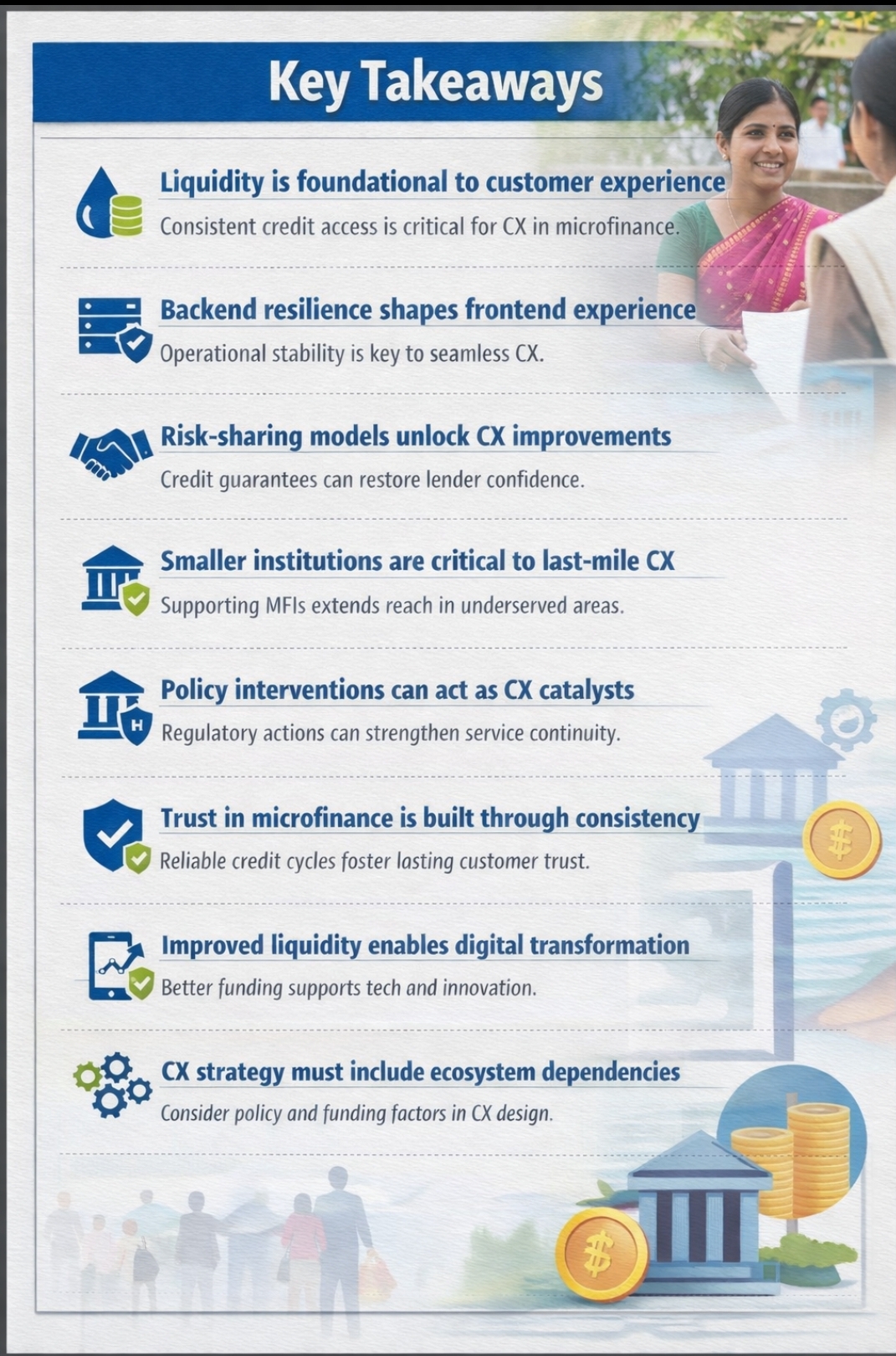
Key Takeaways
- Liquidity is foundational to customer experience
In microfinance, consistent access to credit is a core CX driver. Funding disruptions directly translate into broken customer journeys and loss of trust. - Backend resilience shapes frontend experience
Digital interfaces and onboarding improvements cannot compensate for unstable funding. Operational and financial stability remain critical enablers of seamless CX. - Risk-sharing models can unlock CX improvements
Credit guarantee frameworks like CGSMFI-2.0 reduce lender hesitation, enabling smoother credit flow and more reliable service delivery for end customers. - Smaller institutions are critical to last-mile CX
Supporting small and mid-sized MFIs strengthens reach in underserved segments, improving accessibility and inclusivity in customer experience. - Policy interventions can act as CX catalysts
Regulatory and government initiatives are not just compliance mechanisms—they can directly enhance service continuity, trust, and customer outcomes. - Trust in microfinance is built through consistency
Predictable lending cycles and reliable access to funds matter more than feature-rich platforms in building long-term customer relationships. - Improved liquidity enables digital transformation
With reduced funding pressure, MFIs can invest in technology, streamline operations, and enhance customer engagement models. - CX strategy must include ecosystem dependencies
Leaders, in fact, need to account for external factors—policy, funding, and institutional partnerships—when designing and delivering customer experiences.
The post CGSMFI 2.0 Aims to Strengthen Microfinance Liquidity appeared first on CX Quest.


Potrebbe anche piacerti
DCodex Officially Launches DPay, a Visa-Powered USDT Payment Card Bridging Crypto Assets and Real-World Spending

Western Digital Jumps 7% on Morgan Stanley’s 33% Price-Target Hike, Seagate Gains 5% as the AI Storage Boom Rolls On

'Why even bother?' Trump stuns after casually folding on 'his main justification' for war


Notizie di tendenza
Altro
