


Expert Speaks
Ma. Theresa Lazaro, Secretary for Foreign Affairs of the Republic of the Philippines, addresses the general debate of the General Assembly’s eightieth session.Ma. Theresa Lazaro, Secretary for Foreign Affairs of the Republic of the Philippines, addresses the general debate of the General Assembly’s eightieth session.
Marcos at the UN: Philippines’ push for Security Council seat
Per feedback o dubbi su questo contenuto, contattateci all'indirizzo crypto.news@mexc.com.
When President Ferdinand Marcos Jr. addressed the United Nations General Assembly (UNGA) for the first time in 2022, he was a different president at a different time in the world.
It was September 2022, just months after he had won as the first majority-elected Philippine president since the ouster of his namesake and father, the late dictator Ferdinand E. Marcos. His political alliances were still intact, and Manila was only beginning to chart its place in the world under a second Marcos presidency.
Fast forward to March 2026, and Marcos returns to the United Nations more weary over the domestic upheavals and crises — many of them self-made — that he has had to face, and backdropped by a world order that’s shifting before our very eyes.
The President is in New York from March 9 to 10 to speak during the 70th Session of the Commission on the Status of Women, as well as during a special session before the UN General Assembly (UNGA). He will also be meeting with UN Secretary-General Antonio Guterres.
Marcos’ New York visit had always been meant as his last in-person push for the Philippines’ bid to secure a seat as a non-permanent member of the powerful UN Security Council for 2027–2028. Voting is set to take place in June 2026.
Marcos and the Philippines have long emphasized the importance of middle powers and smaller nations working together to shape their own destiny amid the superpower rivalry between the United States and China.
Missiles continue to launch in the Gulf, triggered by a “pre-emptive” strike by the United States, once the purveyor of an international system based on rules, norms, and predictability. Closer to home, in waters it calls the West Philippine Sea, Manila continues to face a China that’s also been openly flouting international law, including the hard-won 2016 arbitral award.
Why a UN SC seat?
“Bakit nga ba mahalaga na magkaroon tayo ng seat sa UN Security Council? Uulitin po natin, mahalaga po ito dahil nagbibigay ito sa Pilipinas ng kapangyarihan at boses sa mga usaping global safety at security. Importante po ang mga usaping ito para sa mga Pilipino at mga mamamayan mula sa mga developing countries. May impact po ito sa ating sovereignty, maritime security, sa global economy at sa safety ng ating Overseas Filipino Workers (OFW),” said Department of Foreign Affairs (DFA) spokesperson Assistant Secretary Angelica Escalona on a briefing on March 7.
(Why is it important for the Philippines to get a seat in the UN Security Council? It’s important because it gives the Philippines power and a voice in discussions of global safety and security. This is important for Filipinos and for people from developing countries. This has an impact on sovereignty, maritime security, the global economy, and the safety of our Overseas Filipino Workers.)
It is not just Marcos who has changed, in demeanor and circumstance, since his last UNGA visit. The world has changed dramatically since — more so, even in just the past two weeks.
When Marcos spoke of “tectonic shifts” in his address in 2022, he was referring mostly to the changes and disruptions brought about by the COVID-19 pandemic, Russia’s war on Ukraine, and advancements in technology.
“Widening geopolitical polarities and sharpening strategic competitions are transforming the international political landscape. A profound lack of trust is putting enormous strains on our multilateral system,” Marcos said in 2022.
The strain had increased exponentially since.
Before February 2026 ended, the US, a treaty ally of the Philippines and a permanent member of the UN SC, launched what it has sometimes claimed were preemptive strikes against Iran, alongside Israel. President Donald Trump and his administration’s explanation for those strikes and the “imminent” threat that would have justified them has been erratic, at best.
Iran responded by striking its neighbors in the Gulf, as well as Israel. It’s a conflict that has brought much of the Middle East to a standstill. While the conflict does not involve the Philippines directly, its effects were felt immediately — over the safety of millions of OFWs in the region, and oil prices back home.
Malacañang and the DFA framed the New York visit also in the context of the tensions in the Middle East.
“Napakahalaga po ng biyaheng ito, ito po ang tamang pagkakataon dahil sa mga nangyayari ngayon sa Middle East. Ang UN ang pinakaangkop na lugar upang manawagan ang ating Pangulo para sa kapayapaan sa Middle East at sa kaligtasan ng lahat ng mga sibilyan lalo na ng ating mga kababayan,” explained Escalona.
(This trip is important and happens at an opportune time because of what is happening in the Middle East. The UN is the best platform for the President to make a call for peace in the Middle East and the safety of civilians, especially our countrymen.)
The situation in the Middle East will also be on the agenda when Marcos meets Guterres, whose tenure as UN Secretary General ends in 2026.
Guterres has condemned the escalation of hostilities in the Middle East, particularly the “use of force by the United States and Israel against Iran, and the subsequent retaliation by Iran across the region, [undermining] international peace and security.”
Marcos has been less strong in his rhetoric on the situation in the region, but has called for a cessation of hostilities.
Philippines’ voice in the region, globally
The Philippines’ campaign for a UN SC seat has been quite public and prominent and has been a near-constant talking point for diplomats and the President. Kyrgyzstan, which has never been a member of the UN SC, is also vying for a seat in the 2027–2028 term.
For Manila, the importance of the seat has always been about having a say in global security issues and its faith in a multilateral system, despite its painfully obvious shortcomings and limitations. While commentators have often emphasized the significance of a UN SC seat in the context of the Philippines’ dispute with the superpower China in the South China Sea, Manila itself has been mindful of signalling that this won’t necessarily be a priority should it secure a slot in the council.
The Philippines, after all, is balancing another gargantuan task: the chairmanship of the Association of Southeast Asian Nations (ASEAN) in the same year as a border conflict between Thailand and Cambodia, a Myanmar that has yet to comply with the 5-Point Consensus, and aspirations to conclude a Code of Conduct (COC) for the South China Sea.
The argument could be simplified this way: a seat for the Philippines in the UN SC means a voice with moral ascendancy that stands for international law and the rules-based order in the broadest terms — and not just relative to its specific maritime interests.
The UN SC is considered the most powerful body in the UN and is tasked with upholding “international peace and security in accordance with the principles and purposes of the United Nations.” Before the UNGA is where sentiments are made by member nations. It’s in the UN SC that those sentiments are, theoretically, turned into action.
Five countries are permanent members of the UN SC and have veto power, which means one vote from them could thwart any resolution or proposed action. They are China, France, Russia, the United Kingdom, and the US.
The Philippines is among those who have called for reform and better inclusivity in the UN SC, as well as “an empowered General Assembly that can hold the Council to account,” Marcos said in 2022.
The last time Manila held a non-permanent seat on the Security Council was from 2004 to 2005, or two decades ago. It previously held seats in 1957, 1963, and from 1980 to 1981.
Marcos’ official delegation for the two-day working visit includes First Lady Louise Araneta-Marcos, Secretary of Foreign Affairs Maria Theresa Lazaro, Secretary of Migrant Workers Hans Leo Cacdac, Presidential Adviser on Peace, Reconciliation and Unity Secretary Carlito Galvez Jr., and Acting Communications Secretary Dave Gomez. – Rappler.com
Disclaimer: gli articoli ripubblicati su questo sito provengono da piattaforme pubbliche e sono forniti esclusivamente a scopo informativo. Non riflettono necessariamente le opinioni di MEXC. Tutti i diritti rimangono agli autori originali. Se ritieni che un contenuto violi i diritti di terze parti, contatta crypto.news@mexc.com per la rimozione. MEXC non fornisce alcuna garanzia in merito all'accuratezza, completezza o tempestività del contenuto e non è responsabile per eventuali azioni intraprese sulla base delle informazioni fornite. Il contenuto non costituisce consulenza finanziaria, legale o professionale di altro tipo, né deve essere considerato una raccomandazione o un'approvazione da parte di MEXC.
Potrebbe anche piacerti
Markets await Fed’s first 2025 cut, experts bet “this bull market is not even close to over”
Will the Fed’s first rate cut of 2025 fuel another leg higher for Bitcoin and equities, or does September’s history point to caution? First rate cut of 2025 set against a fragile backdrop The Federal Reserve is widely expected to…
Condividi
Crypto.news2025/09/18 00:27
Solana (SOL) Price Analysis: Can $80 Support Hold Against Mounting Pressure?
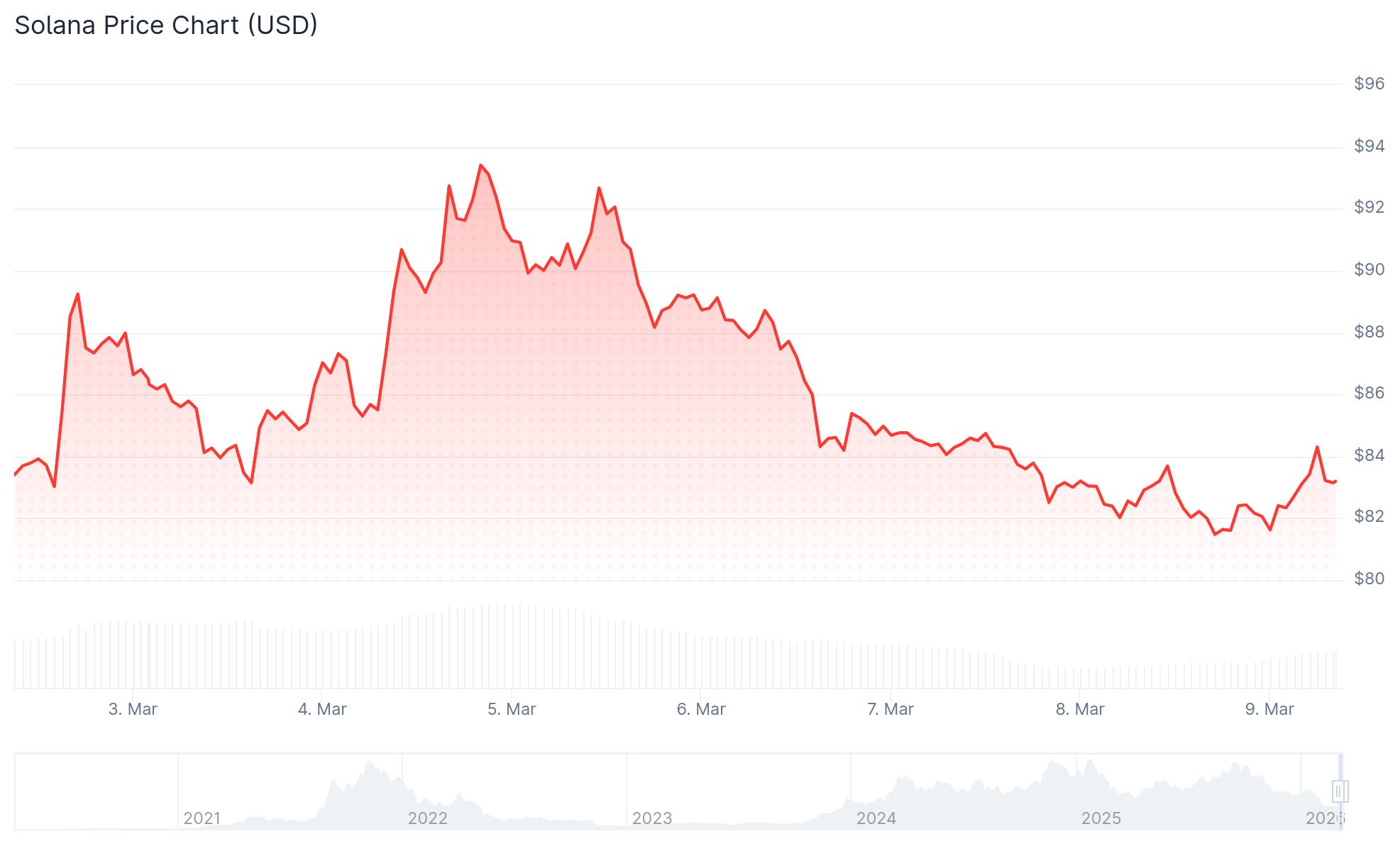
Solana (SOL) price analysis: Testing $80 support with resistance at $85.50. ETF outflows return while RWA wallet count overtakes Ethereum for first time. The post
Condividi
Blockonomi2026/03/09 16:32
SOL Price Prediction: Targets $88-95 Recovery by End of March
Solana trades at $83.09 with neutral RSI at 43.63. Technical analysis suggests SOL could target $88-95 by month-end if it breaks above $85 resistance, though bearish
Condividi
BlockChain News2026/03/09 16:03