Future of Finance: TDA and Machine Learning for Market Prediction
Table of Links
I. Introduction
II. Methodology
III. TDA Approach to analyzing multiple time series
IV. Data Analyzed
V. Results and Discussion
A. Obtaining point cloud from stock price time-series
B. EE due to the 2008 Financial crisis
C. EE due to COVID-19 pandemic
D. Impact of COVID-19 on different Indian sectors
VI. Conclusion
VII. Acknowledgments and References
VI. CONCLUSION
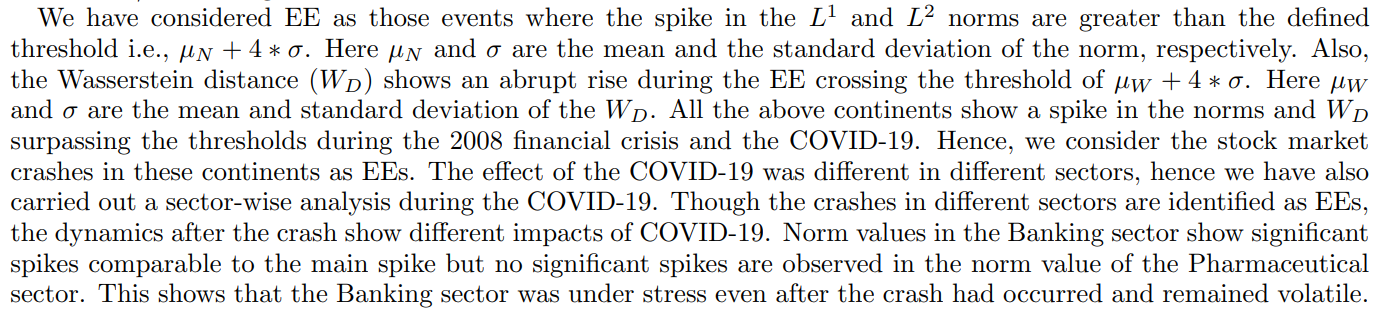
Our study has proven successful in detecting continent-wise and sector-wise extreme events (EEs) in the stock market using Topological Data Analysis (TDA). The 2008 financial crisis and the crash due to the COVID-19 pandemic are identified as EEs in Asia, Europe, North-South America, and Oceania continents. A sector-wise analysis has been carried out during the COVID-19 pandemic. Earlier work has identified the crash due to COVID-19 as an EE taking the stock indices of each country separately proving it to be unsuitable for analyzing continent-wise or sector-wise. However, TDA overcomes this difficulty and we can identify continent-wise & sector-wise EE by analyzing stock prices of n stocks/indices together.
\ 
\ Our results are consistent with the empirical mode decomposition-based Hilbert-Huang transform technique used for the identification of EEs by Mahata et al.[10] and Anish et al.[13]. Hence, TDA is capable of identifying EEs in the stock market. In the future, TDA may be applied with machine learning techniques to understand the market dynamics and also may help in the prediction of stock prices.
\
:::info Authors:
(1) Anish Rai, Department of Physics, National Institute of Technology Sikkim, Sikkim, India-737139;
(2) Buddha Nath Sharma, Department of Physics, National Institute of Technology Sikkim, Sikkim, India-737139;
(3) Salam Rabindrajit Luwang, Department of Physics, National Institute of Technology Sikkim, Sikkim, India-737139;
(4) Md.Nurujjaman, Department of Physics, National Institute of Technology Sikkim, Sikkim, India-737139;
(5) Sushovan Majhi, Data Science Program, George Washington University, USA, 20052.
:::
:::info This paper is available on arxiv under CC BY 4.0 DEED license.
:::
\


Potrebbe anche piacerti

The Agentic AI Era Demands New Entry-Level Roles. Are SA Companies Creating Them?

South Africa agriculture trade faces Middle East risks