

Liquidity, Retail Access, and DeFi Integration Discussed As Catalysts For Tokenized Asset Growth At HSC Asset Management In Hong Kong
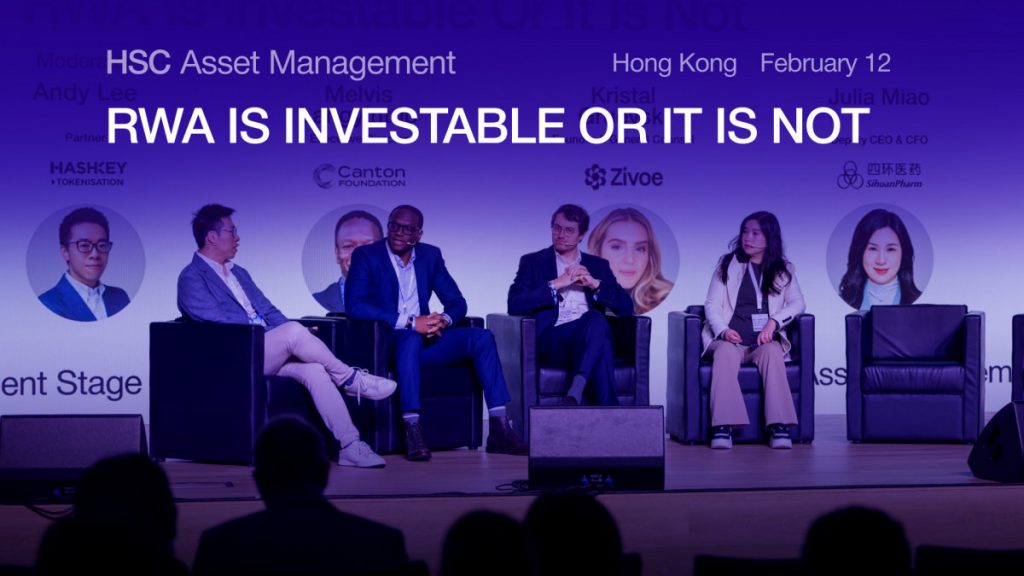
At the recent HSC Asset Management held in Hong Kong on February 12th, a group of senior market participants met to discuss how institutional adoption of tokenized real-world assets is evolving and whether these products can meet professional investment standards.
The session, titled “RWA Is Investable Or It Is Not” and moderated by Andy Lee of HashKey Tokenisation, brought together Philip Rage of Soter Insure, Melvis Langyintuo representing Canton Network, and Julia Miao from Sihuan Pharmaceutical Group.
The discussion focused on whether tokenized real-world assets can satisfy institutional requirements around legal enforceability, underwriting standards and risk management practices, as well as the sustainability of yield structures. Participants also addressed the importance of distinguishing durable investment fundamentals from short-term market narratives as capital markets increasingly explore tokenized formats for traditional assets.
Regulatory Clarity As A Foundation For Institutional Adoption
The panel began with a discussion on regulatory clarity and its role in enabling institutional engagement with tokenized real-world assets (RWAs). Melvis Langyintuo explained that Canton Network’s infrastructure is designed to support multiple regulatory regimes while maintaining flexibility for both private and public blockchain applications. Philip Rage highlighted that institutions require clear rules to confidently participate in tokenized markets, noting that regulatory clarity influences where firms choose to deploy capital. Julia Miao added that recent policy guidance in Hong Kong and broader Asia signals an important opening for tokenized assets. The discussion concluded that while regulations continue to evolve, technology can advance in parallel to facilitate secure and compliant issuance.
Choosing The Right Blockchain Infrastructure
The panel then switched to the question of which blockchain platforms are most suitable for issuing RWAs. Melvis argued that highly specialized or narrowly focused chains can limit interoperability and composability, which are critical for liquidity and operational efficiency. Philip emphasized that liquidity benefits depend on access to secondary markets and the ability to trade assets broadly. Julia provided a corporate perspective, noting that issuing on widely recognized public chains can enhance visibility and credibility for new asset issuers. Overall, the panel highlighted the trade-offs between privacy, flexibility, and market reach, suggesting that infrastructure choices should reflect the intended purpose and target participants of the asset.
Liquidity, Retail Access, And DeFi Integration
The discussion then turned to liquidity and access considerations for RWAs. Panelists noted that highly liquid assets, such as tokenized treasuries and equities, can move efficiently on-chain, while bespoke assets, including private credit or pharmaceutical IP, face inherent liquidity constraints. Melvis explained that blockchain technology can still provide operational and capital efficiency for illiquid assets. Philip stressed the importance of network composability for enabling secondary market activity. The panel also debated retail participation, with all agreeing that early RWA adoption remains largely institutional but has the potential to broaden as markets mature. Julia emphasized that complex assets like pharmaceutical IP are better suited to professional investors due to their specialized nature.
The session concluded with reflections on the interplay between traditional finance and decentralized finance (DeFi). Panelists observed growing interest from institutions in leveraging DeFi protocols to increase efficiency, liquidity, and innovative investment strategies, while noting that full integration is still in early stages. The discussion underscored the value of faith in RWA adoption and collaboration across the industry to realize operational, regulatory, and market potential.
The post Liquidity, Retail Access, and DeFi Integration Discussed As Catalysts For Tokenized Asset Growth At HSC Asset Management In Hong Kong appeared first on Metaverse Post.


Potrebbe anche piacerti

Bitcoin Miners Warn No Bottom Yet, CryptoQuant Says—What On-Chain Metrics Reveal

Anchor plops Trumper in hotseat over president’s 'grift'

Veterans urge GOP to back War Powers Resolution and honor 13 Americans killed in Iran


Notizie di tendenza
Altro
