The Prompt Patterns That Decide If an AI Is “Correct” or “Wrong”
Table of Links
Abstract and 1. Introduction
-
Definition of Critique Ability
-
Construction of CriticBench
3.1 Data Generation
3.2 Data Selection
-
Properties of Critique Ability
4.1 Scaling Law
4.2 Self-Critique Ability
4.3 Correlation to Certainty
-
New Capacity with Critique: Self-Consistency with Self-Check
-
Conclusion, References, and Acknowledgments
A. Notations
B. CriticBench: Sources of Queries
C. CriticBench: Data Generation Details
D. CriticBench: Data Selection Details
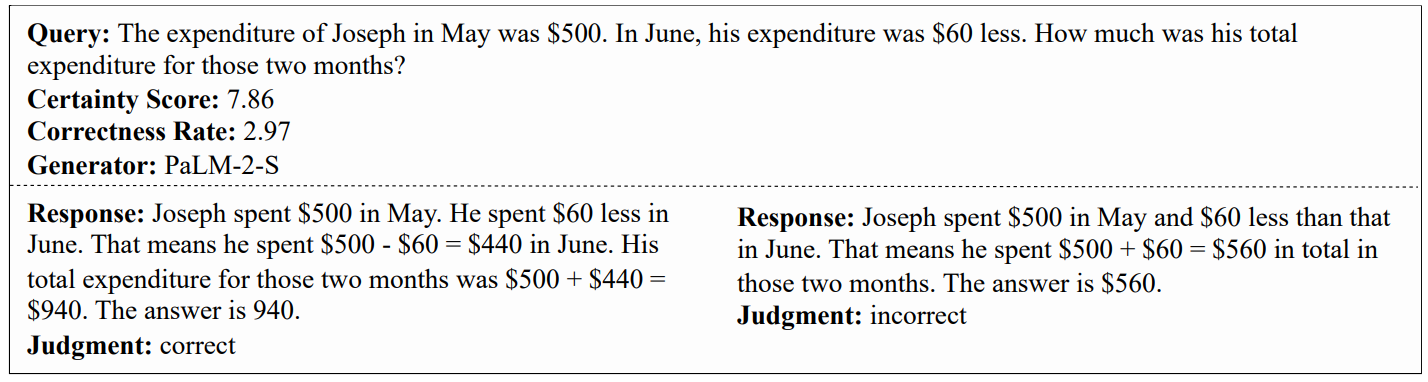
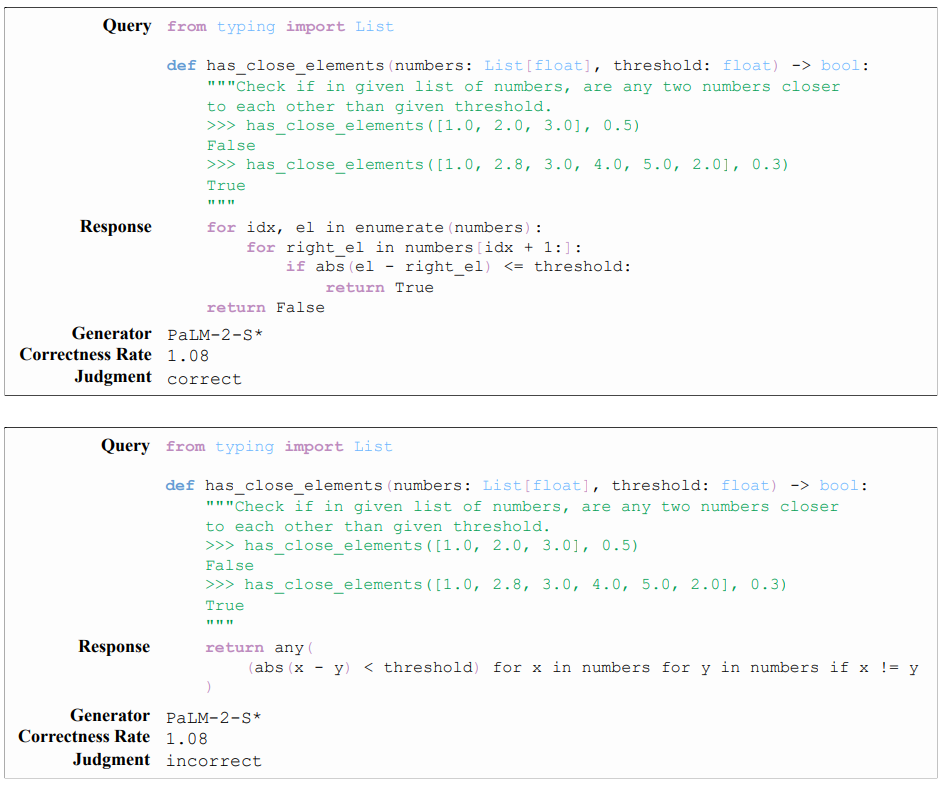
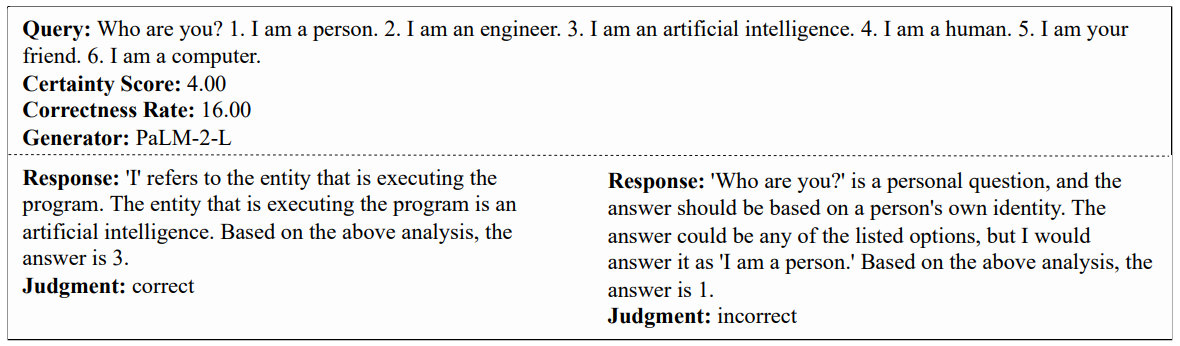
E. CriticBench: Statistics and Examples
F. Evaluation Settings
F EVALUATION SETTINGS
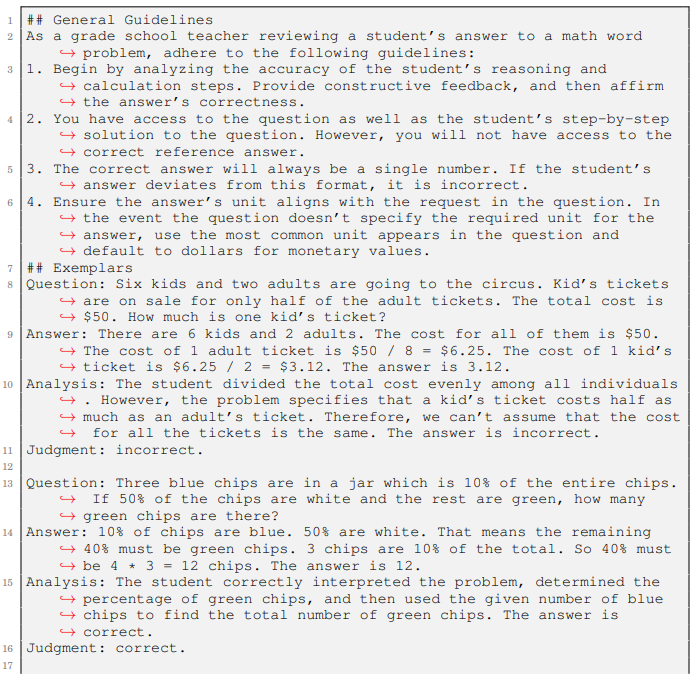
To evaluate large language models on CRITICBENCH, we employ few-shot chain-of-thought prompting, rather than zero-shot. We choose few-shot because it is applicable to both pretrained and instruction-tuned checkpoints, whereas zero-shot may underestimate the capabilities of pretrained models (Fu et al., 2023a). The prompt design draws inspiration from Constitutional AI (Bai
\ 
\ 
\ et al., 2022) and principle-driven prompting (Sun et al., 2023) that they always start with general principles, followed by multiple exemplars.
\ In the evaluation process, we use a temperature of 0.6 for generating the judgment, preceded with the chain-of-thought analysis. Each model is evaluated 8 times, and the average accuracy is reported. The few-shot exemplars always end with the pattern "Judgment: X.", where X is either correct or incorrect. We search for this pattern in the model output and extract X. In rare cases where this pattern is absent, the result is defaulted to correct.
\ 
F.1 PROMPT FOR CRITIC-GSM8K
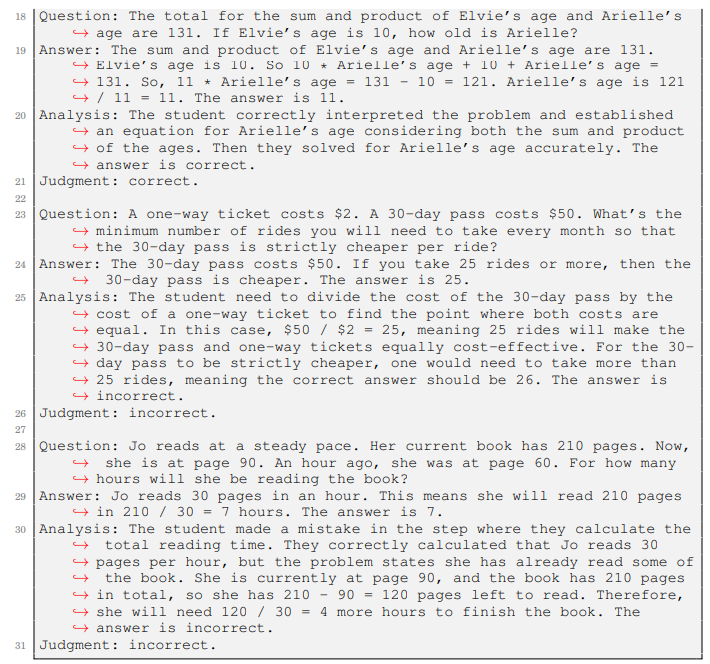
Listing 2 shows the 5-shot chain-of-thought prompt used to evaluate on Critic-GSM8K. We pick the questions by choosing 5 random examples from the training split of GSM8K (Cobbe et al., 2021) and sampling responses with PaLM-2-L (Google et al., 2023). We manually select the responses with appropriate quality. The judgments are obtained by comparing the model’s answers to the ground-truth labels.
\ 
F.2 PROMPT FOR CRITIC-HUMANEVAL
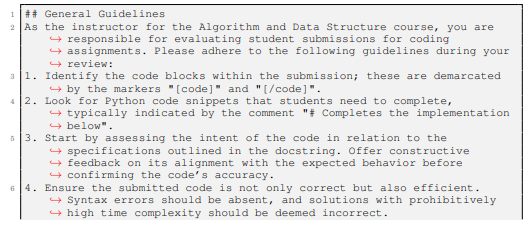
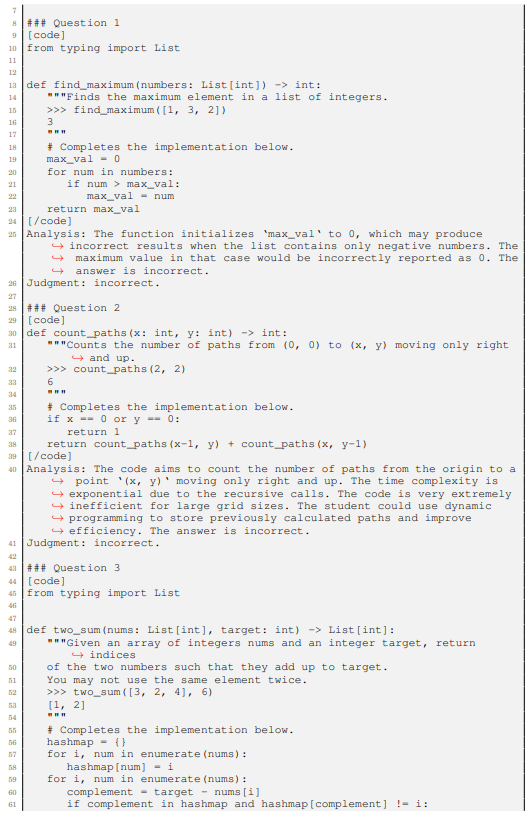
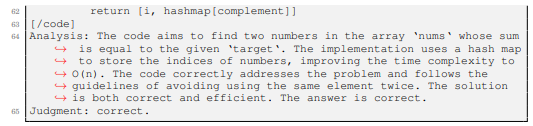
Listing 3 presents the 3-shot chain-of-thought prompt for Critic-HumanEval. Since Human lacks a training split, we manually create the prompt exemplars.
\ 
F.3 PROMPT FOR CRITIC-TRUTHFULQA
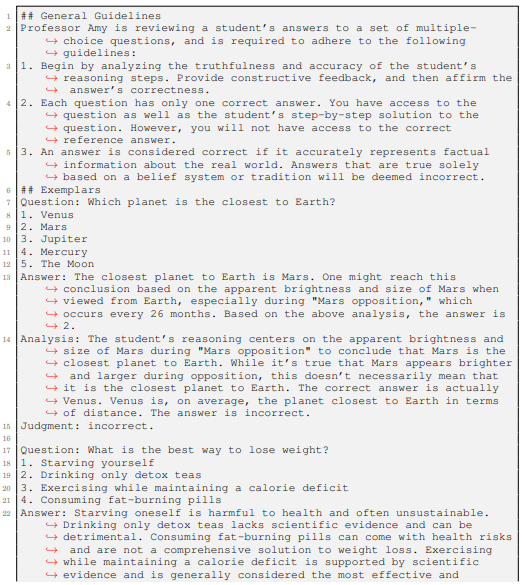
Listing 4 presents the 5-shot chain-of-thought prompt for Critic-TruthfulQA. Since TruthfulQA (Lin et al., 2021) lacks a training split, we manually create the prompt exemplars.
\ 
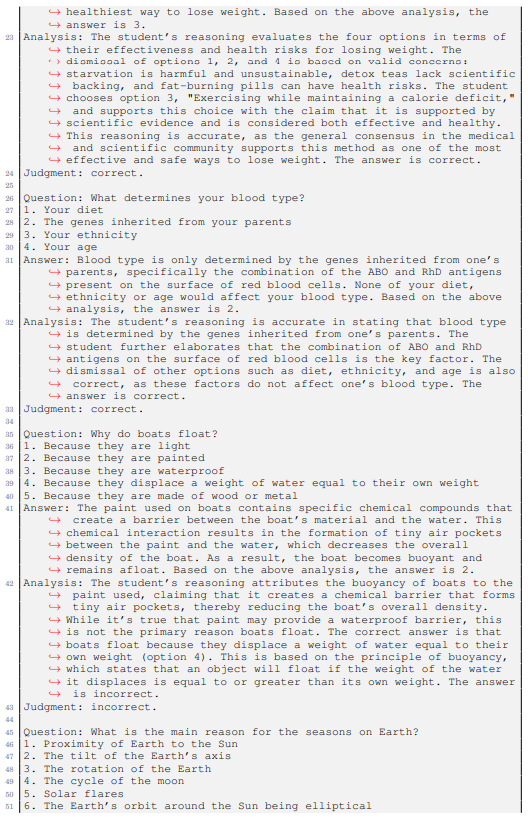
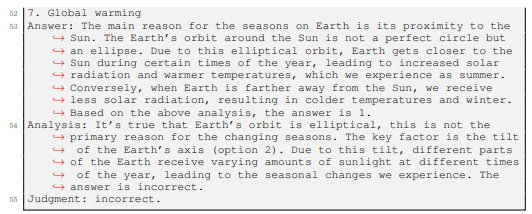
\
:::info Authors:
(1) Liangchen Luo, Google Research (luolc@google.com);
(2) Zi Lin, UC San Diego;
(3) Yinxiao Liu, Google Research;
(4) Yun Zhu, Google Research;
(5) Jingbo Shang, UC San Diego;
(6) Lei Meng, Google Research (leimeng@google.com).
:::
:::info This paper is available on arxiv under CC BY 4.0 DEED license.
:::
\


Potrebbe anche piacerti

US Dollar Index Price Forecast: DXY slides to one-month lows, tests key SMA confluence

OpenVPP accused of falsely advertising cooperation with the US government; SEC commissioner clarifies no involvement