The post Trump Grab For Defense Firms Could Be Nightmare For Musk’s SpaceX appeared on BitcoinEthereumNews.com. Elon Musk speaks with Donald Trump as they watch the launch of the sixth test flight of SpaceX’s Starship rocket last November in Brownsville, Texas. Getty Images The U.S. government spends hundreds of billions of dollars a year with defense companies. The Trump administration seems to think it deserves something more in return than goods and services: equity. The Defense Department is considering taking ownership stakes in defense contractors, Commerce Secretary Howard Lutnick said Tuesday in an interview on CNBC. The financing of munitions acquisitions needs rethinking, and Secretary of Defense Pete Hegseth and Undersecretary Stephen Feinberg “are on it,” Lutnick said. “The way it has been done has been a giveaway.” His comments, which came during a discussion on the U.S. government’s assumption of a stake in Intel, caught defense watchers by surprise. But major defense companies may be better able to fend off any government demands. For fast-moving SpaceX, allowing the government a seat at the owners’ table and inside scrutiny of how it operates might be particularly repellant for billionaire founder Elon Musk. And he may have stronger leverage than anyone to deny that. Unlike the ailing chipmaker and rare earths mine developer MP Materials, both of which gave the government equity stakes in return for badly needed funding, SpaceX and other major defense contractors have robust balance sheets. That even includes Boeing, which raised $24 billion in equity last year and has made substantial progress toward improving production of its commercial airplanes and straightening out troubled defense programs. If Trump started making eyes at companies like SpaceX or Lockheed Martin, it’s unclear that the administration has any legal authority to seize stakes “in perfectly healthy defense companies,” noted Todd Harrison, a defense analyst at the American Enterprise Institute. In June, when the president’s relationship with billionaire… The post Trump Grab For Defense Firms Could Be Nightmare For Musk’s SpaceX appeared on BitcoinEthereumNews.com. Elon Musk speaks with Donald Trump as they watch the launch of the sixth test flight of SpaceX’s Starship rocket last November in Brownsville, Texas. Getty Images The U.S. government spends hundreds of billions of dollars a year with defense companies. The Trump administration seems to think it deserves something more in return than goods and services: equity. The Defense Department is considering taking ownership stakes in defense contractors, Commerce Secretary Howard Lutnick said Tuesday in an interview on CNBC. The financing of munitions acquisitions needs rethinking, and Secretary of Defense Pete Hegseth and Undersecretary Stephen Feinberg “are on it,” Lutnick said. “The way it has been done has been a giveaway.” His comments, which came during a discussion on the U.S. government’s assumption of a stake in Intel, caught defense watchers by surprise. But major defense companies may be better able to fend off any government demands. For fast-moving SpaceX, allowing the government a seat at the owners’ table and inside scrutiny of how it operates might be particularly repellant for billionaire founder Elon Musk. And he may have stronger leverage than anyone to deny that. Unlike the ailing chipmaker and rare earths mine developer MP Materials, both of which gave the government equity stakes in return for badly needed funding, SpaceX and other major defense contractors have robust balance sheets. That even includes Boeing, which raised $24 billion in equity last year and has made substantial progress toward improving production of its commercial airplanes and straightening out troubled defense programs. If Trump started making eyes at companies like SpaceX or Lockheed Martin, it’s unclear that the administration has any legal authority to seize stakes “in perfectly healthy defense companies,” noted Todd Harrison, a defense analyst at the American Enterprise Institute. In June, when the president’s relationship with billionaire…

Trump Grab For Defense Firms Could Be Nightmare For Musk’s SpaceX

2025/08/27 19:20
5 min di lettura
Per feedback o dubbi su questo contenuto, contattateci all'indirizzo crypto.news@mexc.com.

Elon Musk speaks with Donald Trump as they watch the launch of the sixth test flight of SpaceX’s Starship rocket last November in Brownsville, Texas.

Getty Images

The U.S. government spends hundreds of billions of dollars a year with defense companies. The Trump administration seems to think it deserves something more in return than goods and services: equity.

The Defense Department is considering taking ownership stakes in defense contractors, Commerce Secretary Howard Lutnick said Tuesday in an interview on CNBC.

The financing of munitions acquisitions needs rethinking, and Secretary of Defense Pete Hegseth and Undersecretary Stephen Feinberg “are on it,” Lutnick said. “The way it has been done has been a giveaway.”

His comments, which came during a discussion on the U.S. government’s assumption of a stake in Intel, caught defense watchers by surprise. But major defense companies may be better able to fend off any government demands. For fast-moving SpaceX, allowing the government a seat at the owners’ table and inside scrutiny of how it operates might be particularly repellant for billionaire founder Elon Musk. And he may have stronger leverage than anyone to deny that.

Unlike the ailing chipmaker and rare earths mine developer MP Materials, both of which gave the government equity stakes in return for badly needed funding, SpaceX and other major defense contractors have robust balance sheets. That even includes Boeing, which raised $24 billion in equity last year and has made substantial progress toward improving production of its commercial airplanes and straightening out troubled defense programs.

If Trump started making eyes at companies like SpaceX or Lockheed Martin, it’s unclear that the administration has any legal authority to seize stakes “in perfectly healthy defense companies,” noted Todd Harrison, a defense analyst at the American Enterprise Institute.

In June, when the president’s relationship with billionaire first bro Elon Musk collapsed spectacularly, former Trump adviser Steve Bannon called for him to use the Defense Production Act to take over SpaceX. If it were 1951, that might have been possible. But in 1952 the Supreme Court declared unconstitutional President Harry Truman’s attempt to use the act to nationalize steel mills, and its seizure powers were formally repealed by Congress in 2009.

Given that SpaceX is the world’s No. 1 launch provider and maker of low-Earth orbit satellites, the U.S. government has little alternative to the company for many of the roughly $13 billion in outstanding contracts it holds – and little leverage.

Musk, who comfortably controls the majority of SpaceX’s voting shares, is unlikely to give the government a stake, said Kimberly Siversen Burke, director of government affairs at the consultancy Quilty Space, for the same reason that he hasn’t taken the company public – he doesn’t need the money and he doesn’t want outside scrutiny. “The second outside shareholders — let alone Uncle Sam — get a look under the SpaceX hood, the whole game changes,” she said. “Transparency, board seats, GAO audits … Elon’s worst nightmare.”


Got a tip? Contact Jeremy Bogaisky at [email protected] or jeremy.282 on Signal.


The Defense Department declined to comment. White House spokesman Kush Desai wrote that in the wake of taking a stake in Intel, “the Administration will continue to explore other deals that ensure taxpayers reap the benefits of investments being made with their money by the federal government.”

The U.S. government has taken equity stakes and warrants in struggling companies before amid severe economic crises, rescuing banks and General Motors during the Great Recession, and airlines during the pandemic. But Trump is reaching for an unprecedented share of the spoils of corporate America’s activities. The administration extracted a “golden share” in U.S. Steel as a condition for approving its merger with Nippon Steel, and cut a deal for 15% of Nvidia’s chip sales to China. On Friday the government secured a 10% stake in Intel in return for releasing $5.7 billion in grants previously committed under the CHIPS Act and $3.2 billion from another Biden-era program.

White House economic advisor Kevin Hassett described it as a “down payment” on a sovereign wealth fund that Trump aims to establish.

If the major defense contractors cave to political pressure, equity investments could create nightmarish conflicts of interest, Jefferies analyst Sheila Kahyaoglu wrote in a note. “We can only imagine the first protest of an award that goes to a prime that the gov’t has an equity stake in over a non-government prime.”

It could also have a chilling impact on companies’ willingness to do business with the U.S. government and on the willingness of investors to put money into companies that do, said Harrison — and work against the Pentagon’s recent attempts to expand the number of companies that compete for government contracts. “VC and PE investment in defense startups could dry up if there is a perception that the government is interfering in the market and creating an unfair playing field,” he said.

MORE FROM FORBES

ForbesBefore Trump Deal, Intel Worked With Chinese Companies Sanctioned By U.S.ForbesThe U.S. Government Is Stuck With SpaceX. But Trump Can Still Hurt It.ForbesApex Wants To Bring Henry Ford-Style Mass Production To Satellites

Source: https://www.forbes.com/sites/jeremybogaisky/2025/08/27/a-trump-grab-for-stakes-in-defense-firms-could-be-a-nightmare-for-musks-spacex/

Opportunità di mercato
Logo OFFICIAL TRUMP
Valore OFFICIAL TRUMP (TRUMP)
$2.969
$2.969$2.969
-1.94%
USD
Grafico dei prezzi in tempo reale di OFFICIAL TRUMP (TRUMP)
Disclaimer: gli articoli ripubblicati su questo sito provengono da piattaforme pubbliche e sono forniti esclusivamente a scopo informativo. Non riflettono necessariamente le opinioni di MEXC. Tutti i diritti rimangono agli autori originali. Se ritieni che un contenuto violi i diritti di terze parti, contatta crypto.news@mexc.com per la rimozione. MEXC non fornisce alcuna garanzia in merito all'accuratezza, completezza o tempestività del contenuto e non è responsabile per eventuali azioni intraprese sulla base delle informazioni fornite. Il contenuto non costituisce consulenza finanziaria, legale o professionale di altro tipo, né deve essere considerato una raccomandazione o un'approvazione da parte di MEXC.

Potrebbe anche piacerti

Navigating The Critical Sideways Bias With Safe-Haven Support

Navigating The Critical Sideways Bias With Safe-Haven Support

The post Navigating The Critical Sideways Bias With Safe-Haven Support appeared on BitcoinEthereumNews.com. USD/CAD Forecast: Navigating The Critical Sideways Bias
Condividi
BitcoinEthereumNews2026/03/09 17:39
Support at 1.15 under pressure – ING

Support at 1.15 under pressure – ING

The post Support at 1.15 under pressure – ING appeared on BitcoinEthereumNews.com. ING’s Chris Turner highlights that strong support just below 1.1500 in EUR/USD
Condividi
BitcoinEthereumNews2026/03/09 17:19
Crucial ETH Unstaking Period: Vitalik Buterin’s Unwavering Defense for Network Security

Crucial ETH Unstaking Period: Vitalik Buterin’s Unwavering Defense for Network Security

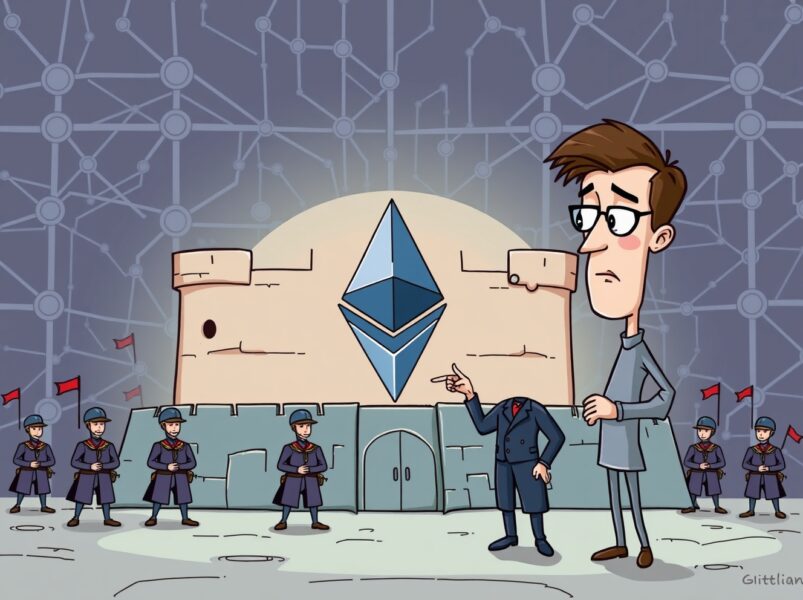
BitcoinWorld Crucial ETH Unstaking Period: Vitalik Buterin’s Unwavering Defense for Network Security Ever wondered why withdrawing your staked Ethereum (ETH) isn’t an instant process? It’s a question that often sparks debate within the crypto community. Ethereum founder Vitalik Buterin recently stepped forward to defend the network’s approximately 45-day ETH unstaking period, asserting its crucial role in safeguarding the network’s integrity. This lengthy waiting time, while sometimes seen as an inconvenience, is a deliberate design choice with profound implications for security. Why is the ETH Unstaking Period a Vital Security Measure? Vitalik Buterin’s defense comes amidst comparisons to other networks, like Solana, which boast significantly shorter unstaking times. He drew a compelling parallel to military operations, explaining that an army cannot function effectively if its soldiers can simply abandon their posts at a moment’s notice. Similarly, a blockchain network requires a stable and committed validator set to maintain its security. The current ETH unstaking period isn’t merely an arbitrary delay. It acts as a critical buffer, providing the network with sufficient time to detect and respond to potential malicious activities. If validators could instantly exit, it would open doors for sophisticated attacks, jeopardizing the entire system. Currently, Ethereum boasts over one million active validators, collectively staking approximately 35.6 million ETH, representing about 30% of the total supply. This massive commitment underpins the network’s robust security model, and the unstaking period helps preserve this stability. Network Security: Ethereum’s Paramount Concern A shorter ETH unstaking period might seem appealing for liquidity, but it introduces significant risks. Imagine a scenario where a large number of validators, potentially colluding, could quickly withdraw their stake after committing a malicious act. Without a substantial delay, the network would have limited time to penalize them or mitigate the damage. This “exit queue” mechanism is designed to prevent sudden validator exodus, which could lead to: Reduced decentralization: A rapid drop in active validators could concentrate power among fewer participants. Increased vulnerability to attacks: A smaller, less stable validator set is easier to compromise. Network instability: Frequent and unpredictable changes in validator numbers can lead to performance issues and consensus failures. Therefore, the extended period is not a bug; it’s a feature. It’s a calculated trade-off between immediate liquidity for stakers and the foundational security of the entire Ethereum ecosystem. Ethereum vs. Solana: Different Approaches to Unstaking When discussing the ETH unstaking period, many point to networks like Solana, which offers a much quicker two-day unstaking process. While this might seem like an advantage for stakers seeking rapid access to their funds, it reflects fundamental differences in network architecture and security philosophies. Solana’s design prioritizes speed and immediate liquidity, often relying on different consensus mechanisms and validator economics to manage security risks. Ethereum, on the other hand, with its proof-of-stake evolution from proof-of-work, has adopted a more cautious approach to ensure its transition and long-term stability are uncompromised. Each network makes design choices based on its unique goals and threat models. Ethereum’s substantial value and its role as a foundational layer for countless dApps necessitate an extremely robust security posture, making the current unstaking duration a deliberate and necessary component. What Does the ETH Unstaking Period Mean for Stakers? For individuals and institutions staking ETH, understanding the ETH unstaking period is crucial for managing expectations and investment strategies. It means that while staking offers attractive rewards, it also comes with a commitment to the network’s long-term health. Here are key considerations for stakers: Liquidity Planning: Stakers should view their staked ETH as a longer-term commitment, not immediately liquid capital. Risk Management: The delay inherently reduces the ability to react quickly to market volatility with staked assets. Network Contribution: By participating, stakers contribute directly to the security and decentralization of Ethereum, reinforcing its value proposition. While the current waiting period may not be “optimal” in every sense, as Buterin acknowledged, simply shortening it without addressing the underlying security implications would be a dangerous gamble for the network’s reliability. In conclusion, Vitalik Buterin’s defense of the lengthy ETH unstaking period underscores a fundamental principle: network security cannot be compromised for the sake of convenience. It is a vital mechanism that protects Ethereum’s integrity, ensuring its stability and trustworthiness as a leading blockchain platform. This deliberate design choice, while requiring patience from stakers, ultimately fortifies the entire ecosystem against potential threats, paving the way for a more secure and reliable decentralized future. Frequently Asked Questions (FAQs) Q1: What is the main reason for Ethereum’s long unstaking period? A1: The primary reason is network security. A lengthy ETH unstaking period prevents malicious actors from quickly withdrawing their stake after an attack, giving the network time to detect and penalize them, thus maintaining stability and integrity. Q2: How long is the current ETH unstaking period? A2: The current ETH unstaking period is approximately 45 days. This duration can fluctuate based on network conditions and the number of validators in the exit queue. Q3: How does Ethereum’s unstaking period compare to other blockchains? A3: Ethereum’s unstaking period is notably longer than some other networks, such as Solana, which has a two-day period. This difference reflects varying network architectures and security priorities. Q4: Does the unstaking period affect ETH stakers? A4: Yes, it means stakers need to plan their liquidity carefully, as their staked ETH is not immediately accessible. It encourages a longer-term commitment to the network, aligning staker interests with Ethereum’s stability. Q5: Could the ETH unstaking period be shortened in the future? A5: While Vitalik Buterin acknowledged the current period might not be “optimal,” any significant shortening would likely require extensive research and network upgrades to ensure security isn’t compromised. For now, the focus remains on maintaining robust network defenses. Found this article insightful? Share it with your friends and fellow crypto enthusiasts on social media to spread awareness about the critical role of the ETH unstaking period in Ethereum’s security! To learn more about the latest Ethereum trends, explore our article on key developments shaping Ethereum’s institutional adoption. This post Crucial ETH Unstaking Period: Vitalik Buterin’s Unwavering Defense for Network Security first appeared on BitcoinWorld.
Condividi
Coinstats2025/09/18 15:30