Probabilistic Circuits (PCs) offer a unified framework for tractable probability distributions, enabling efficient probabilistic inference through structured computation graphs. Researchers are advancing their speed and scalability via GPU parallelization, tensorized designs, and even custom hardware like DAG Processing Units. With applications ranging from explainability and data compression to neuro-symbolic AI and large language model detoxification, PCs are emerging as a powerful foundation for the next wave of efficient, interpretable AI.Probabilistic Circuits (PCs) offer a unified framework for tractable probability distributions, enabling efficient probabilistic inference through structured computation graphs. Researchers are advancing their speed and scalability via GPU parallelization, tensorized designs, and even custom hardware like DAG Processing Units. With applications ranging from explainability and data compression to neuro-symbolic AI and large language model detoxification, PCs are emerging as a powerful foundation for the next wave of efficient, interpretable AI.

Why Researchers Are Betting on PCs to Power the Next Wave of AI

2025/08/25 07:10
4 min di lettura
Per feedback o dubbi su questo contenuto, contattateci all'indirizzo crypto.news@mexc.com.

Abstract and 1. Introduction

  1. Preliminaries and Related Work

  2. Key Bottlenecks in PC Parallelization

  3. Harnessing Block-Based PC Parallelization

    4.1. Fully Connected Sum Layers

    4.2. Generalizing To Practical Sum Layers

    4.3. Efficient Implementations by Compiling PC Layers

    4.4. Analysis: IO and Computation Overhead

  4. Optimizing Backpropagation with PC Flows

  5. Experiments

    6.1. Faster Models with PyJuice

    6.2. Better PCs At Scale

    6.3. Benchmarking Existing PCs

  6. Conclusion, Acknowledgements, Impact Statement, and References

A. Algorithm Details

B. Additional Technical Details

C. Experimental Details

D. Additional Experiments

\

2. Preliminaries and Related Work

Many probabilistic inference tasks can be cast into computing sums of products. By viewing them from a computation graph standpoint, PCs provide a unified perspective on many bespoke representations of tractable probability distributions, including Arithmetic Circuits (Darwiche, 2002; 2003), Sum-Product Networks (Poon & Domingos, 2011), Cutset Networks (Rahman et al., 2014), and Hidden Markov Models (Rabiner & Juang, 1986). Specifically, PCs define distributions with computation graphs consisting of sum and product operations, as elaborated below.

\
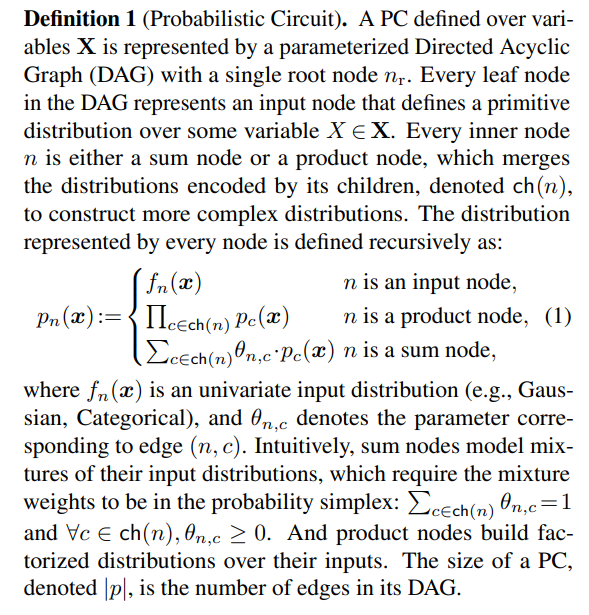
\ The key to guaranteeing exact and efficient computation of various probabilistic queries is to impose proper structural constraints on the DAG of the PC. As an example, with smoothness and decomposability (Poon & Domingos, 2011), computing any marginal probability amounts to a forward pass (children before parents) following Equation (1), with the only exception that we set the value of input nodes defined on marginalized variables to be 1. Please refer to Choi et al. (2020) for a comprehensive overview of different structural constraints and what queries they enable.

\
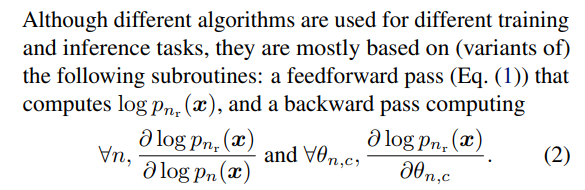
\ For example, Peharz et al. (2020a) demonstrate how the above parameter gradients can be used to apply ExpectationMaximization (EM) updates, and Vergari et al. (2021) elaborates how the forward pass can be used to compute various probabilistic and information-theoretic queries when coupled with PC structure transformation algorithms. Therefore, the speed and memory efficiency of these two procedures largely determine the overall efficiency of PCs.

\ Figure 1. Layering a PC by grouping nodes with the same topological depth (as indicated by the colors) into disjoint subsets. Both the forward and the backward computation can be carried out independently on nodes within the same layer.
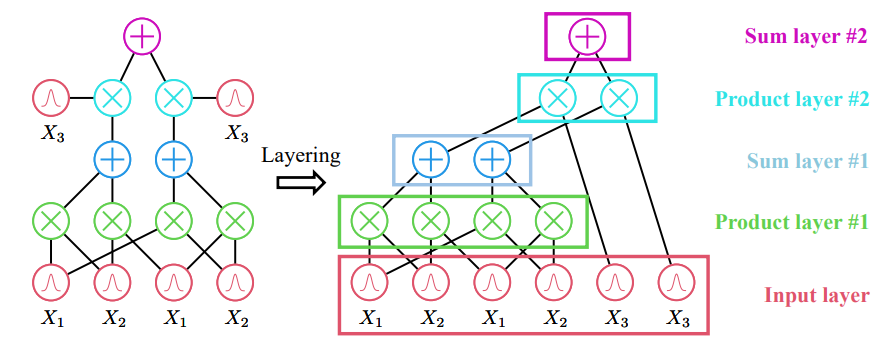
\ Related work on accelerating PCs. There has been a great amount of effort put into speeding up training and inference for PCs. One of the initial attempts performs nodebased computations on both CPUs (Lowd & Rooshenas, 2015) and GPUs (Pronobis et al., 2017; Molina et al., 2019), i.e., by computing the outputs for a mini-batch of inputs (data) recursively for every node. Despite its simplicity, it fails to fully exploit the parallel computation capability possessed by modern GPUs since it can only parallelize over a batch of samples. This problem is mitigated by also parallelizing topologically independent nodes (Peharz et al., 2020a; Dang et al., 2021). Specifically, a PC is chunked into topological layers, where nodes in the same layer can be computed in parallel. This leads to 1-2 orders of magnitude speedup compared to node-based computation.

\ The regularity of edge connection patterns is another key factor influencing the design choices. Specifically, EiNets (Peharz et al., 2020a) leverage off-the-shelf Einsum operations to parallelize dense PCs where every layer contains groups of densely connected sum and product/input nodes. Mari et al. (2023) generalize the notion of dense PCs to tensorized PCs, which greatly expands the scope of EiNets. Dang et al. (2021) instead focus on speeding up sparse PCs, where different nodes could have drastically different numbers of edges. They use custom CUDA kernels to balance the workload of different GPU threads and achieve decent speedup on both sparse and dense PCs.

\ Another thread of work focuses on designing computation hardware that is more suitable for PCs. Specifically, Shah et al. (2021) propose DAG Processing Units (DPUs) that can efficiently traverse sparse PCs, Dadu et al. (2019) introduce an indirect read reorder-buffer to improve the efficiency of data-dependent memory accesses in PCs, and Yao et al. (2023) use addition-as-int multiplications to significantly improve the energy efficiency of PC inference algorithms.

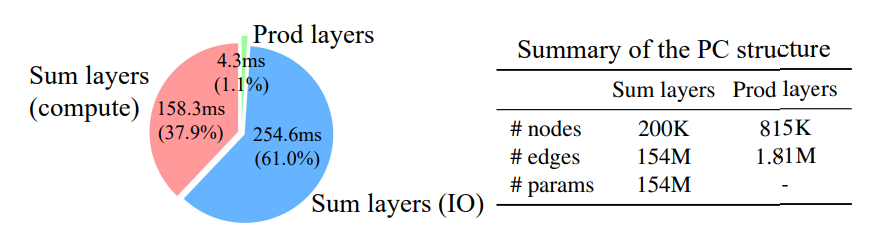
\ Figure 2. Runtime breakdown of the feedforward pass of a PC with ∼150M edges. Both the IO and the computation overhead of the sum layers are significantly larger than the total runtime of product layers. Detailed configurations of the PC are shown in the table.
\ Applications of PCs. PCs have been applied to many domains such as explainability and causality (Correia et al., 2020; Wang & Kwiatkowska, 2023), graph link prediction (Loconte et al., 2023), lossless data compression (Liu et al., 2022), neuro-symbolic AI (Xu et al., 2018; Manhaeve et al., 2018; Ahmed et al., 2022a;b), gradient estimation (Ahmed et al., 2023b), graph neural networks rewiring (Qian et al., 2023), and even large language model detoxification (Ahmed et al., 2023a).

\

:::info Authors:

(1) Anji Liu, Department of Computer Science, University of California, Los Angeles, USA (liuanji@cs.ucla.edu);

(2) Kareem Ahmed, Department of Computer Science, University of California, Los Angeles, USA;

(3) Guy Van den Broeck, Department of Computer Science, University of California, Los Angeles, USA;

:::


:::info This paper is available on arxiv under CC BY 4.0 DEED license.

:::

\

Opportunità di mercato
Logo NodeAI
Valore NodeAI (GPU)
$0,02959
$0,02959$0,02959
+0,88%
USD
Grafico dei prezzi in tempo reale di NodeAI (GPU)
Disclaimer: gli articoli ripubblicati su questo sito provengono da piattaforme pubbliche e sono forniti esclusivamente a scopo informativo. Non riflettono necessariamente le opinioni di MEXC. Tutti i diritti rimangono agli autori originali. Se ritieni che un contenuto violi i diritti di terze parti, contatta crypto.news@mexc.com per la rimozione. MEXC non fornisce alcuna garanzia in merito all'accuratezza, completezza o tempestività del contenuto e non è responsabile per eventuali azioni intraprese sulla base delle informazioni fornite. Il contenuto non costituisce consulenza finanziaria, legale o professionale di altro tipo, né deve essere considerato una raccomandazione o un'approvazione da parte di MEXC.

Potrebbe anche piacerti

Synopsys (SNPS) Stock — Elliott Investment Builds Multibillion-Dollar Stake
Synopsys (SNPS) Stock — Elliott Investment Builds Multibillion-Dollar Stake

TLDR Elliott Investment Management has built a multibillion-dollar stake in Synopsys (SNPS), per the WSJ. The activist firm wants Synopsys to generate more revenue
Condividi
Coincentral2026/03/23 17:00
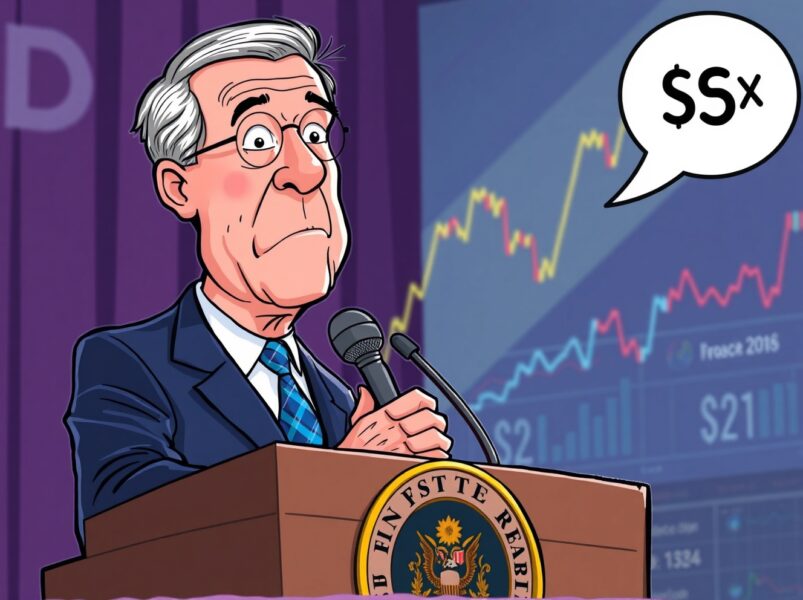
Jerome Powell’s Press Conference: Crucial Insights Unveiled for the Market’s Future

Jerome Powell’s Press Conference: Crucial Insights Unveiled for the Market’s Future

BitcoinWorld Jerome Powell’s Press Conference: Crucial Insights Unveiled for the Market’s Future The financial world, including the dynamic cryptocurrency market, often hangs on every word from the Federal Reserve. Recently, Jerome Powell’s press conference following the Federal Open Market Committee (FOMC) meeting concluded, leaving investors and analysts dissecting his remarks for clues about the future economic direction. This event is always a pivotal moment, shaping expectations for inflation, interest rates, and the overall stability of global markets. What Were the Key Takeaways from Jerome Powell’s Press Conference? During Jerome Powell’s press conference, the Fed Chair provided an update on the central bank’s monetary policy decisions and its economic outlook. His statements often reiterate the Fed’s dual mandate: achieving maximum employment and stable prices. This time was no different, with a strong emphasis on managing persistent inflation. Key points from the recent discussion included: Inflation Control: Powell emphasized the Fed’s unwavering commitment to bringing inflation back down to its 2% target. He reiterated that the fight against rising prices remains the top priority, even if it entails some economic slowdown. Interest Rate Policy: While the Fed’s stance on future interest rate adjustments was discussed, the path remains data-dependent. Powell indicated that decisions would continue to be made meeting-by-meeting, based on incoming economic data. Economic Projections: The updated Summary of Economic Projections (SEP) offered insights into the Fed’s forecasts for GDP growth, unemployment, and inflation. These projections help market participants gauge the central bank’s expectations for the economy’s trajectory. Quantitative Tightening (QT): The ongoing process of reducing the Fed’s balance sheet, known as quantitative tightening, was also a topic. This reduction in liquidity in the financial system has broad implications for asset prices. How Did Jerome Powell’s Remarks Impact Cryptocurrency Markets? The conclusion of Jerome Powell’s press conference often sends ripples through traditional financial markets, and cryptocurrencies are increasingly sensitive to these macroeconomic shifts. Digital assets, once thought to be uncorrelated, now frequently react to the Fed’s monetary policy signals. Higher interest rates, for instance, tend to make riskier assets like cryptocurrencies less attractive. This is because investors might prefer safer, interest-bearing investments. Consequently, we often see increased volatility in Bitcoin (BTC) and Ethereum (ETH) prices immediately following such announcements. The tightening of financial conditions, driven by the Fed, reduces overall liquidity in the system, which can put downward pressure on asset valuations across the board. However, some argue that this growing correlation signifies crypto’s increasing integration into the broader financial ecosystem. It suggests that institutional investors and mainstream finance are now paying closer attention to digital assets, treating them more like other risk-on investments. Navigating the Economic Landscape After Jerome Powell’s Press Conference For cryptocurrency investors, understanding the implications of Jerome Powell’s press conference is crucial for making informed decisions. The Fed’s policy trajectory directly influences the availability of capital and investor sentiment, which are key drivers for crypto valuations. Here are some actionable insights for navigating this environment: Stay Informed: Regularly monitor Fed announcements and economic data releases. Understanding the macroeconomic backdrop is as important as analyzing individual crypto projects. Assess Risk Tolerance: In periods of economic uncertainty and tighter monetary policy, a reassessment of personal risk tolerance is wise. Diversification within your crypto portfolio and across different asset classes can mitigate potential downsides. Focus on Fundamentals: While market sentiment can be swayed by macro news, projects with strong fundamentals, clear use cases, and robust development teams tend to perform better in the long run. Long-Term Perspective: Cryptocurrency markets are known for their volatility. Adopting a long-term investment horizon can help weather short-term fluctuations driven by macro events like Fed meetings. The challenges include potential continued volatility and reduced liquidity. However, opportunities may arise from market corrections, allowing strategic investors to accumulate assets at lower prices. In summary, Jerome Powell’s press conference provides essential guidance on the Fed’s economic strategy. Its conclusions have a profound impact on financial markets, including the dynamic world of cryptocurrencies. Staying informed, understanding the nuances of monetary policy, and maintaining a strategic investment approach are paramount for navigating the evolving economic landscape. The Fed’s actions underscore the interconnectedness of traditional finance and the burgeoning digital asset space. Frequently Asked Questions (FAQs) Q1: What is the Federal Open Market Committee (FOMC)? A1: The FOMC is the monetary policy-making body of the Federal Reserve System. It sets the federal funds rate target and directs open market operations, influencing the availability of money and credit in the U.S. economy. Q2: How do the Fed’s interest rate decisions typically affect cryptocurrency markets? A2: Generally, when the Fed raises interest rates, it makes borrowing more expensive and reduces liquidity in the financial system. This often leads investors to shy away from riskier assets like cryptocurrencies, potentially causing prices to decline. Conversely, lower rates can stimulate investment in riskier assets. Q3: What does “data-dependent” mean in the context of Fed policy? A3: “Data-dependent” means that the Federal Reserve’s future monetary policy decisions, such as interest rate adjustments, will primarily be based on the latest economic data. This includes inflation reports, employment figures, and GDP growth, rather than a predetermined schedule. Q4: Should I change my cryptocurrency investment strategy based on Jerome Powell’s press conference? A4: While it’s crucial to be aware of the macroeconomic environment shaped by Jerome Powell’s press conference, drastic changes to a well-researched investment strategy may not always be necessary. It’s recommended to review your portfolio, assess your risk tolerance, and consider if your strategy aligns with the current economic outlook, focusing on long-term fundamentals. If you found this analysis helpful, please consider sharing it with your network! Your insights and shares help us reach more readers interested in the intersection of traditional finance and the exciting world of cryptocurrencies. Spread the word! To learn more about the latest crypto market trends, explore our article on key developments shaping Bitcoin price action. This post Jerome Powell’s Press Conference: Crucial Insights Unveiled for the Market’s Future first appeared on BitcoinWorld.
Condividi
Coinstats2025/09/18 16:25
Oil Demand Elasticity: Sobering Analysis Reveals Limited Price Relief Ahead – Societe Generale

Oil Demand Elasticity: Sobering Analysis Reveals Limited Price Relief Ahead – Societe Generale

BitcoinWorld Oil Demand Elasticity: Sobering Analysis Reveals Limited Price Relief Ahead – Societe Generale Global energy markets face a sobering reality in 2025
Condividi
bitcoinworld2026/03/23 17:05