Amazon and Apple beat earnings expectations, but their shares fell on weak jobs data.Amazon and Apple beat earnings expectations, but their shares fell on weak jobs data.

Dow Jones down 600 points as rate cuts odds surge on hiring slump

2025/08/02 02:22
2 min di lettura
Per feedback o dubbi su questo contenuto, contattateci all'indirizzo crypto.news@mexc.com.

U.S. stock indices fell as weak jobs data spooked investors, despite earnings beats from Apple and Amazon.

Summary
  • Dow Jones fell more than 600 points on weak jobs data.
  • Apple stock fell despite strong earnings.
  • Fed may have to lower interest rates to boost hiring.

Weak jobs data hit stocks hard, despite improving odds of the Federal Reserve cutting interest rates. On Friday, April 1, the Dow Jones dropped 620 points, or 1.42%, while the S&P 500 lost 1.75%. At the same time, the tech-heavy Nasdaq declined as much as 2.33%. The main driver of the declines was July’s labor market report, which showed just 73,000 new jobs versus the expected 104,000.

Tech stocks were among the biggest losers, and even Apple fell 2.5% despite strong earnings. The tech giant reported its highest revenue growth since December 2021. The report indicated that U.S. consumers continued spending despite inflation concerns stemming from the trade war. Apple also stated it plans to significantly increase its investment in AI.
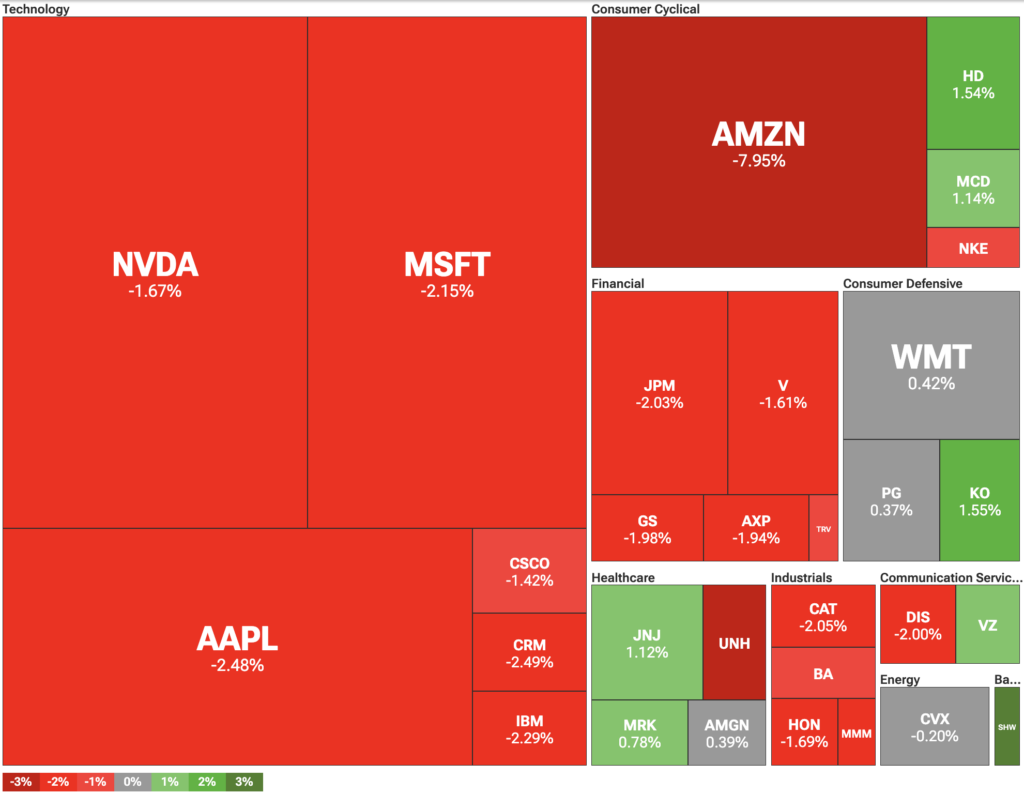
Dow Jones Industrial Average heatmap

Amazon’s earnings also exceeded expectations, with earnings per share of $1.68 compared to the $1.33 estimate. However, the company’s third-quarter guidance was relatively modest. This fell short of investor expectations, especially following the company’s multibillion-dollar investment in AI. As a result, its stock was among the biggest losers, falling 8%.

Fed may have to cut rates on weak jobs data

While tech stocks took a beating, there may be a silver lining. Specifically, the weak labor market could force the Federal Reserve to cut interest rates. CME FedWatch futures markets are now pricing in an 83% chance of a rate cut in September, up sharply from 38% just a day earlier—likely due to the disappointing employment data.

The Fed has a dual mandate to maintain low inflation and high employment. So far, the central bank has resisted pressure from President Donald Trump’s White House to lower rates, despite a split among FOMC members.

Disclaimer: gli articoli ripubblicati su questo sito provengono da piattaforme pubbliche e sono forniti esclusivamente a scopo informativo. Non riflettono necessariamente le opinioni di MEXC. Tutti i diritti rimangono agli autori originali. Se ritieni che un contenuto violi i diritti di terze parti, contatta crypto.news@mexc.com per la rimozione. MEXC non fornisce alcuna garanzia in merito all'accuratezza, completezza o tempestività del contenuto e non è responsabile per eventuali azioni intraprese sulla base delle informazioni fornite. Il contenuto non costituisce consulenza finanziaria, legale o professionale di altro tipo, né deve essere considerato una raccomandazione o un'approvazione da parte di MEXC.

Potrebbe anche piacerti

Cashing In On University Patents Means Giving Up On Our Innovation Future

Cashing In On University Patents Means Giving Up On Our Innovation Future

The post Cashing In On University Patents Means Giving Up On Our Innovation Future appeared on BitcoinEthereumNews.com. “It’s a raid on American innovation that would deliver pennies to the Treasury while kneecapping the very engine of our economic and medical progress,” writes Pipes. Getty Images Washington is addicted to taxing success. Now, Commerce Secretary Howard Lutnick is floating a plan to skim half the patent earnings from inventions developed at universities with federal funding. It’s being sold as a way to shore up programs like Social Security. In reality, it’s a raid on American innovation that would deliver pennies to the Treasury while kneecapping the very engine of our economic and medical progress. Yes, taxpayer dollars support early-stage research. But the real payoff comes later—in the jobs created, cures discovered, and industries launched when universities and private industry turn those discoveries into real products. By comparison, the sums at stake in patent licensing are trivial. Universities collectively earn only about $3.6 billion annually in patent income—less than the federal government spends on Social Security in a single day. Even confiscating half would barely register against a $6 trillion federal budget. And yet the damage from such a policy would be anything but trivial. The true return on taxpayer investment isn’t in licensing checks sent to Washington, but in the downstream economic activity that federally supported research unleashes. Thanks to the bipartisan Bayh-Dole Act of 1980, universities and private industry have powerful incentives to translate early-stage discoveries into real-world products. Before Bayh-Dole, the government hoarded patents from federally funded research, and fewer than 5% were ever licensed. Once universities could own and license their own inventions, innovation exploded. The result has been one of the best returns on investment in government history. Since 1996, university research has added nearly $2 trillion to U.S. industrial output, supported 6.5 million jobs, and launched more than 19,000 startups. Those companies pay…
Condividi
BitcoinEthereumNews2025/09/18 03:26
Subaru Motors Finance Reviews 2026

Subaru Motors Finance Reviews 2026

If you’re at a Subaru dealership, your heart is set on the perfect Outback or Forester. The salesperson asks, “Would you like to finance it today?” That’s where
Condividi
Fintechzoom2026/03/08 10:55
Shiba Inu Price Prediction: Dubai Cracks Down on KuCoin as Pepeto Outpaces DOGE and SHIB With $7.4M Raised

Shiba Inu Price Prediction: Dubai Cracks Down on KuCoin as Pepeto Outpaces DOGE and SHIB With $7.4M Raised

SHIB trades near cycle lows, but Pepeto is outpacing every Shiba Inu price prediction with $7.4M raised and a full exchange ecosystem approaching launch as Dubai
Condividi
Techbullion2026/03/08 10:54