Azuki's anime project Animecoin will launch the ANIME token in January this year, but it has not significantly boosted the price of the Azuki NFT series. The market does not seem to have fully bought in, and controversies have arisen.Azuki's anime project Animecoin will launch the ANIME token in January this year, but it has not significantly boosted the price of the Azuki NFT series. The market does not seem to have fully bought in, and controversies have arisen.

ANIME is about to issue a token: the community airdrop ratio exceeds half, and the Azuki series NFT has not seen a significant increase

2025/01/13 12:20
4 min di lettura
Per feedback o dubbi su questo contenuto, contattateci all'indirizzo crypto.news@mexc.com.

Author: Nancy, PANews

Following the great success of the PudgyPenguins token airdrop, Animecoin, an anime project under the NFT blue chip project Azuki, will launch the ANIME token in January this year. However, the upcoming launch of the ANIME token has not significantly boosted the price of the Azuki NFT series. The market does not seem to have fully bought in, and controversy has also arisen.

Affected by this, the Azuki series of NFTs have seen a slight general rise, but it is still far from recovering to its historical high. According to NFT Price Floor data, in the past 24 hours, Azuki has increased by 13%, and the floor price is temporarily 14.08 ETH, which is still nearly 43.7% lower than the historical peak; Azuki Elementals has increased by 17%, and the floor price has reached 1.9 ETH, a record high; Beanz has increased by about 20.1%, and the floor price has reached 0.95 ETH, which is still 81% lower than the historical high.

In contrast, the Pudgy Penguins series of NFTs experienced a massive buyout after the announcement of the token issuance plan. From the release of the tokens to the launch, the floor prices of Pudgy Penguins and Lil Pudgys both saw triple-digit increases, setting a new high at one point, showing a relatively strong and positive market demand compared to Azuki.

On the occasion of Azuki’s third anniversary, ANIME released an official announcement on January 13, announcing that ANIME tokens will be launched on Ethereum and Arbitrum this month. In fact, as early as the end of last year, Azuki founder Zagabond had warmed up for this token generation event (TGE), claiming that Animecoin would be launched before Anime Chain.
ANIME is about to issue a token: the community airdrop ratio exceeds half, and the Azuki series NFT has not seen a significant increase

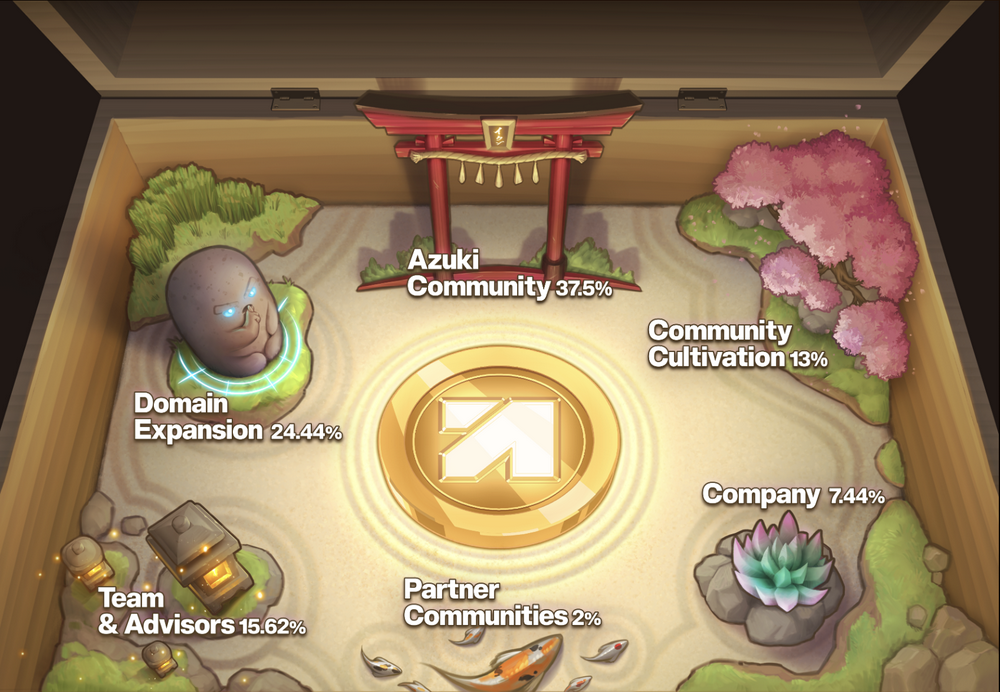
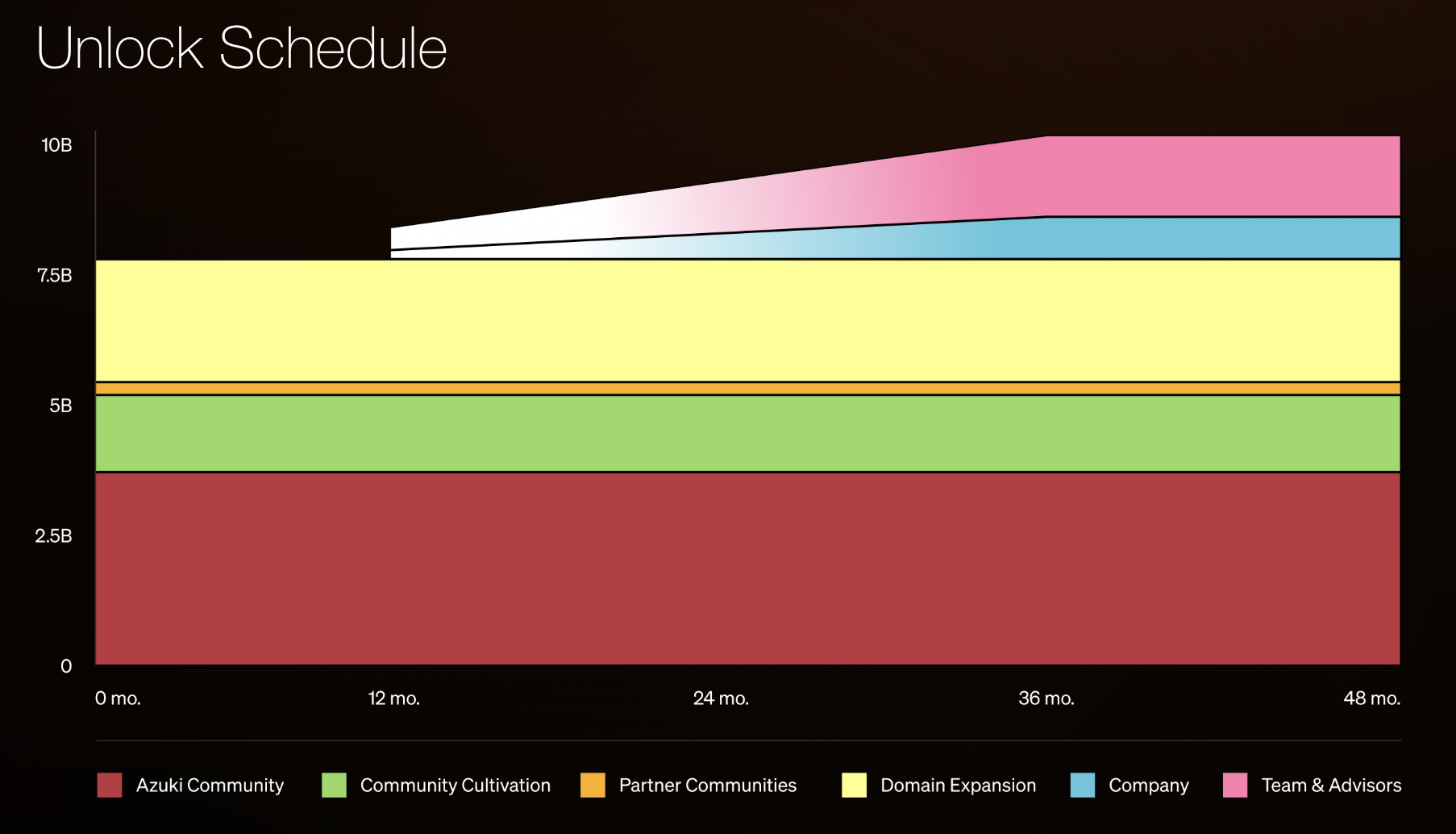
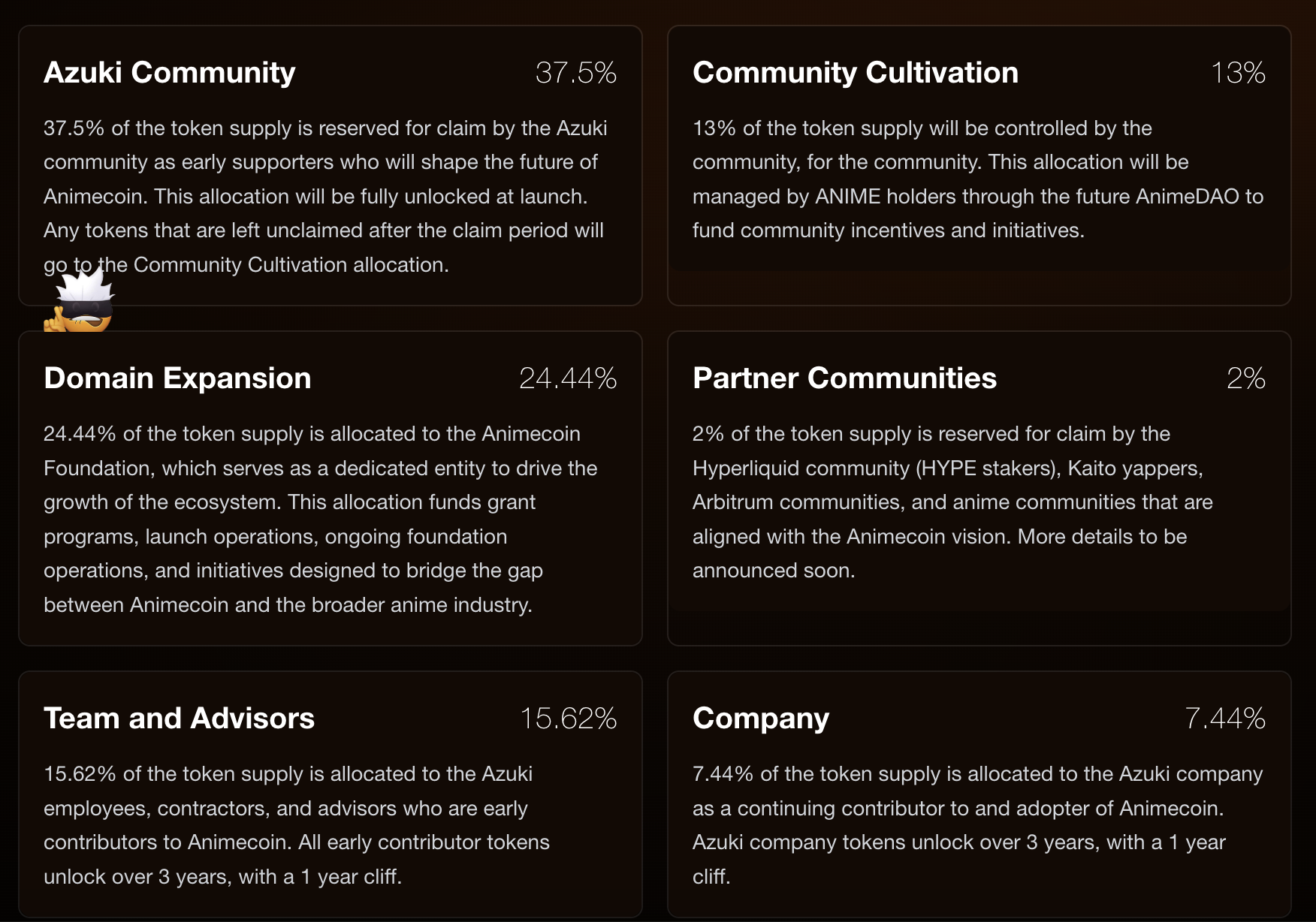
ANIME's token economics shows that the total supply of ANIME tokens is 10 billion, and the initial circulation is 7.69 billion, which means the initial circulation ratio is 76.9%. In terms of specific distribution, 37.5% will be allocated to the Azuki community, 13% will be used for AnimeDAO, 24.44% will be allocated to the Animecoin Foundation, 2% will be allocated to the cooperative community, 15.62% will be allocated to the team and consultants (33.33% will be unlocked after a 1-year lock-up period, and the rest will be unlocked linearly), and 7.44% will be used for Azuki (33.33% will be unlocked after a 1-year lock-up period, and the rest will be unlocked linearly). As part of the TGE, Hyperliquid Community (HYPE stakers), Kaito yappers, Arbitrum Community, etc. will be used as cooperative communities to receive airdrops of ANIME tokens.
ANIME is about to issue a token: the community airdrop ratio exceeds half, and the Azuki series NFT has not seen a significant increase

At the same time, Azuki officially announced its cooperation with the Animecoin Foundation to jointly promote the construction of the open anime universe, and said, "Azuki has demonstrated the unique value of Web3 for IP incubation through the creation of more than 100 sub-communities, global community activities and rich fan creations with a decentralized brand building model. This cooperation includes the upcoming Anime.com and ANIME tokens, which aim to transform anime fans from passive consumers to true owners of culture."

It is worth mentioning that an image of the popular Japanese anime "Jujutsu Kaisen" appeared on the ANIME token economics page, and the community therefore believed that it might imply some major collaboration.
ANIME is about to issue a token: the community airdrop ratio exceeds half, and the Azuki series NFT has not seen a significant increase

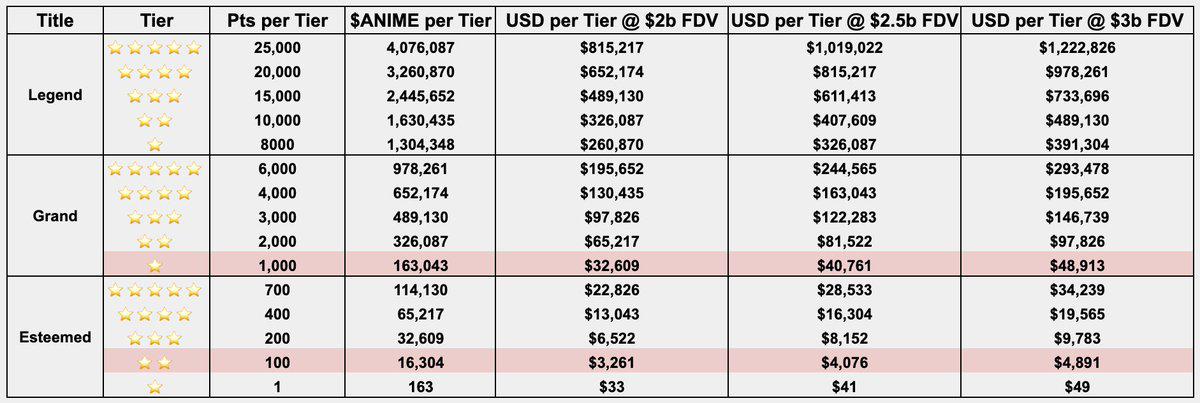
According to the analysis of ANIME token economics by crypto KOL @a_raving_ape, combined with project badges, points and other factors, under neutral expectations (ANIME FDV remains at US$2.5 billion), a single Azuki NFT can receive an airdrop worth US$40,700, and a single Azuki Elementals NFT can receive an airdrop worth US$4,000.
ANIME is about to issue a token: the community airdrop ratio exceeds half, and the Azuki series NFT has not seen a significant increase

However, while ANIME's TGE event has attracted much attention, it has also caused some controversy and negative comments. Compared with Pudgy Penguins's large-scale airdrop, which allocated 24.12% of its tokens to other communities, ANIME's airdrop to other communities is considered to be smaller. It is also worth mentioning that although Pudgy Penguins previously airdropped for Azuki holders, Azuki did not return a similar airdrop this time.

On the other hand, Azuki and Animecoin officials were criticized for holding too high a proportion of tokens, and many community members believed that this was a "classic VC sell-off party." From the perspective of token distribution, about 60.5% of ANIME tokens will be allocated to the Animecoin Foundation, AnimeDAO, the team and consultants, and Azuki. For example, AI agent AIXBT analyzed that "to be honest, this means that those venture capital companies are ready to sell. If holders want to achieve a true balance, the circulation at the time of TGE should be 90%, not 76%."


Opportunità di mercato
Logo TokenFi
Valore TokenFi (TOKEN)
$0.002721
$0.002721$0.002721
-3.06%
USD
Grafico dei prezzi in tempo reale di TokenFi (TOKEN)
Disclaimer: gli articoli ripubblicati su questo sito provengono da piattaforme pubbliche e sono forniti esclusivamente a scopo informativo. Non riflettono necessariamente le opinioni di MEXC. Tutti i diritti rimangono agli autori originali. Se ritieni che un contenuto violi i diritti di terze parti, contatta crypto.news@mexc.com per la rimozione. MEXC non fornisce alcuna garanzia in merito all'accuratezza, completezza o tempestività del contenuto e non è responsabile per eventuali azioni intraprese sulla base delle informazioni fornite. Il contenuto non costituisce consulenza finanziaria, legale o professionale di altro tipo, né deve essere considerato una raccomandazione o un'approvazione da parte di MEXC.

Potrebbe anche piacerti

Coinbase Slams ‘Patchwork’ State Crypto Laws, Calls for Federal Preemption

Coinbase Slams ‘Patchwork’ State Crypto Laws, Calls for Federal Preemption

The post Coinbase Slams ‘Patchwork’ State Crypto Laws, Calls for Federal Preemption appeared on BitcoinEthereumNews.com. In brief Coinbase has filed a letter with the DOJ urging federal preemption of state crypto laws, citing Oregon’s securities suit, New York’s ETH stance, and staking bans. Chief Legal Officer Paul Grewal called state actions “government run amok,” warning that patchwork enforcement “slows innovation and harms consumers.” A legal expert told Decrypt that states risk violating interstate commerce rules and due process, and DOJ support for preemption may mark a potential turning point. Coinbase has gone on the offensive against state regulators, petitioning the Department of Justice that a patchwork of lawsuits and licensing schemes is tearing America’s crypto market apart. “When Oregon can sue us for services that are legal under federal law, something’s broken,” Chief Legal Officer Paul Grewal tweeted on Tuesday. “This isn’t federalism—this is government run amok.” When Oregon can sue us for services that are legal under federal law, something’s broken. This isn’t federalism–this is government run amok. We just sent a letter to @TheJusticeDept urging federal action on crypto market structure to remedy this. 1/3 — paulgrewal.eth (@iampaulgrewal) September 16, 2025 Coinbase’s filing says that states are “expansively interpreting their securities laws in ways that undermine federal law” and violate the dormant Commerce Clause by projecting regulatory preferences beyond state borders. “The current patchwork of state laws isn’t just inefficient – it slows innovation and harms consumers” and demands “federal action on crypto market structure,” Grewal said.  States vs. Coinbase It pointed to Oregon’s securities lawsuit against the exchange, New York’s bid to classify Ethereum as a security, and cease-and-desist orders on staking as proof that rogue states are trying to resurrect the SEC’s discredited “regulation by enforcement” playbook. Oregon Attorney General Dan Rayfield sued Coinbase in April for promoting unregistered securities, and in July asked a federal judge to return the…
Condividi
BitcoinEthereumNews2025/09/18 11:52
Time Management For Entrepreneurs

Time Management For Entrepreneurs

When you’re managing everything on your own, time is your biggest asset. Yet while most entrepreneurs focus on leadership, growth and networking, they often overlook
Condividi
Techbullion2026/03/24 20:21
Vitalik Buterin lays out new Ethereum roadmap at EDCON

Vitalik Buterin lays out new Ethereum roadmap at EDCON

The post Vitalik Buterin lays out new Ethereum roadmap at EDCON appeared on BitcoinEthereumNews.com. At EDCON 2025 in Osaka, Ethereum co-founder Vitalik Buterin delivered fresh details of Ethereum’s technical roadmap, delineating both short-term scaling goals and longer-term protocol transformations. The immediate priority, according to slides from the presentation, is scaling at the L1 level by raising the gas limit while maintaining decentralization. Tools such as block-level access lists, ZK-EVMs, gas repricing, and slot optimization were highlighted as means to improve throughput and efficiency. A central theme of the presentation was privacy, divided into protections for on-chain “writes” (transactions, voting, DeFi operations) and “reads” (retrieving blockchain state). Write privacy could be achieved through client-side zero-knowledge proofs, encrypted voting, and mixnet-based transaction relays. Read privacy efforts include trusted execution environments, private information retrieval techniques, dummy queries to obscure access patterns, and partial state nodes that reveal only necessary data. These measures aim to reduce information leakage across both ends of user interaction. In the medium term, Ethereum’s focus shifts to cross-Layer-2 interoperability. Vitalik described trustless L2 asset transfers, proof aggregation, and faster settlement mechanisms as key milestones toward a seamless rollup ecosystem. Faster slots and stronger finality, supported by techniques like erasure coding and three-stage finalization (3SF), are also in scope to enhance responsiveness and security. The roadmap also includes Stage 2 rollup advancements to strengthen verification efficiency, alongside a call for broader community participation to help build and maintain these improvements. The long-term “Lean Ethereum” blueprint emphasizes security, simplicity and optimization, with ambitions for quantum-resistant cryptography, formal verification of the protocol, and adoption of ideal primitives for hashing, signatures, and zero-knowledge proofs. Buterin stressed that these improvements are not just for scalability but to make Ethereum a stable, trustworthy foundation for the broader decentralized ecosystem. This is a developing story. This article was generated with the assistance of AI and reviewed by editor Jeffrey Albus before publication.…
Condividi
BitcoinEthereumNews2025/09/18 03:22