NASDAQ-Listed AVAX One Debuts Avalanche Validator: Report
This article was first published on The Bit Journal.
AVAX One Technology Ltd., a NASDAQ-listed company (Nasdaq: AVX), has launched an institutional-grade Avalanche validator on the Avalanche blockchain. The company said the validator is open for public delegation.
The move signals a shift in AVAX One’s strategy. The firm is moving from a passive token holder to an active infrastructure operator.
It also brings a regulated public company into Avalanche’s staking layer. AVAX One said the Avalanche validator is designed for high uptime and strong performance.
AVAX One Confirms First Public Validator Launch
AVAX One announced the launch of its first public validator node on Avalanche. The firm described it as a step toward optimizing its blockchain capabilities. It also said the launch supports its long-term goal of maximizing shareholder value.
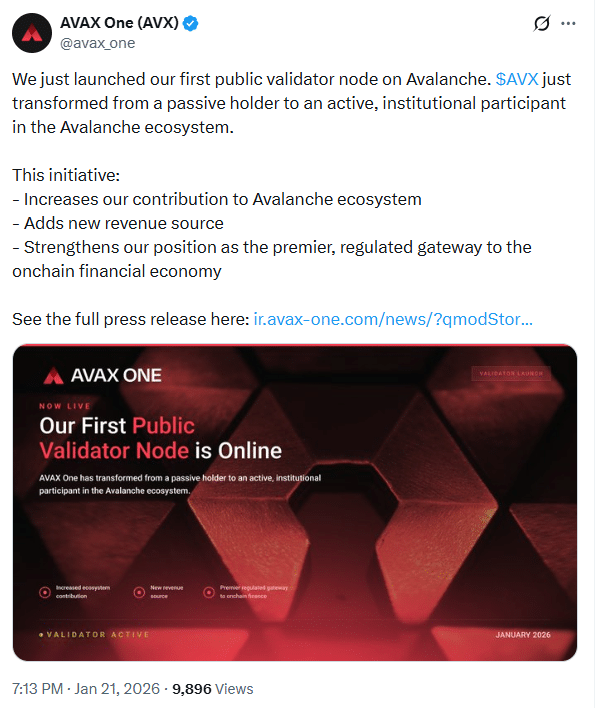 Source: X
This validator joins the core infrastructure that secures Avalanche. Validator operators help confirm transactions and maintain consensus. AVAX One said its Avalanche validator directly supports these network functions.
Also Read: Avalanche Treasury’s $675M SPAC Deal Could Unlock $1B AVAX Buying Spree
Public Delegation Expands Staking Access
The Avalanche validator supports public delegation. This means users can delegate AVAX to AVAX One’s node and earn rewards. They do not need to manage hardware or complex validator settings.
Delegation lowers the technical barrier. Many users avoid validator setup due to uptime risks and operational mistakes. Delegating stake to an experienced operator removes that burden. AVAX One aims to attract delegators looking for stable returns and simple staking access.
Institutional Validators Focus on Uptime and Security
Institutional validators often compete on reliability. They use strong cloud setups, monitoring tools, and security controls. These features help avoid downtime and reduce operational risk.
AVAX One said its Avalanche validator uses institutional-grade cloud architecture. The company expects high uptime and consistent performance. That matters for delegators since staking rewards depend on validator operation and stability.
Delegation Fees Create a New Revenue Stream
AVAX One said it plans to earn revenue from delegation fees. This is a standard validator model. Operators take a commission from staking rewards generated by delegators.
The firm also stated it wants to offer delegation at minimum cost. Competitive fees can help attract more staked AVAX quickly. A larger delegation base increases the potential earnings of the Avalanche validator over time.
CEO Describes Shift From Passive Holder to Active Operator
Jolie Kahn, Chief Executive Officer of AVAX One, said the validator launch reflects the company’s evolution. She said the firm is moving from passive AVAX exposure to active participation in the Avalanche ecosystem.
Kahn said operating validator infrastructure strengthens the company’s contribution to Avalanche. She also said it adds a revenue source. AVAX One framed the validator as part of its strategy to compound long-term shareholder value.
CFO Signals Future Expansion Into Third-Party Services
Chris Polimeni, Chief Financial Officer of AVAX One, said the company is building in-house validator capabilities. He called it part of a broader commitment to the on-chain economy.
Polimeni added that the platform could later support third-party validation services. That would expand the firm’s infrastructure utility beyond internal operations. It could also create additional partnerships tied to Avalanche validator services.
What This Means for Avalanche’s Broader Growth
Avalanche competes with other Layer 1 blockchains for developers, users, and capital. Institutional-grade infrastructure can strengthen confidence in the network. It can also support adoption beyond crypto-native use cases.
AVAX One’s Avalanche validator adds credibility to Avalanche’s staking ecosystem. The launch also signals that regulated companies are willing to operate core blockchain infrastructure. This trend could bring more professional participation into staking markets.
Conclusion
AVAX One has launched its first public Avalanche validator and opened it for public delegation. The company said the validator supports Avalanche consensus and allows users to stake AVAX without running their own nodes.
The firm expects to generate revenue through delegation fees and expand ecosystem participation. AVAX One also suggested it could build toward third-party validator services. The move adds institutional momentum to Avalanche’s staking economy and validator ecosystem.
Also Read: Avalanche’s First Nasdaq Firm Plans $700M AVAX Treasury After $550M Raise
Appendix: Glossary of Key Terms
Avalanche validator: A node that runs Avalanche and validates transactions.
Public delegation: One of the staking techniques in which public users delegate AVAX to a validator.
Delegator: User who stakes AVAX through a validator but does not operate a node.
Staking rewards: Payouts to users for staking AVAX and securing the network.
Delegation fee: A percentage commission the validator operator charges out of rewards.
Proof-of-stake: A model in which staking tokens is used to validate transactions and secure the chain.
Consensus: How validators “vote” on which network transactions are valid.
Node operator: The organization that operates validator infrastructure and secure the stability.
Uptime: The proportion of time in which a validator is on line and operational.
Frequently Asked Questions About Avalanche Validator
1- What is an Avalanche validator?
An Avalanche validator is a node that helps secure the Avalanche blockchain by participating in consensus and transaction verification.
2- Can anyone stake AVAX with AVAX One’s validator?
Yes. AVAX One said its Avalanche validator supports public delegation, meaning any eligible token holder can delegate and earn rewards.
3- Do delegators need to run their own node?
No. Public delegation lets users stake through an Avalanche validator operator without running validator hardware themselves.
4- How does AVAX One earn revenue from the validator?
The company expects to generate revenue through delegation fees collected from users delegating stake to its Avalanche validator.
Reference
Coinomedia
Read More: NASDAQ-Listed AVAX One Debuts Avalanche Validator: Report">NASDAQ-Listed AVAX One Debuts Avalanche Validator: Report


Potrebbe anche piacerti

edgeX (EDGE) Surges 44.9% to All-Time High: Volume Spike Analysis

Governor gives thousands of prisoners commutation hope for first time since 1990s