

$11.58M Gone in Seconds: Binance Whale Liquidation Stuns Traders
This article was first published on The Bit Journal.
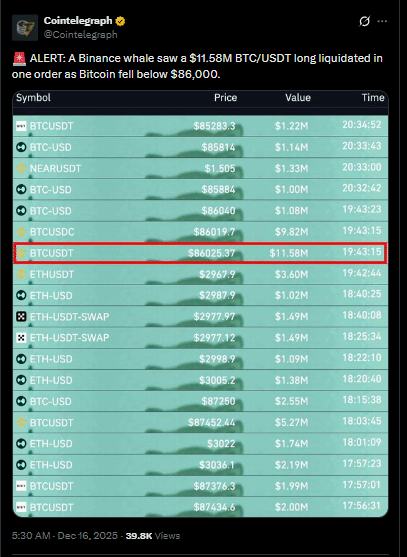
Binance whale liquidation is a phrase traders see often, but it rarely carries this much weight. In a matter of moments, a single leveraged trade worth $11.58 million vanished as the market dipped below a critical level. The event did not unfold during panic or chaos. It happened during a routine pullback, which makes the lesson even sharper.
The liquidation occurred when prices fell below $86,000, a level many traders had been watching closely. According to the source, the position was a BTC/USDT long placed on Binance. As the market moved against it, the exchange’s risk system automatically closed the trade. There was no room to recover once the margin limit was crossed.
 Source: X (Formerly Twitter)
A Brief Dip With Heavy Consequences
At the time of the liquidation, Bitcoin was trading around $85,900, according to real-time data from an official source. The price drop was not extreme by historical standards. Still, for leveraged positions, even small moves can be costly.
The trader behind the position expected prices to keep rising. That assumption had support from recent momentum. Yet markets do not move in straight lines. When the pullback arrived, leverage magnified the loss instead of the opportunity.
This is where many traders struggle. Leverage feels safe during strong trends, but it leaves little margin for error when conditions change. Once the liquidation price is reached, the system reacts instantly. Emotion, confidence, and long-term belief no longer matter.
Why Binance Whale Liquidation Matters to the Whole Market
A Binance whale liquidation is never just about one trader. Extensive forced closures add sudden selling pressure. That pressure can push prices lower and trigger other liquidations, creating a chain reaction.
Market researchers have studied this pattern closely. Analysis published by the Bank for International Settlements explains how leveraged liquidations often intensify short-term volatility before markets stabilize again. These events tend to flush out excessive risk rather than signal more profound weakness.
In this case, trading activity spiked soon after the liquidation. Screens shared across social platforms showed the order hitting the books in one sweep. Similar behavior has occurred during previous Bitcoin corrections, where leverage unwinds faster than sentiment shifts.
What Current Data Suggests About Risk
Derivatives data shows that open interest remains elevated across major exchanges. This suggests traders continue to take on leveraged exposure. History shows that such conditions can persist, but they often come with sharp resets.
A derivatives strategist recently explained in a market commentary that leverage does not respond to narratives. It responds to numbers. When margin thresholds break, positions close without delay. This is why even experienced traders can face sudden losses.
For financial students and analysts, this serves as a practical lesson. Automated systems enforce discipline where human judgment may hesitate. Understanding this structure is key to reading modern crypto markets.
The Broader Picture Remains Intact
Despite the loss, the long-term outlook for Bitcoin has not changed. Prices remain well above levels seen earlier in the year. Institutional interest, ETF-related flows, and long-term holders continue to support the market.
Still, Binance whale liquidation events remind traders that timing and position size matter as much as direction. Markets reward patience more often than boldness during volatile phases.
Developers building trading platforms and analysts modeling risk can draw the same conclusion. Volatility is not the enemy. Poor risk control is.
Final Thought
In the end, Binance whale liquidation tells a familiar story in a modern setting. Leverage turns routine pullbacks into defining moments. As Bitcoin matures, discipline remains the quiet skill that separates survival from sudden loss. The market always teaches. The cost depends on how closely the lesson is heard.
Glossary of Key Terms
Binance Whale Liquidation: Forced closure of a massive leveraged trade on Binance when margin requirements are breached.
Whale: A trader or organization with a large position that is capable of moving markets.
Leverage:Borrowed money used to amplify potential returns (and losses) of an investment position.
Liquidation: A process by which an exchange is forced to close a position in order to prevent further losses when its margin, or equity, has run out.
BTC/USDT: A pair of Bitcoin trading in exchange for USDT.
FAQs About Binance Whale Liquidation
1. What caused the Binance whale liquidation?
The liquidation occurred when prices fell below the trader’s margin level, triggering an automatic closure of the leveraged position.
2. Why do whale liquidations affect the market?
Large liquidations add sudden selling pressure, which can push prices lower and trigger more forced trades.
3. Is leverage always dangerous in crypto trading?
Leverage increases risk because even small price moves can lead to significant losses when margin limits are reached.
4. Does this liquidation change Bitcoin’s long-term outlook?
No. The event reflects short-term volatility, not a shift in the broader market trend.
Sources
Coinmarketcap
bis.org
Read More: $11.58M Gone in Seconds: Binance Whale Liquidation Stuns Traders">$11.58M Gone in Seconds: Binance Whale Liquidation Stuns Traders
Potrebbe anche piacerti

Brent Crude Forecast: Societe Generale Issues Stark $150 Risk Warning Amid Market Turbulence

Headwind Helps Best Wallet Token


