Perpetual contracts are the most valuable and frequently traded products in the on-chain financial ecosystem, but they also pose the most significant systemic risks. In March 2025, Hyperliquid's HLP pool suffered significant losses due to whales using excessive leverage and repeatedly withdrawing collateral on the platform, exposing structural weaknesses in its mark-price mechanism and liquidation process. Such events remind us that beyond superficial trading depth and user growth, the true stability of Perp DEX ultimately stems from the resilience of its risk model under extreme market conditions. Whether it's market maker losses, liquidation cascades, or systemic risks triggered by individual actions, they are all directly related to the same core issue: how the protocol is priced, how risk is allocated, and how leverage and liquidation are handled. Therefore, without understanding the risk control architecture, one cannot truly understand Perp DEX's competitive advantage. This article will start with the "risk model" and systematically break down the core architecture, sources of risk, differences in risk control, and future trends of Perp DEX, providing a professional and comprehensive analytical framework for funds, quantitative traders, and Web3 investors. Perp DEX's Risk Model: The Protocol's Lifeline The risk model is the protocol's dynamic risk control hub, determining its survival under extreme market conditions. It is similar to the risk engine in traditional finance, but more complex because on-chain systems cannot be subject to temporary manual intervention. A mature Perp DEX risk model is a system composed of multiple core components, and its architecture and interrelationships are shown in the following diagram: Figure 1: (This figure illustrates how the risk model starts with price inputs, is processed through the core risk control layer, and ultimately outputs the overall stability and capital efficiency of the system through the risk buffer layer. It reveals the intrinsic connections between modules such as the price model, margin rules, liquidation mechanism, and insurance fund.) These modules together form the protocol's "risk skeleton." A weakness in any one of these components could lead to structural failures during major market movements. LPs or market makers may experience uncontrollable losses (common in AMM models). The agreement was insolvent, and the insurance fund was quickly depleted. Delayed liquidation triggered a chain reaction of margin calls and widespread losses. Oracle was manipulated, triggering an arbitrage attack. The uncontrolled risk of a multi-asset, multi-leverage portfolio led to a total margin call. In other words, the risk model determines how much capital a protocol can support, what types of traders it can serve, and whether it can survive in extreme market conditions. Therefore, the risk model ultimately determines the upper limit of all indicators such as trading experience, market depth, capital efficiency, protocol revenue, and token value capture. This is why, in the past two years, competition in Perp DEX has shifted to underlying risk control architecture, rather than just transaction mining or fee wars. Breakdown of core modules of mainstream PERP architecture and risk model The architectural evolution of Perp DEX is essentially a path of "how risk is redistributed". Phase 1 (Off-chain Order Book): The risk lies in the robustness of the centralized matching nodes. Represented by dYdX, this design ensures transaction efficiency, but the risk is highly concentrated on the availability and security of off-chain matching. Phase Two (AMM): Risk is transferred to the directional exposure of the liquidity pool. For example, in GMX, under the AMM model, LPs bear extremely strong directional risk, making permanent loss, extreme market deviations, and MEV (Mean Equity) unavoidable issues for this architecture. The third stage (On-Chain Order Book - CLOB): Risk shifts to reliance on the performance and determinism of the underlying public blockchain. A representative project is Hyperliquid, where 70-80% of perpetual transaction volume is now concentrated in the order book model. This high-performance on-chain environment also means an unprecedented reliance on TPS, mempool stability, and contract execution security. Frontier Exploration (Hybrid Mode): The risk lies in the logic and feedback loop of the dynamic switching between the order book and liquidity pool. Taking Drift on Solana as an example, it uses AMM as a deep backup mechanism and automatically replenishes quotes when the order book lacks liquidity, thereby finding a new balance between execution quality and capital efficiency. The differences between the different architectures are ultimately reflected in the design of the following four core risk control modules: 2.1. Price Model: The System's Benchmark The price model determines the fairness of transactions, liquidation triggers, and funding rates, serving as the underlying benchmark for perpetual contract systems. It faces challenges such as oracle latency, manipulation, and MEV (Mean Equity). Mature systems employ multi-source aggregation, TWAP (Transfer-Only-Pay), and maximum deviation limits to enhance resistance to attacks. AMM (Automated Market Maker) architectures also require internal pricing mechanisms to simulate liquidity depth, a core variable in their risk exposure. 2.2. Liquidation Model: A Key Risk Buffer The liquidation mechanism determines the system's ability to withstand price fluctuations and is the most critical risk buffer layer of a perpetual protocol. Its security boundary consists of the initial margin, maintenance margin, and liquidation buffer. The execution logic (partial liquidation, full liquidation, auction) directly impacts user experience and system efficiency. Liquidation itself also faces attack surfaces such as on-chain congestion and bid manipulation. 2.3. Insurance Funds: The Last Line of Defense The insurance fund is used to absorb losses from margin calls. Its size and usage rules directly reflect the agreement's risk tolerance and serve as the system's "last line of defense" in extreme market conditions. The design needs to balance security and capital efficiency: too large a size will affect returns, while too small a size will easily trigger automatic liquidation, damaging the agreement's reputation. 2.4. Position Management: The System's Global Risk Controller Position management ensures the system doesn't spiral out of control due to excessive concentration of one-sided positions. Mechanisms such as position limits, dynamic margin requirements, and funding rates are used to regulate market forces. For multi-asset and long-tail assets, managing correlation and manipulation risks presents even greater challenges. Risk model trade-off analysis in mainstream cases Current mainstream platforms are transitioning towards CLOB or CLOB-Centric hybrid solutions to achieve better matching accuracy and capital efficiency. The table below systematically compares the risk model characteristics and core trade-offs of four representative projects: Chart 2 (This chart compares Hyperliquid, Aster, edgeX, and Lighter side-by-side from six dimensions: core architecture, pricing model, liquidation mechanism, insurance fund, major risks, and core trade-offs, demonstrating the risk preferences and trade-offs under different technology routes.) Key points of case analysis: Hyperliquid achieves near-CEX efficiency and depth, but its matching logic combines on-chain settlement and order book verification, increasing system complexity and reliance on risk control mechanisms. It requires a large HLP liquidity pool and complex risk control mechanisms, transferring extremely high risk control pressure to liquidity providers and the protocol itself. Aster: The liquidation mechanism is based on the principle of "reducing risk layer by layer". It improves capital efficiency and robustness during periods of low volatility through the "risk pooling" strategy, but at the cost of a more complex risk transmission path and extreme sensitivity to parameter settings. edgeX uses ZK-Rollup technology to ensure extremely high transparency and verifiability, reducing reliance on external insurance funds. However, this comes at the cost of performance limitations imposed by L2 data availability and state commit latency. The system needs to rely on redundancy mechanisms, verifiable playback, and robust monitoring to mitigate the impact of these risks on overall stability. Lighter: Under the "verifiable off-chain order book" architecture, auditability and on-chain trust are given priority, but at the cost of performance that cannot reach the upper limit of pure off-chain matching. Therefore, it is more suitable for users who prefer transparency, verifiability and lower systemic risk. Conclusion: Security Boundaries and Future Trends By 2025, Perp DEX's security boundary had transitioned from "smart contract security" to "system-level security." On-chain matching, oracle price sources, liquidation logic, risk parameters, LP liquidity pool exposure control, robustness of the market-making mechanism, and the integrity of cross-chain messages together constitute an interdependent security framework. Three major trends for the future: 1. Semi-automated risk control: On-chain mechanisms are insufficient to cope with complex attacks. In the future, a "semi-automated governance" system will be formed by combining off-chain real-time monitoring and dynamic parameter adjustment. 2. Compliance Integration: The hybrid model of "no custody required but subject to regulation" will become key to attracting institutional-grade liquidity. Verifiable KYC and compliant liquidity pools will become the new infrastructure. 3. Technology-driven expansion of security boundaries: Technologies such as zero-knowledge proofs, high-performance L2, and modular design will enable complex real-time risk models to run on the blockchain, elevating risk control capabilities to the level of financial infrastructure. The winners of the future will no longer be those who compete on transaction fees or depth, but rather those who can integrate technological security, financial engineering, and compliance frameworks.Perpetual contracts are the most valuable and frequently traded products in the on-chain financial ecosystem, but they also pose the most significant systemic risks. In March 2025, Hyperliquid's HLP pool suffered significant losses due to whales using excessive leverage and repeatedly withdrawing collateral on the platform, exposing structural weaknesses in its mark-price mechanism and liquidation process. Such events remind us that beyond superficial trading depth and user growth, the true stability of Perp DEX ultimately stems from the resilience of its risk model under extreme market conditions. Whether it's market maker losses, liquidation cascades, or systemic risks triggered by individual actions, they are all directly related to the same core issue: how the protocol is priced, how risk is allocated, and how leverage and liquidation are handled. Therefore, without understanding the risk control architecture, one cannot truly understand Perp DEX's competitive advantage. This article will start with the "risk model" and systematically break down the core architecture, sources of risk, differences in risk control, and future trends of Perp DEX, providing a professional and comprehensive analytical framework for funds, quantitative traders, and Web3 investors. Perp DEX's Risk Model: The Protocol's Lifeline The risk model is the protocol's dynamic risk control hub, determining its survival under extreme market conditions. It is similar to the risk engine in traditional finance, but more complex because on-chain systems cannot be subject to temporary manual intervention. A mature Perp DEX risk model is a system composed of multiple core components, and its architecture and interrelationships are shown in the following diagram: Figure 1: (This figure illustrates how the risk model starts with price inputs, is processed through the core risk control layer, and ultimately outputs the overall stability and capital efficiency of the system through the risk buffer layer. It reveals the intrinsic connections between modules such as the price model, margin rules, liquidation mechanism, and insurance fund.) These modules together form the protocol's "risk skeleton." A weakness in any one of these components could lead to structural failures during major market movements. LPs or market makers may experience uncontrollable losses (common in AMM models). The agreement was insolvent, and the insurance fund was quickly depleted. Delayed liquidation triggered a chain reaction of margin calls and widespread losses. Oracle was manipulated, triggering an arbitrage attack. The uncontrolled risk of a multi-asset, multi-leverage portfolio led to a total margin call. In other words, the risk model determines how much capital a protocol can support, what types of traders it can serve, and whether it can survive in extreme market conditions. Therefore, the risk model ultimately determines the upper limit of all indicators such as trading experience, market depth, capital efficiency, protocol revenue, and token value capture. This is why, in the past two years, competition in Perp DEX has shifted to underlying risk control architecture, rather than just transaction mining or fee wars. Breakdown of core modules of mainstream PERP architecture and risk model The architectural evolution of Perp DEX is essentially a path of "how risk is redistributed". Phase 1 (Off-chain Order Book): The risk lies in the robustness of the centralized matching nodes. Represented by dYdX, this design ensures transaction efficiency, but the risk is highly concentrated on the availability and security of off-chain matching. Phase Two (AMM): Risk is transferred to the directional exposure of the liquidity pool. For example, in GMX, under the AMM model, LPs bear extremely strong directional risk, making permanent loss, extreme market deviations, and MEV (Mean Equity) unavoidable issues for this architecture. The third stage (On-Chain Order Book - CLOB): Risk shifts to reliance on the performance and determinism of the underlying public blockchain. A representative project is Hyperliquid, where 70-80% of perpetual transaction volume is now concentrated in the order book model. This high-performance on-chain environment also means an unprecedented reliance on TPS, mempool stability, and contract execution security. Frontier Exploration (Hybrid Mode): The risk lies in the logic and feedback loop of the dynamic switching between the order book and liquidity pool. Taking Drift on Solana as an example, it uses AMM as a deep backup mechanism and automatically replenishes quotes when the order book lacks liquidity, thereby finding a new balance between execution quality and capital efficiency. The differences between the different architectures are ultimately reflected in the design of the following four core risk control modules: 2.1. Price Model: The System's Benchmark The price model determines the fairness of transactions, liquidation triggers, and funding rates, serving as the underlying benchmark for perpetual contract systems. It faces challenges such as oracle latency, manipulation, and MEV (Mean Equity). Mature systems employ multi-source aggregation, TWAP (Transfer-Only-Pay), and maximum deviation limits to enhance resistance to attacks. AMM (Automated Market Maker) architectures also require internal pricing mechanisms to simulate liquidity depth, a core variable in their risk exposure. 2.2. Liquidation Model: A Key Risk Buffer The liquidation mechanism determines the system's ability to withstand price fluctuations and is the most critical risk buffer layer of a perpetual protocol. Its security boundary consists of the initial margin, maintenance margin, and liquidation buffer. The execution logic (partial liquidation, full liquidation, auction) directly impacts user experience and system efficiency. Liquidation itself also faces attack surfaces such as on-chain congestion and bid manipulation. 2.3. Insurance Funds: The Last Line of Defense The insurance fund is used to absorb losses from margin calls. Its size and usage rules directly reflect the agreement's risk tolerance and serve as the system's "last line of defense" in extreme market conditions. The design needs to balance security and capital efficiency: too large a size will affect returns, while too small a size will easily trigger automatic liquidation, damaging the agreement's reputation. 2.4. Position Management: The System's Global Risk Controller Position management ensures the system doesn't spiral out of control due to excessive concentration of one-sided positions. Mechanisms such as position limits, dynamic margin requirements, and funding rates are used to regulate market forces. For multi-asset and long-tail assets, managing correlation and manipulation risks presents even greater challenges. Risk model trade-off analysis in mainstream cases Current mainstream platforms are transitioning towards CLOB or CLOB-Centric hybrid solutions to achieve better matching accuracy and capital efficiency. The table below systematically compares the risk model characteristics and core trade-offs of four representative projects: Chart 2 (This chart compares Hyperliquid, Aster, edgeX, and Lighter side-by-side from six dimensions: core architecture, pricing model, liquidation mechanism, insurance fund, major risks, and core trade-offs, demonstrating the risk preferences and trade-offs under different technology routes.) Key points of case analysis: Hyperliquid achieves near-CEX efficiency and depth, but its matching logic combines on-chain settlement and order book verification, increasing system complexity and reliance on risk control mechanisms. It requires a large HLP liquidity pool and complex risk control mechanisms, transferring extremely high risk control pressure to liquidity providers and the protocol itself. Aster: The liquidation mechanism is based on the principle of "reducing risk layer by layer". It improves capital efficiency and robustness during periods of low volatility through the "risk pooling" strategy, but at the cost of a more complex risk transmission path and extreme sensitivity to parameter settings. edgeX uses ZK-Rollup technology to ensure extremely high transparency and verifiability, reducing reliance on external insurance funds. However, this comes at the cost of performance limitations imposed by L2 data availability and state commit latency. The system needs to rely on redundancy mechanisms, verifiable playback, and robust monitoring to mitigate the impact of these risks on overall stability. Lighter: Under the "verifiable off-chain order book" architecture, auditability and on-chain trust are given priority, but at the cost of performance that cannot reach the upper limit of pure off-chain matching. Therefore, it is more suitable for users who prefer transparency, verifiability and lower systemic risk. Conclusion: Security Boundaries and Future Trends By 2025, Perp DEX's security boundary had transitioned from "smart contract security" to "system-level security." On-chain matching, oracle price sources, liquidation logic, risk parameters, LP liquidity pool exposure control, robustness of the market-making mechanism, and the integrity of cross-chain messages together constitute an interdependent security framework. Three major trends for the future: 1. Semi-automated risk control: On-chain mechanisms are insufficient to cope with complex attacks. In the future, a "semi-automated governance" system will be formed by combining off-chain real-time monitoring and dynamic parameter adjustment. 2. Compliance Integration: The hybrid model of "no custody required but subject to regulation" will become key to attracting institutional-grade liquidity. Verifiable KYC and compliant liquidity pools will become the new infrastructure. 3. Technology-driven expansion of security boundaries: Technologies such as zero-knowledge proofs, high-performance L2, and modular design will enable complex real-time risk models to run on the blockchain, elevating risk control capabilities to the level of financial infrastructure. The winners of the future will no longer be those who compete on transaction fees or depth, but rather those who can integrate technological security, financial engineering, and compliance frameworks.

Risk control is the lifeline: Analyzing the underlying game theory of Perp DEX through the Hyperliquid incident.

2025/12/05 12:00
8 min di lettura
Per feedback o dubbi su questo contenuto, contattateci all'indirizzo crypto.news@mexc.com.

Perpetual contracts are the most valuable and frequently traded products in the on-chain financial ecosystem, but they also pose the most significant systemic risks.

In March 2025, Hyperliquid's HLP pool suffered significant losses due to whales using excessive leverage and repeatedly withdrawing collateral on the platform, exposing structural weaknesses in its mark-price mechanism and liquidation process. Such events remind us that beyond superficial trading depth and user growth, the true stability of Perp DEX ultimately stems from the resilience of its risk model under extreme market conditions.

Whether it's market maker losses, liquidation cascades, or systemic risks triggered by individual actions, they are all directly related to the same core issue: how the protocol is priced, how risk is allocated, and how leverage and liquidation are handled. Therefore, without understanding the risk control architecture, one cannot truly understand Perp DEX's competitive advantage.

This article will start with the "risk model" and systematically break down the core architecture, sources of risk, differences in risk control, and future trends of Perp DEX, providing a professional and comprehensive analytical framework for funds, quantitative traders, and Web3 investors.

Perp DEX's Risk Model: The Protocol's Lifeline

The risk model is the protocol's dynamic risk control hub, determining its survival under extreme market conditions. It is similar to the risk engine in traditional finance, but more complex because on-chain systems cannot be subject to temporary manual intervention.

A mature Perp DEX risk model is a system composed of multiple core components, and its architecture and interrelationships are shown in the following diagram:

Figure 1: (This figure illustrates how the risk model starts with price inputs, is processed through the core risk control layer, and ultimately outputs the overall stability and capital efficiency of the system through the risk buffer layer. It reveals the intrinsic connections between modules such as the price model, margin rules, liquidation mechanism, and insurance fund.)

These modules together form the protocol's "risk skeleton." A weakness in any one of these components could lead to structural failures during major market movements.

  • LPs or market makers may experience uncontrollable losses (common in AMM models).
  • The agreement was insolvent, and the insurance fund was quickly depleted.
  • Delayed liquidation triggered a chain reaction of margin calls and widespread losses.
  • Oracle was manipulated, triggering an arbitrage attack.
  • The uncontrolled risk of a multi-asset, multi-leverage portfolio led to a total margin call.

In other words, the risk model determines how much capital a protocol can support, what types of traders it can serve, and whether it can survive in extreme market conditions. Therefore, the risk model ultimately determines the upper limit of all indicators such as trading experience, market depth, capital efficiency, protocol revenue, and token value capture.

This is why, in the past two years, competition in Perp DEX has shifted to underlying risk control architecture, rather than just transaction mining or fee wars.

Breakdown of core modules of mainstream PERP architecture and risk model

The architectural evolution of Perp DEX is essentially a path of "how risk is redistributed".

  • Phase 1 (Off-chain Order Book): The risk lies in the robustness of the centralized matching nodes. Represented by dYdX, this design ensures transaction efficiency, but the risk is highly concentrated on the availability and security of off-chain matching.
  • Phase Two (AMM): Risk is transferred to the directional exposure of the liquidity pool. For example, in GMX, under the AMM model, LPs bear extremely strong directional risk, making permanent loss, extreme market deviations, and MEV (Mean Equity) unavoidable issues for this architecture.
  • The third stage (On-Chain Order Book - CLOB): Risk shifts to reliance on the performance and determinism of the underlying public blockchain. A representative project is Hyperliquid, where 70-80% of perpetual transaction volume is now concentrated in the order book model. This high-performance on-chain environment also means an unprecedented reliance on TPS, mempool stability, and contract execution security.
  • Frontier Exploration (Hybrid Mode): The risk lies in the logic and feedback loop of the dynamic switching between the order book and liquidity pool. Taking Drift on Solana as an example, it uses AMM as a deep backup mechanism and automatically replenishes quotes when the order book lacks liquidity, thereby finding a new balance between execution quality and capital efficiency.

The differences between the different architectures are ultimately reflected in the design of the following four core risk control modules:

2.1. Price Model: The System's Benchmark

The price model determines the fairness of transactions, liquidation triggers, and funding rates, serving as the underlying benchmark for perpetual contract systems. It faces challenges such as oracle latency, manipulation, and MEV (Mean Equity). Mature systems employ multi-source aggregation, TWAP (Transfer-Only-Pay), and maximum deviation limits to enhance resistance to attacks. AMM (Automated Market Maker) architectures also require internal pricing mechanisms to simulate liquidity depth, a core variable in their risk exposure.

2.2. Liquidation Model: A Key Risk Buffer

The liquidation mechanism determines the system's ability to withstand price fluctuations and is the most critical risk buffer layer of a perpetual protocol. Its security boundary consists of the initial margin, maintenance margin, and liquidation buffer. The execution logic (partial liquidation, full liquidation, auction) directly impacts user experience and system efficiency. Liquidation itself also faces attack surfaces such as on-chain congestion and bid manipulation.

2.3. Insurance Funds: The Last Line of Defense

The insurance fund is used to absorb losses from margin calls. Its size and usage rules directly reflect the agreement's risk tolerance and serve as the system's "last line of defense" in extreme market conditions. The design needs to balance security and capital efficiency: too large a size will affect returns, while too small a size will easily trigger automatic liquidation, damaging the agreement's reputation.

2.4. Position Management: The System's Global Risk Controller

Position management ensures the system doesn't spiral out of control due to excessive concentration of one-sided positions. Mechanisms such as position limits, dynamic margin requirements, and funding rates are used to regulate market forces. For multi-asset and long-tail assets, managing correlation and manipulation risks presents even greater challenges.

Risk model trade-off analysis in mainstream cases

Current mainstream platforms are transitioning towards CLOB or CLOB-Centric hybrid solutions to achieve better matching accuracy and capital efficiency. The table below systematically compares the risk model characteristics and core trade-offs of four representative projects:

Chart 2 (This chart compares Hyperliquid, Aster, edgeX, and Lighter side-by-side from six dimensions: core architecture, pricing model, liquidation mechanism, insurance fund, major risks, and core trade-offs, demonstrating the risk preferences and trade-offs under different technology routes.)

Key points of case analysis:

  • Hyperliquid achieves near-CEX efficiency and depth, but its matching logic combines on-chain settlement and order book verification, increasing system complexity and reliance on risk control mechanisms. It requires a large HLP liquidity pool and complex risk control mechanisms, transferring extremely high risk control pressure to liquidity providers and the protocol itself.
  • Aster: The liquidation mechanism is based on the principle of "reducing risk layer by layer". It improves capital efficiency and robustness during periods of low volatility through the "risk pooling" strategy, but at the cost of a more complex risk transmission path and extreme sensitivity to parameter settings.
  • edgeX uses ZK-Rollup technology to ensure extremely high transparency and verifiability, reducing reliance on external insurance funds. However, this comes at the cost of performance limitations imposed by L2 data availability and state commit latency. The system needs to rely on redundancy mechanisms, verifiable playback, and robust monitoring to mitigate the impact of these risks on overall stability.
  • Lighter: Under the "verifiable off-chain order book" architecture, auditability and on-chain trust are given priority, but at the cost of performance that cannot reach the upper limit of pure off-chain matching. Therefore, it is more suitable for users who prefer transparency, verifiability and lower systemic risk.

Conclusion: Security Boundaries and Future Trends

By 2025, Perp DEX's security boundary had transitioned from "smart contract security" to "system-level security." On-chain matching, oracle price sources, liquidation logic, risk parameters, LP liquidity pool exposure control, robustness of the market-making mechanism, and the integrity of cross-chain messages together constitute an interdependent security framework.

Three major trends for the future:

1. Semi-automated risk control: On-chain mechanisms are insufficient to cope with complex attacks. In the future, a "semi-automated governance" system will be formed by combining off-chain real-time monitoring and dynamic parameter adjustment.

2. Compliance Integration: The hybrid model of "no custody required but subject to regulation" will become key to attracting institutional-grade liquidity. Verifiable KYC and compliant liquidity pools will become the new infrastructure.

3. Technology-driven expansion of security boundaries: Technologies such as zero-knowledge proofs, high-performance L2, and modular design will enable complex real-time risk models to run on the blockchain, elevating risk control capabilities to the level of financial infrastructure.

The winners of the future will no longer be those who compete on transaction fees or depth, but rather those who can integrate technological security, financial engineering, and compliance frameworks.

Opportunità di mercato
Logo SQUID MEME
Valore SQUID MEME (GAME)
$30.2418
$30.2418$30.2418
-2.52%
USD
Grafico dei prezzi in tempo reale di SQUID MEME (GAME)
Disclaimer: gli articoli ripubblicati su questo sito provengono da piattaforme pubbliche e sono forniti esclusivamente a scopo informativo. Non riflettono necessariamente le opinioni di MEXC. Tutti i diritti rimangono agli autori originali. Se ritieni che un contenuto violi i diritti di terze parti, contatta crypto.news@mexc.com per la rimozione. MEXC non fornisce alcuna garanzia in merito all'accuratezza, completezza o tempestività del contenuto e non è responsabile per eventuali azioni intraprese sulla base delle informazioni fornite. Il contenuto non costituisce consulenza finanziaria, legale o professionale di altro tipo, né deve essere considerato una raccomandazione o un'approvazione da parte di MEXC.

Potrebbe anche piacerti

Cardano Layer-2 Midgard Hits Major Milestone

Cardano Layer-2 Midgard Hits Major Milestone

The post Cardano Layer-2 Midgard Hits Major Milestone appeared on BitcoinEthereumNews.com. Cardano Layer-2 Midgard Hits Major Milestone Sign Up for Our Newsletter! For updates and exclusive offers enter your email. Jake Simmons has been a Bitcoin enthusiast since 2016. Ever since he heard about Bitcoin, he has been studying the topic every day and trying to share his knowledge with others. His goal is to contribute to Bitcoin’s financial revolution, which will replace the fiat money system. Besides BTC and crypto, Jake studied Business Informatics at a university. After graduation in 2017, he has been working in the blockchain and crypto sector. You can follow Jake on Twitter at @realJakeSimmons. This website uses cookies. By continuing to use this website you are giving consent to cookies being used. Visit our Privacy Center or Cookie Policy. I Agree Source: https://bitcoinist.com/cardano-l2-midgard-major-milestone/
Condividi
BitcoinEthereumNews2025/09/18 02:45
Solar and Internet from Space: The Future of Global Connectivity and Energy Supply
Solar and Internet from Space: The Future of Global Connectivity and Energy Supply

Quiptik broke his promise to post weekly articles on HackerNoon. He was unable to access the internet and electricity in his home country for some reasons. Until we fix power and internet access, many voices will keep going unheard.
Condividi
Hackernoon2025/09/18 14:47
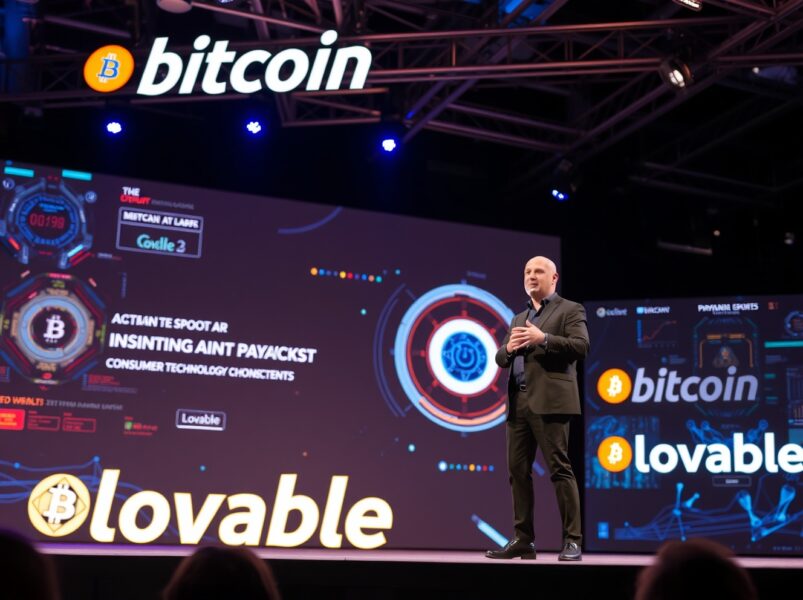
Lovable AI’s Astonishing Rise: Anton Osika Reveals Startup Secrets at Bitcoin World Disrupt 2025

Lovable AI’s Astonishing Rise: Anton Osika Reveals Startup Secrets at Bitcoin World Disrupt 2025

BitcoinWorld Lovable AI’s Astonishing Rise: Anton Osika Reveals Startup Secrets at Bitcoin World Disrupt 2025 Are you ready to witness a phenomenon? The world of technology is abuzz with the incredible rise of Lovable AI, a startup that’s not just breaking records but rewriting the rulebook for rapid growth. Imagine creating powerful apps and websites just by speaking to an AI – that’s the magic Lovable brings to the masses. This groundbreaking approach has propelled the company into the spotlight, making it one of the fastest-growing software firms in history. And now, the visionary behind this sensation, co-founder and CEO Anton Osika, is set to share his invaluable insights on the Disrupt Stage at the highly anticipated Bitcoin World Disrupt 2025. If you’re a founder, investor, or tech enthusiast eager to understand the future of innovation, this is an event you cannot afford to miss. Lovable AI’s Meteoric Ascent: Redefining Software Creation In an era where digital transformation is paramount, Lovable AI has emerged as a true game-changer. Its core premise is deceptively simple yet profoundly impactful: democratize software creation. By enabling anyone to build applications and websites through intuitive AI conversations, Lovable is empowering the vast majority of individuals who lack coding skills to transform their ideas into tangible digital products. This mission has resonated globally, leading to unprecedented momentum. The numbers speak for themselves: Achieved an astonishing $100 million Annual Recurring Revenue (ARR) in less than a year. Successfully raised a $200 million Series A funding round, valuing the company at $1.8 billion, led by industry giant Accel. Is currently fielding unsolicited investor offers, pushing its valuation towards an incredible $4 billion. As industry reports suggest, investors are unequivocally “loving Lovable,” and it’s clear why. This isn’t just about impressive financial metrics; it’s about a company that has tapped into a fundamental need, offering a solution that is both innovative and accessible. The rapid scaling of Lovable AI provides a compelling case study for any entrepreneur aiming for similar exponential growth. The Visionary Behind the Hype: Anton Osika’s Journey to Innovation Every groundbreaking company has a driving force, and for Lovable, that force is co-founder and CEO Anton Osika. His journey is as fascinating as his company’s success. A physicist by training, Osika previously contributed to the cutting-edge research at CERN, the European Organization for Nuclear Research. This deep technical background, combined with his entrepreneurial spirit, has been instrumental in Lovable’s rapid ascent. Before Lovable, he honed his skills as a co-founder of Depict.ai and a Founding Engineer at Sana. Based in Stockholm, Osika has masterfully steered Lovable from a nascent idea to a global phenomenon in record time. His leadership embodies a unique blend of profound technical understanding and a keen, consumer-first vision. At Bitcoin World Disrupt 2025, attendees will have the rare opportunity to hear directly from Osika about what it truly takes to build a brand that not only scales at an incredible pace in a fiercely competitive market but also adeptly manages the intense cultural conversations that inevitably accompany such swift and significant success. His insights will be crucial for anyone looking to understand the dynamics of high-growth tech leadership. Unpacking Consumer Tech Innovation at Bitcoin World Disrupt 2025 The 20th anniversary of Bitcoin World is set to be marked by a truly special event: Bitcoin World Disrupt 2025. From October 27–29, Moscone West in San Francisco will transform into the epicenter of innovation, gathering over 10,000 founders, investors, and tech leaders. It’s the ideal platform to explore the future of consumer tech innovation, and Anton Osika’s presence on the Disrupt Stage is a highlight. His session will delve into how Lovable is not just participating in but actively shaping the next wave of consumer-facing technologies. Why is this session particularly relevant for those interested in the future of consumer experiences? Osika’s discussion will go beyond the superficial, offering a deep dive into the strategies that have allowed Lovable to carve out a unique category in a market long thought to be saturated. Attendees will gain a front-row seat to understanding how to identify unmet consumer needs, leverage advanced AI to meet those needs, and build a product that captivates users globally. The event itself promises a rich tapestry of ideas and networking opportunities: For Founders: Sharpen your pitch and connect with potential investors. For Investors: Discover the next breakout startup poised for massive growth. For Innovators: Claim your spot at the forefront of technological advancements. The insights shared regarding consumer tech innovation at this event will be invaluable for anyone looking to navigate the complexities and capitalize on the opportunities within this dynamic sector. Mastering Startup Growth Strategies: A Blueprint for the Future Lovable’s journey isn’t just another startup success story; it’s a meticulously crafted blueprint for effective startup growth strategies in the modern era. Anton Osika’s experience offers a rare glimpse into the practicalities of scaling a business at breakneck speed while maintaining product integrity and managing external pressures. For entrepreneurs and aspiring tech leaders, his talk will serve as a masterclass in several critical areas: Strategy Focus Key Takeaways from Lovable’s Journey Rapid Scaling How to build infrastructure and teams that support exponential user and revenue growth without compromising quality. Product-Market Fit Identifying a significant, underserved market (the 99% who can’t code) and developing a truly innovative solution (AI-powered app creation). Investor Relations Balancing intense investor interest and pressure with a steadfast focus on product development and long-term vision. Category Creation Carving out an entirely new niche by democratizing complex technologies, rather than competing in existing crowded markets. Understanding these startup growth strategies is essential for anyone aiming to build a resilient and impactful consumer experience. Osika’s session will provide actionable insights into how to replicate elements of Lovable’s success, offering guidance on navigating challenges from product development to market penetration and investor management. Conclusion: Seize the Future of Tech The story of Lovable, under the astute leadership of Anton Osika, is a testament to the power of innovative ideas meeting flawless execution. Their remarkable journey from concept to a multi-billion-dollar valuation in record time is a compelling narrative for anyone interested in the future of technology. By democratizing software creation through Lovable AI, they are not just building a company; they are fostering a new generation of creators. His appearance at Bitcoin World Disrupt 2025 is an unmissable opportunity to gain direct insights from a leader who is truly shaping the landscape of consumer tech innovation. Don’t miss this chance to learn about cutting-edge startup growth strategies and secure your front-row seat to the future. Register now and save up to $668 before Regular Bird rates end on September 26. To learn more about the latest AI market trends, explore our article on key developments shaping AI features. This post Lovable AI’s Astonishing Rise: Anton Osika Reveals Startup Secrets at Bitcoin World Disrupt 2025 first appeared on BitcoinWorld.
Condividi
Coinstats2025/09/17 23:40
