Irys, a layer-1 blockchain listed on major exchanges including Coinbase, is under scrutiny after a single entity captured roughly 20% of its airdrop allocation. On November 28, blockchain analytics firm Bubblemaps said it identified about 900 wallets involved in the process. IRYS Slides After 900 Linked Wallets Take $4 Million in Airdrop Tokens According to the firm, these addresses showed no prior on-chain activity. It described the pattern as consistent with coordinated preparation rather than organic network participation. Following the distribution, the cluster network began consolidating the assets. Data shows that roughly 500 of the identified wallets transferred their IRYS allocations to intermediary addresses before routing the funds to Bitget, a centralized exchange. IRYS Token Address Clusters. Source: BubbleMaps The flow of tokens, valued at approximately $4 million, indicates a likely preparation to liquidate the position. Such a move could introduce significant sell-side pressure on the asset’s order book. IRYS price has come under pressure following the disclosures. The token has declined 16% over the past 24 hours and is trading near $0.032 as of press time. Bubblemaps noted that it found no on-chain evidence linking the IRYS team to the wallet cluster. Irys markets itself as an “on-chain AWS” designed for data storage and smart-contract execution. The protocol has raised more than $13 million from venture capital investors and listed its token this week on major exchanges, including Binance and Coinbase. Crypto Needs Stronger Sybil Protection The episode highlights a structural challenge facing crypto projects that rely on airdrops to expand ownership. Indeed, Irys allocated 8% of its total supply to the event. The goal was to distribute tokens to early users and help decentralize the network. Instead, the concentration of tokens in a single cluster shows how airdrops remain vulnerable to actors using large batches of script-generated wallets to capture outsized allocations. When one entity controls 20% of the initial circulating float, market observers say the result is heightened centralization risk and distorted price discovery. Meanwhile, incidents like this point to broader limitations in token distribution practices across permissionless ecosystems. These environments have minimal identity checks and unrestricted network access. This IRYS episode shows how difficult it is to prevent coordinated airdrop capture without stronger filtering, better identity heuristics, or more robust pre-distribution reviews. Without those safeguards, early liquidity events can disproportionately benefit short-term actors. That dynamic can weaken outcomes for long-term holders and overall network stability.Irys, a layer-1 blockchain listed on major exchanges including Coinbase, is under scrutiny after a single entity captured roughly 20% of its airdrop allocation. On November 28, blockchain analytics firm Bubblemaps said it identified about 900 wallets involved in the process. IRYS Slides After 900 Linked Wallets Take $4 Million in Airdrop Tokens According to the firm, these addresses showed no prior on-chain activity. It described the pattern as consistent with coordinated preparation rather than organic network participation. Following the distribution, the cluster network began consolidating the assets. Data shows that roughly 500 of the identified wallets transferred their IRYS allocations to intermediary addresses before routing the funds to Bitget, a centralized exchange. IRYS Token Address Clusters. Source: BubbleMaps The flow of tokens, valued at approximately $4 million, indicates a likely preparation to liquidate the position. Such a move could introduce significant sell-side pressure on the asset’s order book. IRYS price has come under pressure following the disclosures. The token has declined 16% over the past 24 hours and is trading near $0.032 as of press time. Bubblemaps noted that it found no on-chain evidence linking the IRYS team to the wallet cluster. Irys markets itself as an “on-chain AWS” designed for data storage and smart-contract execution. The protocol has raised more than $13 million from venture capital investors and listed its token this week on major exchanges, including Binance and Coinbase. Crypto Needs Stronger Sybil Protection The episode highlights a structural challenge facing crypto projects that rely on airdrops to expand ownership. Indeed, Irys allocated 8% of its total supply to the event. The goal was to distribute tokens to early users and help decentralize the network. Instead, the concentration of tokens in a single cluster shows how airdrops remain vulnerable to actors using large batches of script-generated wallets to capture outsized allocations. When one entity controls 20% of the initial circulating float, market observers say the result is heightened centralization risk and distorted price discovery. Meanwhile, incidents like this point to broader limitations in token distribution practices across permissionless ecosystems. These environments have minimal identity checks and unrestricted network access. This IRYS episode shows how difficult it is to prevent coordinated airdrop capture without stronger filtering, better identity heuristics, or more robust pre-distribution reviews. Without those safeguards, early liquidity events can disproportionately benefit short-term actors. That dynamic can weaken outcomes for long-term holders and overall network stability.

Irys Airdrop Draws Concern After One Entity Captures 20% of Supply

2025/11/30 01:50
2 min di lettura
Per feedback o dubbi su questo contenuto, contattateci all'indirizzo crypto.news@mexc.com.

Irys, a layer-1 blockchain listed on major exchanges including Coinbase, is under scrutiny after a single entity captured roughly 20% of its airdrop allocation.

On November 28, blockchain analytics firm Bubblemaps said it identified about 900 wallets involved in the process.

IRYS Slides After 900 Linked Wallets Take $4 Million in Airdrop Tokens

According to the firm, these addresses showed no prior on-chain activity. It described the pattern as consistent with coordinated preparation rather than organic network participation.

Following the distribution, the cluster network began consolidating the assets.

Data shows that roughly 500 of the identified wallets transferred their IRYS allocations to intermediary addresses before routing the funds to Bitget, a centralized exchange.
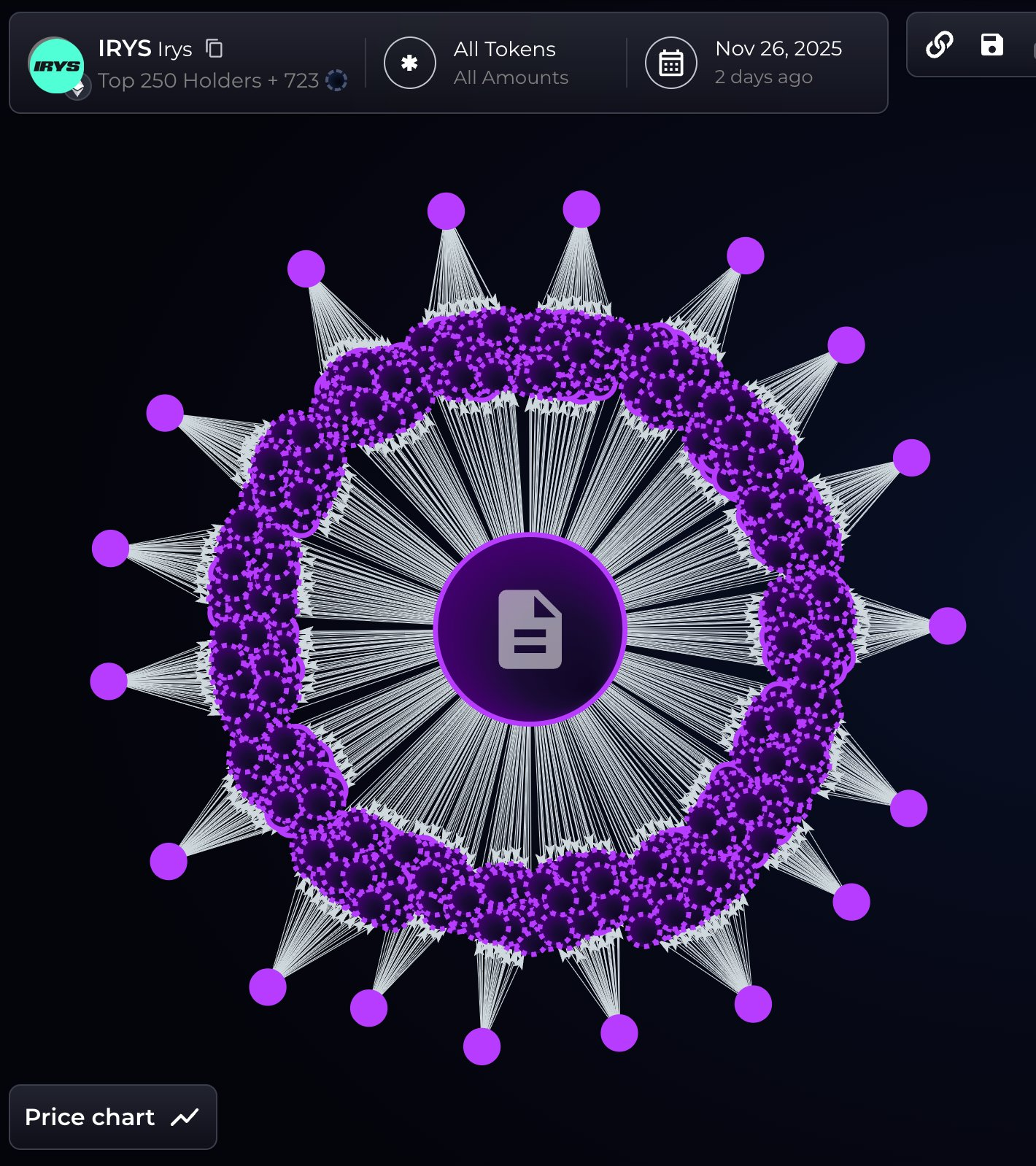
IRYS Token Address Clusters. Source: BubbleMaps

The flow of tokens, valued at approximately $4 million, indicates a likely preparation to liquidate the position. Such a move could introduce significant sell-side pressure on the asset’s order book.

IRYS price has come under pressure following the disclosures. The token has declined 16% over the past 24 hours and is trading near $0.032 as of press time.

Bubblemaps noted that it found no on-chain evidence linking the IRYS team to the wallet cluster.

Irys markets itself as an “on-chain AWS” designed for data storage and smart-contract execution.

The protocol has raised more than $13 million from venture capital investors and listed its token this week on major exchanges, including Binance and Coinbase.

Crypto Needs Stronger Sybil Protection

The episode highlights a structural challenge facing crypto projects that rely on airdrops to expand ownership.

Indeed, Irys allocated 8% of its total supply to the event. The goal was to distribute tokens to early users and help decentralize the network.

Instead, the concentration of tokens in a single cluster shows how airdrops remain vulnerable to actors using large batches of script-generated wallets to capture outsized allocations.

When one entity controls 20% of the initial circulating float, market observers say the result is heightened centralization risk and distorted price discovery.

Meanwhile, incidents like this point to broader limitations in token distribution practices across permissionless ecosystems. These environments have minimal identity checks and unrestricted network access.

This IRYS episode shows how difficult it is to prevent coordinated airdrop capture without stronger filtering, better identity heuristics, or more robust pre-distribution reviews.

Without those safeguards, early liquidity events can disproportionately benefit short-term actors. That dynamic can weaken outcomes for long-term holders and overall network stability.


Opportunità di mercato
Logo Irys
Valore Irys (IRYS)
$0.01758
$0.01758$0.01758
+3.65%
USD
Grafico dei prezzi in tempo reale di Irys (IRYS)
Disclaimer: gli articoli ripubblicati su questo sito provengono da piattaforme pubbliche e sono forniti esclusivamente a scopo informativo. Non riflettono necessariamente le opinioni di MEXC. Tutti i diritti rimangono agli autori originali. Se ritieni che un contenuto violi i diritti di terze parti, contatta crypto.news@mexc.com per la rimozione. MEXC non fornisce alcuna garanzia in merito all'accuratezza, completezza o tempestività del contenuto e non è responsabile per eventuali azioni intraprese sulla base delle informazioni fornite. Il contenuto non costituisce consulenza finanziaria, legale o professionale di altro tipo, né deve essere considerato una raccomandazione o un'approvazione da parte di MEXC.

Potrebbe anche piacerti

SEC and CFTC Introduce Crypto Classification Framework

SEC and CFTC Introduce Crypto Classification Framework

The post SEC and CFTC Introduce Crypto Classification Framework appeared on BitcoinEthereumNews.com. SEC and CFTC issued a framework that identified various digital
Condividi
BitcoinEthereumNews2026/03/19 13:30
NYSE, Nasdaq, Cboe Align Crypto ETF Options With Liquidity Driven Limits

NYSE, Nasdaq, Cboe Align Crypto ETF Options With Liquidity Driven Limits

The post NYSE, Nasdaq, Cboe Align Crypto ETF Options With Liquidity Driven Limits appeared on BitcoinEthereumNews.com. Crypto ETF options are rapidly being folded
Condividi
BitcoinEthereumNews2026/03/19 12:47
Headwind Helps Best Wallet Token

Headwind Helps Best Wallet Token

The post Headwind Helps Best Wallet Token appeared on BitcoinEthereumNews.com. Google has announced the launch of a new open-source protocol called Agent Payments Protocol (AP2) in partnership with Coinbase, the Ethereum Foundation, and 60 other organizations. This allows AI agents to make payments on behalf of users using various methods such as real-time bank transfers, credit and debit cards, and, most importantly, stablecoins. Let’s explore in detail what this could mean for the broader cryptocurrency markets, and also highlight a presale crypto (Best Wallet Token) that could explode as a result of this development. Google’s Push for Stablecoins Agent Payments Protocol (AP2) uses digital contracts known as ‘Intent Mandates’ and ‘Verifiable Credentials’ to ensure that AI agents undertake only those payments authorized by the user. Mandates, by the way, are cryptographically signed, tamper-proof digital contracts that act as verifiable proof of a user’s instruction. For example, let’s say you instruct an AI agent to never spend more than $200 in a single transaction. This instruction is written into an Intent Mandate, which serves as a digital contract. Now, whenever the AI agent tries to make a payment, it must present this mandate as proof of authorization, which will then be verified via the AP2 protocol. Alongside this, Google has also launched the A2A x402 extension to accelerate support for the Web3 ecosystem. This production-ready solution enables agent-based crypto payments and will help reshape the growth of cryptocurrency integration within the AP2 protocol. Google’s inclusion of stablecoins in AP2 is a massive vote of confidence in dollar-pegged cryptocurrencies and a huge step toward making them a mainstream payment option. This widens stablecoin usage beyond trading and speculation, positioning them at the center of the consumption economy. The recent enactment of the GENIUS Act in the U.S. gives stablecoins more structure and legal support. Imagine paying for things like data crawls, per-task…
Condividi
BitcoinEthereumNews2025/09/18 01:27