The stablecoin market is booming again in 2025, with total market capitalization reaching a new all-time high of $228 billion, according to a report by CryptoQuant. That marks a $33 billion increase so far this year, a 17% rise, driven by renewed crypto trading activity, growing use in payments, and increased regulatory clarity in the United States under President Donald Trump. Source: CryptoQuant . USDT and USDC Lead $33B Market Cap Jump According to the report, Tether (USDT) and Circle’s USDC continue to lead the market. USDT now holds a $155 billion market cap, up $18 billion year-to-date. USDC has gained $17 billion, climbing to a record high of $61 billion, an increase of 39% since January. On centralized exchanges, stablecoin reserves are also surging. The total value of ERC-20 stablecoins held on exchanges has reached $50 billion. Stablecoins are booming again. Market cap hit a record $228B, up $33B (+17%) in 2025. Driven by rising trading activity, growing payment use, and clearer U.S. regulation under Trump. pic.twitter.com/76zKj49UWB — CryptoQuant.com (@cryptoquant_com) June 12, 2025 USDC reserves in particular have grown 1.6 times in 2025 alone, now totaling around $8 billion. This influx supports deeper liquidity for crypto markets. The report also noted that stablecoins are bouncing back in the yield-bearing segment. These are stablecoins that pay interest to holders, often used in DeFi. The value of staked stablecoins has reached $6.9 billion, up 28% since late May. Most of that growth has come from rising demand for sUSDe and sUSDs, which gained $1.23 billion and $700 million in market cap, respectively. A recent report from on-chain data platforms Artemis and Dune shows broader user adoption. According to the report, titled “The State of Stablecoins 2025,” active stablecoin wallets rose from 19.6 million to 30 million over the past year, a 53% increase. The report said the data “suggests wider user engagement” and pointed to stablecoins becoming a key part of digital finance. It also noted that stablecoins are increasingly used in decentralized finance (DeFi), gaming, and NFTs. “Stablecoins have emerged as a bridge between traditional finance and crypto,” it said, “and are becoming a core piece of payment and settlement infrastructure.” This surge in usage is also supported by the rise in real-world payment activity. Data from Artemis shows $94.2 billion in stablecoin transactions were settled between January 2023 and February 2025. Business-to-business (B2B) payments made up the largest chunk, reaching an annual run rate of $36 billion. Card-linked payments using stablecoins crossed $13 billion in volume. Stablecoin Legislation Gains Ground as Tech and Finance Giants Pile In Increased demand has also come alongside progress on the regulatory front. For example, the U.S. Senate advanced the “Guiding and Establishing National Innovation for U.S. Stablecoins Act” or GENIUS Act this week. Backed by President Trump, the bill is designed to create a federal framework for dollar-backed stablecoins. The legislation would require stablecoins to be fully backed by U.S. dollars or highly liquid assets. It would also mandate annual audits for issuers with over $50 billion in market cap, and include requirements for foreign issuers. 🚨 The U.S. Senate Set for Historic Stablecoin Showdown as GENIUS Act nears final vote. #Stablecoins #GeniusAct https://t.co/ZJ59XzuQcn — Cryptonews.com (@cryptonews) June 11, 2025 The Senate voted 68-30 to invoke cloture on the bill , clearing the way for final debate and vote. “This did not happen by accident,” said Senator Tim Scott, one of the bill’s co-sponsors. “To those who said Washington could not act… let’s prove them wrong.” Treasury Secretary Scott Bessent backed the legislation during a Wednesday Senate hearing. He said stablecoins could play a major role in expanding the use of the U.S. dollar globally. “I think $2 trillion is a very reasonable number,” Bessent said, referring to an estimate that the stablecoin market could exceed that level by 2028. “I could see it greatly exceeding that.” 🇺🇸 BREAKING – U.S. Treasury Secretary Bessent: – Stablecoin regulations backed by U.S. Treasuries will expand global USD usage – We could see stablecoin demand exceed $2 TRILLION This is massive for crypto. Regulated stablecoins = institutional trust Institutional trust =… pic.twitter.com/inZh9maAwW — @CryptoELlTES (@CryptooELITES) June 12, 2025 The GENIUS Act appears to be pushing traditional finance further into the stablecoin space. Large U.S. banks, including JPMorgan, Citigroup, Wells Fargo, and Bank of America, are reportedly exploring a joint stablecoin project. Meanwhile, USDC issuer Circle went public earlier this month, with shares jumping 160% on their first day of trading . 🔴 @Circle the company behind the USDC stablecoin, made a dramatic entrance on the NYSE with its shares surging as much as 160% during its trading debut. #Circle #NYSE https://t.co/EJQJ4Yy3m3 — Cryptonews.com (@cryptonews) June 5, 2025 Tech firms are also watching closely. According to Fortune , Apple, Google, Airbnb, and Elon Musk’s X are all exploring stablecoin integrations. Google has already processed two stablecoin payments. 🍎 Apple, X, and Airbnb are in early talks with crypto firms to integrate stablecoin payments. #apple #google #stablecoin https://t.co/gmEbx3i4PN — Cryptonews.com (@cryptonews) June 6, 2025 Airbnb has held talks with Worldpay to cut credit card fees using stablecoins. X is reportedly planning to include stablecoins in its X Money app.The stablecoin market is booming again in 2025, with total market capitalization reaching a new all-time high of $228 billion, according to a report by CryptoQuant. That marks a $33 billion increase so far this year, a 17% rise, driven by renewed crypto trading activity, growing use in payments, and increased regulatory clarity in the United States under President Donald Trump. Source: CryptoQuant . USDT and USDC Lead $33B Market Cap Jump According to the report, Tether (USDT) and Circle’s USDC continue to lead the market. USDT now holds a $155 billion market cap, up $18 billion year-to-date. USDC has gained $17 billion, climbing to a record high of $61 billion, an increase of 39% since January. On centralized exchanges, stablecoin reserves are also surging. The total value of ERC-20 stablecoins held on exchanges has reached $50 billion. Stablecoins are booming again. Market cap hit a record $228B, up $33B (+17%) in 2025. Driven by rising trading activity, growing payment use, and clearer U.S. regulation under Trump. pic.twitter.com/76zKj49UWB — CryptoQuant.com (@cryptoquant_com) June 12, 2025 USDC reserves in particular have grown 1.6 times in 2025 alone, now totaling around $8 billion. This influx supports deeper liquidity for crypto markets. The report also noted that stablecoins are bouncing back in the yield-bearing segment. These are stablecoins that pay interest to holders, often used in DeFi. The value of staked stablecoins has reached $6.9 billion, up 28% since late May. Most of that growth has come from rising demand for sUSDe and sUSDs, which gained $1.23 billion and $700 million in market cap, respectively. A recent report from on-chain data platforms Artemis and Dune shows broader user adoption. According to the report, titled “The State of Stablecoins 2025,” active stablecoin wallets rose from 19.6 million to 30 million over the past year, a 53% increase. The report said the data “suggests wider user engagement” and pointed to stablecoins becoming a key part of digital finance. It also noted that stablecoins are increasingly used in decentralized finance (DeFi), gaming, and NFTs. “Stablecoins have emerged as a bridge between traditional finance and crypto,” it said, “and are becoming a core piece of payment and settlement infrastructure.” This surge in usage is also supported by the rise in real-world payment activity. Data from Artemis shows $94.2 billion in stablecoin transactions were settled between January 2023 and February 2025. Business-to-business (B2B) payments made up the largest chunk, reaching an annual run rate of $36 billion. Card-linked payments using stablecoins crossed $13 billion in volume. Stablecoin Legislation Gains Ground as Tech and Finance Giants Pile In Increased demand has also come alongside progress on the regulatory front. For example, the U.S. Senate advanced the “Guiding and Establishing National Innovation for U.S. Stablecoins Act” or GENIUS Act this week. Backed by President Trump, the bill is designed to create a federal framework for dollar-backed stablecoins. The legislation would require stablecoins to be fully backed by U.S. dollars or highly liquid assets. It would also mandate annual audits for issuers with over $50 billion in market cap, and include requirements for foreign issuers. 🚨 The U.S. Senate Set for Historic Stablecoin Showdown as GENIUS Act nears final vote. #Stablecoins #GeniusAct https://t.co/ZJ59XzuQcn — Cryptonews.com (@cryptonews) June 11, 2025 The Senate voted 68-30 to invoke cloture on the bill , clearing the way for final debate and vote. “This did not happen by accident,” said Senator Tim Scott, one of the bill’s co-sponsors. “To those who said Washington could not act… let’s prove them wrong.” Treasury Secretary Scott Bessent backed the legislation during a Wednesday Senate hearing. He said stablecoins could play a major role in expanding the use of the U.S. dollar globally. “I think $2 trillion is a very reasonable number,” Bessent said, referring to an estimate that the stablecoin market could exceed that level by 2028. “I could see it greatly exceeding that.” 🇺🇸 BREAKING – U.S. Treasury Secretary Bessent: – Stablecoin regulations backed by U.S. Treasuries will expand global USD usage – We could see stablecoin demand exceed $2 TRILLION This is massive for crypto. Regulated stablecoins = institutional trust Institutional trust =… pic.twitter.com/inZh9maAwW — @CryptoELlTES (@CryptooELITES) June 12, 2025 The GENIUS Act appears to be pushing traditional finance further into the stablecoin space. Large U.S. banks, including JPMorgan, Citigroup, Wells Fargo, and Bank of America, are reportedly exploring a joint stablecoin project. Meanwhile, USDC issuer Circle went public earlier this month, with shares jumping 160% on their first day of trading . 🔴 @Circle the company behind the USDC stablecoin, made a dramatic entrance on the NYSE with its shares surging as much as 160% during its trading debut. #Circle #NYSE https://t.co/EJQJ4Yy3m3 — Cryptonews.com (@cryptonews) June 5, 2025 Tech firms are also watching closely. According to Fortune , Apple, Google, Airbnb, and Elon Musk’s X are all exploring stablecoin integrations. Google has already processed two stablecoin payments. 🍎 Apple, X, and Airbnb are in early talks with crypto firms to integrate stablecoin payments. #apple #google #stablecoin https://t.co/gmEbx3i4PN — Cryptonews.com (@cryptonews) June 6, 2025 Airbnb has held talks with Worldpay to cut credit card fees using stablecoins. X is reportedly planning to include stablecoins in its X Money app.

Stablecoin Surge: Market Cap Hits Record $228B in 2025 Amid Trading Boom and Trump-Era Clarity

2025/06/13 08:05
4 min di lettura
Per feedback o dubbi su questo contenuto, contattateci all'indirizzo crypto.news@mexc.com.

The stablecoin market is booming again in 2025, with total market capitalization reaching a new all-time high of $228 billion, according to a report by CryptoQuant.

That marks a $33 billion increase so far this year, a 17% rise, driven by renewed crypto trading activity, growing use in payments, and increased regulatory clarity in the United States under President Donald Trump.
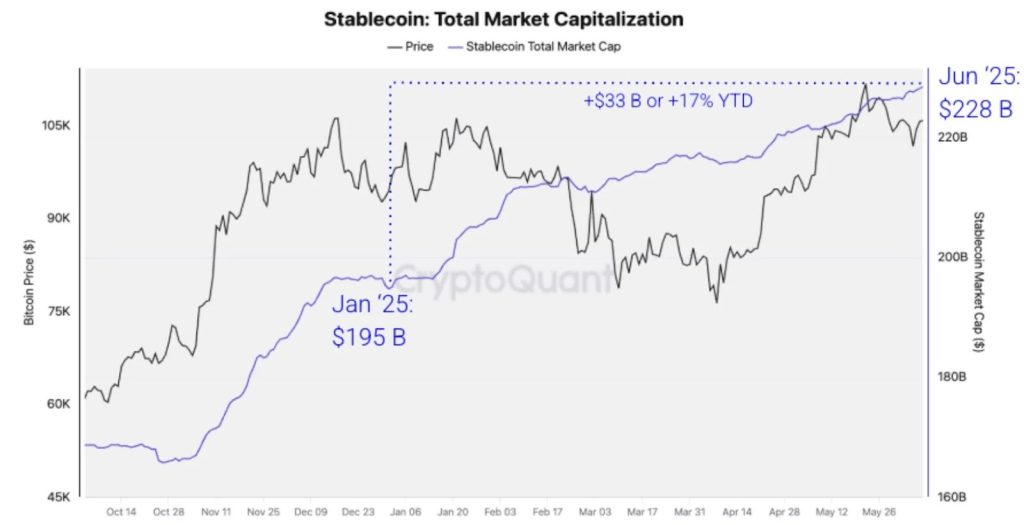
Source: CryptoQuant.

USDT and USDC Lead $33B Market Cap Jump

According to the report, Tether (USDT) and Circle’s USDC continue to lead the market. USDT now holds a $155 billion market cap, up $18 billion year-to-date. USDC has gained $17 billion, climbing to a record high of $61 billion, an increase of 39% since January.

On centralized exchanges, stablecoin reserves are also surging. The total value of ERC-20 stablecoins held on exchanges has reached $50 billion.

USDC reserves in particular have grown 1.6 times in 2025 alone, now totaling around $8 billion. This influx supports deeper liquidity for crypto markets.

The report also noted that stablecoins are bouncing back in the yield-bearing segment. These are stablecoins that pay interest to holders, often used in DeFi. The value of staked stablecoins has reached $6.9 billion, up 28% since late May.

Most of that growth has come from rising demand for sUSDe and sUSDs, which gained $1.23 billion and $700 million in market cap, respectively.

A recent report from on-chain data platforms Artemis and Dune shows broader user adoption. According to the report, titled “The State of Stablecoins 2025,” active stablecoin wallets rose from 19.6 million to 30 million over the past year, a 53% increase.

The report said the data “suggests wider user engagement” and pointed to stablecoins becoming a key part of digital finance. It also noted that stablecoins are increasingly used in decentralized finance (DeFi), gaming, and NFTs.

“Stablecoins have emerged as a bridge between traditional finance and crypto,” it said, “and are becoming a core piece of payment and settlement infrastructure.”

This surge in usage is also supported by the rise in real-world payment activity. Data from Artemis shows $94.2 billion in stablecoin transactions were settled between January 2023 and February 2025.

Business-to-business (B2B) payments made up the largest chunk, reaching an annual run rate of $36 billion. Card-linked payments using stablecoins crossed $13 billion in volume.

Stablecoin Legislation Gains Ground as Tech and Finance Giants Pile In

Increased demand has also come alongside progress on the regulatory front. For example, the U.S. Senate advanced the “Guiding and Establishing National Innovation for U.S. Stablecoins Act” or GENIUS Act this week.

Backed by President Trump, the bill is designed to create a federal framework for dollar-backed stablecoins.

The legislation would require stablecoins to be fully backed by U.S. dollars or highly liquid assets. It would also mandate annual audits for issuers with over $50 billion in market cap, and include requirements for foreign issuers.

The Senate voted 68-30 to invoke cloture on the bill, clearing the way for final debate and vote.

“This did not happen by accident,” said Senator Tim Scott, one of the bill’s co-sponsors. “To those who said Washington could not act… let’s prove them wrong.”

Treasury Secretary Scott Bessent backed the legislation during a Wednesday Senate hearing. He said stablecoins could play a major role in expanding the use of the U.S. dollar globally.

“I think $2 trillion is a very reasonable number,” Bessent said, referring to an estimate that the stablecoin market could exceed that level by 2028. “I could see it greatly exceeding that.”

The GENIUS Act appears to be pushing traditional finance further into the stablecoin space. Large U.S. banks, including JPMorgan, Citigroup, Wells Fargo, and Bank of America, are reportedly exploring a joint stablecoin project.

Meanwhile, USDC issuer Circle went public earlier this month, with shares jumping 160% on their first day of trading.

Tech firms are also watching closely. According to Fortune, Apple, Google, Airbnb, and Elon Musk’s X are all exploring stablecoin integrations. Google has already processed two stablecoin payments.

Airbnb has held talks with Worldpay to cut credit card fees using stablecoins. X is reportedly planning to include stablecoins in its X Money app.


Opportunità di mercato
Logo Threshold
Valore Threshold (T)
$0,006405
$0,006405$0,006405
-0,98%
USD
Grafico dei prezzi in tempo reale di Threshold (T)
Disclaimer: gli articoli ripubblicati su questo sito provengono da piattaforme pubbliche e sono forniti esclusivamente a scopo informativo. Non riflettono necessariamente le opinioni di MEXC. Tutti i diritti rimangono agli autori originali. Se ritieni che un contenuto violi i diritti di terze parti, contatta crypto.news@mexc.com per la rimozione. MEXC non fornisce alcuna garanzia in merito all'accuratezza, completezza o tempestività del contenuto e non è responsabile per eventuali azioni intraprese sulla base delle informazioni fornite. Il contenuto non costituisce consulenza finanziaria, legale o professionale di altro tipo, né deve essere considerato una raccomandazione o un'approvazione da parte di MEXC.

Potrebbe anche piacerti

OpenVPP accused of falsely advertising cooperation with the US government; SEC commissioner clarifies no involvement

OpenVPP accused of falsely advertising cooperation with the US government; SEC commissioner clarifies no involvement

PANews reported on September 17th that on-chain sleuth ZachXBT tweeted that OpenVPP ( $OVPP ) announced this week that it was collaborating with the US government to advance energy tokenization. SEC Commissioner Hester Peirce subsequently responded, stating that the company does not collaborate with or endorse any private crypto projects. The OpenVPP team subsequently hid the response. Several crypto influencers have participated in promoting the project, and the accounts involved have been questioned as typical influencer accounts.
Condividi
PANews2025/09/17 23:58
Trump's allegation against Noem would constitute a federal crime: analyst

Trump's allegation against Noem would constitute a federal crime: analyst

President Donald Trump caught everyone off guard by suddenly firing Homeland Security Secretary Kristi Noem — but being out of a job could just be the start of
Condividi
Rawstory2026/03/06 04:49
Aave DAO to Shut Down 50% of L2s While Doubling Down on GHO

Aave DAO to Shut Down 50% of L2s While Doubling Down on GHO

The post Aave DAO to Shut Down 50% of L2s While Doubling Down on GHO appeared on BitcoinEthereumNews.com. Aave DAO is gearing up for a significant overhaul by shutting down over 50% of underperforming L2 instances. It is also restructuring its governance framework and deploying over $100 million to boost GHO. This could be a pivotal moment that propels Aave back to the forefront of on-chain lending or sparks unprecedented controversy within the DeFi community. Sponsored Sponsored ACI Proposes Shutting Down 50% of L2s The “State of the Union” report by the Aave Chan Initiative (ACI) paints a candid picture. After a turbulent period in the DeFi market and internal challenges, Aave (AAVE) now leads in key metrics: TVL, revenue, market share, and borrowing volume. Aave’s annual revenue of $130 million surpasses the combined cash reserves of its competitors. Tokenomics improvements and the AAVE token buyback program have also contributed to the ecosystem’s growth. Aave global metrics. Source: Aave However, the ACI’s report also highlights several pain points. First, regarding the Layer-2 (L2) strategy. While Aave’s L2 strategy was once a key driver of success, it is no longer fit for purpose. Over half of Aave’s instances on L2s and alt-L1s are not economically viable. Based on year-to-date data, over 86.6% of Aave’s revenue comes from the mainnet, indicating that everything else is a side quest. On this basis, ACI proposes closing underperforming networks. The DAO should invest in key networks with significant differentiators. Second, ACI is pushing for a complete overhaul of the “friendly fork” framework, as most have been unimpressive regarding TVL and revenue. In some cases, attackers have exploited them to Aave’s detriment, as seen with Spark. Sponsored Sponsored “The friendly fork model had a good intention but bad execution where the DAO was too friendly towards these forks, allowing the DAO only little upside,” the report states. Third, the instance model, once a smart…
Condividi
BitcoinEthereumNews2025/09/18 02:28



